


TL;DR:
- Effective segmentation requires segments to be measurable, accessible, substantial, and differentiable to support targeted marketing strategies. Regular audits and combining behavioral with demographic data increase the relevance and impact of segmentation efforts. Building a clear activation plan and updating segments frequently prevent inefficiency and ensure ongoing relevance.
Segmentation research is the practice of dividing a broad market into smaller, meaningful groups based on shared traits or behaviors to inform more targeted marketing efforts. The industry standard term is market segmentation analysis, and the two phrases describe the same discipline. Done well, segmentation research tells you exactly who to reach, what to say, and where to spend your budget. Done poorly, it produces a stack of personas that never make it past a PowerPoint slide. This guide covers the criteria, methods, and process that turn raw data into segments your team can actually use.
What makes segmentation research produce actionable segments?
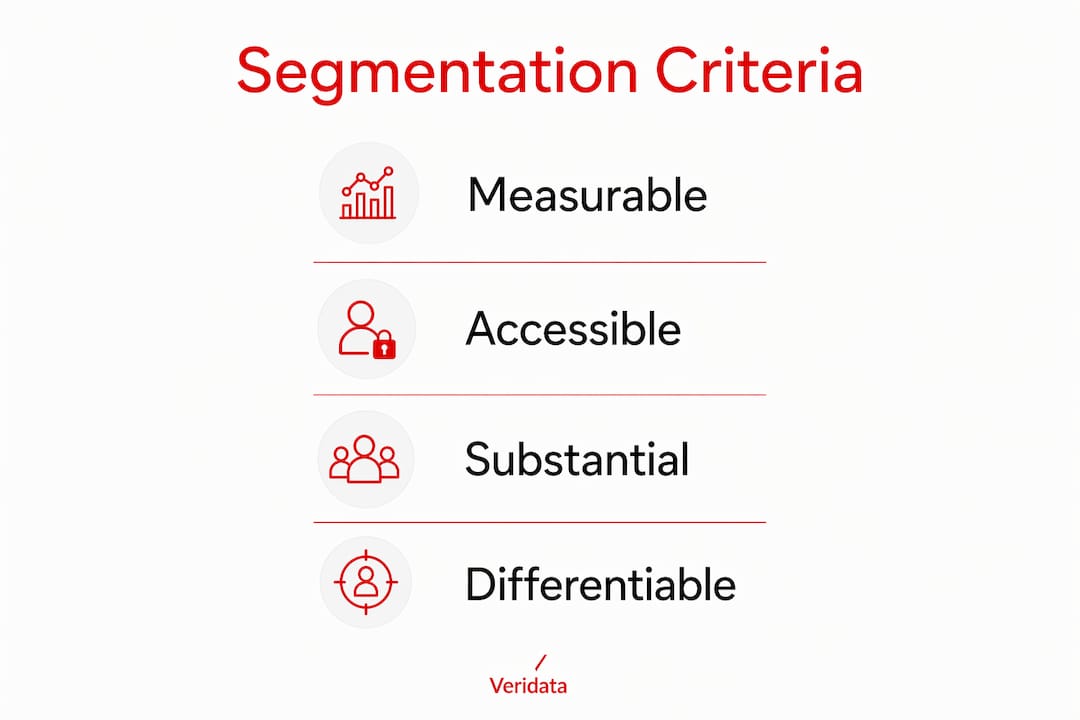
Every actionable market segment must meet four criteria: measurable, accessible, substantial, and differentiable. These are not suggestions. They are the filter that separates a useful segment from an interesting observation.

Measurable means you can quantify the segment’s size and purchasing power with real data. If you cannot put a number on it, you cannot budget for it.
Accessible means your marketing channels can actually reach that group. A segment of high-income retirees who never use social media is inaccessible if your entire activation plan runs through Instagram.
Substantial means the segment is large enough and profitable enough to justify a dedicated strategy. Chasing a segment that generates thin margins at low volume is a resource drain, not a growth play.
Differentiable means the segment responds differently to marketing stimuli than other groups do. If two segments react the same way to the same message, they are one segment, not two.
Common pitfalls show up when teams skip the differentiability test. They build separate campaigns for groups that behave identically, then wonder why results look the same across both. The measurability and accessibility criteria also trip up teams that rely on third-party data with gaps in demographic coverage.
Pro Tip: Before you finalize any segment, run it through all four criteria as a checklist. If it fails even one, either gather more data or merge it with a neighboring segment.
How to conduct segmentation research: a step-by-step process
The segmentation research process runs through five stages: defining business questions, choosing segmentation criteria, collecting and analyzing data, identifying segments, and evaluating segments economically. Each stage builds on the last. Skipping one creates gaps that show up later as unusable outputs.
- Define your business question. Start with what decision the segmentation needs to support. Are you launching a new product? Reallocating ad spend? Entering a new geography? The question shapes every choice that follows.
- Choose your segmentation criteria. Decide whether you will segment by demographics, behavior, psychographics, geography, or a combination. The criteria must connect directly to your business question. Segmenting by age group makes sense for a retirement product. It makes little sense for a B2B software platform.
- Collect and analyze data. Pull from multiple sources: surveys, CRM records, behavioral analytics, and third-party panels. Single-source segmentation misses the full picture. A solid survey methodology is the backbone of quality primary data collection at this stage.
- Identify your segments. Use cluster analysis, factor analysis, or latent class analysis to group respondents. The goal is internal homogeneity within each segment and clear separation between segments. This is where statistical rigor pays off.
- Evaluate segments economically. Calculate the revenue potential, acquisition cost, and lifetime value for each segment. A segment that looks interesting in the data but costs more to acquire than it generates is not a target. It is a trap.
The most common mistake happens at stage three. Teams collect survey data without connecting it to behavioral or transactional records. The result is a segmentation built on stated preferences rather than actual behavior. Stated preferences and actual behavior diverge more than most researchers expect.
Pro Tip: Run a market research process review before fieldwork begins. Catching a methodology gap before data collection costs far less than discovering it during analysis.
What are the main segmentation types and when to use each?
Four foundational methods cover most segmentation needs. Each has a distinct strength, and the best studies combine more than one.
| Segmentation type | Primary variable | Best use case | Limitation |
|---|---|---|---|
| Demographic | Age, income, gender, education | Predicting purchasing power | Assumes behavior follows demographics |
| Behavioral | Purchase history, usage, loyalty | Revenue-linked targeting | Requires transactional data access |
| Psychographic | Values, lifestyle, attitudes | Brand positioning and messaging | Self-reported data can be unreliable |
| Geographic | Region, climate, urban density | Local campaign planning | Ignores within-region variation |
Demographic segmentation is the oldest and most widely used approach. It groups customers by observable personal traits like age and income, which often predict purchasing power. The limitation is that two people with identical demographics can behave completely differently as consumers.
Behavioral segmentation organizes customers by actual actions: purchase history, loyalty status, and usage frequency. It is the most directly tied to revenue outcomes because it reflects what people do, not what they say they will do. A loyalty program database is a behavioral segmentation goldmine.
Psychographic segmentation studies values, attitudes, and lifestyle. It is most useful for brand positioning work where you need to understand why a customer chooses you over a competitor. The risk is that psychographic data often comes from self-reported surveys, and people do not always describe themselves accurately.
Geographic segmentation works well for regional campaign planning and retail site selection. It becomes less useful when your product or service is digital and geography has little bearing on behavior.
The real power comes from combining methods. A B2B segmentation strategy might start with firmographic data (company size, industry, revenue) and layer in behavioral signals like product usage frequency and support ticket volume. That combination produces segments that are both identifiable and directly tied to account health.
- Demographic alone: useful for broad audience sizing
- Behavioral alone: useful for retention and upsell targeting
- Demographic plus behavioral: the standard for most consumer segmentation studies
- Psychographic plus behavioral: the strongest combination for brand and messaging work
Common challenges in segmentation implementation
The most frequent mistake in consumer segmentation methods is creating too many segments. Excessive segmentation leads to activation paralysis. When a team has 14 segments and a finite media budget, no single segment gets enough investment to perform. Define minimum viable segment thresholds before you start, and hold to them.
Static segmentation is the second major failure mode. Profitable segments can become liabilities if retention or acquisition costs shift. A segment that delivered strong returns two years ago may now cost more to reach than it generates. Regular audits and updates are not optional. They are part of the work.
Segmentation is not a one-time project. It is an ongoing practice. The market moves, costs shift, and behaviors change. Teams that treat a segmentation study as a finished deliverable will find it outdated within 18 months.
Neglecting compliance and operational feasibility reviews early in the design phase creates segments that are difficult or risky to activate. A segment built on data that violates privacy regulations, or that requires a channel your organization does not have, is not a segment. It is a liability.
Common challenges to watch for:
- Too many segments with no clear prioritization framework
- Segments built on stated preferences rather than observed behavior
- No operational review to confirm the segment is reachable through existing channels
- No scheduled refresh cycle to catch performance drift
Pro Tip: Build a compliance and activation checklist into your segmentation design phase, not your post-analysis review. Catching a data privacy issue before fieldwork is a minor fix. Catching it after is a project restart.
Key takeaways
Segmentation research produces results only when segments meet measurable, accessible, substantial, and differentiable criteria and are reviewed on a regular cycle.
| Point | Details |
|---|---|
| Four criteria are non-negotiable | Every segment must be measurable, accessible, substantial, and differentiable before activation. |
| Five-stage process prevents gaps | Define the business question first; economic evaluation of segments comes last. |
| Behavior beats demographics | Behavioral segmentation ties most directly to revenue and should anchor most studies. |
| Fewer segments perform better | Activation paralysis sets in when too many segments compete for a finite budget. |
| Segmentation requires regular audits | Profitable segments shift over time; schedule reviews to catch performance drift early. |
Why I think most segmentation studies fail before the data is collected
After working with research teams across B2B, B2C, and healthcare markets, the pattern I see most often is this: the segmentation study is treated as a research deliverable rather than a business decision tool. The team defines segments, presents them beautifully, and then watches them sit unused because no one asked whether the organization could actually act on them.
The fix is not more sophisticated analysis. It is asking the activation question at the start, not the end. Who will use these segments? Through what channels? With what budget? If you cannot answer those questions before fieldwork begins, you are building segments for a presentation, not a campaign.
I also think the industry underestimates how fast segments go stale. A customer research and segmentation study from 18 months ago reflects a market that no longer exists in the same form. Costs shift, behaviors change, and the segment that drove growth last year may now be unprofitable to reach. Building a refresh cycle into the original project scope is the single most underused practice in segmentation work.
The teams that get the most value from segmentation research are the ones that treat it as a living system, not a finished product.
How Veridata Insights supports your segmentation work
Veridata Insights works with market researchers, brand managers, and strategists who need segmentation studies that hold up under real-world conditions. We handle the full process: consultation and design, methodology selection, questionnaire review, data collection, analysis, and reporting. No project minimums. Seven days a week, 365 days a year. Whether you need a focused consumer segmentation study or a full B2B segmentation strategy with economic validation, we build it to your scope. If you are ready to move from interesting data to segments your team can actually activate, reach out to our team and tell us what you are working on.
FAQ
What is segmentation research?
Segmentation research is the process of dividing a market into distinct groups based on shared characteristics or behaviors. The goal is to identify segments that are measurable, accessible, substantial, and differentiable enough to support targeted marketing decisions.
What are the four criteria for an actionable market segment?
An actionable segment must be measurable, accessible, substantial, and differentiable. A segment that fails any one of these tests is either too vague to target or too small to justify a dedicated strategy.
Which segmentation type is most effective?
Behavioral segmentation is most directly tied to revenue outcomes because it reflects actual customer actions rather than assumed traits. Combining behavioral data with demographic or psychographic variables produces the sharpest targeting.
How often should segmentation studies be updated?
Segmentation studies should be audited at least annually. Acquisition costs and retention patterns shift over time, and a segment that was profitable 18 months ago may no longer justify its targeting costs.
What is the biggest mistake in segmentation research?
Creating too many segments is the most common mistake. Excessive segmentation leads to activation paralysis, where no single segment receives enough budget or attention to perform. Define minimum viable segment thresholds before analysis begins.