


TL;DR:
- Descriptive research systematically observes and records population characteristics without manipulating variables.
- It primarily uses surveys, observational studies, and case studies to gather data for various industries.
- These methods identify patterns and frequencies but cannot determine why those patterns occur.
Descriptive research is defined as a systematic method of observing and recording the characteristics of a population or phenomenon without manipulating any variables or testing causal hypotheses. It answers the questions of what, who, where, and how often, but never why. That distinction matters more than most researchers expect. When you need a clear, reliable snapshot of what exists before committing to a full experimental design, descriptive methods are your starting point. Veridata Insights works with researchers and professionals across industries who rely on these methods to build the data foundation their bigger studies depend on.
What are the main descriptive research methods?

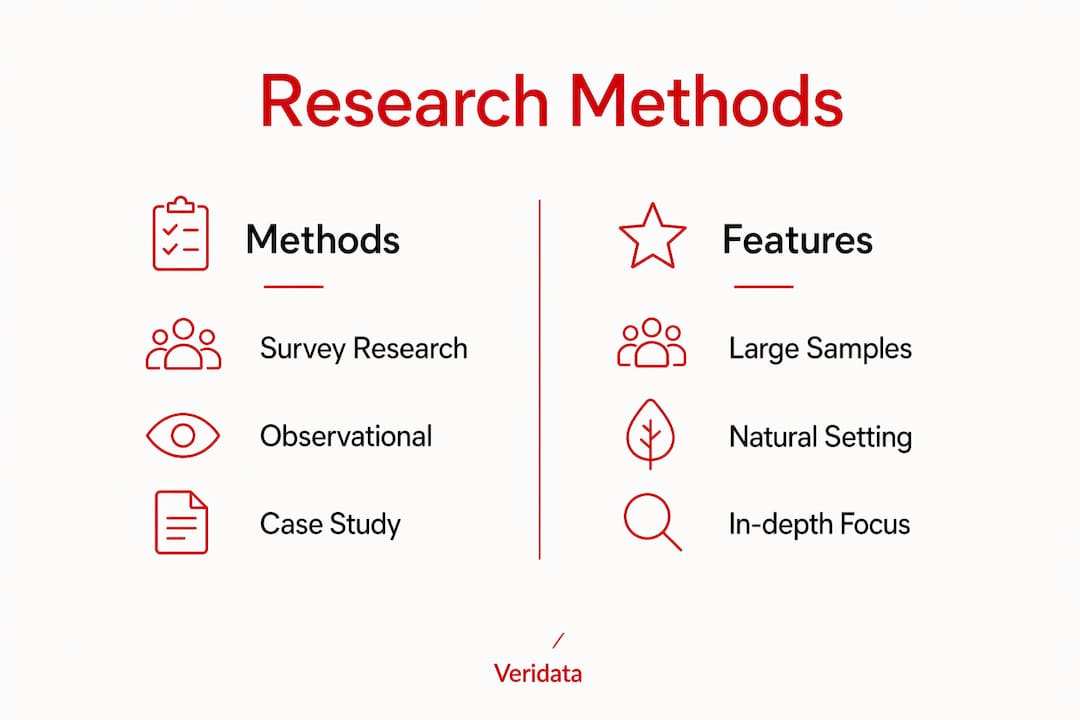
Survey research, observational studies, and case studies are the three primary descriptive research methods used across industries. Each one serves a different data collection need, and choosing the right one shapes the quality of your findings.
Survey research uses structured questionnaires and interviews to collect data from a defined sample. It scales well, produces quantifiable results, and works for both B2B and B2C audiences. A well-designed B2B market research survey captures attitudes, behaviors, and demographics across large groups quickly.
Observational studies record behavior in natural settings without any interference from the researcher. A retail analyst watching how shoppers move through a store, or a public health researcher tracking handwashing compliance in a hospital, both use observational methods. The data reflects real behavior, not self-reported behavior, which removes a layer of bias.
Case studies provide a detailed investigation of a single entity, whether that is one organization, one community, or one individual. They are especially useful when context matters and numbers alone cannot tell the full story. A case study of a hospital’s patient intake process, for example, can reveal workflow problems that a survey would never surface.
Two additional methods round out the descriptive toolkit. Content analysis examines text, media, or communications to identify patterns and themes. Archival research draws on existing records and historical data, making it cost-effective but requiring careful disclosure of potential bias from the original data collection process.
| Method | Best for | Key strength | Key limitation |
|---|---|---|---|
| Survey research | Large samples, quantifiable data | Scalable and fast | Self-report bias |
| Observational study | Behavioral data in natural settings | High ecological validity | Time-intensive |
| Case study | Deep context on a single entity | Rich qualitative detail | Not generalizable |
| Content analysis | Text, media, communications | Unobtrusive data collection | Interpretation subjectivity |
| Archival research | Historical or existing records | Low cost | Bias from original collection |
How does descriptive research differ from experimental research?
Descriptive research does not manipulate variables or test causal hypotheses, and it typically requires fewer resources and less time than experimental designs. That is not a weakness. It is a feature that makes descriptive methods the right tool for specific jobs.
Experimental research controls conditions, introduces treatments, and measures outcomes to establish cause and effect. Descriptive research simply observes and records. A pharmaceutical company running a clinical trial is doing experimental research. A public health agency counting how many adults in a county smoke cigarettes is doing descriptive research. Both are valid. They just answer different questions.
The most common misconception is treating descriptive findings as causal conclusions. Descriptive studies identify patterns, frequencies, and distributions, but they do not explain why those patterns exist. Seeing that two variables move together does not mean one causes the other. That is the correlation-causation trap, and it is the most damaging error in descriptive research reporting.
Pro Tip: Always frame descriptive findings as observations, not explanations. Write “X was associated with Y” rather than “X caused Y.” That single word choice protects your credibility and keeps your methodology honest.
Explanatory research goes one step further than descriptive work by building and testing theoretical models. Descriptive research sits between exploratory research, which generates initial ideas, and explanatory research, which tests them. Knowing where your study fits in that sequence helps you set the right expectations with stakeholders from day one.
When and how should you apply descriptive research effectively?
Descriptive research serves as the baseline or hypothesis-generating stage before causal or explanatory investigations begin. That makes it the right choice in three specific situations: when you are entering a new market or topic with limited prior data, when you need a population profile before designing a larger study, and when a stakeholder needs a reliable snapshot to support a decision.
Here is a practical framework for designing a descriptive study that holds up:
- Define your research question clearly. Descriptive questions follow a specific form: “What are the characteristics of X?” or “How frequently does Y occur in population Z?” If your question starts with “why,” you are in explanatory territory.
- Select your method based on your data type. Quantitative data needs surveys or structured observation. Qualitative depth needs case studies or content analysis. Both together need a mixed methods design.
- Determine your sample size before data collection. Underpowered samples produce unreliable frequency distributions. For surveys, work with a statistician or a research partner to calculate the minimum sample needed for your confidence level.
- Collect data consistently. Inconsistent data collection procedures introduce error that no amount of analysis can fix. Standardize your instruments, train your data collectors, and document every deviation.
- Analyze for patterns, not causes. Use frequency tables, cross-tabulations, and descriptive statistics like mean, median, and mode. Report what you found, not what you think it means causally.
- Present findings with context. A number without context misleads. Pair every statistic with a sentence explaining what it means for the population you studied.
Combining quantitative and qualitative data in a single descriptive study produces richer findings than either approach alone. A survey tells you that 60% of employees report low engagement. An observational study or a set of interviews tells you what low engagement actually looks like in practice. Together, they give decision-makers something they can act on.
Pro Tip: When using archival data, document the original source, the date of collection, and any known limitations of that dataset. Researchers who skip this step expose their findings to credibility challenges they cannot defend.
What industries benefit most from descriptive research studies?
Customer satisfaction surveys, market demographics analysis, and organizational profiling are among the most common applications of descriptive methods in professional settings. The industries that rely on these methods most heavily share one thing in common: they need to know what their population looks like before they can make good decisions.
- Public health: Epidemiologists use descriptive studies to map disease prevalence, identify at-risk populations, and track health behaviors over time. A county-level survey of vaccination rates is a classic descriptive research study.
- Education: Researchers profile student demographics, learning outcomes, and classroom behaviors to identify gaps before designing interventions. Standardized test score distributions are descriptive data.
- Business and marketing: Brand managers use descriptive methods to understand customer demographics, purchase frequency, and product awareness. A market sizing study is almost always descriptive at its core.
- Social science: Sociologists and psychologists use observational studies and surveys to document social behaviors, attitudes, and group characteristics across defined populations.
- Healthcare organizations: Hospital administrators use descriptive profiling to understand patient flow, readmission rates, and staff-to-patient ratios before proposing operational changes.
Descriptive research establishes a baseline that researchers use to map a situation or profile populations before committing to more resource-intensive analytical studies. Skipping the descriptive phase and jumping straight to experimental or explanatory research is one of the most expensive mistakes a research team can make. You end up testing hypotheses built on assumptions instead of data.
Mixed methods approaches add particular value in applied settings like healthcare and organizational research, where numeric trends alone rarely capture the full picture. A descriptive study that combines a patient satisfaction survey with structured interviews of nursing staff gives hospital leadership both the scale and the story.
Descriptive research as the foundation, not the afterthought
Researchers often treat descriptive work as the “easy” phase before the real research begins. That framing is wrong, and it costs projects dearly.
The quality of every causal or explanatory study you run downstream depends entirely on how well you described the population or phenomenon first. A weak baseline produces weak hypotheses. Weak hypotheses produce inconclusive experiments. The whole chain breaks at the descriptive stage.
What I have seen repeatedly in practice is that researchers rush the descriptive phase to get to the “interesting” analysis. They use convenience samples instead of representative ones. They skip mixed methods because qualitative data takes longer to process. They present frequency distributions without disclosing how the data was collected. Each of those shortcuts creates a credibility problem that shows up later, usually at the worst possible moment.
Archival data is particularly underestimated as a descriptive method. It is cost-effective and often covers time spans that no new study could replicate. But researchers who use it without disclosing the limitations of the original collection process are setting themselves up for peer review problems. Transparency is not optional in descriptive work. It is the whole point.
My honest advice: treat your descriptive research study with the same rigor you would apply to a randomized controlled trial. The methods are simpler, but the standards for transparency and representativeness are just as high. Get the description right, and everything that follows gets easier.
How Veridata Insights supports your research design
Veridata Insights works with researchers and professionals who need descriptive research done right, from study design through data presentation. Whether you need a full-service research solution that combines quantitative surveys with qualitative depth, or targeted support on questionnaire design and data collection, Veridata Insights delivers without project minimums, seven days a week. We specialize in B2B, B2C, healthcare, and hard-to-reach audiences, so your sample reflects the population you actually need to describe. Good descriptive research starts with a solid methodology. Contact Veridata Insights to talk through your research objectives and get a design that holds up.
Key takeaways
Descriptive research is the foundation of credible study design because it documents what exists before any causal analysis begins, and its value depends entirely on methodological rigor.
| Point | Details |
|---|---|
| Definition and purpose | Descriptive research observes and records population characteristics without manipulating variables or testing causality. |
| Three core methods | Surveys, observational studies, and case studies are the primary descriptive research methods used across industries. |
| Critical limitation | Descriptive findings show patterns and frequencies but cannot explain why those patterns occur. |
| Mixed methods advantage | Combining quantitative and qualitative data in descriptive studies produces richer, more usable findings than single-method designs. |
| Baseline role | Descriptive research establishes the population profile that makes downstream causal and explanatory research possible. |
FAQ
What is descriptive research in simple terms?
Descriptive research is a method of systematically observing and recording the characteristics of a population or phenomenon without changing any conditions. It answers what, who, where, and how often, but not why.
What are the main descriptive research methods?
Survey research, observational studies, and case studies are the three primary descriptive methods. Content analysis and archival research serve as complementary approaches depending on the data available.
Can descriptive research prove causation?
Descriptive research cannot establish causation. It identifies patterns, frequencies, and distributions, but explaining why those patterns exist requires experimental or explanatory research designs.
When should you use a mixed methods approach in descriptive research?
Use mixed methods when numeric data alone cannot capture the full context of what you are studying. Combining a survey with interviews, for example, gives you both the scale and the meaning behind the numbers.
How do you avoid the correlation-causation trap in descriptive studies?
Present all findings as observations rather than explanations. Use language like “X was associated with Y” instead of “X caused Y,” and clearly state that your study design does not support causal conclusions.