

TL;DR:
- The Green Book is an online platform that connects market research professionals with verified providers and industry resources. It promotes a problem-first, iterative research process and advocates for the integration of AI with strong governance practices. The platform offers benchmarking reports, directories, and educational tools to improve research planning and outcomes.
The market research Green Book is defined as the leading online directory and resource platform connecting professionals with verified market research companies, methodologies, and industry expertise. Known formally as Greenbook, it serves as far more than a supplier catalog. It consolidates the GRIT Insights Practice Report, expert-vetted frameworks, and a growing library of qualitative and quantitative guidance into one authoritative hub. For professionals who need reliable data and trusted partners, Greenbook sets the standard for how research gets planned, executed, and evaluated.
What methodologies and frameworks does the market research Green Book support?
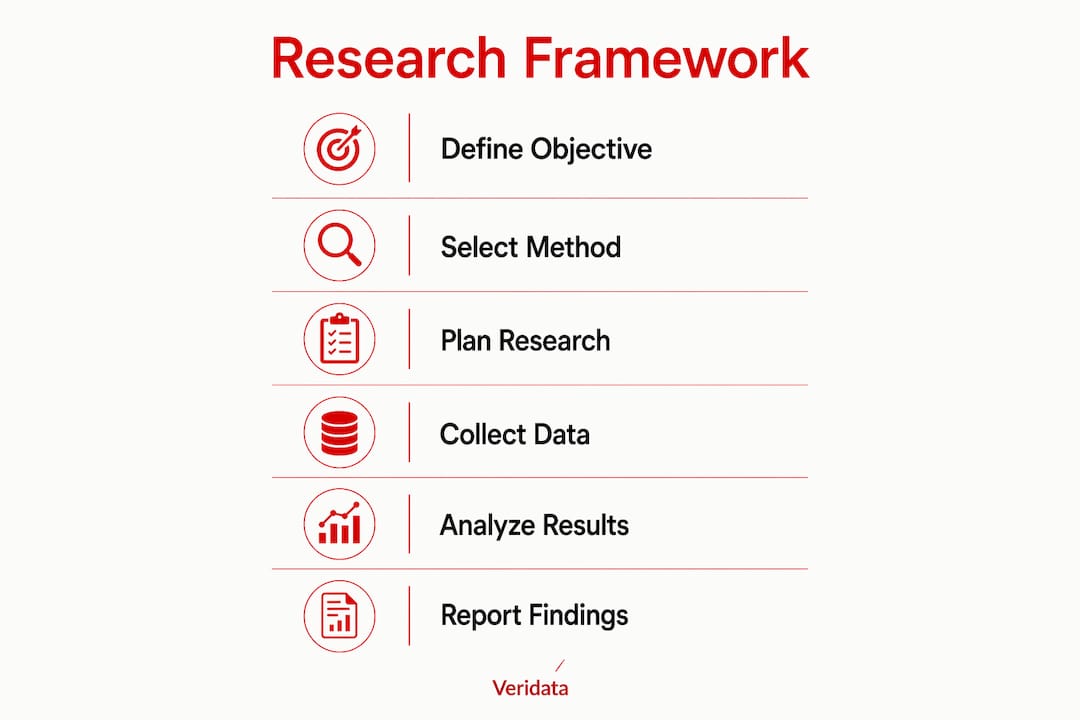
The Green Book supports a structured, repeatable research process that follows a 5–7 step framework spanning objective definition, methodology selection, data collection, analysis, and insight application. That framework is increasingly treated as an iterative cycle rather than a one-time sequence. Each pass through the cycle sharpens the research question and improves the quality of the output.

The most common failure in research design is starting with a method instead of a problem. The SAGE Handbook of Marketing Research identifies the “problem-first” approach as the single most important factor in producing research that actually drives decisions. When teams select a survey format before defining what decision the data must support, they generate answers to the wrong questions.
A practical framework for applying problem-first research design looks like this:
- Define the business decision the research must inform.
- Write the research objective as a specific, answerable question.
- Select the methodology that best fits the question and audience, whether it is B2B, B2C, or healthcare.
- Design the data collection instrument based on the methodology.
- Collect, analyze, and interpret data with the original decision in mind.
- Apply insights and document what worked for the next cycle.
The Green Book also champions mixed-method research, which combines qualitative depth with quantitative scale. Hybrid approaches produce richer, validated insights that support strategic decision-making in ways that single-method studies rarely achieve.
Key methodology principles the Green Book reinforces:
- Problem-first design prevents wasted fieldwork and misaligned questions.
- Mixed-method integration adds context that numbers alone cannot provide.
- Iterative cycles allow teams to refine hypotheses between research phases.
- AI governance checkpoints protect data integrity throughout the process.
Pro Tip: Before selecting any methodology, write your research objective as a single sentence that names the decision it will support. If you cannot write that sentence, you are not ready to design the study.
How does the Green Book incorporate AI and emerging technologies?
AI is now embedded in three primary research tasks: data analysis, report updates, and data integration. That adoption is widespread and accelerating. The gap, however, is not in AI use. It is in AI governance.
The 2026 GRIT Insights Practice Report identifies AI governance as a critical risk management gap across the industry. Organizations that use AI tools without clear policies for validation, bias review, and output auditing expose their research to reliability failures that can undermine entire programs. Governance is not a compliance checkbox. It is the difference between AI that improves research and AI that quietly corrupts it.
The firms winning in 2026 are not the ones using the most AI. They are the ones governing it best. AI governance is the pivotal differentiator for organizations thriving amid growing automation and data challenges.
Fraud detection is one area where AI governance has already matured. Between 70% and 88% of market research professionals now regularly use automated fraud detection tools, making it a de facto industry standard. That adoption rate signals that data quality protection is no longer optional at any firm size.
Emerging AI capabilities the Green Book highlights include:
- Synthetic data generation for testing survey instruments before full deployment.
- Automated quality flagging that identifies inconsistent or fraudulent responses in real time.
- AI-assisted report drafting that compresses analysis timelines without replacing analyst judgment.
- Hybrid research acceleration, where AI handles data processing while human researchers focus on interpretation.
The productivity gains from AI in agency settings are real, but they require deliberate governance structures to hold. Firms that pair automation with human oversight consistently outperform those that treat AI as a set-and-forget solution.
What resources and tools does the Green Book offer for research planning?
Greenbook provides multiple platforms including directories, reports, podcasts, and events to help practitioners stay current and connected with research best practices. Each resource serves a distinct purpose in the research planning cycle.
The GRIT Insights Practice Report is the most cited benchmarking tool in the industry. It tracks methodology adoption, technology integration, firm growth patterns, and governance maturity across hundreds of research organizations. Professionals use it to validate their own practices against peer benchmarks and to identify where their programs lag behind the field.
The verified supplier directory is the resource most professionals encounter first. It covers qualitative research firms, quantitative data collection providers, and hybrid research specialists. Each listing is categorized by capability, making vendor selection faster and more defensible than a generic web search.
Key Green Book resources for research planning:
- GRIT Insights Practice Report: Annual benchmarking across methodology, technology, and firm performance.
- Verified supplier directory: Categorized listings for qualitative, quantitative, and hybrid providers.
- Greenbook events: Conferences and workshops focused on emerging methods and industry standards.
- Greenbook podcasts: Practitioner interviews covering real-world research challenges and solutions.
Pro Tip: Use the GRIT report as a pre-project checklist. If your planned methodology or vendor selection process does not align with current GRIT benchmarks, treat that gap as a risk to address before fieldwork begins.
How can professionals apply Green Book insights to improve research outcomes?
The most direct application of Green Book frameworks is aligning your research objective with the right methodology before any vendor conversation begins. Defining research objectives upfront accounts for the majority of research success. Teams that skip this step spend budget on data that answers no useful question.
Here is a practical sequence for applying Green Book principles to a real project:
- State the business decision your research must support, in writing, before any other planning.
- Review GRIT benchmarks to confirm your methodology choice reflects current best practices.
- Select vendors from verified directories rather than relying on existing relationships alone.
- Build AI governance into your project plan with explicit validation steps for any AI-generated output.
- Use a mixed-method approach when the research question requires both depth and scale.
- Apply automated fraud detection as a standard quality control step, not an afterthought.
Vendor management deserves particular attention. Larger firms increasingly shift focus from fieldwork to analytics and consulting, which increases reliance on external suppliers and the complexity of managing them. A clear vendor governance policy, informed by GRIT standards, reduces that risk significantly.
The SAGE Handbook of Marketing Research reinforces one more principle worth building into every project: depth and contextual understanding often deliver more value than raw data volume. Bigger samples do not automatically produce better decisions. Richer questions do.
Pro Tip: Run a brief qualitative phase before your quantitative survey. Even six to eight in-depth interviews can surface language, objections, and concepts that make your survey instrument dramatically more accurate.
Key Takeaways
The Green Book’s greatest value is not its directory. It is the governance and methodology frameworks that help professionals produce research worth acting on.
| Point | Details |
|---|---|
| Problem-first design | Define the business decision before selecting any methodology to avoid misaligned data. |
| Mixed-method research | Combining qualitative and quantitative approaches produces richer, more reliable insights. |
| AI governance as standard | Automated fraud detection is used by 70–88% of professionals and must be paired with clear oversight policies. |
| GRIT benchmarking | Use the annual GRIT Insights Practice Report to validate your methodology and vendor choices against industry standards. |
| Vendor management discipline | Verified supplier directories and governance policies reduce risk as firms rely more on external research partners. |
Why the Green Book changed how I think about research design
I spent years watching research programs fail not because of bad data, but because of bad questions. Teams would commission a survey, collect thousands of responses, and then realize the data did not answer the decision they actually needed to make. The market research process looked rigorous on paper. The problem was upstream.
What the Green Book, and specifically the GRIT reports, made clear to me is that the industry’s most persistent problem is structural. Method-first thinking is baked into how many organizations budget and plan research. The survey gets approved before the objective gets written. That sequence produces expensive noise.
The AI governance conversation is where I see the same mistake repeating itself. Firms are adopting AI tools at speed, which is fine. But mid-size firms leading in AI governance maturity are outperforming larger legacy agencies precisely because they built policies before they scaled adoption. The lesson is the same one the problem-first framework teaches. Governance before tooling. Objective before method.
The Green Book is most useful when you treat it as a mirror, not just a directory. Check your practices against GRIT benchmarks. Read the methodology debates in the podcasts and events. Let the friction between what you are doing and what the field recommends tell you something. That discomfort is where the improvement lives.
How Veridata Insights applies these frameworks for you
Veridata Insights builds every project on the same problem-first, governance-forward principles the Green Book champions. Whether you need full-service mixed-method research or targeted support for a single phase, Veridata Insights handles consultation and design, methodology selection, questionnaire review, data collection, processing, and reporting. There are no project minimums and no days off. The team covers B2B, B2C, healthcare, and hard-to-reach audiences with the same commitment to data quality. If your next research program needs to produce decisions, not just data, reach out to Veridata Insights and let’s build something worth acting on.
FAQ
What is the Green Book in market research?
The Green Book, formally known as Greenbook, is a leading online directory and resource platform for market research professionals. It provides verified supplier listings, the GRIT Insights Practice Report, and educational resources covering methodologies, technology, and industry trends.
How do I use the Green Book to select a research vendor?
Use the Greenbook verified supplier directory to filter providers by capability, including qualitative, quantitative, and hybrid research specializations. Cross-reference vendor choices against GRIT benchmarks to confirm alignment with current industry standards.
What is the GRIT Insights Practice Report?
The GRIT Insights Practice Report is Greenbook’s annual benchmarking study tracking methodology adoption, AI integration, fraud detection practices, and firm performance across the market research industry. It is the most widely cited benchmarking tool in the field.
Why does the Green Book emphasize problem-first research design?
The problem-first approach, as reinforced by the SAGE Handbook of Marketing Research, prevents teams from selecting a methodology before defining the business decision the research must support. Method-first design is the dominant failure mode in market research planning.
How does AI fit into Green Book research frameworks?
AI is embedded in data analysis, report updating, and data integration across the industry, but the 2026 GRIT report identifies AI governance as the critical gap. Between 70% and 88% of professionals use automated fraud detection, and firms with clear governance policies consistently outperform those without them.