

TL;DR:
- B2B marketing involves promoting products to multiple decision-makers over long sales cycles through trust and engagement. It requires understanding complex buyer roles, personalized content, and multi-channel strategies like LinkedIn, SEO, and ABM. Success depends on ongoing research, measuring pipeline metrics, and building tailored campaigns for high-value accounts.
B2B marketing is defined as the practice of promoting products or services from one business directly to another, targeting committees of decision-makers through multi-channel campaigns built on trust, demonstrated ROI, and sustained engagement over long sales cycles. Unlike consumer marketing, where a single buyer makes an emotional purchase in minutes, a typical B2B purchase involves 6–10 stakeholders, takes 3–12 months, and requires 27 content interactions before a vendor even makes the shortlist. Those numbers are not a warning. They are a blueprint. The marketing professionals who understand this complexity and build their programs around it consistently outperform those who borrow tactics from the consumer playbook.
How does B2B marketing differ from B2C marketing?
The core difference between B2B and B2C marketing is who makes the decision and why. A consumer buys running shoes because they feel good. A procurement team buys enterprise software because it reduces operational risk, fits existing workflows, and shows a measurable return. B2B marketing focuses on risk mitigation, operational fit, and quantifiable ROI. That shift in motivation changes everything downstream.
The buying committee structure is the most practical difference. B2C targets one person. B2B targets a group, often including a technical evaluator, a financial approver, an end user, and a C-suite sponsor. Each role has different concerns, different objections, and different content preferences. A single message rarely satisfies all of them.
Sales cycle length follows directly from that complexity. Consumer purchases close in seconds or days. B2B deals routinely run 3–12 months. That timeline demands content that educates, reassures, and stays relevant across multiple touchpoints.
| Dimension | B2B marketing | B2C marketing |
|---|---|---|
| Decision makers | 6–10 stakeholders | 1 individual |
| Sales cycle | 3–12 months | Minutes to days |
| Primary message | ROI, risk, operational fit | Emotion, lifestyle, aspiration |
| Content formats | Case studies, whitepapers, demos | Product photos, reviews, short video |
| Key channels | LinkedIn, webinars, ABM, email | Meta, TikTok, Google Shopping |
| Deal size | $5,000–$500,000+ | Typically under $1,000 |
Channel selection also diverges sharply. LinkedIn dominates B2B reach. Webinars build credibility with technical buyers. Account-Based Marketing (ABM) targets named accounts with personalized outreach. None of those tactics belong in a standard consumer campaign, and the reverse is equally true.
What are the most effective B2B marketing strategies in 2026?

The most effective business-to-business marketing programs combine content and SEO, ABM, LinkedIn, email nurture, and webinars into a coordinated system. No single channel wins alone. B2B buyers use an average of 10 different channels across their purchasing cycle. That means your brand needs to show up consistently across multiple touchpoints, not just one.
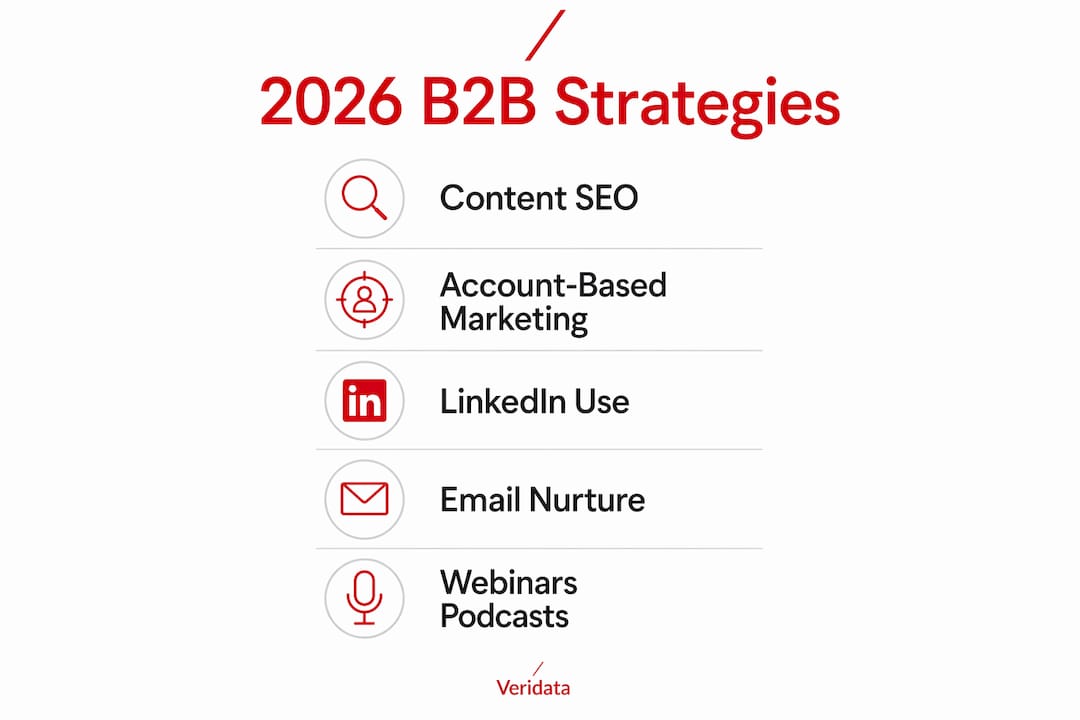
Content marketing and SEO produce the highest long-term return of any organic channel. B2B SEO content targeting commercial-intent keywords builds meaningful traffic after 6–9 months, with compounding returns after that. The patience required is real, but so is the payoff. Ranking for the questions your buyers are already asking builds authority that paid channels cannot replicate.
Account-Based Marketing (ABM) flips the traditional funnel. Instead of casting wide and filtering down, ABM targets 50–500 high-value accounts with personalized campaigns built around custom landing pages, LinkedIn ads, direct mail, and tailored outbound sequences. It works best when average contract values exceed $25,000, because the investment per account is significant.
LinkedIn is the dominant platform for reaching B2B professionals. Sponsored content, thought leadership posts, and LinkedIn Events all generate qualified engagement that Meta and TikTok simply do not deliver for most B2B categories.
Email nurture keeps your brand present during the long gaps between buyer interactions. Segmented email sequences with lead scoring, built inside platforms like HubSpot, ActiveCampaign, or Brevo, allow you to send the right message to the right role at the right stage. That precision reduces churn from your pipeline.
Webinars and podcasts build the kind of trust that display ads cannot. A 45-minute webinar with a credible speaker demonstrates expertise in a way that a banner ad never will. They also generate recordings that fuel content repurposing for months.
Pro Tip: Do not try to run all five strategies simultaneously from day one. Pick two channels, execute them well for 90 days, measure the results, and then expand. Spreading budget and attention too thin is the fastest way to get mediocre results from every channel.
An omnichannel approach ties these channels together into a unified buyer experience. The goal is not to be everywhere. The goal is to be consistent and relevant wherever your buyers actually spend their time.
How to build an effective B2B marketing plan step by step
A B2B marketing plan that produces results starts with one thing: a clear Ideal Customer Profile (ICP). Your ICP defines the firmographic data (industry, company size, revenue, geography) and psychographic data (goals, fears, buying triggers) that characterize your best-fit accounts. Without it, every downstream decision is a guess.
Once your ICP is defined, map the buying committee. Identify the roles involved in a typical purchase, the questions each role asks, and the objections each role raises. A CFO wants to see payback period. An IT director wants to see integration specs. A department head wants to see workflow impact. Your content needs to address all three.
Build your website to serve those roles. Every page should answer a specific buyer question, load fast, and include a clear next step. SEO-optimized pages targeting commercial-intent keywords are the foundation of long-term organic lead generation.
From there, follow this sequence:
- Choose two primary channels. LinkedIn and SEO work well together for most B2B companies. LinkedIn drives awareness and engagement. SEO captures buyers who are already searching.
- Build a consistent content engine. Publish 2–4 pieces of content monthly. Prioritize case studies, because they address the risk concerns that dominate B2B decisions.
- Implement marketing automation. Connect your CRM to your email platform. Set up lead scoring so that sales receives warm, qualified handoffs rather than cold lists. Tools like HubSpot and ActiveCampaign handle this well.
- Integrate sales and marketing data. Your pipeline data tells you which content actually converts. Review it monthly, not quarterly.
- Adjust based on performance. Track cost per lead, MQL to SQL conversion rate, and sales cycle length. When a channel underperforms for 90 days, reallocate budget rather than waiting for a miracle.
Pro Tip: A marketing automation checklist built before you launch your first campaign saves weeks of rework later. Map your lead stages, scoring thresholds, and handoff criteria before you write a single email.
The B2B research best practices that inform your ICP and buyer personas are not a one-time exercise. Revisit them every 6–12 months. Markets shift, buyer priorities change, and the ICP that worked in 2024 may not describe your best customers in 2026.
What metrics and KPIs are essential for measuring B2B marketing success?
Measurement in B2B marketing is not about vanity metrics. Page views and social likes tell you almost nothing about pipeline health. The metrics that matter connect marketing activity directly to revenue.
Lead qualification and scoring are the foundation. A Marketing Qualified Lead (MQL) meets your ICP criteria and has engaged enough to warrant outreach. A Sales Qualified Lead (SQL) has been vetted by sales and is ready for a discovery call. The gap between MQL and SQL conversion rate reveals whether your targeting is accurate or your content is attracting the wrong audience.
Beyond lead quality, track these core KPIs:
- Customer Acquisition Cost (CAC): Total marketing and sales spend divided by new customers acquired. This tells you whether your growth is economically sustainable.
- Customer Lifetime Value (LTV): Average revenue per customer over the full relationship. LTV relative to CAC is the clearest indicator of business model health.
- Pipeline velocity: How fast deals move through your funnel. Slow velocity often signals a content gap or a qualification problem, not a sales problem.
- Return on Marketing Investment (ROMI): Revenue attributed to marketing divided by marketing spend. Multi-touch attribution models distribute credit across channels rather than awarding it all to the last click.
- Cost per lead by channel: This tells you where to put more budget and where to cut.
Measuring pipeline velocity and tracking conversion rates through each funnel stage supports data-driven budget allocation. When you know which channels produce the fastest-moving, highest-converting leads, you stop debating budget and start deploying it with confidence.
Data hygiene matters as much as the metrics themselves. Duplicate records, missing firmographic fields, and untracked lead sources corrupt every report you run. A clean CRM is not an IT problem. It is a marketing performance problem.
Key takeaways
Effective B2B marketing requires a research-grounded, multi-channel approach that addresses every stakeholder in the buying committee across a sales cycle that can span 3–12 months.
| Point | Details |
|---|---|
| Know your buying committee | Map all 6–10 stakeholders, their roles, and their specific objections before building content. |
| Start with two channels | Focus on LinkedIn and SEO first, then expand once you have performance data to guide decisions. |
| Measure what moves pipeline | Track MQL to SQL conversion, pipeline velocity, and CAC rather than page views or follower counts. |
| Audience research is ongoing | Revisit your ICP and buyer personas every 6–12 months as market conditions shift. |
| ABM for high-value accounts | Use Account-Based Marketing when average contract values exceed $25,000 and your account list is defined. |
What I have learned about B2B marketing that most guides skip
Most B2B marketing guides treat the buying process as a rational, linear sequence. Buyer sees content, downloads whitepaper, books demo, signs contract. Clean. Predictable. Almost never true.
Internal politics, risk aversion, and incumbent vendor relationships influence B2B deals far more than product ROI does. I have watched well-qualified prospects go dark for three months, not because the product was wrong, but because a senior stakeholder was protecting a relationship with the existing vendor. No amount of case studies fixes that. What fixes it is understanding the organizational dynamics before you pitch.
The marketers or consultancies who consistently shorten sales cycles are the ones who build content for the skeptic in the room, not just the champion. They create materials that address political risk, implementation risk, and career risk for the buyer who sticks their neck out to recommend a new vendor. That is a very different brief than “write a case study about ROI.”
Automation is genuinely useful, but it is not a substitute for human judgment. The best email nurture sequences I have seen still require a human to decide when to break the sequence and pick up the phone. Knowing when to stop automating is a skill that most marketing teams undervalue.
The role of B2B audience research in all of this is larger than most teams realize. You cannot write for the skeptic in the room if you have never actually talked to one. Qualitative research, including in-depth interviews with real buyers, surfaces the objections, fears, and internal dynamics that no survey can fully capture. Build that research into your planning cycle, not just your campaign retrospectives.
How Veridata Insights supports your B2B marketing goals
B2B marketing decisions are only as good as the buyer understanding behind them. Veridata Insights specializes in B2B market research that gives marketing teams and decision-makers the precise audience intelligence they need to build campaigns that actually convert. From quantitative surveys to qualitative interviews with hard-to-reach B2B audiences, Veridata Insights handles every stage: consultation, questionnaire design, data collection, analysis, and reporting. There are no project minimums, and the team is available 7 days a week. If your marketing strategy needs sharper audience data to back it up, Veridata Insights is ready to help you get it right.
FAQ
What is B2B marketing?
B2B marketing is the practice of promoting products or services from one business to another, targeting multiple decision-makers through content, channels, and campaigns focused on ROI and operational fit.
How many stakeholders are involved in a typical B2B purchase?
The average B2B purchase involves 6–10 stakeholders and requires 27 content interactions before a vendor is shortlisted, making multi-touch engagement a requirement rather than an option.
What is the role of B2B research in marketing?
B2B market research defines your Ideal Customer Profile, maps buyer committee roles and objections, and surfaces the organizational dynamics that determine whether a deal closes or stalls.
How long does B2B SEO take to show results?
B2B SEO content targeting commercial-intent keywords typically generates meaningful organic traffic after 6–9 months, with compounding returns as topical authority builds over time.
How do you conduct B2B market research effectively?
Effective B2B market research combines quantitative surveys with qualitative interviews to capture both measurable trends and the nuanced buyer motivations that numbers alone cannot reveal.