

TL;DR:
- Step-by-step data quality management involves assessing, defining standards, implementing rules, and continuously monitoring data. Success depends on clear governance, role accountability, and building a data inventory before selecting tools. Continuous oversight and strong ownership ensure data quality programs deliver lasting value.
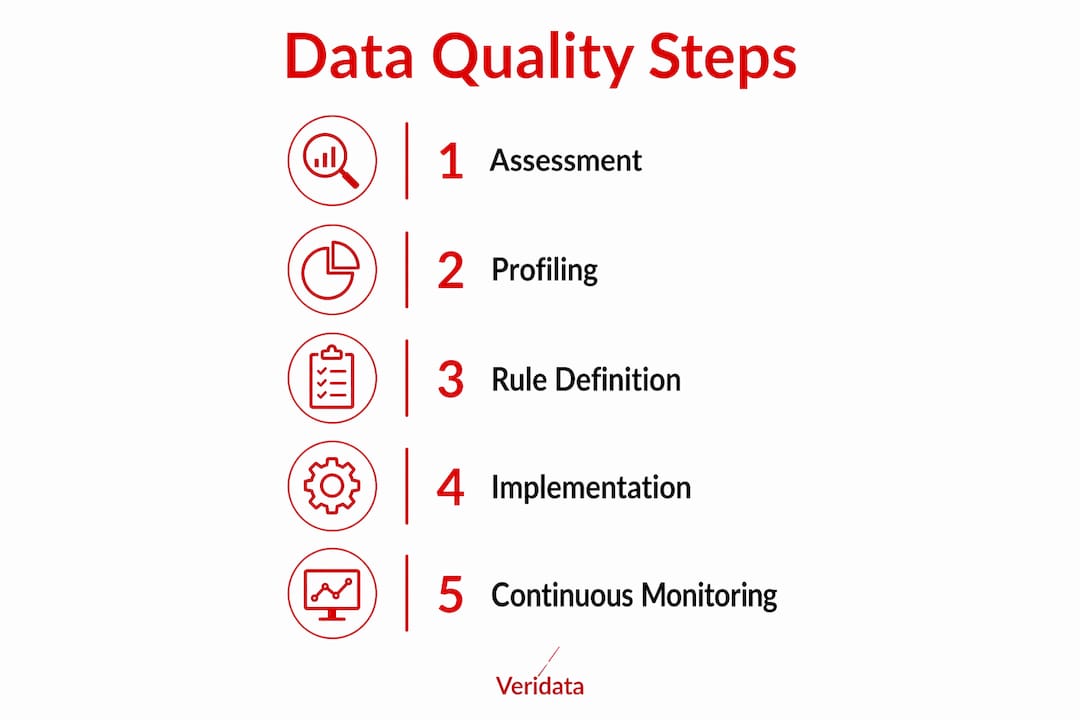
Step-by-step data quality management is a systematic process designed to ensure data is accurate, complete, timely, valid, unique, and consistent for its intended use. The six core data quality dimensions recognized across industry practice in 2026 give professionals a shared language for diagnosing problems and measuring progress. Most frameworks follow a 5–7 phase lifecycle: assess, identify, define standards, implement fixes, and monitor continuously. This guide walks through each phase with the specificity you need to build a program that holds up over time.
What prerequisites do you need before starting a data quality program?

The most common reason data quality programs fail is not bad tooling. It is the absence of clear ownership and executive commitment before a single rule gets written.
Governance and sponsorship come first. Without an executive sponsor, data quality work gets deprioritized the moment a competing project appears. The sponsor does not need to be technical. They need to be accountable for outcomes and willing to enforce standards across teams.
Roles define accountability. A working program needs four types of people:
- Data owners: Business leaders who are accountable for a specific data domain, such as customer records or financial transactions.
- Data stewards: Practitioners who enforce quality rules, investigate root causes, and coordinate fixes day to day.
- Data engineers: The people who build and maintain the pipelines where quality controls get embedded.
- Analysts: The consumers who surface issues and validate that fixes actually solve the business problem.
Foundational tools matter, but they are not the starting point. Profiling software, automated monitoring platforms, and rule engines all serve the program. A data catalog and inventory give you a map of what data exists, where it lives, and who uses it. Without that map, you cannot prioritize what to fix first.
Pro Tip: Build a data inventory before buying any tooling. A simple spreadsheet listing data sources, owners, and downstream consumers will reveal your highest-risk domains faster than any platform demo.
Data quality challenges are more organizational and cultural than purely technical. Governance and stewardship roles are what separate programs that last from programs that produce a one-time cleanup and then decay.
How do you assess, profile, and baseline your data quality?
Profiling is the diagnostic phase. You cannot define standards or write rules until you know what you are actually working with.
A structured assessment covers all six quality dimensions for each critical data domain:
- Completeness: What percentage of required fields are populated? A customer table with 30% missing email addresses has a completeness problem, not an email problem.
- Accuracy: Do values reflect reality? Cross-reference a sample against a trusted source, such as a CRM record against a signed contract.
- Validity: Do values conform to defined formats and ranges? A date field containing “99/99/9999” fails validity regardless of completeness.
- Uniqueness: How many duplicate records exist? Count exact duplicates and fuzzy matches separately.
- Consistency: Do the same facts appear the same way across systems? A product listed as “Widget A” in one system and “WDGT-A” in another creates a consistency failure.
- Timeliness: How stale is the data relative to its intended use? A customer address updated once per year may be fine for annual mailings but unacceptable for real-time fraud detection.
A well-structured audit checklist covers duplicates, missing values, invalid entries, consistency, and timeliness, supported by automated tools. Run automated profiling first to get counts and percentages at scale. Then apply manual spot-checks to validate that the numbers reflect real-world meaning.
Profiling output example:
| Dimension | Metric | Example threshold |
|---|---|---|
| Completeness | % fields populated | 95% minimum |
| Uniqueness | Duplicate record rate | Less than 0.5% |
| Validity | % values passing format rules | 98% minimum |
| Timeliness | Average record age vs. refresh cycle | Within 24 hours for operational data |
Set quality thresholds aligned with business purpose, not arbitrary targets. A 95% completeness threshold for a marketing email list has a very different consequence than the same threshold for a clinical trial dataset. The threshold must reflect what “good enough” actually means for the downstream use case.
Pro Tip: Profile a random sample of 1,000–5,000 records before running full-dataset profiling. Sampling surfaces the most common error patterns quickly and lets you calibrate your automated rules before they run at scale.
How do you define and implement data quality rules?
Rules are the operational translation of your standards. Every rule should trace back to a specific business requirement, not a technical preference.
Follow this sequence to build rules that stick:
- Translate business requirements into data policies. If the finance team needs revenue figures reconciled within one business day, that is a timeliness policy. Write it down in plain language before writing any code.
- Define rules per dimension per domain. A rule for customer email validity looks different from a rule for product SKU format. Domain-specific rules prevent over-generalization that produces false positives.
- Embed controls in data pipelines. ETL and ELT pipelines are the right place to enforce rules because they catch problems at the point of ingestion, not after the data has already propagated downstream.
- Apply format validation, deduplication, and completeness enforcement. These three controls address the majority of common data quality failures. Format validation rejects malformed entries. Deduplication merges or flags duplicate records. Completeness enforcement blocks records with missing required fields from advancing through the pipeline.
- Build repeatable transformation rules. One-off fixes create technical debt. A reusable transformation rule that standardizes phone number formats, for example, runs every time new data arrives without manual intervention.
Prevention at the point of entry is more cost-effective than post-hoc cleanup. Embedding controls like dropdowns and required fields at the source reduces future remediation costs significantly. This is the same logic behind proactive fraud prevention: stop the bad data before it enters the system rather than chasing it afterward.
Pro Tip: Write rules in a version-controlled repository, not directly in pipeline scripts. When a business requirement changes, you can update the rule, test it, and deploy it without touching production code.
How do you monitor data quality continuously?
Monitoring is what separates a one-time cleanup from a sustained program. Without it, quality degrades silently until a downstream failure makes the problem visible.
A working monitoring setup includes:
- Dashboards and scorecards that track quality metrics by domain over time. Trend lines matter more than point-in-time scores. A completeness rate dropping from 98% to 94% over three weeks signals a systemic issue, not a one-off error.
- Real-time alerting for critical datasets. Pipeline-frequency alerting is necessary for AI models or executive dashboards. Batch-based monitoring is insufficient in these contexts because errors compound before anyone sees them.
- Alert routing to the right owner. An alert that goes to a generic inbox gets ignored. Route alerts to the designated data steward for the affected domain, with a defined response time.
- Manual spot-checks alongside automation. Human subject-matter experts identify contextual and logical errors that automated rules miss. A rule can confirm that a date field is formatted correctly. Only a human can confirm that the date makes business sense.
- Cross-system reconciliation. Compare record counts and key metrics across source systems and downstream reports on a scheduled basis. Discrepancies surface integration failures that profiling alone will not catch.
Continuous monitoring paired with business-driven workflows enables rapid response and corrective action. Scale the program over time using federated governance, where each domain team owns its quality metrics within a centralized standard framework.
What are the most common data quality challenges?
Even well-designed programs run into predictable obstacles. Knowing them in advance lets you address them before they derail the work.
- Cultural resistance: Teams that have operated without quality standards often push back on new rules. Frame quality as a service to them, not a constraint on them. Show how bad data costs them time and credibility.
- Role ambiguity: When no one knows who owns a data domain, issues go unresolved. A RACI matrix for data ownership resolves this faster than any governance policy document.
- Over-reliance on automation: Automated rules catch what they are programmed to catch. They miss novel error patterns, business logic violations, and contextual anomalies. Manual verification is not optional.
- Prioritization without a framework: Not all data quality issues deserve equal attention. Use an impact-based formula: Impact = number of consumers multiplied by severity of wrong decisions. Fix the highest-impact issues first.
- Technical debt in quality scripts: Rules written as one-off scripts accumulate into an unmaintainable mess. Treat quality logic as production code with version control, testing, and documentation.
Pro Tip: Run a quarterly review of your quality rules. Business requirements change, and rules that were accurate six months ago may now produce false positives or miss new error patterns entirely.
Key Takeaways
A sustained data quality program requires governance, structured assessment, rule-based automation, and continuous monitoring working together across every critical data domain.
| Point | Details |
|---|---|
| Governance before tooling | Assign data owners and stewards before selecting any platform or writing any rules. |
| Profile first, then set thresholds | Baseline profiling across all six dimensions reveals which domains need the most urgent attention. |
| Embed rules in pipelines | Prevention at ingestion is more cost-effective than cleanup after data has propagated downstream. |
| Monitor in real time for critical data | Batch monitoring misses compounding errors in AI models and executive dashboards. |
| Prioritize by downstream impact | Use Impact = consumers × severity to rank issues and direct remediation where it matters most. |
Data quality is a people problem first
Here is the uncomfortable truth I have seen play out repeatedly: organizations spend months evaluating profiling tools and monitoring platforms, then wonder why their data quality program stalls six months after launch. The tool was never the problem.
The programs that actually hold up over time share one characteristic. Someone specific is accountable for each data domain, and that person has the authority to enforce standards. Not a committee. Not a shared inbox. One named person who answers for the quality of that data.
The concept of fitness for purpose is the other thing most programs get wrong. Data quality is not an absolute standard. It is relative to the intended use. A dataset that is perfectly adequate for trend analysis may be completely unacceptable for regulatory reporting. When teams argue about whether data is “good enough,” they are usually arguing past each other because they have different use cases in mind. Defining the use case first resolves most of those arguments before they start.
The value of data-driven decisions depends entirely on the quality of the data underneath them. No amount of analytical sophistication compensates for a broken foundation. Get the foundation right, and the rest of the work becomes significantly easier.
How Veridata Insights supports your data quality program
Building a data quality program from scratch is genuinely hard work. Veridata Insights works with data teams and research organizations to design governance frameworks, define quality standards, and build the monitoring workflows that keep data reliable over time. Whether you need help with a full program design or support for a specific phase like profiling or rule implementation, Veridata Insights offers flexible research services with no project minimums, seven days a week. The team brings deep experience across quantitative and qualitative research, B2B, B2C, healthcare, and hard-to-reach audiences. Quality data starts with the right process. Veridata Insights helps you build it.
FAQ
What is a step-by-step data quality management process?
A step-by-step data quality management process is a structured lifecycle that moves from profiling and assessment through standards definition, rule implementation, and continuous monitoring. Most frameworks follow a 5–7 phase structure designed to produce sustained, measurable improvement.
What are the six core data quality dimensions?
The six core dimensions are accuracy, completeness, consistency, timeliness, validity, and uniqueness. Each dimension measures a distinct aspect of data fitness and requires its own profiling metrics and quality rules.
How do you prioritize which data quality issues to fix first?
Prioritize by downstream impact using the formula: Impact = number of consumers multiplied by severity of wrong decisions. This approach directs remediation effort toward the data issues that cause the most business harm.
Why is prevention better than cleanup in data quality management?
Embedding validation logic at the point of data entry or ingestion stops errors before they propagate through downstream systems. Post-hoc cleanup is more expensive and less reliable because errors compound across reports, models, and integrations before they are caught.
How often should you run data quality checks?
Critical datasets feeding AI models or executive dashboards require real-time, pipeline-frequency monitoring. Less critical datasets can use scheduled batch checks, with the frequency matched to how quickly errors in that data would cause a business problem.