

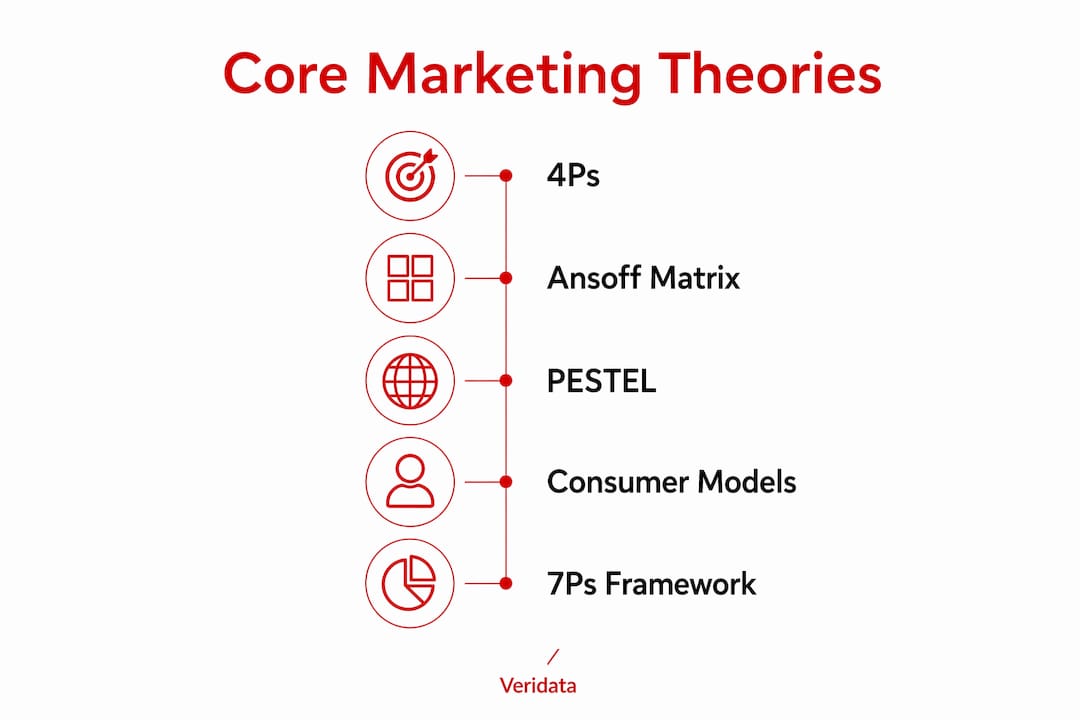
The most useful marketing theories are not abstract academic exercises. They are practical frameworks that explain why customers buy, how markets behave, and where your strategy should focus. The core theories you need to know include the Marketing Mix (4Ps and its expansions), the Ansoff Matrix, PESTEL analysis, consumer behavior models like the Engel-Kollat-Blackwell (EKB) model and the Howard-Sheth model, and the Black Box stimulus-response model. Together, these form the strategic foundation that separates guesswork from deliberate, data-informed marketing.
Here is a quick reference to the frameworks covered in this article:
- Marketing Mix (4Ps): Product, Price, Place, Promotion. The starting point for any marketing plan.
- Social Marketing Expansion (8Ps): Adds Public, Partnership, Policy, and Purse-strings for nonprofit and behavioral change goals.
- 7Ps: Extends the 4Ps with People, Process, and Physical Evidence for service-oriented businesses.
- Ansoff Matrix: Four growth strategies: market penetration, product development, market development, and diversification.
- PESTEL Analysis: Scans Political, Economic, Social, Technological, Environmental, and Legal macro-factors.
- EKB Model: Maps the full consumer decision journey from problem recognition to post-purchase evaluation.
- Howard-Sheth Model: Explains high-involvement brand choice through stimuli, perception, and learning.
- Black Box Model: Links external marketing stimuli to consumer responses through the buyer’s internal process.
- Diffusion of Innovation: Explains how new products spread across adopter categories over time.
- Relationship Marketing: Prioritizes long-term customer relationships over single transactions.
- Service-Dominant Logic: Treats service, not goods, as the fundamental basis of economic exchange.
What are the classic marketing theories you need to master?
The 4Ps framework, introduced by E. Jerome McCarthy in the 1960s, remains the most widely taught and applied model in marketing. Product covers what you sell and how it meets customer needs. Price reflects perceived value and competitive positioning. Place determines how and where customers access your offering. Promotion encompasses every channel and message you use to create awareness and drive purchase. These four levers interact constantly, and pulling one without considering the others is where most campaigns go wrong.
Social marketing extends the classic 4Ps by adding four more: Public (the audience segments you want to influence), Partnership (organizations you collaborate with to amplify reach), Policy (regulatory or institutional changes that support behavior change), and Purse-strings (the funding sources that make the program viable). This expanded 8Ps model is particularly relevant for public health campaigns, nonprofit initiatives, and any effort aimed at population-level behavior change rather than commercial conversion.
The Ansoff Matrix gives you a structured way to think about growth. Its four quadrants map risk against opportunity:
- Market penetration: Sell more of your existing product to your existing market. Lowest risk.
- Product development: Create new products for your existing customer base.
- Market development: Take your existing product into new markets or geographies.
- Diversification: New products for new markets. Highest risk, highest potential reward.
Most businesses instinctively jump to diversification when growth stalls, but the matrix makes clear that penetration and development strategies often offer better returns with less exposure.
PESTEL analysis gives you the macro-environmental view that the 4Ps cannot provide. Political factors include trade policy and regulatory shifts. Economic factors cover inflation, interest rates, and consumer spending power. Social factors address demographic trends and cultural attitudes. Technological factors include digital disruption and automation. Environmental factors cover sustainability pressures and climate-related risks. Legal factors encompass consumer protection law and industry-specific compliance. Running a PESTEL scan before building a campaign plan prevents the common mistake of designing a strategy that ignores forces outside your control.
Pro Tip: Combine the Ansoff Matrix and PESTEL together. Use PESTEL to identify which macro-forces make certain growth quadrants more or less viable right now, then use the matrix to choose your growth direction accordingly. This two-step approach turns both tools from standalone checklists into a connected strategic argument.
How do consumer behavior models shape your marketing approach?
Consumer behavior models are theoretical frameworks that explain why and how customers make purchasing decisions. They give marketers a predictable map of the buyer’s journey, which is far more useful than intuition alone when you are deciding where to invest budget and how to frame messaging.
The EKB model, developed by Engel, Kollat, and Blackwell in 1968, identifies the key stages a consumer moves through: problem recognition, information search, evaluation of alternatives, purchase decision, and post-purchase evaluation. For SaaS companies and high-consideration B2B purchases, this model is especially useful because it reveals exactly where buyers stall and what kind of content or reassurance moves them forward.
The Howard-Sheth model focuses on high-involvement purchases, where customers invest real time and effort in comparing options. It highlights three areas: stimuli (what the buyer sees and hears), internal processes built from perception and learning, and responses (the actual purchase behavior). Brands selling complex or expensive products benefit most from this model because it explains how repeated exposure and positive experience build the mental shortcuts that eventually drive brand preference.

The Black Box model, also called the stimulus-response model, takes a different angle. External stimuli, both from the marketing mix and from environmental factors like economic conditions and cultural norms, enter the consumer’s “black box,” where they interact with beliefs, attitudes, motives, and values. The output is a purchase decision. The model is called a black box because what happens inside the mind is not directly observable. Marketers using this framework focus on controlling the quality and consistency of the stimuli they send, since that is the lever they can actually pull.
| Model | Core Focus | Best Marketing Application |
|---|---|---|
| EKB Model | Full decision journey, stage by stage | Content strategy, SaaS, high-consideration B2B |
| Howard-Sheth | High-involvement brand choice | Premium products, complex sales cycles |
| Black Box | Stimulus-to-response relationship | Advertising design, message consistency |
| Nicosia Model | Company-to-consumer communication loop | Brand messaging, customer attitude research |
| Fishbein-Ajzen | Attitudes, beliefs, and behavioral intention | Behavior change campaigns, social marketing |
Key features and use cases at a glance:
- EKB: Identifies friction points across the purchase journey so you can address them with targeted content.
- Howard-Sheth: Explains how learning and perception build brand loyalty over repeated exposures.
- Black Box: Focuses attention on the quality of marketing stimuli rather than assumptions about internal motivation.
- Nicosia: Useful when your primary growth lever is marketing communication rather than product differentiation.
- Fishbein-Ajzen: Applies directly to campaigns designed to shift attitudes before changing behavior.
Traditional consumer behavior models are increasingly insufficient on their own in a digital environment, where contextual relevance outperforms simple demographic targeting. A buyer’s prior beliefs and the specific context in which they encounter your message shape their response far more than age or income bracket alone.
How does the 7Ps framework apply to service and social marketing?
The 7Ps model extends the original 4Ps by adding three elements that matter enormously in service businesses and social marketing contexts: People, Process, and Physical Evidence. This expansion was developed specifically to address the reality that services cannot be separated from the people who deliver them or the systems that support them.
Here is how each additional P functions in practice:
- People: Every employee who interacts with a customer is part of the product experience. In service marketing, staff training, attitude, and expertise directly affect perceived quality.
- Process: The systems and workflows that deliver your service shape the customer experience as much as the service itself. A clunky onboarding process or slow support response undermines even a genuinely good product.
- Physical Evidence: Because services are intangible, customers look for tangible cues to evaluate quality. Office environment, website design, packaging, and even email formatting all serve as physical evidence.
Social marketing applies these frameworks to influence behavior rather than drive commercial purchase. Campaigns designed to reduce smoking, increase vaccination rates, or promote recycling all use the 8Ps structure (the classic 4Ps plus Public, Partnership, Policy, and Purse-strings) to design interventions that compete with the appeal of the undesired behavior. The goal is voluntary behavior change, and the marketing design has to account for the fact that the “product” being sold is often less immediately gratifying than the behavior it aims to replace.
For nonprofits and public sector organizations, the 7Ps model helps professionalize marketing efforts that might otherwise rely on goodwill alone. Applying Process thinking to a donor journey or Physical Evidence thinking to a community health clinic makes the marketing more deliberate and measurably more effective. You can explore how market research drives decisions in these expanded-model contexts to see how theory connects to practice.
How do you apply marketing frameworks to understand your audience and sharpen strategy?
Theory only earns its keep when it changes what you do on Monday morning. The most direct application of marketing frameworks is in segmentation, targeting, and positioning (STP), which draws on the EKB model, the 4Ps, and PESTEL simultaneously. Segmentation divides the market by meaningful criteria. Targeting selects the segments worth pursuing given your resources and goals. Positioning defines how you want to be perceived relative to alternatives in the minds of your chosen segment.
Defining business goals first, then using marketing theory to understand consumers before choosing channels and tactics, is the logical sequence that prevents wasted spend. Skipping the diagnostic theory phase and jumping straight to social ads or paid search without clear funnel objectives leads to disconnected tactical efforts that burn budget without compounding results.
Practical steps guided by theory:
- Set business objectives first. Revenue targets, customer acquisition goals, or market share ambitions define what marketing needs to accomplish.
- Apply the Ansoff Matrix to determine which growth direction your objectives require, then select theories relevant to that quadrant.
- Use STP to identify who you are talking to and what they care about most.
- Map the EKB stages to your buyer’s journey and identify where prospects drop off.
- Apply PESTEL to stress-test your channel and message choices against macro-environmental risks.
- Build a KPI tree that connects channel-level metrics to business goals, so measurement stays tied to outcomes rather than vanity metrics.
Pro Tip: Connecting channel-level KPIs to business goals using a KPI tree converts a static marketing plan into a dynamic growth engine. Without this connection, even a well-designed campaign becomes impossible to evaluate or improve.
Understanding shifting consumer preferences is not a one-time exercise. Markets change, and the theoretical frameworks you apply should be revisited regularly as new data comes in.
Why market research is the engine behind theory-driven marketing
Marketing theories give you the map. Market research tells you where you actually are on it. Without research, you are applying frameworks to assumptions rather than facts, and the gap between assumption and reality is where strategies fail.
Research validates the premises that theories rely on. The EKB model assumes consumers move through identifiable stages, but which stages matter most for your specific product and audience? A well-designed qualitative study can surface that answer in weeks. PESTEL analysis identifies macro-factors, but quantitative research tells you which of those factors your customers actually weight in their decisions.
How research strengthens theory-driven marketing:
- Validates segmentation assumptions by testing whether the segments you have defined actually behave differently from one another.
- Refines positioning by revealing how your target audience currently perceives you versus how you intend to be perceived.
- Identifies friction in the buyer journey by mapping where prospects disengage, which EKB stage they stall at, and what information would move them forward.
- Tests message effectiveness before full campaign launch, reducing the cost of creative that misses the mark.
- Tracks behavioral change in social marketing campaigns to determine whether the intervention is actually shifting the intended behavior.
Veridata Insights specializes in exactly this kind of research, whether the project calls for quantitative surveys, qualitative focus groups, or hard-to-reach audience recruitment across B2B, B2C, and healthcare sectors. We work with no project minimums, seven days a week, and we cover every stage from questionnaire design through data visualization. The impact of market insights on client success is measurable when research is built into the strategy cycle rather than bolted on at the end.
Marketing theory development relies on frameworks like relationship marketing, resource-advantage theory, and the functionalist theory of market processes. Understanding these theoretical foundations enables marketers to develop distinctive competitive advantages rather than simply copying tactics that worked for someone else.
How does diffusion of innovation explain the way new products spread?
Everett Rogers’ Diffusion of Innovation theory, first published in 1962, explains how new products, ideas, and behaviors spread through a population over time. Rogers identified five adopter categories: Innovators (the first 2.5% to adopt), Early Adopters, Early Majority, Late Majority, and Laggards. Each group has distinct motivations, risk tolerances, and information needs.
The practical implication for marketers is that the message and channel that converts an Innovator will not work on the Late Majority. Innovators respond to novelty and technical depth. The Early Majority, who represent the largest addressable segment during a product’s growth phase, need social proof and evidence that the product works in real-world conditions. Crossing the gap between Early Adopters and the Early Majority is where most new products stall, and it is a gap that marketing strategy, not product improvement alone, has to bridge.
Social marketing theory connects directly to diffusion thinking. Behavior change campaigns that target community opinion leaders, who typically fall in the Early Adopter category, use those leaders to accelerate adoption through the social networks that reach the Early and Late Majority. This is why public health campaigns invest in trusted local figures rather than broad media buys alone. The theory predicts that peer influence travels faster and farther than institutional messaging.
What do modern marketing theories add that classical frameworks miss?
Marketing theory development has produced at least 16 recognized schools of thought over the past century, with four major new schools emerging in the last 30 years. Three of the most practically relevant for working marketers are relationship marketing, service-dominant logic, and experiential marketing.
Relationship marketing shifts the focus from individual transactions to long-term customer relationships. The commitment-trust theory developed by Morgan and Hunt in 1994 argues that successful relational exchanges depend on two variables: commitment (the belief that the relationship is worth maintaining) and trust (confidence that the partner is reliable and honest). For B2B marketers especially, this reframes success metrics away from single-sale conversion rates toward customer lifetime value and retention.
Service-dominant logic (SDL) proposes that service, not goods, is the fundamental basis of all economic exchange. Even when a customer buys a physical product, what they are really purchasing is the service that product performs for them. SDL treats customers as co-creators of value rather than passive recipients, which has direct implications for product development, customer support design, and how you measure satisfaction. Marketing practitioners working in B2B contexts find SDL particularly useful because complex buying cycles involve service relationships that the 4Ps model was never designed to capture.
Experiential marketing focuses on creating memorable, emotionally resonant interactions between a brand and its audience. Rather than communicating product features, experiential campaigns invite participation. The theory holds that experiences generate stronger emotional connections and longer-lasting brand associations than information-based advertising. Live events, immersive digital experiences, and co-creation campaigns all draw on this framework.
How do psychological theories explain consumer decision-making?
Three psychological theories have had the most durable influence on marketing practice: Maslow’s Hierarchy of Needs, cognitive dissonance theory, and prospect theory.
Maslow’s Hierarchy of Needs organizes human motivation into five levels, from physiological needs at the base through safety, belonging, esteem, and self-actualization at the top. Marketers use this framework to position products at the motivational level most relevant to their audience. A home security brand appeals to safety needs. A luxury watch brand appeals to esteem. A travel brand selling transformative experiences appeals to self-actualization. The hierarchy is a useful shortcut for identifying which emotional register your messaging should occupy.
Cognitive dissonance describes the discomfort a buyer feels after making a purchase when new information conflicts with their decision. Post-purchase dissonance is especially common in high-involvement purchases like cars, software subscriptions, or major appliances. Marketers who understand this theory invest in post-purchase communication, onboarding content, and customer success programs that reinforce the buyer’s decision and reduce the likelihood of returns or cancellations.
Prospect theory, developed by Daniel Kahneman and Amos Tversky, demonstrates that people feel losses more acutely than equivalent gains. A $50 loss hurts more than a $50 gain feels good. This asymmetry has direct implications for pricing strategy, promotional framing, and risk communication. Framing an offer as “save $200” rather than “get $200 off” activates loss aversion and tends to drive higher response rates. Subscription cancellation flows that highlight what the customer will lose by leaving apply the same principle.
How do digital marketing frameworks update classical theory?
Digital channels have not replaced classical marketing theories. They have added new layers of complexity that require updated frameworks to address. The Consumer Contextual Decision-Making Model (CCDMM) is one such update, proposing that consumers apply prior beliefs shaped by context when making decisions, and that contextual relevance of messaging outperforms broad demographic targeting in digital environments.
Online consumer behavior models extend the EKB framework to account for digital touchpoints: search queries, social media interactions, review platforms, and retargeting ads. The buyer’s journey in a digital context is rarely linear. A prospect might discover a brand through a YouTube ad, research it on Reddit, read reviews on G2, and convert through a Google search ad three weeks later. Attribution models, from last-click to data-driven, are the practical tools that translate this complexity into budget allocation decisions.
Engagement models like the AIDA framework (Awareness, Interest, Desire, Action) remain useful as a top-level funnel structure, but digital marketing has expanded each stage significantly. Awareness now includes organic search, paid social, influencer content, and podcast advertising. The Action stage now encompasses not just purchase but also subscription, trial, referral, and community participation. Mapping these expanded stages to your KPI tree, as the advertising strategy framework recommends, keeps measurement connected to business outcomes rather than platform-level vanity metrics.
Organic marketing theories grounded in real marketing practice solve modern market challenges better than frameworks borrowed wholesale from economics or psychology. Digital marketing has accelerated the need for theories that are native to the marketing discipline rather than adapted from adjacent fields.
What are the real limitations of these marketing frameworks?
Every framework in this article has critics, and understanding those critiques makes you a better practitioner, not a more skeptical one.
The 4Ps model has been criticized for being product-centric and supply-side in its orientation. It describes what the marketer does, not what the customer experiences. The shift toward customer-centric marketing has prompted alternatives like the 4Cs model (Customer, Cost, Convenience, Communication), which maps the same decisions from the buyer’s perspective. Neither model is wrong. They are looking at the same transaction from different sides.
The Ansoff Matrix oversimplifies risk. Diversification is labeled “high risk,” but the actual risk depends entirely on the organization’s capabilities, market conditions, and competitive dynamics. A company with deep R&D capability and strong distribution might find diversification less risky than market development in a geography it does not understand. The matrix is a starting point for strategic conversation, not a substitute for it.
Consumer behavior models like EKB and Howard-Sheth were developed before digital commerce existed. They assume a relatively linear decision process and a limited information environment. Real digital buyers jump between stages, revisit earlier ones, and are influenced by social proof and algorithmic recommendations in ways these models did not anticipate. Decision-making models must continually evolve to remain relevant as digitalization reshapes consumer behavior.
Marketing practitioners should treat theories as flexible mental models rather than rigid rules. B2B marketing in particular often requires service-dominant logic or relationship marketing frameworks to address complex buying cycles that the 4Ps model was never designed to handle. The best approach is to know multiple frameworks well enough to select the right one for the specific problem you are solving.
What do successful theory applications look like across industries?
Theory without application is just vocabulary. Here are how real industries put these frameworks to work.
Consumer packaged goods (CPG): Procter & Gamble has long used the 4Ps as the organizing structure for brand planning, with each brand team responsible for articulating a clear product, pricing, distribution, and promotional strategy. The discipline of working through each P explicitly prevents the common failure mode of over-investing in promotion while neglecting product or distribution gaps.
Healthcare and public health: The 8Ps social marketing model has been applied in smoking cessation campaigns, vaccine uptake programs, and opioid prevention initiatives. The Policy P is particularly critical in healthcare, where regulatory changes can either support or undermine a behavior change campaign. Campaigns that ignore the Policy dimension often achieve short-term awareness without lasting behavior change.
B2B technology: Service-dominant logic has reshaped how enterprise software companies think about their offerings. Salesforce, for example, positions its platform not as software but as a service that co-creates value with the customer through implementation, customization, and ongoing support. This framing justifies premium pricing and shifts the competitive conversation away from feature comparisons.
Retail: The diffusion of innovation framework explains why early-adopter loyalty programs and exclusive product launches work so well. Retailers like Nike use limited releases to activate the Innovator and Early Adopter segments, generating social proof and media coverage that then pulls the Early Majority into the next, broader release. The theory predicts this sequence, and the execution confirms it.
Nonprofits: The commitment-trust theory of relationship marketing applies directly to donor retention. Organizations that invest in transparent communication, impact reporting, and genuine relationship-building retain donors at higher rates than those that treat every communication as a solicitation. The theory explains why, and the data from donor retention programs confirms the pattern.
Key Takeaways
Marketing theories are flexible mental models, not rigid rules, and the most effective practitioners combine multiple frameworks to match the specific problem they are solving.
| Point | Details |
|---|---|
| Start with goals, not tactics | Define business objectives first, then select the theory that fits your growth direction and audience. |
| Layer your frameworks | Combine PESTEL with the Ansoff Matrix to stress-test growth strategies against macro-environmental forces. |
| Update classical models for digital | Consumer behavior models like EKB need digital-era extensions to account for non-linear, multi-touchpoint buyer journeys. |
| Research validates theory | Market research confirms whether your theoretical assumptions about segments, positioning, and buyer behavior match reality. |
| Modern theories fill classical gaps | Relationship marketing, service-dominant logic, and experiential marketing address what the 4Ps model was never designed to capture. |