


TL;DR:
- Evaluation research systematically assesses a program’s effectiveness using structured methods and real-world data. Different types focus on development, outcomes, processes, or causal mechanisms to provide tailored insights. Proper method choice depends on program stage, data availability, and the specific question, ensuring credible and useful results.
Evaluation research is the systematic process of assessing a program or intervention’s effectiveness using structured methods and real-world data to guide improvements and policy decisions. Unlike academic research focused on building theory, evaluation research targets specific programs, asking whether they work, for whom, and under what conditions. The field draws on diverse evaluation methods ranging from randomized controlled trials to realist evaluation and AI-assisted qualitative analysis. For researchers and practitioners in social sciences, education, and public policy, understanding concrete evaluation research examples is the fastest path from methodology to meaningful results.
What are the main types of evaluation research examples?
Evaluation research divides into four core types, and knowing which one fits your program is half the battle. Formative evaluation happens during program development. It identifies weaknesses before they become expensive failures. Summative evaluation measures outcomes after a program ends, answering whether it achieved its goals. Process evaluation examines how a program is delivered, not just what it delivers. Outcome evaluation tracks changes in participants’ behavior, knowledge, or status that the program intended to produce.
Each type calls for different methods. Formative evaluation strategies often use usability testing, focus groups, and rapid-cycle feedback loops. Summative evaluation examples typically rely on pre/post surveys, quasi-experimental designs, or interrupted time series analysis. Process evaluations lean on administrative data, observation, and staff interviews. Outcome evaluations frequently combine quantitative surveys with qualitative interviews to capture both scale and depth.
The UK Magenta Book is the leading government guidance document on evaluation design. It frames evaluation as a discipline that must balance methodological rigor with the practical constraints of real-world programs. That balance is not a compromise. It is a design principle.
Pro Tip: Match your evaluation type to your program’s maturity. A brand-new intervention needs formative evaluation first. Jumping straight to a summative RCT wastes resources and often produces inconclusive results.
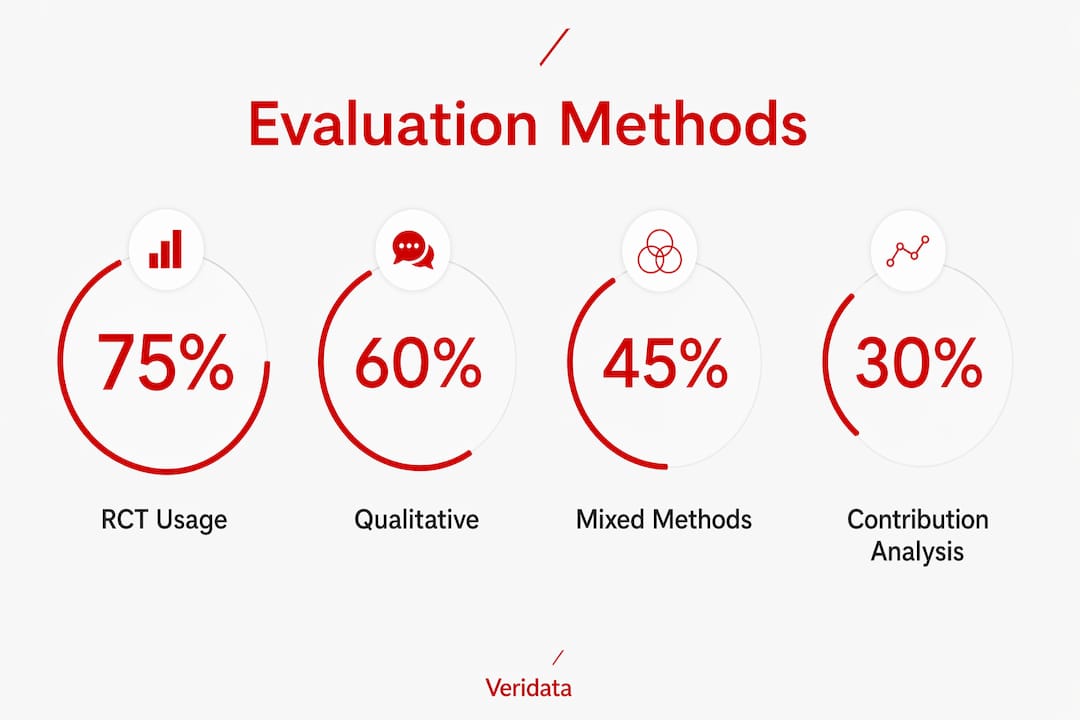
Advanced methods add further depth. Contribution analysis traces causal logic through a theory of change when a controlled experiment is not feasible. Realist evaluation asks not just “did it work?” but “what works, for whom, in what context?” Interrupted time series (ITS) uses longitudinal administrative data to detect program effects over time. Each method carries trade-offs in cost, data requirements, and the types of causal claims it supports.
| Method | Best suited for | Key limitation |
|---|---|---|
| Randomized controlled trial | Measuring average treatment effect | Requires large samples and ethical clearance |
| Realist evaluation | Complex, context-dependent programs | Resource-intensive analysis |
| Interrupted time series | Longitudinal administrative data | Needs sufficient pre-intervention data points |
| Contribution analysis | Programs where RCTs are not feasible | Relies on theory-based reasoning |
| Mixed methods | Capturing both scale and depth | Requires expertise across qualitative and quantitative traditions |
Real-life evaluation examples from social sciences, education, and public policy
Case studies in evaluation are where methodology meets reality. Three examples illustrate how different designs produce different kinds of knowledge.
The Breaking Barriers Rapid Rehousing Program
The Breaking Barriers Rapid Rehousing Program in Los Angeles County targeted justice-involved individuals experiencing homelessness. The evaluation tracked housing outcomes over 12 months using a combination of case management records and participant interviews. The program achieved an 80% housing retention rate at the 12-month mark. That figure demonstrates the measurable impact of individualized, wraparound support services when paired with rigorous outcome tracking. The evaluation’s design allowed practitioners to identify which support components drove retention, not just whether retention occurred.

AI-assisted qualitative evaluation in Bangladesh
An OECD-linked evaluation in Bangladesh applied AI and natural language processing to qualitative data from 860 households, covering 645 hours of audio collected on climate adaptation behaviors. Traditional survey methods had missed nuanced livelihood strategies that only emerged through in-depth interviews. The AI-assisted analysis scaled what would have taken a team of analysts months into a fraction of the time. This case study shows that NLP in qualitative evaluation does not replace human judgment. It amplifies it, surfacing patterns across thousands of data points that no manual review could catch at that scale.
Education program evaluation using mixed methods
A mixed-method evaluation of a literacy intervention in a U.S. school district combined standardized test score analysis with teacher interviews and classroom observation. The quantitative component showed statistically significant gains in reading fluency. The qualitative component revealed that implementation fidelity varied sharply across schools, explaining why some sites outperformed others. This combination is a textbook example of how process and outcome evaluation work together. Numbers tell you what happened. Interviews tell you why.
These three cases share a common thread. Each evaluation matched its method to the program’s specific questions, context, and available data. That alignment is what separates credible evaluation from expensive guesswork.
How does evaluation research differ from general scientific research?
Evaluation research and scientific research share methods but not goals. Program evaluation’s primary purpose is to improve a specific program, not to generate knowledge that generalizes across populations or contributes to theoretical frameworks. That distinction has real procedural consequences.
Institutional Review Board (IRB) approval is one of the clearest examples. Scientific research that produces generalizable knowledge almost always requires IRB review. Program evaluation focused solely on improving an internal program often does not, though this depends on how data is collected and whether findings will be published. Practitioners should check with their institution’s IRB office before assuming exemption applies.
Ethical standards still apply regardless of IRB status. Participant confidentiality, informed consent, and data security remain non-negotiable. The evaluation research framework must account for these protections from the design stage, not as an afterthought.
Key distinctions practitioners should keep in mind:
- Evaluation research asks “does this program work?” Scientific research asks “does this mechanism explain a phenomenon?”
- Evaluation findings are typically shared with program stakeholders. Scientific findings target the broader academic community.
- Evaluation timelines are driven by program cycles. Scientific research timelines are driven by publication and peer review.
- Evaluation designs adapt to available data. Scientific designs control data collection from the start.
Pro Tip: If your evaluation findings will be published in a peer-reviewed journal or shared beyond your organization, treat it as research and seek IRB review. The line between evaluation and research blurs the moment you aim for generalizability.
What practical steps guide effective evaluation research design?
Effective evaluation design starts with a clear question, not a preferred method. The method follows from what you need to know, not from what is familiar or fashionable.
- Define the evaluation question. Is the program working? How is it being delivered? For whom does it work best? Each question points to a different design.
- Build or review the theory of change. A theory of change maps the causal logic from inputs to outcomes. Contribution analysis and theories of change provide the evidence-tracing structure needed for credible impact claims when experimental designs are not feasible.
- Assess your data. Causal inference methods like interrupted time series require at least 8–10 pre-intervention data points to establish a credible baseline. If you do not have that, ITS is not your method.
- Match method to context. Realist evaluation fits complex programs with multiple delivery contexts. RCTs fit programs with clear treatment and control conditions and sufficient sample sizes. Selecting evaluation methods should account for what the program needs to know, not just what is methodologically prestigious.
- Plan for iteration. Evaluation is not a one-time event. Build in checkpoints for formative feedback, especially in multi-year programs.
Resource constraints are real. A small nonprofit cannot run a multi-site RCT. A government agency with 20 years of administrative data can run a strong ITS analysis. The right design is the one that answers your question credibly within your actual constraints, not the one that looks best in a methods textbook.
Pro Tip: Before selecting a method, list your data sources, your timeline, and your stakeholder questions. If the method you want requires data you do not have, choose a different method. Credibility comes from fit, not from ambition.
Key takeaways
Evaluation research produces its most useful findings when method, question, and context align from the start.
| Point | Details |
|---|---|
| Match type to program stage | Use formative evaluation during development and summative evaluation after implementation. |
| Real cases prove method value | The Breaking Barriers program’s 80% retention rate shows what rigorous outcome tracking delivers. |
| AI scales qualitative analysis | NLP tools analyzed 645 hours of audio in Bangladesh, revealing patterns surveys missed entirely. |
| IRB status depends on intent | Evaluation aimed at internal improvement often differs from research requiring formal IRB review. |
| Data availability drives design | ITS requires 8–10 pre-intervention data points; choose methods your actual data can support. |
Why the method choice matters more than most practitioners admit
I have seen evaluations fail not because the program was bad, but because the evaluation design was wrong for the question. A team runs an RCT on a community health program with 60 participants. The sample is too small to detect any real effect. The program gets defunded. Nobody wins.
The uncomfortable truth is that practitioners commonly reach for RCTs because they carry prestige, not because they fit the program. Realist evaluation, contribution analysis, and mixed-method designs often answer the real policy question better. They ask not just “did it work?” but “why did it work here and not there?” That is the question funders and program managers actually need answered.
AI integration is changing what is feasible in qualitative evaluation. Applying NLP to large interview datasets is no longer a research frontier. It is a practical option for mid-sized evaluation teams. The Bangladesh climate adaptation case is proof. But AI does not fix a bad evaluation question or a poorly designed data collection instrument. It amplifies what you put in.
My advice for 2026: invest in your theory of change before you invest in your method. If you cannot draw the causal logic on a whiteboard, no statistical technique will save you. Rigor and pragmatism are not opposites. The Magenta Book’s core principle says it plainly. The best evaluation is the one that is actually useful, not the one that is theoretically perfect.
Veridata Insights supports your evaluation research needs
Evaluation research works best when the methodology is built right from the start. Veridata Insights works with researchers and practitioners in social sciences, education, and public policy to design and execute evaluations that produce credible, decision-ready findings. From research design and consultation to data collection, qualitative coding, and analytics, the team handles as much or as little as your project requires. No project minimums. Seven days a week. If you are planning an evaluation and want a research partner who understands both the methods and the stakes, reach out to Veridata Insights directly.
FAQ
What is the definition of evaluation research?
Evaluation research is the systematic assessment of a program or intervention’s design, implementation, and outcomes using structured methods. Its primary goal is to improve the program, not to generate generalizable scientific theory.
What are the four main types of evaluation research?
The four main types are formative, summative, process, and outcome evaluation. Each type addresses a different question about a program’s development, delivery, or results.
When does evaluation research require IRB approval?
IRB approval is typically required when findings will be published or generalized beyond the specific program. Internal program improvement evaluations often do not require formal IRB review, but practitioners should confirm with their institution.
What is a theory of change in evaluation research?
A theory of change is a causal map that links a program’s inputs and activities to its intended outcomes. It provides the logical foundation for selecting evaluation methods and interpreting findings.
How is AI being used in evaluation research?
AI tools, particularly natural language processing, are being applied to large qualitative datasets to identify behavioral patterns at scale. An OECD-linked evaluation in Bangladesh used NLP to analyze 645 hours of interview audio from 860 households, uncovering insights that surveys alone could not capture.