

TL;DR:
- Better data governance is essential for reliable insights and AI implementation in finance.
- Overloading organizations with data can cause confusion and decision paralysis.
- Combining human expertise with technology is key to successful financial data strategies.
More data is not the same as better decisions. That idea catches a lot of financial leaders off guard, but it’s one of the most important distinctions in modern finance. The real challenge is not collecting data. It’s turning complex, fragmented information into clear, reliable insights that drive real strategic action. Risk management, performance optimization, forecasting accuracy, fraud prevention: all of these depend on how well your organization interprets and governs data, not simply on how much of it you hold. This article breaks down exactly what data does in finance, where it delivers measurable value, and where the common traps are.
Table of Contents
- Understanding the foundation: What does data really do in finance?
- Key applications: How finance leaders leverage data for advantage
- Data governance: The difference between actionable insights and noise
- Navigating the interpretation crisis: Why more data isn’t always better
- Emerging tools and proven models: What’s working in 2026
- Why data strategy in finance is about people and context, not just algorithms
- How Veridata Insights can help you build a strategic data advantage
- Frequently asked questions
Key Takeaways
| Point | Details |
|---|---|
| Quality over quantity | Effective data use in finance depends on governance and interpretation, not just volume. |
| Predictive power | Advanced analytics and hybrid models substantially boost forecasting and risk management. |
| Governance is essential | Strong data governance ensures accuracy, compliance, and trust for strategic decisions. |
| Beware data overload | Without the right frameworks, excessive data can create confusion and bias. |
| People drive results | Organizational culture and expertise are crucial for translating data into actionable insights. |
Understanding the foundation: What does data really do in finance?
Most people think of data in finance as reporting. Quarterly numbers, balance sheets, compliance filings. That’s part of it, but it’s barely the surface. Data’s role in finance extends to real-time decision-making, strategic forecasting, risk modeling, performance monitoring, and regulatory compliance. When it works well, it gives leadership a single, trusted view of the organization. When it doesn’t, it creates confusion, delays, and costly errors.
The concept behind data’s impact on strategic consulting captures this well. Finance leaders who treat data as a strategic asset rather than an administrative byproduct consistently outperform those who don’t. They make faster decisions, catch risks earlier, and allocate capital more efficiently.
Here are the core functions data serves in financial institutions:
- Regulatory compliance and reporting: Accurate, traceable data keeps organizations on the right side of regulators and reduces audit risk.
- Strategic forecasting: Historical and real-time data feeds predictive models that guide investment, hiring, and product decisions.
- Performance monitoring: Dashboards and analytics track KPIs against targets, allowing rapid course correction.
- Risk identification: Pattern recognition tools flag anomalies, credit risks, and fraud signals before they escalate.
- AI and machine learning readiness: Structured, clean data is the fuel for any AI initiative.
That last point deserves attention. Data governance best practices are foundational to AI adoption. You cannot train a reliable model on unreliable data. As one industry analysis puts it, “decision-grade data” requires ownership, definitions, validation, reconciliation, and change control to be reliable for board-level decisions. That’s not a technical nicety. It’s a business requirement.
“Data governance ensures high-quality data essential for AI and analytics in finance, achieving ‘decision-grade data’ reliable for board-level decisions.” — LSEG Insights
Pro Tip: Build a data lake with clearly defined ownership before you invest heavily in AI tooling. Without a single source of truth, even the most advanced models will produce outputs nobody trusts.
With the core importance of high-quality, well-governed data established, let’s examine the main ways financial institutions leverage data for tangible advantage.
Key applications: How finance leaders leverage data for advantage
Understanding what data can do is one thing. Knowing how leading finance teams actually apply it is another. The gap between awareness and execution is where most organizations lose competitive ground.
Predictive analytics in finance typically follows a structured process:
- Data collection from multiple sources including transactional systems, market feeds, economic indicators, and alternative data sets.
- Algorithm selection ranging from simple regression models to deep neural networks, depending on complexity.
- Model training and validation using historical data to calibrate predictions and test accuracy.
- Probabilistic forecasting that generates ranges and confidence intervals, not just point estimates.
- Integration into decision-making where outputs are embedded into planning cycles, risk reviews, and capital allocation processes.
This process, when executed well, delivers results that are genuinely hard to ignore.
| Application | Traditional approach | Data-driven approach | Performance gain |
|---|---|---|---|
| Cash flow forecasting | Spreadsheet models | AI-driven dynamic steering | Up to 40% accuracy improvement |
| Credit risk assessment | Static scoring | ML behavioral models | Fewer defaults, better pricing |
| Fraud detection | Rule-based filters | Anomaly detection algorithms | Faster detection, lower false positives |
| Portfolio optimization | Historical returns | Ensemble and hybrid AI | Superior Sharpe ratios |
The forecasting techniques in finance that are gaining the most traction right now combine classical statistical methods with machine learning. Neither works as well alone. Together, they handle both stable patterns and sudden market shifts.
Machine learning in financial risk management is also reshaping credit and operational risk. Models can now process thousands of variables simultaneously, catching correlations that humans simply can’t spot manually. The AI and analytics in financial market research space is evolving fast, and organizations that adopt these tools thoughtfully are building durable competitive advantages.

One area where data delivers especially visible value is fraud prevention. Financial institutions using behavioral analytics and graph-based fraud models are catching fraud significantly earlier in the transaction lifecycle. That directly reduces losses and improves customer trust.
Recognizing how financial organizations apply data raises another challenge: not all data is equally useful or reliable. Let’s compare what happens when data governance is prioritized versus when it’s lacking.
Data governance: The difference between actionable insights and noise
Governance is not glamorous. It rarely shows up in pitch decks. But it is the single most important factor determining whether your data strategy succeeds or fails. Without it, even the most sophisticated analytics tools produce outputs that analysts distrust, executives ignore, and regulators question.
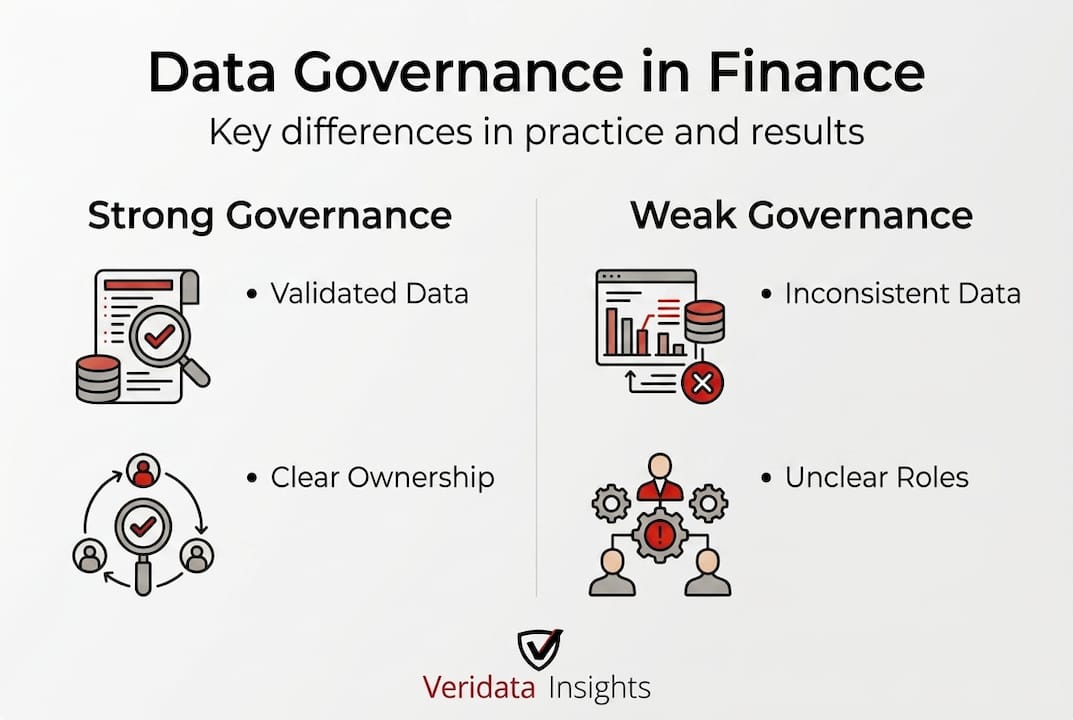
Strong governance involves several specific disciplines. Ownership means someone is accountable for each data domain. Validation ensures incoming data meets defined quality standards. Reconciliation compares data across systems to catch discrepancies. Change control tracks how definitions and structures evolve over time. Together, these processes turn raw inputs into “decision-grade data” that leadership can actually rely on.
Here’s what the contrast looks like in practice:
| Dimension | Strong governance | Weak governance |
|---|---|---|
| Data accuracy | Validated, auditable, consistent | Inconsistent, disputed across teams |
| AI readiness | Clean pipelines, model-ready | Fragmented, biased training sets |
| Decision speed | Fast, confident | Slow, requires manual reconciliation |
| Regulatory risk | Low, well-documented | High, prone to errors and gaps |
| Organizational trust | High, single source of truth | Low, parallel shadow spreadsheets |
The impact of governance on compliance is particularly significant in regulated industries. Financial institutions that invest in governance consistently show lower compliance costs and fewer regulatory findings. They spend less time arguing about the numbers and more time acting on them.
83% of financial services leaders say strong data infrastructure is a direct accelerator of AI adoption, according to recent industry surveys. That number tells you something important. AI success is a downstream outcome of governance quality, not a replacement for it. You can read more about financial firm data governance and why it’s become a board-level priority.
Practical data processing standards also play a role here. Organizations that standardize how they ingest, transform, and store data find that new use cases and tools integrate far more easily over time.
Pro Tip: Treat governance as a product, not a project. Assign ongoing ownership, run regular data quality reviews, and make governance metrics visible to leadership. Problems caught early are cheap. Problems discovered at the board level are expensive.
Now that we’ve contrasted effective and ineffective data governance, it’s crucial to address a hidden challenge: as volumes grow, data can introduce confusion just as easily as clarity.
Navigating the interpretation crisis: Why more data isn’t always better
Here’s the uncomfortable truth that most data vendors won’t tell you. More data can actually make decisions harder. When organizations accumulate information faster than they can interpret it, something called an interpretation crisis develops. Analysts are overwhelmed. Reports proliferate. Executives receive conflicting signals. Confidence drops even as data volume rises.
This is not a hypothetical risk. The interpretation crisis in finance is a documented pattern where more data amplifies existing biases and increases uncertainty rather than reducing it. The focus needs to shift from volume to interpretive frameworks.
Signs your organization may be facing data overload:
- Competing dashboards: Different teams use different numbers to describe the same metric.
- Analyst bottlenecks: Requests for analysis pile up faster than they can be addressed.
- Decision paralysis: Leaders delay decisions waiting for “more data” that never fully arrives.
- Model distrust: Outputs from predictive tools are routinely overridden without clear rationale.
- Governance gaps: Nobody is sure which data set is the authoritative one for key decisions.
“The focus in finance has shifted toward interpretive frameworks over data volume. More data without interpretation creates confusion, not clarity.” — Global Banking & Finance Review
Building frameworks for extracting actionable meaning requires a few deliberate choices. First, define what decisions you actually need to make, then work backward to identify which data genuinely informs those decisions. Second, standardize how insights are communicated, including format, frequency, and the level of detail appropriate for each audience. Third, build in challenge mechanisms where assumptions and model outputs are regularly questioned by people with domain expertise.
Data-driven insights for decision-makers are most valuable when they are clear, contextualized, and tied directly to a specific choice. Raw data without context is just noise wearing a spreadsheet.
With these pitfalls in mind, which data approaches and tool sets are currently delivering the highest impact?
Emerging tools and proven models: What’s working in 2026
The AI and machine learning landscape in finance is moving fast. Not all tools are equally mature, and not all of them are ready for real-world deployment at scale. That said, several approaches are clearly delivering measurable results.
Hybrid models are the standout story right now. The VLSTM (Variational Long Short-Term Memory) architecture, for example, combines classical time series methods with deep learning to handle the volatility and structural breaks common in financial data. Benchmarks show hybrid models like VLSTM achieve superior risk-adjusted performance in financial time series forecasting compared to either approach alone.
| Model type | Strengths | Limitations | Best use case |
|---|---|---|---|
| Classical regression | Transparent, simple, stable | Limited with non-linear data | Stable macro forecasting |
| Standard LSTM | Handles sequences well | Overfits, data-hungry | Medium-term trend prediction |
| VLSTM (hybrid) | Superior Sharpe ratios, robust | Higher complexity | Risk-adjusted portfolio modeling |
| Ensemble learning | Reduces model variance | Harder to explain | Fraud detection, credit risk |
Ensemble learning, which combines outputs from multiple models to reduce error, is also proving highly effective for fraud detection and credit risk scoring. No single model captures every pattern. Combining them reduces blind spots significantly.
Hybrid models in forecasting are becoming the new standard for organizations serious about forecast accuracy. The AI and ML analytics for finance field is moving toward these combined approaches because pure deep learning can overfit to historical patterns that don’t repeat in volatile markets.
Pro Tip: When evaluating new analytics tools, prioritize explainability alongside performance. A model that improves Sharpe ratios by 15% but nobody can explain to a regulator is a liability, not an asset. Look for tools that offer clear interpretability features alongside strong predictive metrics.
Having explored which tools stand out in 2026, let’s consider how to approach data strategy in finance with a realistic and experience-driven perspective.
Why data strategy in finance is about people and context, not just algorithms
We want to say something that goes against the current hype cycle: technology is not your competitive advantage in data strategy. People and context are.
Here’s what we see consistently. Organizations invest in sophisticated AI platforms. They build impressive infrastructure. Then they find that adoption stalls, insights are ignored, and the models drift out of alignment with business reality. Why? Because they underinvested in the human side of the equation.
The technical literature itself acknowledges this gap. Current research in financial data science is fragmented and heavily biased toward technical innovation over real-world scalability and explainability. Non-traditional data integration remains largely experimental. The gap between what’s published and what actually works at scale in a regulated institution is significant.
What closes that gap? Cross-functional expertise. A risk model built by data scientists alone, without input from credit officers and compliance leads, will miss context that matters. An analytics platform deployed without change management will be quietly ignored. A governance framework designed without front-line data users will fail to stick.
The organizations winning with data right now are investing equally in three areas: tools, governance, and people. They are hiring for interpretive skills alongside technical ones. They are building explainability into their model selection criteria. And they are creating cultures where questioning data outputs is encouraged rather than treated as a sign of distrust.
Enabling transformative insights in consulting requires exactly this kind of balanced investment. The firms that get the most value from research and analytics are the ones that pair strong methodology with strong communication and clear decision frameworks.
Data strategy is ultimately a people strategy. The algorithms are tools. The real differentiator is the judgment your team brings to interpreting what the tools produce.
How Veridata Insights can help you build a strategic data advantage
At Veridata Insights, we know that financial decision-makers need more than raw data. You need research that is designed, collected, and analyzed with your specific strategic questions in mind. Whether you are building a forecasting framework, assessing market risks, or trying to understand customer behavior at a deeper level, we bring the methodology expertise to make it count.
We offer full flexible-service market research with no project minimums, available seven days a week. Our team covers quantitative and qualitative research across B2B, B2C, healthcare, and hard-to-reach financial audiences. From questionnaire design through data processing, analytics, and visualization, we handle as much or as little as you need. Ready to turn your data challenges into a strategic asset? Let’s talk at veridatainsights.com.
Frequently asked questions
What is the main benefit of data governance in finance?
Strong data governance ensures that financial data is reliable, accurate, and trusted for high-stakes decisions and AI adoption. Data governance achieves “decision-grade data” that is reliable for board-level decisions.
How can predictive analytics improve financial forecasting?
Predictive analytics can increase forecast accuracy by up to 40% improvement through AI-driven dynamic steering and advanced data integration across multiple sources.
What are common challenges when using big data in finance?
Key challenges include data imbalance, lack of explainability, integrating non-traditional data, and scaling solutions. Big data and ML techniques face challenges in real-world deployment and scalability across regulated financial environments.
Why does more data sometimes create confusion instead of clarity?
Without strong interpretive frameworks, more data amplifies biases and increases uncertainty rather than improving decision-making. The interpretation crisis in finance shows that volume without structure creates fewer answers, not more.
What are the latest data-driven tools being adopted in finance?
Hybrid AI models are leading the way. Benchmarks show VLSTM achieves superior risk-adjusted performance in financial time series forecasting, outperforming both classical and standard deep learning approaches.
Recommended
- The Value of Data-Driven Insights for Management Consulting Firms – Veridata Insights
- How Data and Analytics Are Transforming Strategic Consulting – Veridata Insights
- Translating Market Data into Strategic Recommendations – Veridata Insights
- Financial Services Market Research: Why Veridata Insights Is the Partner of Choice – Veridata Insights