


TL;DR:
- Survey programming involves translating questionnaires into logic-driven software, encompassing skip rules, display conditions, and validation checks. It is a complex process that requires interpreting ambiguous specs, managing dependencies, and exhaustively testing multiple respondent paths to ensure data integrity. Proper expertise, clear specifications, and thorough testing are essential for reliable surveys and high-quality research outcomes.
Survey programming is one of those things that looks simple from the outside and turns out to be anything but. You write the questions, someone “programs” them, and you field the survey. Easy, right? Not even close. What is survey programming, really? It is the process of translating a questionnaire document into a fully functioning, logic-driven software instrument, complete with branching rules, display conditions, validation checks, and platform-specific configurations. Get it wrong, and you are fielding broken surveys, collecting garbage data, or scrambling to fix routing errors mid-study. Get it right, and everything downstream flows cleanly.
Table of Contents
- Understanding the role of survey programming
- Key components of survey programming logic and platform specifics
- Challenges and bottlenecks in survey programming
- Survey programming services and modern trends including AI integration
- Best practices for successful survey programming and quality assurance
- Why survey programming deserves more attention in market research workflows
- Leverage expert survey programming to elevate your research
- Frequently asked questions
Key Takeaways
| Point | Details |
|---|---|
| Survey programming complexity | Survey programming involves translating questionnaire logic into platform-specific software and is often a major bottleneck. |
| Branching and display logic | These key logic components personalize surveys by routing and showing questions based on prior answers. |
| Platform-specific coding | Different survey platforms require unique programming formats, making technical expertise essential. |
| AI and automation | Emerging AI tools may speed programming but require responsible implementation and human oversight. |
| Best practices | Clear specs, iterative testing, and early collaboration improve survey programming quality and timeliness. |
Understanding the role of survey programming
To appreciate survey programming, let us first understand what it actually involves and why it is more complex than many realize.
Most researchers hand off a Word document or PDF spec sheet and expect a working survey in return. What happens in between is far from mechanical. The programmer reads through the spec, interprets the intent behind every question, identifies logical dependencies, and encodes all of it into the platform’s own scripting language or configuration system.
A solid survey programming definition covers several layers of work:
- Skip logic and branching: Routing respondents to different questions based on their answers
- Display logic: Showing or hiding questions based on one or more prior conditions
- Piping: Pulling earlier answers into later questions dynamically (e.g., “You mentioned [Brand X]. How satisfied are you with [Brand X]?”)
- Loops and grids: Repeating question sets for multiple items a respondent identified earlier
- Validation rules: Preventing bad data entry, like requiring a minimum number of selections or capping numeric inputs
- Quota management: Controlling how many respondents complete each segment of the study
Taken together, this is not data entry. It is software logic applied to questionnaires, requiring the programmer to resolve ambiguity, catch logical contradictions, and build something that works correctly for every possible respondent path.
Key components of survey programming logic and platform specifics
With that foundation in place, let us look at the key logical building blocks and how they vary across survey platforms.
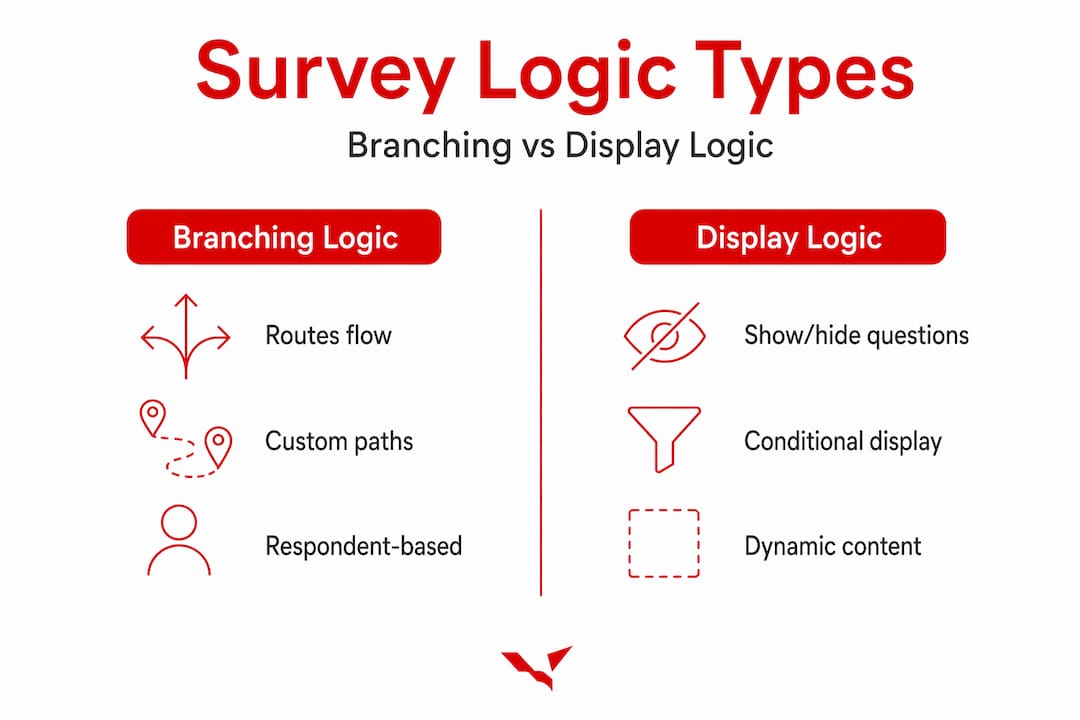
The two most misunderstood components are branching logic and display logic. They sound similar but serve distinct purposes. Branching logic routes respondents through personalized paths by skipping questions that do not apply to them. Display logic controls whether a question appears at all based on conditions, sometimes involving multiple prior answers evaluated together.
Here is how they compare in practice:
| Feature | Branching (skip) logic | Display logic |
|---|---|---|
| Primary function | Routes respondents to a new question or section | Shows or hides a question on the same page |
| Trigger | Single prior answer | One or multiple prior conditions |
| Respondent experience | Jumps past irrelevant questions | Reveals contextually relevant questions in place |
| Common use case | Skip product questions for non-buyers | Show follow-up only if a rating falls below 3 |
| Programming complexity | Moderate, but compounds with scale | Can be high when combining multiple conditions |
Platform differences add another layer. Qualtrics uses a visual logic builder with underlying JavaScript options for advanced cases. Decipher (now part of Forsta) relies on an XML-based scripting format that demands much more hands-on coding. What works as a two-click configuration in one platform might require custom code in another. This is why platform-specific expertise matters so much in expert survey programming.
Pro Tip: Always test your logic with respondents who change previous answers. Many platforms re-evaluate routing when a respondent goes back, and this can break carefully built branching trees in ways that are hard to catch without deliberate edge-case testing.
Challenges and bottlenecks in survey programming
Understanding the core logic is vital, but putting it into practice reveals challenges that often delay research fielding.
Here are the most common obstacles you will encounter:
- Ambiguous specs: Questionnaire documents written by researchers often leave gaps. “Skip to the brand section if not a buyer” sounds clear until you realize there are three definitions of “buyer” in the screener. Resolving these gaps requires back-and-forth that eats days, not hours.
- Cascading dependencies: Logic dependencies form an interconnected web, meaning a change to Question 5 can affect the routing of Questions 12, 18, and 24 simultaneously. Every edit carries downstream risk.
- Exhaustive path testing: A 30-question survey with branching logic can produce dozens of unique respondent paths. Testing each one manually is time-consuming, but skipping it means fielding a survey with hidden errors.
- Edge cases and quotas: What happens when a respondent qualifies for two quota cells? What if they skip a question that drives later routing? These scenarios require programmer judgment, not just rule-following.
“Survey programming is the forgotten middle of the research process. It sits between questionnaire design and data collection, yet it is where the majority of delays and errors originate.”
These common survey programming challenges are not signs of programmer failure. They are built into the nature of the work. The spec-to-software translation is genuinely hard, and underestimating it is what turns a two-day turnaround into a two-week delay.
Survey programming services and modern trends including AI integration

To meet these programming challenges, many businesses turn to specialized services or emerging AI tools.
Professional survey programming services have become a standard part of the market research supply chain. Most providers price projects based on question count, logic complexity, and platform. A straightforward 20-question survey with basic routing might turn around in two business days. A 60-question study with complex loops, quota management, and multilingual requirements could take a week or more. Professional survey programming services typically offer tiered packages to accommodate this range.
What is changing fast is AI integration in survey research. AI tools are beginning to assist with translating questionnaire specs into platform-ready configurations, flagging logic conflicts before a human programmer even touches the file, and auto-generating test cases. The potential to cut programming cycle times by 30 to 50 percent is real and being actively explored.
But speed without oversight is dangerous. The AAPOR task force on responsible AI has emphasized that AI adoption in survey research must maintain transparency in logic decisions and keep human reviewers accountable for data quality outcomes. An AI that mis-programs a skip condition does not flag its own error. A human reviewer who understands the instrument will.
Key factors to evaluate when considering survey programming services:
- Platform expertise: Does the provider specialize in the tools your team uses?
- Turnaround guarantees: What is the realistic timeline for your complexity level?
- Testing protocols: How do they verify all logic paths before fielding?
- Communication process: How quickly do they resolve spec ambiguities?
Pro Tip: When outsourcing, document every logic rule in your spec before the kickoff call. Ambiguities you resolve in advance are hours you save in revision cycles.
Best practices for successful survey programming and quality assurance
By following these best practices, you can improve data quality and keep your research on schedule.
Here is a practical sequence that works across platforms and project types:
- Write a clear, unambiguous spec. Every skip, display condition, and validation rule should be written out explicitly. “Skip if not applicable” is not a spec. “Skip Q7 if Q3 = ‘No’” is.
- Select your platform before finalizing logic. Some logic constructs are easy on one platform and costly on another. Knowing your platform upfront shapes how you write the spec.
- Program in a staging environment. Never program directly in a live survey link. Errors in staging are free. Errors in a fielded survey cost you data.
- Test iteratively, not just at the end. Test each logical section as it is built rather than waiting for the complete survey. Catching a routing error in section two is far cheaper than finding it after full programming is complete.
- Simulate real respondents. Run test submissions that mirror actual respondent behavior, including edge cases like skipping optional questions or entering unexpected values.
- Final validation with the research team. Have the person who wrote the questionnaire walk through every path in the programmed survey before fielding.
Common logic errors and their impacts are worth knowing upfront:
| Logic error | Impact on data | Prevention |
|---|---|---|
| Broken skip logic | Respondents see irrelevant questions | Test all routing paths end to end |
| Missing validation | Accepts out-of-range or blank entries | Define validation rules in the spec |
| Incorrect piping | Displays wrong answer text in follow-ups | Verify piping variables against source questions |
| Quota misconfiguration | Overcollects or undercollects in segments | Test quota logic with simulated completions |
| Loop termination errors | Survey gets stuck or skips items | Test loops with minimum and maximum item counts |
Thorough testing of branching logic and clear communication between researchers and programmers are what separate surveys that deliver clean data from surveys that create analysis headaches. We have seen well-designed research studies produce unusable data simply because the programming was treated as an afterthought.
Pro Tip: Review survey design tips before finalizing your questionnaire spec. Design decisions made early directly reduce programming complexity later.
Why survey programming deserves more attention in market research workflows
Let us consider why survey programming often remains undervalued despite its critical role.
Here is the uncomfortable truth: most research timelines are built around fieldwork and analysis. The programming step gets whatever is left in between. That is backwards. Survey programming forms the foundation for reliable data collection, and treating it as a two-hour task on a complex study is how projects go sideways.
We have seen it repeatedly. A client signs off on a questionnaire on Monday expecting data by Thursday. The spec has six unresolved logic conflicts. The programmer flags them, the researcher clarifies, revisions go back and forth, and suddenly it is the following Wednesday. The delay was not in the programming. It was in the gap between what the questionnaire said and what it actually needed to do.
“Investing in programming expertise and proper specification upfront is not overhead. It is the most cost-effective decision you can make in a research project.”
The importance of survey programming is most visible in complex studies: conjoint analysis, concept testing with rotations, longitudinal trackers, and multilingual studies. These are high-stakes, high-cost projects where a logic error in programming is not just an inconvenience. It is a validity threat.
What separates good research teams from great ones is how seriously they treat every link in the data collection chain. Survey programming is not the glamorous part of the job. But it is the hinge everything else swings on. Skimping on it is like building a strong foundation on sand and being surprised when the walls crack.
Leverage expert survey programming to elevate your research
To avoid common pitfalls and accelerate your survey projects, consider expert programming support.
At Veridata Insights, we know that survey programming is not where you want to cut corners. Our team brings hands-on experience across multiple platforms and a track record on projects ranging from straightforward customer satisfaction studies to multilingual, multi-quota B2B trackers. We handle the logic, the edge cases, the testing, and the iteration so your team can stay focused on strategy and analysis.
Whether you need full-service programming support or just a second set of expert eyes on your specs, we work with no project minimums, seven days a week. Reach out to our team through professional survey programming help and let us take the bottleneck out of your next research project.
Frequently asked questions
What exactly does a survey programmer do?
A survey programmer converts questionnaire specs into a logic-driven survey instrument, implementing conditional rules such as branching, display conditions, piping, and data validation within a specific software platform.
Why is survey programming considered a bottleneck in research workflows?
It requires resolving ambiguous specs, managing cascading logic dependencies, and exhaustive path testing, all of which take more time than most research timelines budget for.
Can AI help with survey programming?
AI tools are emerging to assist with automating parts of survey programming, but responsible AI adoption requires human oversight to ensure logic accuracy and data quality throughout the process.
How long does professional survey programming typically take?
Professional programming turnaround is typically around two business days for standard projects, though complex surveys with heavy logic, quotas, or multiple languages can take considerably longer.
What are best practices to ensure high-quality survey programming?
Thorough testing of branching logic, writing unambiguous specs, engaging programmers early in questionnaire design, and conducting iterative validation before fielding are the practices that consistently produce clean, reliable data.