

TL;DR:
- Poor questionnaire construction is the root of bad research, as flawed questions compromise data quality before collection begins. Effective design transforms research goals into clear, unbiased questions, considering respondent interpretation, context, and relevant response formats to ensure validity and reliability. Iterative testing, expert review, and ethical framing are essential steps for producing actionable insights and trustworthy results.
Bad research rarely starts with bad analysis. It starts with a bad questionnaire. You can have the best sample, the smartest analysts, and a generous budget, but if the questions are poorly constructed, the data you collect is already broken before anyone looks at it. Questionnaire design is the process of turning a measurement goal into a set of questions and answer options that respondents can understand and answer consistently, so the resulting data can be analyzed confidently. This guide breaks down the definition, core principles, validity and reliability, the development process, and what truly separates functional surveys from ones that produce insights your team can act on.
Table of Contents
- What is questionnaire design?
- Core principles of high-quality questionnaire design
- Ensuring validity and reliability in surveys
- The questionnaire development process: Steps from concept to fieldwork
- A unique perspective on questionnaire design: Beyond checklists
- Ready to level up your questionnaire design?
- Frequently asked questions
Key Takeaways
| Point | Details |
|---|---|
| Design drives data quality | A well-designed questionnaire is essential for collecting reliable and actionable research data. |
| Follow core principles | Effective design starts with clear objectives, simple language, and neutral, testable questions. |
| Prioritize validity and reliability | Ensuring your questionnaire measures accurately and consistently is non-negotiable. |
| Iterate for improvement | Review, test, and refine your questionnaire through pilot studies and expert feedback. |
| See beyond the checklist | Treat questionnaire design as both a science and an interactive communication with respondents. |
What is questionnaire design?
Now that we’ve set the stage for why design matters, let’s clarify exactly what constitutes questionnaire design and how it’s understood in research practice.
At its core, questionnaire design is about transforming a research objective into a structured, measurable instrument. Every question you write is a translation exercise. You’re converting abstract business or scientific goals into language a respondent can understand, a scale they can use, and an answer you can actually analyze. That’s harder than it sounds.
Here’s what many researchers underestimate: a questionnaire is not just a methodological tool. In research methodology, questionnaires are data-collection instruments whose usefulness depends on how they are designed, used, and validated. In other words, the questionnaire is also a social encounter. A respondent brings their assumptions, their fatigue, their interpretation of your phrasing, and their own context to every single item they read. Design that ignores this reality invites error.
“A questionnaire is not just a list of questions. It’s a standardized conversation between a researcher and a respondent, and like any conversation, the way it’s framed shapes the answers it gets.”
When design fails, the consequences are significant:
- Unreliable findings that can’t be replicated or trusted
- Poor business decisions based on data that doesn’t reflect reality
- Wasted resources on fieldwork that generates noise instead of signal
- Loss of stakeholder confidence in research as a function
Common design errors include double-barreled questions (asking two things at once), vague or undefined terms, loaded language that nudges respondents toward a particular answer, and response scales that don’t match the question being asked. Each of these flaws introduces systematic error. For practical questionnaire design tips that address these issues head on, it’s worth thinking about design as a discipline, not a task you squeeze in before programming.
Core principles of high-quality questionnaire design
Having defined questionnaire design, let’s break down the principles and pitfalls that shape whether your survey yields actionable data.

A core set of questionnaire design mechanics includes defining the purpose, writing clear and unbiased questions, avoiding problematic wording, choosing the right question types, setting up trustworthy response options, following logical flow, and pretesting before deployment. These aren’t optional. Each step is load-bearing.
Here’s how these principles break down in practice:
- Link every question to your research objective. If you can’t explain why a question is in your survey, it shouldn’t be there. Scope creep in questionnaire design is real and costly.
- Use plain, specific language. Avoid jargon unless your audience is defined by it. A B2B survey targeting IT procurement managers can use technical terms. A consumer survey on household spending should not.
- Keep wording neutral. Leading questions (“Don’t you agree that…”) and loaded terms push respondents toward predetermined answers. That’s not data, that’s confirmation bias in disguise.
- Avoid double-barreled questions. “How satisfied are you with our price and delivery speed?” is actually two questions. Split them. Always.
- Match question types to your analysis plan. If you need to run regression models, you need scaled or numerical responses. If you need to understand the “why,” open-ended items are your friend.
- Sequence questions logically. Start with broader, easier items before moving to sensitive or complex ones. This builds respondent trust and reduces dropout rates.
- Pilot test before full deployment. Always.
| Design element | Common mistake | Better approach |
|---|---|---|
| Question wording | Vague or jargon-heavy | Plain, specific, audience-matched |
| Response scale | Doesn’t match the question | Aligned to measurement goal |
| Question order | Sensitive items upfront | Broad to specific, easy to hard |
| Answer options | Overlapping or exhaustive | Mutually exclusive and complete |
| Survey length | Too long, no prioritization | Only essential questions included |
Pro Tip: Design quality can fail even when a survey looks well-structured if items are hard to interpret or response options are mis-specified. Always read your survey out loud before sending it. If you stumble, so will your respondents.
For teams designing B2B survey instruments, these principles carry even more weight. B2B respondents are often time-constrained executives or specialists. Clarity and relevance aren’t just nice to have. They’re the difference between a completed survey and a 20% dropout rate.
Ensuring validity and reliability in surveys
Core principles give you the blueprint, but measurement accuracy depends on two critical concepts: validity and reliability.
Validity concerns whether the instrument measures what it intends to measure, and reliability concerns consistency. These are conceptually independent, and that distinction matters enormously in practice.
Think of it this way: imagine a scale that consistently reads five pounds too heavy. It’s reliable (same result every time) but not valid (it’s wrong). Now imagine a scale that gives you a different number every time you step on it. That’s neither reliable nor valid. Your questionnaire can make the same mistakes. A poorly worded question might produce wildly different answers from the same person on different days (low reliability). A question about brand awareness that actually triggers memory of a competitor’s ad instead of yours measures the wrong thing (low validity).
Here’s a simple framework for evaluating both:
- Define your construct clearly before you write a single question. What exactly are you measuring?
- Use established scales where they exist. Don’t reinvent the Likert scale. Borrow validated instruments when your construct has been measured before.
- Review items for face validity. Do the questions look like they’re measuring what you intend? Have subject matter experts weigh in.
- Check for internal consistency. If several questions are supposed to measure the same underlying concept, their responses should correlate. A Cronbach’s alpha above 0.7 is a common benchmark.
- Test-retest when possible. Ask the same questions to a subset of respondents at two points in time. High correlation means high reliability.
- Evaluate response distributions. If 95% of respondents pick the same answer, the item may lack discrimination. You might be measuring nothing meaningful.
| Measurement concept | Question to ask | Design solution |
|---|---|---|
| Content validity | Does this cover the full concept? | Map items to all facets of your construct |
| Construct validity | Does it correlate as expected? | Run factor analysis on pilot data |
| Criterion validity | Does it predict known outcomes? | Compare against a benchmark measure |
| Reliability | Are results consistent? | Evaluate Cronbach’s alpha and test-retest data |
For teams building a customized market research survey, validity and reliability aren’t academic luxuries. They’re what separates a research investment from a research expense.
The questionnaire development process: Steps from concept to fieldwork
Understanding what should be built, it’s critical to walk through how the development process unfolds—from planning to deployment.
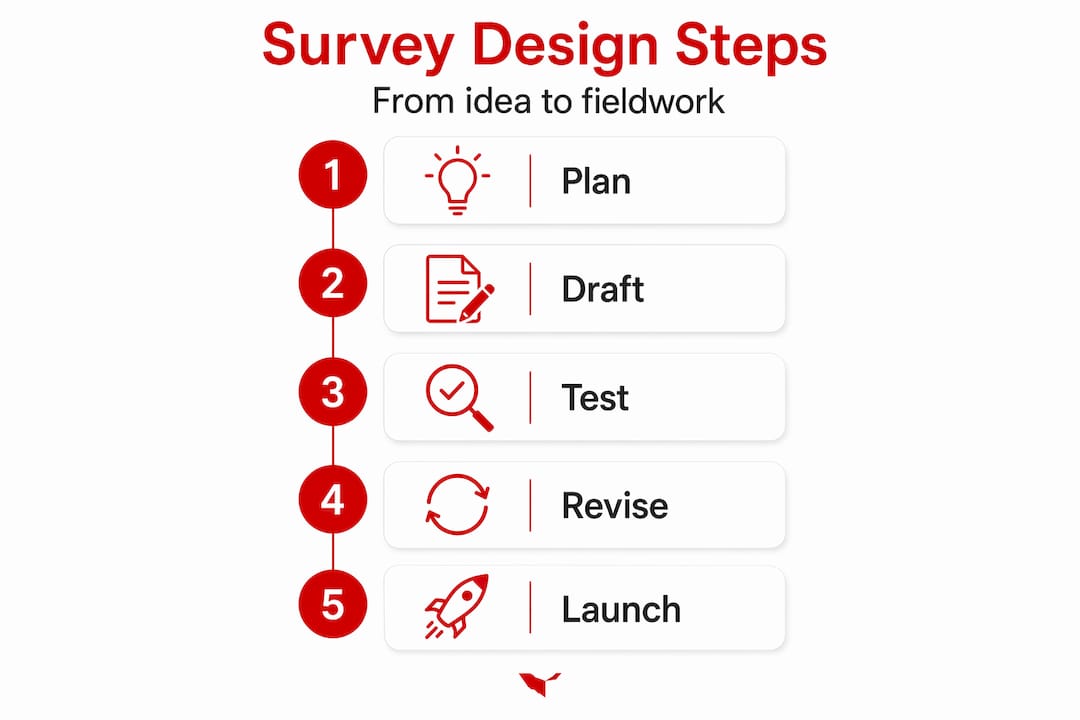
Questionnaire design should account for respondent comprehension and bias risks, and often uses an iterative development sequence including drafting, expert review for content validity, pilot testing, and statistical evaluation. That iterative word is key. Most research teams treat questionnaire development as linear. Write it, send it, analyze it. The reality is more like a loop.
Here’s how we recommend structuring the process:
- Assess existing tools and prior research. Don’t build from scratch if a validated instrument already exists. Review previous surveys on the same topic, especially if you want to track changes over time.
- Define your measurement objectives with precision. What decisions will this data inform? What hypotheses are you testing? Every item should trace back to an objective.
- Draft your questions with simplicity and bias awareness. Write simply. Flag any item that could be interpreted more than one way. If you’re not sure, ask a colleague who wasn’t part of the design process.
- Obtain expert review. This is a content validity step. Have subject matter experts, a methodologist, and ideally a member of your target audience review the draft before it goes anywhere near a sample.
- Run a cognitive pretest. Ask a small group of people from your target audience to “think aloud” as they answer your questions. This reveals comprehension gaps that you’ll never catch by reading the survey yourself.
- Pilot test with a representative sample. Deploy to a small portion of your target audience. Analyze the data statistically. Look for items with poor variability, high non-response, or unexpected correlations.
- Iterate based on findings. Revise problem items, re-pilot if needed, and only proceed to full fieldwork once validity and reliability benchmarks are met.
Pew Research Center’s testing practices set a useful standard for what rigorous questionnaire development looks like at scale. Their methodology emphasizes extensive pretesting, meaning surveys are refined through multiple rounds before being deployed to thousands of respondents. That commitment to iteration is a meaningful reason why their findings carry weight.
Pro Tip: One of the most common mistakes we see is skipping the pilot test when timelines are tight. But a poorly designed question that reaches 1,000 respondents doesn’t just waste their time. It wastes yours. A small pilot saves significant rework downstream.
For tips on keeping respondents engaged throughout this process, consider how your design affects their experience. Thoughtful engagement strategies for market research respondents can reduce dropout, improve data quality, and make your fieldwork far more efficient.
A unique perspective on questionnaire design: Beyond checklists
While established best practices guide the process, truly effective design means navigating the realities of human interpretation and context. Here’s what experience has taught us.
There’s a tendency in research to treat a well-formatted questionnaire as a validated one. But a clean survey with correct grammar and logical flow can still produce garbage data if the respondent doesn’t trust the context, misunderstands the intent, or answers in a way that’s socially acceptable rather than personally honest.
Questionnaires function as a negotiation and communication situation that carries ethical and epistemological implications. That framing challenges the “design it right and you’re done” mindset. We’ve seen surveys that checked every methodological box but still yielded data that led clients astray. Why? Because the questions were technically sound but contextually tone-deaf. The phrasing assumed a level of self-awareness respondents didn’t have. The response scale didn’t map to how people actually think about the topic. The survey felt like an interrogation instead of a conversation.
This is where we believe most guides fall short. They treat questionnaire design as a purely technical problem. It’s not. It’s a communication challenge. The best questionnaires are written from the respondent’s perspective first, and the researcher’s perspective second. That means understanding how your audience uses language, what concepts they’re familiar with, and what level of cognitive effort they’re willing to extend.
Ethical responsibility is also often missing from design discussions. How you frame questions shapes the knowledge you produce. An instrument that consistently uses negative framing will yield more negative data, not because the world is more negative, but because you designed it that way. That’s a form of research bias with real-world consequences when those findings inform policy, product decisions, or market strategy.
The bottom line: checklists are a starting point, not a destination. Great advanced design strategies require judgment, iteration, and a genuine respect for the humans on the other end of your instrument. We know that sounds obvious. You’d be surprised how rarely it guides actual practice.
Ready to level up your questionnaire design?
If you’re ready to overcome survey pitfalls and create questionnaires that deliver accurate, actionable insights, here’s how to take the next step.
At Veridata Insights, we work with business leaders and research teams who need more than a template. Whether you need a full questionnaire review, end-to-end survey programming, or consultation on which design approach fits your specific research objective, we’re ready to help. We offer flexible services with no project minimums, available seven days a week. Our team covers quantitative and qualitative research across B2B, B2C, healthcare, and hard-to-reach audiences. If you want data you can trust and a team that’s genuinely invested in your success, reach out to Veridata Insights and let’s build something that works.
Frequently asked questions
What is the difference between a questionnaire and a survey?
A questionnaire is the set of questions and response formats, while a survey refers to the entire process of data collection, including distribution and analysis. Think of the questionnaire as the instrument and the survey as the study.
Why does poor questionnaire design lead to bad data?
Flaws like confusing wording, vague response scales, or unclear instructions cause respondents to answer incorrectly, making results unreliable. Design quality can fail even when a survey looks well-structured if items are hard to interpret or response options are mis-specified.
How many questions should a good questionnaire have?
The number depends on your research goal. Focus on essential questions that align with your decision needs and cut anything that doesn’t directly serve an objective. Shorter and focused almost always beats long and thorough.
What is pretesting or piloting a questionnaire?
Pretesting means testing your draft with a small sample to spot issues before full deployment, ensuring questions are clear and data is valid. Pretesting and piloting is a recommended step before any full-scale deployment.
Can questionnaire design methods apply to both qualitative and quantitative research?
Yes, but your design should match your analysis. Survey goals and qualitative versus quantitative data needs shape question design directly. Open-ended items work for qualitative depth, while scaled or structured items support quantitative measurement and statistical analysis.