


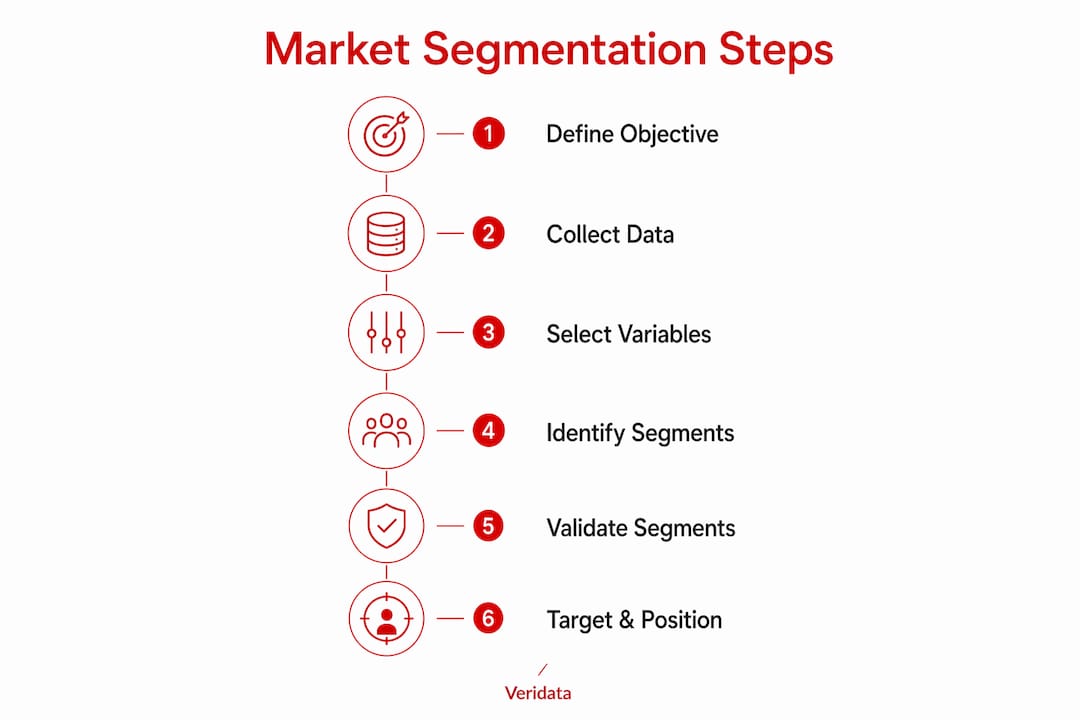
The market segmentation procedure is a structured process that divides a broad market into distinct, actionable groups so you can target each one with precision. Done right, it transforms generic “talk to everyone” messaging into focused conversations that convert. At its core, segmentation follows a ten-step approach that moves from deciding whether to segment at all through to continuous performance monitoring. Here is what that looks like at a glance:
- Step 1: Decide if segmentation is necessary
- Step 2: Specify ideal segment characteristics
- Step 3: Collect and clean empirical data
- Step 4: Explore and understand data structure
- Step 5: Extract segments using statistical methods
- Step 6: Profile and analyze each segment
- Step 7: Describe and differentiate segments
- Step 8: Select target segment(s) — the point of no return
- Step 9: Customize the marketing mix per segment
- Step 10: Evaluate effectiveness and monitor continuously
Each step builds directly on the one before it. Skip one, and the whole structure gets shaky.
The market segmentation procedure, step by step
A ten-step structured process is the most reliable framework practitioners use. Here is how each step plays out in practice.
- Decide if segmentation is necessary. Not every business needs a full segmentation strategy. Weigh the costs, your organizational capacity, and whether distinct customer groups actually exist in your market. If your product genuinely serves everyone the same way, segmentation adds complexity without payoff.
- Specify ideal segment characteristics. Before collecting a single data point, define what your ideal segment looks like. What size? What behaviors? What needs? This step keeps the analysis grounded in business reality rather than statistical curiosity.
- Collect and clean empirical data. Pull data from your CRM, transaction history, web analytics, customer surveys, and third-party enrichment sources. Clean it thoroughly — remove duplicates, standardize formats, and address missing values. Data quality here is the single most important determinant of segment reliability.
- Explore and understand data structure. Before extracting segments, explore the data to understand its shape. Look for natural clusters, outliers, and variable distributions. This exploratory phase prevents you from forcing a segmentation model onto data that does not support it.
- Extract segments using statistical methods. Apply clustering algorithms or structural equation modeling to identify distinct groups. K-means clustering is the most commonly cited method, but it struggles with high-dimensional data and needs complementary techniques like dimensionality reduction or latent class analysis for accuracy.
- Profile and analyze segments in detail. Once segments are extracted, describe each one using all available variables, not just the ones used to create them. Profiling reveals who is in each segment and what drives their behavior.
- Describe and differentiate segments. Translate statistical profiles into plain language that your marketing and product teams can actually use. Each segment description should make it obvious why this group is distinct and what they need.
- Select target segment(s). This is the point of no return. Choosing your target segment requires trade-offs that typically cannot be undone without restarting the analysis. Evaluate each segment for size, growth potential, competitive intensity, and alignment with your organizational strengths.
- Customize the marketing mix per segment. Develop a distinct offer, price point, promotion strategy, and distribution approach for each target segment. The marketing program should reflect the deep understanding of purchasing habits and media preferences revealed in the segment profile.
- Evaluate effectiveness and monitor continuously. Track segment-level performance and refresh segments regularly. Markets shift, and a segmentation model that was accurate last year may be misleading today. Build in a review cadence of at least every six to twelve months.
What are the core types of market segmentation?
The four foundational segmentation models each answer a different question about your customer. Most effective programs combine more than one.
- Geographic segmentation asks where your customers are. It groups audiences by location, from country level down to zip code or neighborhood. Useful for businesses with physical locations, regional pricing, or products whose relevance varies by climate or culture.
- Demographic segmentation asks who your customers are. It divides markets by age, gender, income, education, and occupation. It is the most widely used model because the data is accessible, but it tells you who buys, not why.
- Psychographic segmentation asks why customers buy. It captures values, attitudes, interests, and lifestyle choices. Two people with identical demographic profiles can have completely different buying motivations, and psychographic segmentation surfaces that gap.
- Behavioral segmentation asks how customers act. It groups people by purchase history, usage frequency, loyalty status, and benefits sought. Because it works from observed actions rather than assumptions, it tends to be the most commercially useful model.
- Firmographic segmentation is the B2B equivalent of demographics. Widely used by B2B marketers, it groups organizations by company size, industry, revenue, SIC/NAICS codes, and technology maturity rather than simple headcount. It is typically the first filter a B2B team applies before layering on behavioral or psychographic variables.
Combining models is where the real power lies. A segment of high-income professionals within a certain age range becomes far more useful when you also know they are high-frequency buyers with a preference for premium tiers.
Why market segmentation pays off
Segmentation is not just a research exercise. It has direct, measurable effects on how efficiently your marketing budget works.
- Sharper targeting and messaging. When you know exactly who you are talking to, every message can speak to that group’s specific needs. Generic campaigns get ignored; relevant ones get clicks.
- Reduced wasted spend. Broad campaigns spread budget across people who will never buy. Segmentation concentrates resources on groups with real purchase intent.
- Tailored product and pricing strategies. Different segments often have different price sensitivities and feature priorities. Segmentation lets you match your offer to what each group actually values.
- Clearer market opportunity prioritization. Not every segment is worth pursuing. Segmentation helps you rank opportunities by size, growth rate, and fit with your capabilities.
- Deeper understanding of customer motivation. Behavioral and psychographic data reveal why people buy, not just who buys. That understanding shapes better product development and retention strategies.
- Tighter alignment between marketing and business goals. When segments are defined around business objectives, marketing activity connects directly to revenue outcomes rather than vanity metrics.
Does your segmentation actually work? Five tests to run
A segment that looks clean on paper can still be commercially useless. Effective segmentation requires every segment to pass five quality tests before you activate it.
- Measurable. You can quantify the segment’s size and purchasing power using available data. If you cannot measure it, you cannot track performance against it.
- Accessible. You can reach the segment through your existing marketing and sales channels. A perfectly defined segment you cannot reach is a theoretical exercise.
- Substantial. The segment is large and profitable enough to justify dedicated investment. Micro-segments can feel precise but rarely generate enough return to cover the cost of targeting them separately.
- Differentiable. The segment responds differently to marketing stimuli than other segments do. If two segments behave identically, they are one segment, not two.
- Actionable. The segment can inform a distinct marketing or product response. If your team cannot do something meaningfully different for this group, the segment adds no value.
Fail any one of these tests, and the segment should be reconsidered before it enters your targeting plan.
How Veridata Insights approaches the segmentation process
We have seen what works and what quietly derails otherwise solid segmentation projects. A few patterns show up repeatedly.
The biggest mistake is leaning too hard on demographics. Demographics tell you who your customer is, but behavioral data provides the most actionable truths for aligning product and pricing. Age and income alone rarely explain why someone buys. Layering behavioral signals onto demographic foundations produces segments that are both precisely defined and deeply understood.

Pro Tip: When using K-means clustering, always pair it with a dimensionality reduction technique like PCA or a latent class analysis for high-dimensional datasets. The algorithm alone will produce statistically tidy clusters that do not reflect real commercial differences.
Here is what we recommend for US marketing teams executing segmentation in 2026:
- Layer at least two segmentation models. Combining behavioral and demographic data consistently yields richer, more actionable segments than any single variable.
- Build segment profiling into the process before selection. Profiling is what makes Step 8 defensible. Without it, target selection is a gut call.
- Treat segmentation as a living model, not a one-time deliverable. Markets shift. A static snapshot from eighteen months ago is a liability, not an asset.
- Prioritize data quality over model sophistication. A sophisticated algorithm built on dirty data produces segments that are statistically precise but commercially useless.
- Integrate firmographic data for any B2B application. Revenue tiers, technology maturity, and industry codes give you far more signal than headcount alone.
- Test segment-specific messaging before scaling. Pilot campaigns within a segment before committing full budget. The feedback loop is what separates a working segmentation from a theoretical one.
Veridata Insights works with B2B, B2C, healthcare, and hard-to-reach audiences across the US. We bring methodological rigor to every step of this process, from questionnaire design through data processing and reporting. If your segmentation needs a sharper foundation, reach out to our team.
What data collection methods work best for segmentation?
The data you collect shapes every segment you build. Most US marketing teams draw from a combination of primary and secondary sources.
Primary research gives you data collected directly for your segmentation objective. Surveys are the most common tool, particularly for psychographic and attitudinal variables that do not exist in transaction records. Focus groups and in-depth interviews add qualitative texture that quantitative data alone cannot capture. For B2B segmentation, structured interviews with key accounts often surface firmographic nuances that no database captures cleanly.
Secondary and behavioral data comes from sources already in your stack. CRM records, transaction histories, web analytics platforms, and marketing automation logs all carry behavioral signals. Third-party data enrichment services can append firmographic or demographic attributes to existing records. The challenge is consistency: data pulled from multiple systems often needs significant cleaning before it is usable.
Observational and passive data rounds out the picture. Clickstream data, social listening tools, and loyalty program records capture behavior without asking customers to self-report. This data tends to be more accurate than survey responses for behavioral variables, since it reflects what people actually do rather than what they say they do.
How do you choose the right segmentation variables?
Variable selection is where many segmentation projects quietly go wrong. Picking variables that are easy to collect rather than variables that actually explain customer differences produces segments that look clean but do not drive decisions.
The right variable must meet three practical tests. First, it must be relevant to the purchase decision you are trying to understand. Hair color is irrelevant to a financial services segmentation; income and risk tolerance are not. Second, it must be measurable with data you can realistically collect. Psychographic variables require deliberate survey design; you cannot infer values reliably from zip codes. Third, it must produce meaningful differences between groups. A variable that distributes evenly across your entire market creates no useful segments.
For consumer markets, the most productive starting combinations tend to be demographic plus behavioral, or psychographic plus behavioral. For B2B markets, firmographic variables plus behavioral signals from product usage data tend to outperform any single-variable approach. Start with two to three variables, validate the segments they produce, and add complexity only when the simpler model fails to explain enough variation.
Which tools support segmentation analysis?
The right tool depends on your data volume, team capability, and the segmentation model you are running.

Statistical and analytics platforms like R and Python (with libraries such as scikit-learn and ggplot2) give analysts full control over clustering algorithms, dimensionality reduction, and visualization. They are the standard for data-driven segmentation in organizations with dedicated analytics teams.
CRM and marketing platforms like Salesforce and HubSpot have built-in segmentation features that work well for rule-based or commonsense segmentation. They are accessible to marketing teams without deep statistical expertise and integrate directly with campaign execution.
Survey platforms like Qualtrics and SurveyMonkey support primary data collection for psychographic and attitudinal segmentation. Qualtrics in particular includes analytics features that can feed directly into segment profiling.
Business intelligence tools like Tableau and Power BI are valuable for visualizing segment profiles and communicating findings to stakeholders. Segment selection is partly a business judgment call, and clear visualization makes that conversation much easier.
For B2B segmentation research, firmographic data providers and intent data platforms add another layer of signal that internal CRM data alone rarely covers.
How does segmentation connect to targeting and positioning?
Segmentation is only the first step in the S-T-P framework: Segmentation, Targeting, and Positioning. The three are sequential and interdependent. Segmentation without targeting is just analysis. Targeting without positioning is just a list.
Targeting is the decision about which segments to pursue. Not every segment worth identifying is worth pursuing. Evaluate each one for market size, growth rate, competitive intensity, your ability to serve it, and profit potential. A large segment dominated by an entrenched competitor may be less attractive than a smaller, underserved one where you can win at a healthy margin. Most organizations can execute effectively against three to five primary segments. Twelve segments sounds rigorous; it usually gets ignored because no team can run a distinct strategy for that many groups simultaneously.
Positioning is how you present your offer so it resonates with each target segment. It connects your segment’s specific pains and gains to what your product actually delivers differently from alternatives. The clearest positioning statements come directly from segment profiling: when you know what motivates a segment, you know what to say to them. Identifying your target audience with that level of specificity is what separates positioning that sticks from messaging that blends into the background.
Segmentation feeds targeting, targeting informs positioning, and positioning shapes the entire marketing mix. The three work as a system, not as independent steps.
Key Takeaways
A sound market segmentation procedure requires clean data, the right variable selection, and continuous monitoring to stay commercially relevant as markets evolve.
| Point | Details |
|---|---|
| Follow all ten steps | Skipping steps, especially profiling and exploration, produces segments that look clean but fail in execution. |
| Layer multiple models | Combining behavioral data with demographic or firmographic insights yields richer, more actionable segments than any single variable. |
| Apply the five quality tests | Every segment must be measurable, accessible, substantial, differentiable, and actionable before activation. |
| Step 8 is the point of no return | Target segment selection requires irreversible strategic commitment; get profiling right before you reach it. |
| Monitor continuously | Refresh segments at least every six to twelve months, and rebuild the model whenever a significant market shift occurs. |