

Start by defining a minimum-acceptable profile, then pick a channel mix, write a short verification-led screener, set a fair incentive, and build in extra time. Groups like the Insights Association track quality benchmarks for exactly this reason, and we’ve built our recruitment process around the same logic for every hard-to-reach B2B audience we staff.
TL;DR:
- Blend at least two channels for quotas above 30 completes; panels suit moderate incidence, while direct outreach and trusted partners reach scarce roles.
- Confirm titles with open text, ask about decision authority and recent purchases, and reserve recorded or document checks for shortlisted candidates when stakes are high.
- Manager and specialist panels often fill in three to seven business days; senior or niche decision makers can take two to six weeks or longer.
- Request batch level duplication and attention metrics and scrub rates by reason; a high scrub rate alone may reflect effective screening, not poor quality.
- Add at least one extra week of buffer for director level or higher studies, and budget for no shows and rescheduling.
Table of Contents
- Which channels work best for recruiting B2B respondents?
- How do you design a screener that verifies real B2B respondents?
- Setting incentives and schedules that keep B2B respondents showing up
- Recruiting hard-to-reach B2B decision-makers: field-tested tactics
- Quality-control metrics to request from every sample supplier
- Tools and workflow: what to automate versus manage directly
- How long should B2B recruitment take, and what should it cost?
- Keeping B2B respondents engaged across multi-stage studies
- Validating respondent authenticity beyond the basic screener
- Balancing representativeness with target specificity in B2B samples
- How Veridata Insights handles B2B respondent recruitment for you
- FAQ
- Sources
Which channels work best for recruiting B2B respondents?
Channel choice depends on how rare your target respondent is and how deep the vetting needs to go. Curated panels and supplier networks move fast for moderate-incidence audiences (think IT managers at mid-size firms) because the pool is pre-profiled and ready to screen. Direct outreach and your own customer lists work better for narrow or lower-incidence targets, since you already know these people fit and just need to confirm availability.
Partner organizations and trade associations earn their place when incidence drops further. A respondent is more likely to open an email from a group they already trust than from an unfamiliar research firm.
Mixing channels reduces bias and helps you hit quota without over-relying on one source that might skew toward a single personality type or company size.
- Panels and supplier networks: fastest route for moderate-incidence B2B roles.
- Customer lists and direct outreach: best for known, narrow targets.
- Partner and association channels: most effective for scarce or senior audiences.
- Blend at least two channels on any study with a quota above 30 completes.
Before fieldwork starts, write a short sourcing brief specifying role, seniority, company size, and industry codes, then ask each source for a quick sample of profiles to check against that brief. If the first batch looks off, that is your signal to adjust the channel split before burning budget.
How do you design a screener that verifies real B2B respondents?
A tight screener beats a long one. Over-screening, asking for ten nice-to-have attributes instead of the two or three that actually define fit, is the single biggest reason B2B recruitment stalls. Build around a minimum-acceptable-profile: the handful of traits (role, decision authority, recent relevant activity) that actually disqualify someone, and leave softer criteria for a follow-up question or a later screening stage.
- Confirm job title and function with an open-text field, not a dropdown that invites guessing.
- Ask about decision authority directly: “Do you approve, influence, or simply use this type of purchase?”
- Verify company size and industry with a specific numeric range rather than a vague size band.
- Include one recency question, such as the last time they evaluated or purchased in the category.
- Save secondary nice-to-haves for a brief follow-up rather than the initial screener.
Verification can run on a sliding scale depending on study stakes: a corporate email domain check is fast and nearly frictionless, a LinkedIn or firmographic cross-check adds confidence for mid-stakes studies, and a short recorded response or document check fits high-stakes executive research where the cost of a bad recruit is high.
Pro Tip: Ask for recent activity, not hypothetical willingness. “When did you last evaluate a vendor in this category?” filters out window-shoppers far better than “Would you consider switching vendors?”
Setting incentives and schedules that keep B2B respondents showing up
B2B respondents weigh their time differently than consumers; a manager skipping a client call to join your study expects compensation that reflects that tradeoff. Incentive levels should scale with seniority and modality: a 20-minute survey from a line-level employee needs far less than a 45-minute interview with a director who had to rearrange a calendar.
- Match incentive type to modality: cash or gift cards for surveys, higher-value honoraria for interviews and focus groups.
- Send a direct calendar link at the moment of confirmation, not a follow-up email asking for availability.
- Pair every booking with a confirmation email and a reminder closer to the session.
- Offer a small partial payment upfront for scheduled interviews to cut no-shows.
- Build overbooking into group sessions and keep a short list of backups for individual interviews.
A brief pre-call confirmation message sent the morning of the session catches most last-minute conflicts before they become empty slots.
Recruiting hard-to-reach B2B decision-makers: field-tested tactics
Senior executives and niche specialists rarely respond to cold outreach alone, so recruiting hard-to-reach B2B respondents often means borrowing credibility from someone the respondent already trusts. Trade associations, employer partners, and professional networks can open doors that a generic panel invite cannot, because the respondent’s guard is already down when the ask comes from a familiar source.
Trust and verification work hand in hand here. Practitioner guidance on recruiting hard-to-reach audiences treats verification and trust-building as part of research design, not an afterthought bolted onto a screener. Short video responses of 30 to 90 seconds work well here: a respondent states their role and answers a quick prompt on camera, which confirms identity and gives you an early read on how articulate they’ll be in a qualitative session.
- Lean on trade associations or employer contacts to vouch for respondent legitimacy before outreach.
- Request a short video response for identity confirmation and articulation screening.
- Offer bilingual outreach when the target audience spans multiple language groups.
- Stage verification steps so the easiest checks happen first and the heaviest checks happen only for shortlisted candidates.
Pro Tip: Save your most intensive verification step, like a document check or a recorded interview, for the final round. Front-loading it scares off otherwise-qualified respondents before you’ve built any rapport.
Quality-control metrics to request from every sample supplier
Ask suppliers for five numbers before you sign off on a sample source: scrub rates, duplication rates, attention or engagement scores, dropout timing, and source transparency. Agencies reported pre- and in-survey removal rates of 28.5% overall, compared with 21.2% among suppliers, according to the Insights Association’s H1 2026 benchmarking report, which shows how much variance exists even among established vendors.
A high scrub rate is not automatically bad; it can mean a supplier is catching problems before they reach your data. What matters is why respondents were removed and at what stage. Duplication rates flag panel overlap, attention scores flag rushed or inattentive responses, and dropout timing tells you whether your screener or your survey itself is driving people away.
- Ask for scrub rate broken down by reason, not just a single aggregate number.
- Request duplication and attention metrics for the specific sample batch, not historical averages.
- Run a small pilot batch before committing to full fieldwork on an unfamiliar supplier.
- Treat quality as an upstream sourcing decision, as the Data Quality Co-op recommends, rather than relying on cleaning data after collection.
Tools and workflow: what to automate versus manage directly
A B2B recruitment workflow usually spans six tool categories: sample access, outreach or CRM, screener platforms, scheduling integrations, incentive and payment systems, and reporting dashboards. Treat each one in line with the project at hand. A detailed guide to designing a B2B survey that works is worth reviewing before you lock in your screener platform, since the two decisions are connected.
- Automate scheduling and reminders; they’re repetitive and error-prone when done manually.
- Keep screener logic and quota management under direct human review for anything beyond a simple survey.
- Favor managed recruitment over DIY tooling when incidence is low, timelines are tight, or your team lacks spare bandwidth.
- Build a short data-security checklist into supplier contracts, referencing a framework such as the NIST Privacy Framework for handling participant data responsibly.
How long should B2B recruitment take, and what should it cost?
Timelines stretch with seniority and specificity. Mid-incidence panels of managers or specialists often fill in three to seven business days, while recruiting senior executives or niche decision-makers can take two to six weeks or longer, especially across international markets.
Budgets break into four pieces: the sourcing or panel fee, the incentive pool, verification overhead (video review, document checks, LinkedIn confirmation), and project management with a contingency buffer.
- Add at least one extra week of buffer for any study targeting director-level or above.
- Budget contingency incentive funds for no-shows and reschedules, especially in multi-stage studies.
- Expect verification overhead to rise with respondent seniority, not fall.
- Treat international recruitment timelines as baseline estimates, then pad them further for time zone and language logistics.
Keeping B2B respondents engaged across multi-stage studies
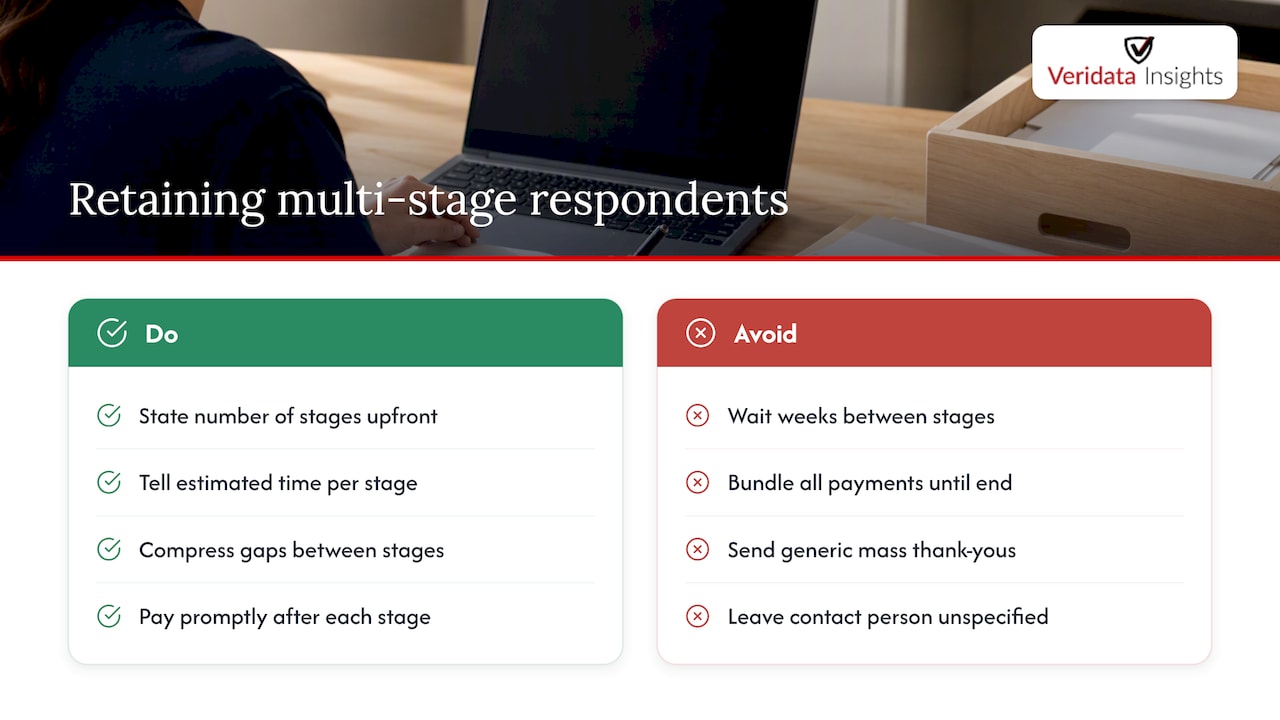
Multi-stage studies lose people between stages more than they lose people mid-session, so retention planning has to start before fieldwork begins. Set expectations clearly at recruitment: tell respondents up front how many stages the study involves, roughly how long each one takes, and when they’ll be paid.
Momentum matters. A respondent who completes stage one and then waits three weeks for stage two is far more likely to drop than one who moves to stage two within a few days. Where your design allows it, compress the gap between stages or send a short check-in message between them to keep the study top of mind.
Pay incentives promptly after each stage rather than bundling everything until the end. A respondent who has already been paid once trusts that the next payment will arrive too, and that trust shows up in your completion rate.
Personal touches go further in B2B than in consumer research. A short, specific thank-you referencing something the respondent actually said in an earlier stage signals that someone is paying attention to their input, not just collecting it. That small gesture often matters more to a busy executive than the incentive itself.
Finally, give respondents a named point of contact for questions throughout the study. Ambiguity about whom to reach when a scheduling conflict comes up is a common, preventable source of silent dropouts.
Validating respondent authenticity beyond the basic screener
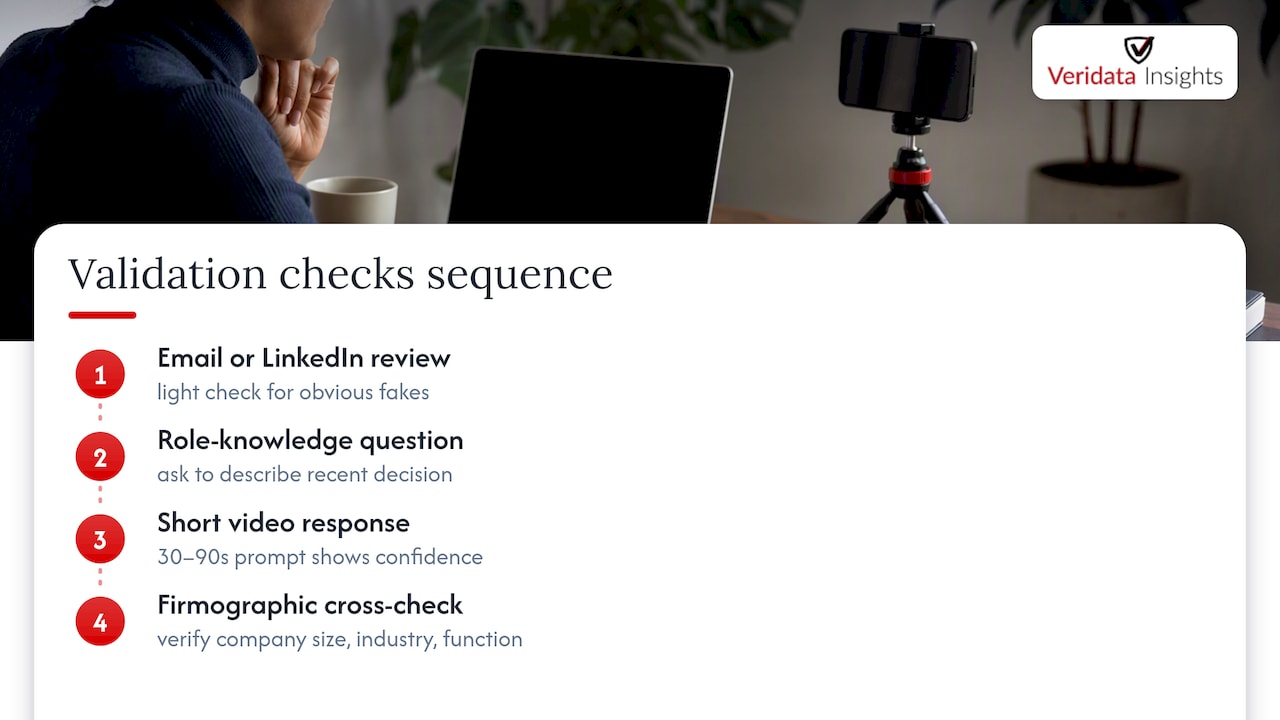
Basic verification, a corporate email or a LinkedIn glance, catches the obvious fakes but misses people who are technically employed where they claim but exaggerate their role or authority to qualify. Deeper validation closes that gap without turning recruitment into an interrogation.
Role-specific knowledge questions work well here. Ask a respondent to describe a recent decision or process relevant to their stated role in their own words rather than selecting from a list. Someone who actually holds the job answers fluently; someone who doesn’t tends to hedge or generalize.
Short video responses, the same 30 to 90 second format useful for hard-to-reach recruitment, double as an authenticity check. Watching someone answer a role-specific prompt on camera reveals confidence and detail that a text screener cannot capture.
Cross-referencing firmographic data against the respondent’s stated company size, industry, and function adds another layer, especially when a discrepancy would be easy to spot (a self-described “VP of Operations” at a two-person company, for instance). None of these steps need to feel heavy-handed if you stage them: run the lightest check first and save deeper validation for respondents who make it to a shortlist.
Balancing representativeness with target specificity in B2B samples
Every B2B study faces the same tension: the tighter your target definition, the smaller and less representative your available pool becomes. Chase specificity too hard and you end up with a sample so narrow it barely resembles the broader market you’re trying to understand. Loosen it too much and you dilute the insight you actually needed.
The fix is usually a tiered target definition rather than a single rigid profile. Define a core set of must-have attributes (the minimum-acceptable-profile again) and a secondary set of nice-to-have attributes you track but don’t hard-filter on. This lets you fill quota without turning away qualified respondents over a minor mismatch, while still reporting on how your final sample breaks down against the attributes that mattered less strictly.
Quota monitoring throughout fieldwork, rather than only at the end, helps you catch skew early. If your pool is filling up with respondents from one region or company size and starving another, you can rebalance channel mix mid-study instead of discovering the gap in analysis. This is also where mixing channels pays off twice: it widens your pool and gives you more flexibility to correct for skew as it appears.
How Veridata Insights handles B2B respondent recruitment for you
We run B2B respondent recruitment as a full-service engagement with no project minimums and availability 7 days a week, 365 days a year, which matters when a senior-decision-maker study needs an extra push on a weekend deadline. Our team has built hands-on expertise recruiting hard-to-reach B2B audiences across industries, pairing channel selection with the verification steps covered above.
A typical engagement starts with a short consult to define your minimum-acceptable profile, moves into a recruitment plan with the right channel mix, applies staged verification suited to your study’s stakes, and delivers screened respondents alongside quality reporting you can hand straight to your team. Explore our respondent recruitment services or reach out through our contact page to get a timeline estimate for your next B2B study.
FAQ
What is B2B in recruitment?
B2B in recruitment means sourcing research participants who represent a business perspective, such as a procurement manager or an IT director, rather than an individual consumer. The respondent is answering on behalf of, or informed by, their professional role and company context.
How do you recruit survey respondents for B2B studies?
Effective recruitment combines the right channel mix (panels, customer lists, partner organizations) with a short, verification-led screener that confirms role, authority, and recent relevant activity. Incentives and realistic scheduling further reduce drop-off once respondents qualify.
What are the different types of recruiting methods in market research?
The main methods are panel and supplier sourcing, direct outreach to known lists, and partner or association-based recruitment that borrows trust from an intermediary. Most B2B studies blend at least two of these to fill quota without introducing channel bias.
What is B2B research?
B2B research studies how businesses, rather than individual consumers, make purchasing, operational, or strategic decisions. It typically requires recruiting respondents with specific job functions, seniority, or decision authority rather than a general population sample.
Sources
- Insights Association Releases H1 2026 Global Data Quality Benchmarking Report – Industry News
- NIST Privacy Framework