

Telephone surveys are generally lawful under the TCPA when they stay bona fide research and skip the sales pitch, but that permission comes with strings attached. Autodialer and prerecorded or AI voice use, consent collection and revocation, and Do Not Call scrubbing all carry real exposure, and recent FCC action tightened consent and revocation rules further. Documentation is what separates a defensible program from a lawsuit.
TL;DR:
- Keep survey scripts free of sales offers, promotions, and follow up sales targeting; commercial content can erase the research exemption and Do Not Call protection.
- Manually initiate calls to wireless numbers; prerecorded or AI voices require prior express written consent, even when the call is a legitimate survey.
- For autodialed or prerecorded calls, capture consent separately for each named caller, and honor revocations received by any reasonable method within 10 business days.
- Scrub lists against national and applicable state registries at least every 31 days, check internal suppression lists and reassigned numbers, and retain timestamped logs.
- Paid survey invitations face uneven treatment across circuits; keep incentive terms factual and documented, and use conservative rules where legal treatment remains unsettled.
Table of Contents
- 1. TCPA fundamentals and the survey safe harbor
- 2. ATDS and prerecorded voice risks that can turn a survey into a restricted call
- 3. Consent and revocation: what the FCC’s one-to-one rule means for survey calls
- 4. DNC registry and scrubbing: when surveys are exempt and how to prove it
- 5. State-level rules and private-right-of-action hazards
- 6. Recordkeeping and audit trails that hold up under scrutiny
- 7. Operational best practices: dialing, caller ID, and vendor diligence
- 8. Recent legal developments affecting survey research
- 9. Compliance playbook: pre-launch, live, and post-campaign checklist
- 10. Handling international phone surveys and cross-border considerations
- 11. Impact of TCPA on IVR and automated survey technologies
- 12. Training and compliance protocols for survey staff
- 13. Veridata Insights: compliance-aware telephone survey execution
- FAQ
- Sources
1. TCPA fundamentals and the survey safe harbor
The Telephone Consumer Protection Act, codified at 47 U.S.C. § 227, restricts calls and texts made using an automatic telephone dialing system (ATDS) or an artificial or prerecorded voice, with extra protection for wireless numbers. The statute was built to stop telemarketing abuse, not to block legitimate research, and that distinction matters for every survey program we design.
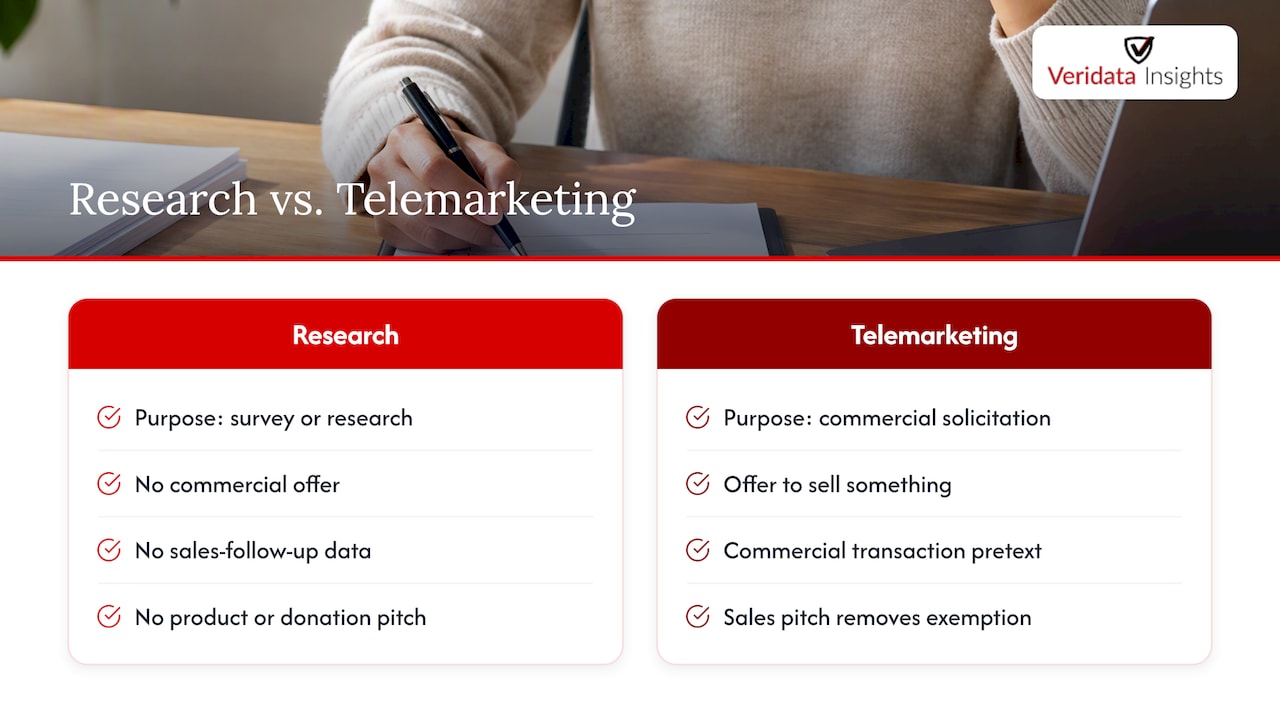
Federal Communications Commission rules implementing the TCPA exclude calls made solely for survey or research purposes from the definition of “telephone solicitation,” which is the category that triggers the strictest consent requirements. The FTC’s guidance on Do Not Call provisions confirms that telephone surveys conducted solely for research are generally not treated as telephone solicitations under the TCPA or the Telemarketing Sales Rule. The exemption disappears the moment a call includes any sales pitch, an offer to sell something, or a pretext for a commercial transaction.
That last point is where survey programs get into trouble. A call that opens with “we’d like your opinion” and closes with “and by the way, can we interest you in…” is no longer a survey in the eyes of regulators. It represents telemarketing wearing a lab coat, and it loses every protection the research exemption offers.
Practical signals that keep a call on the research side of the line include a script with no commercial offer anywhere in it, no attempt to sell a product, service, or donation, and no data collection intended for a later sales follow-up by the same organization. Genuine academic, market, or opinion research, including work we conduct for healthcare, B2B, and consumer clients, typically satisfies these conditions without much adjustment. The moment incentive language starts to resemble a promotional hook, or the sponsor’s identity suggests a sales relationship, compliance counsel should review the script before a single dial goes out.
Text messages fall under the same statutory umbrella as calls when sent via an ATDS, so a survey program that pairs phone outreach with SMS reminders needs to apply the same screening to both channels. The safe harbor for research does not extend automatically to every follow-up communication; each contact method and each message gets evaluated on its own terms.
2. ATDS and prerecorded voice risks that can turn a survey into a restricted call
An automatic telephone dialing system, under the TCPA’s current working definition, is equipment with the capacity to store or produce telephone numbers using a random or sequential number generator and to dial those numbers. Modern predictive dialers and cloud-based calling platforms often have this capacity built in even when a research team never intends to use it, which is why classification disputes are common in TCPA litigation.
The practical risk is straightforward: if your dialing platform qualifies as an ATDS and you call a wireless number without the right consent, the research exemption from telemarketing status does not protect you from the ATDS restrictions. Those are two separate legal questions, and compliance teams sometimes conflate them. A call can be a legitimate survey and still violate the TCPA if it was placed with prohibited dialing technology to a cell phone without adequate consent.
Prerecorded and artificial voice calls carry their own restrictions regardless of ATDS status. FCC consumer guidance on robocalls makes clear that calls using an autodialer or a prerecorded or artificial voice can trigger TCPA restrictions, and the agency’s recent orders extend this reasoning to AI-generated voices used in outbound calling. A synthetic voice reading survey questions is treated the same way a recorded human voice would be.
Practical mitigations that most research operations can put in place without rebuilding their tech stack:
- Dial wireless numbers manually, with a live interviewer initiating each call, rather than through predictive or automated dialing.
- Configure any dialer conservatively, disabling random or sequential number generation features even when the platform offers them.
- Require human-in-loop review before any prerecorded or synthetic voice segment is added to a survey script.
- Flag mixed-mode campaigns, where SMS and voice both touch the same respondent list, for a single consent and consent-scope review.
We cover the broader shift in dialing technology, and what it means for survey operations risk, in our piece on how automation is changing survey research. The short version: automation lowers cost per completed interview, but every automated layer added to a calling program is another layer that needs its own compliance check.
3. Consent and revocation: what the FCC’s one-to-one rule means for survey calls
Consent requirements under the TCPA scale with the technology and the call’s purpose, and getting the tier wrong is one of the most common sources of exposure for research programs. Purely informational calls, including most bona fide surveys, generally require only prior express consent, which can often be inferred from an existing business relationship or a prior request for contact. Calls that use an ATDS or a prerecorded or artificial voice to reach a wireless number, or a prerecorded voice to reach a residential line for telemarketing purposes, require prior express written consent, a higher bar that must be documented in a signed or electronically verifiable form.
The FCC’s one-to-one consent rule, adopted as part of its 2024 Report and Order, changed the landscape for any program that shares respondent lists or leads across multiple callers. Under this rule, consent must be obtained separately for each specific seller or caller when the contact involves an autodialer or prerecorded or artificial voice. A single blanket consent covering a list of unnamed partners no longer satisfies the requirement. For survey operations that rely on third-party recruitment panels or shared respondent databases, this means verifying that consent was captured for the specific entity placing the call, not a generic “research partner” clause buried in a sign-up form.
Revocation has become just as consequential as initial consent. Key points every survey program should build into its process:
- Honor a revocation request through any reasonable method the respondent uses, including saying “stop” on a call, replying to a text, or submitting a written request.
- Treat revocation as effective for the specific caller or campaign the respondent named, consistent with the one-to-one consent framework.
- Process and propagate the revocation across every system touching that number within 10 business days, the outer limit the FCC’s rules set for honoring these requests.
- Log the date, method, and scope of every revocation request as part of the campaign’s audit trail.
- Audit opt-out propagation periodically, since a request logged in one system but not synced to a dialer or CRM is a common point of failure.
That last point is not theoretical. Industry analysis of TCPA disputes identifies opt-out propagation failures as one of the most common operational breakdowns, where a consumer’s stop request is honored in one database but never reaches the system actually placing calls. Treating opt-out as a cross-system event, with monitoring and alerting rather than a single manual update, closes that gap.
4. DNC registry and scrubbing: when surveys are exempt and how to prove it
Calls that qualify strictly as research surveys, with no commercial or promotional content, are exempt from the National Do Not Call Registry requirement under FTC guidance. That exemption is narrower than it sounds. The FTC’s DNC provisions guidance is explicit that the exemption disappears if the call includes any promotional element, so a “survey” that doubles as a soft sales pitch loses DNC protection entirely, not just its telemarketing exemption.
Because the line between pure research and promotional contact can blur in practice, and because registry numbers change constantly, scrubbing against the DNC list remains standard practice even for exempt research programs. The FTC’s most recent biennial report to Congress states that the National DNC Registry contains over 258 million phone numbers as of early 2026. Scrubbing a calling list against a registry of that size needs a defined cadence, not a one-time check at project kickoff.
A defensible scrubbing workflow for survey teams includes:
- Scrub the active calling list against the National DNC Registry no less than every 31 days, matching the frequency the FTC treats as industry standard.
- Layer state-specific DNC lists on top of the national registry where the campaign touches states that maintain their own.
- Cross-check numbers against an internal do-not-call list built from prior opt-outs and revocation requests.
- Run numbers against the Reassigned Numbers Database before calling, since a number reassigned to a new subscriber can invalidate prior consent.
- Log the scrub date, list version, and match results for every campaign, timestamped and stored for audit retrieval.
The Reassigned Numbers Database, maintained to help callers identify numbers that have changed hands, deserves its own line item in any pre-launch checklist. A consent obtained from the prior holder of a number does not transfer to whoever holds it now, and calling that number anyway is one of the more avoidable TCPA violations a research program can commit.
5. State-level rules and private-right-of-action hazards
Federal law sets the floor, not the ceiling. Several states layer their own telemarketing and consumer-protection statutes on top of the TCPA, and some of those statutes carry higher statutory damages, broader definitions of what counts as an automated call, or separate state Do Not Call registries that operate independently of the national one. A calling program that clears federal requirements can still create exposure in a state with stricter rules.
Common state-level differences worth verifying before a multi-state campaign launches include permitted calling hours that are narrower than the federal window, text message consent rules that diverge from TCPA definitions, and private-right-of-action provisions that let individual consumers sue directly, sometimes with lower thresholds for proving a violation than federal courts require. A handful of states have become magnets for TCPA-adjacent litigation precisely because their statutes make it easier for plaintiffs’ attorneys to bring claims.
For survey programs calling across many states, the practical approach is triage rather than exhaustive research before every campaign. Identify the states where your call volume is highest, check those jurisdictions’ current telemarketing and DNC statutes against your script and dialing method, and flag any state where the applicable law is ambiguous or recently amended for a quick legal review. This is not a one-time exercise. State legislatures amend these statutes often enough that a compliance calendar reviewed annually, at minimum, is worth building into any ongoing survey operation.
When a campaign’s volume, incentive structure, or respondent list touches a state known for aggressive TCPA enforcement or litigation, looping in counsel before launch costs far less than responding to a demand letter afterward. Treating state law as an afterthought to federal compliance is one of the more common and more expensive mistakes we see in survey programs that otherwise have solid federal-level controls.
6. Recordkeeping and audit trails that hold up under scrutiny
A compliance program is only as strong as the records that prove it existed. Regulators and plaintiffs’ attorneys alike will ask for documentation, and “we believe we were compliant” is not an answer that survives discovery. The records that matter most are consent artifacts showing when and how each respondent agreed to be contacted, scrub logs showing when lists were checked against DNC and reassigned-number databases, call detail records showing what was dialed and when, opt-out and revocation logs showing how requests were received and processed, and training and policy documentation showing that staff were instructed on these rules.
| Record type | What it proves | Recommended retention |
|---|---|---|
| Consent artifacts (signed forms, verified opt-ins, timestamped digital consent) | Respondent agreed to be contacted and the scope of that agreement | Duration of the respondent relationship plus the applicable statute of limitations |
| DNC and reassigned-number scrub logs | List was checked against current registries before calling | At least the length of the campaign plus the statute of limitations |
| Call detail records (CDRs) | What number was dialed, when, by what method | Matches scrub log retention for consistency |
| Opt-out and revocation logs | Request was received, honored, and propagated across systems | Indefinitely, or at minimum the respondent relationship’s full duration |
| Staff training and policy acknowledgments | Personnel were instructed on TCPA obligations before placing calls | Duration of employment plus a reasonable audit window |
Real-time consent verification and API-based scrubbing tools create a more reliable record than manual spreadsheet tracking, since every check is timestamped automatically rather than relying on someone remembering to log it. An audit sample pulled quarterly, checking a random set of calls against their corresponding consent and scrub records, catches gaps before a regulator or plaintiff’s attorney finds them first. Programs that build this kind of internal spot-check into their operating rhythm tend to find and fix small process failures long before those failures become a pattern serious enough to trigger a complaint.
7. Operational best practices: dialing, caller ID, and vendor diligence
Turning legal requirements into daily operating rules is where most of the real compliance work happens. A few practices make the biggest difference:
- Dial wireless numbers manually rather than through any automated or predictive system, removing the ATDS question from the equation entirely for cell phone outreach.
- Configure any dialing platform used for landlines conservatively, with random and sequential dialing features disabled by default.
- Require a documented human review before any prerecorded, synthetic, or AI-generated voice element is approved for a script, and avoid such elements for wireless outreach altogether.
- Display accurate, traceable caller ID information on every outbound call, consistent with STIR/SHAKEN caller ID authentication standards that the FCC has pushed telecom carriers to implement.
- Script every interviewer to accept an opt-out request in whatever words the respondent uses, log it immediately, and end the call without pressing for a reason.
- Track monitoring metrics such as opt-out rate, complaint rate, and wrong-number rate per campaign, since a spike in any of these usually signals a list or consent problem worth investigating before it compounds.
Pro Tip: Build opt-out handling into interviewer scripts as a single scripted line, not an ad hoc response, so every agent handles it the same way every time.
Vendor diligence deserves particular attention because a research program’s TCPA exposure does not stop at its own front door. When a third-party panel or recruitment vendor supplies a respondent list, that vendor’s consent claims become the research program’s legal foundation, and a weak foundation collapses under litigation. Verifying consent artifacts directly, rather than accepting a vendor’s assurance at face value, is the single most effective step a compliance team can take here. Contracts with any vendor supplying contact lists should include audit rights letting the research program inspect the underlying consent records on request, not just a representation and warranty clause.
Mobile survey design considerations intersect with this operational layer too, since cell phone respondents now make up most survey populations in the United States and the manual-dialing requirement for wireless numbers touches the majority of any modern calling list. Programs built around predictive dialers designed for landline-heavy eras often need real reconfiguration, not just a policy memo, to operate safely today.
For teams building or auditing agent training programs, a call center agent training sample offers a useful reference point for structuring the kind of scripted, consistent opt-out handling that reduces both legal exposure and respondent frustration.
8. Recent legal developments affecting survey research
Circuit courts have not agreed on a question that matters a great deal to survey programs that offer incentives: whether a paid-survey invitation counts as an “advertisement” under the TCPA, a classification that would strip away much of the research exemption’s protection. The split means a paid survey program’s risk profile can shift depending on which federal circuit a respondent lives in, and a national campaign may need to account for inconsistent legal treatment across jurisdictions rather than a single bright-line rule.
On the regulatory side, the FCC’s actions in 2024 and 2025 moved in a consistent direction: tighter consent documentation, faster revocation processing, and explicit coverage of AI-generated voices under the same rules that already applied to traditional prerecorded messages. The FCC’s one-to-one consent rule took effect January 27, 2025, and research programs relying on shared or purchased respondent lists have had to adjust consent capture accordingly.
The practical takeaway for structuring paid survey invitations is to keep incentive language factual and separate from any promotional framing, document consent and incentive terms together so a reviewer can see exactly what the respondent agreed to, and treat any follow-up communication tied to incentive payment as its own consent event rather than an extension of the original survey consent. Given the circuit split on paid-survey classification, programs operating nationally should build in enough flexibility to apply a more conservative standard in jurisdictions where the law remains unsettled.
9. Compliance playbook: pre-launch, live, and post-campaign checklist
A phone survey program holds up under scrutiny when compliance steps are built into the calendar, not improvised under deadline pressure.
- Pre-launch: verify consent scope for every number on the list, scrub against national, state, and internal DNC lists plus the Reassigned Numbers Database, confirm vendor attestations with underlying documentation, and lock in a conservative dialer configuration.
- Live: run real-time consent checks against the latest revocation log before each call, script immediate opt-out handling, log every call detail record as it happens, and monitor opt-out and complaint rates daily rather than waiting for a post-campaign report.
- Post-campaign: retain every consent, scrub, and call record per the program’s documented retention schedule, pull an audit sample to confirm the process matched the plan, and document any gaps found as a concrete remediation item for the next campaign.
| Phase | Key action | Why it matters |
|---|---|---|
| Pre-launch | DNC, state, and RND scrubbing | Confirms the list is current before a single call is placed |
| Live | Real-time consent and opt-out checks | Catches revocation and consent gaps before they become violations |
| Post-campaign | Audit sample and remediation log | Builds the evidentiary record a regulator or court will ask for |
10. Handling international phone surveys and cross-border considerations
The TCPA applies to calls made to or from the United States using covered equipment, but research programs that survey respondents outside the country, or that route calls through international vendors, need to layer in additional rules rather than assume U.S. compliance covers everything. Many countries maintain their own telemarketing and data-protection frameworks, some considerably stricter than the TCPA, that govern consent, calling hours, and recordkeeping for their residents regardless of where the calling program is based.
A cross-border survey program should confirm which country’s law governs each respondent based on where that respondent is located, not where the research firm or its vendor operates. Consent captured under one jurisdiction’s standard does not automatically satisfy another’s, and a calling script compliant for a U.S. respondent may need adjustment for international privacy or telemarketing rules. Vendor contracts for international calling should specify which jurisdiction’s compliance standards apply and require the vendor to document adherence to both.
For research organizations managing panels across multiple countries, including the kind of hard-to-reach and global audience work that spans healthcare, B2B, and consumer research, the safest approach treats every country as its own compliance jurisdiction rather than extending U.S. TCPA logic abroad by assumption.
11. Impact of TCPA on IVR and automated survey technologies
Interactive Voice Response systems, which let respondents answer survey questions by pressing keys or speaking responses to a recorded prompt, sit squarely inside TCPA’s prerecorded voice restrictions. An IVR survey that plays a recorded or synthetic voice to a respondent is making a prerecorded voice call under the statute, regardless of how the research team characterizes the project internally, and that triggers the higher consent bar for wireless numbers and for any call using prerecorded content for a covered purpose.
This does not make IVR survey technology unusable. It means IVR deployments need the same prior express written consent documentation that any other prerecorded-voice campaign requires, and teams should confirm that the specific numbers being dialed through the IVR system carry that documented consent before the campaign launches. A live-interviewer survey and an IVR survey calling the same list are not interchangeable from a consent standpoint, even though they collect similar data.
Programs weighing IVR against live-interviewer calling for cost or scale reasons should treat the consent requirement as a fixed cost of the IVR approach, not a variable one, since the technology itself is what elevates the consent standard rather than any choice about survey content or sponsor.
12. Training and compliance protocols for survey staff
Every control described in this playbook depends on the people executing it, which makes staff training a compliance requirement in practice even where it is not spelled out as one in the statute. New interviewers should receive documented training on what distinguishes a research call from telemarketing, how to recognize and immediately honor an opt-out or revocation request in any form a respondent uses, and why manual dialing matters for wireless numbers specifically.
Training should not be a one-time onboarding event. Scripts change, regulations shift, as the FCC’s 2024 and 2025 actions demonstrate, and refresher sessions tied to any script or policy update keep staff current rather than operating on outdated assumptions. Documenting each training session, including who attended and what material was covered, gives a research program the same kind of audit trail that consent and scrub logs provide elsewhere.
Pairing training with active monitoring closes the loop. Reviewing a sample of recorded calls against the approved script, tracking how consistently interviewers log opt-outs, and flagging agents whose complaint rates run high relative to the team average turn training from a checkbox exercise into an ongoing quality control system.
13. Veridata Insights: compliance-aware telephone survey execution
Running a telephone survey program that holds up to scrutiny takes more than a script and a dialer. It takes consent verification, scrub cadence, and documentation built into the workflow from day one, which is exactly how we structure survey programming and respondent recruitment at Veridata Insights.
We offer full-service market research, quantitative research and qualitative research capabilities, respondent recruitment for hard-to-reach B2B, B2C, and healthcare audiences, and survey programming and consultation that builds compliance checkpoints directly into data collection rather than bolting them on afterward. We work with no project minimums, seven days a week, 365 days a year, so a compliance-sensitive campaign can move on your timeline rather than ours.
If your team needs a telephone survey program that treats TCPA risk as a design requirement rather than an afterthought, reach out to discuss your project and we will scope what a compliant, well-executed survey looks like for your audience.
FAQ
Are telephone surveys exempt from the Do Not Call Registry?
Surveys conducted solely for research, with no sales pitch or promotional content, are generally exempt from the National Do Not Call Registry requirement under FTC guidance. The exemption disappears if the call includes any commercial offer or pretext for a sale, so most research programs still scrub against the registry as a precaution.
Do survey calls need prior express written consent?
Purely informational survey calls generally need only prior express consent, but calls using an autodialer or a prerecorded or artificial voice to reach a wireless number require prior express written consent under FCC rules. The consent tier depends on the technology used and the number type, not on the fact that the call is a survey.
How long do we have to process a revocation request?
Callers must honor consent revocation requests within a reasonable time not to exceed 10 business days under current FCC rules. The request can come through any reasonable method the respondent uses, including saying “stop” during the call itself.
What is the FCC’s one-to-one consent rule?
The one-to-one consent rule, effective January 27, 2025, requires that consent be obtained separately for each specific seller or caller when a call uses an autodialer or prerecorded or artificial voice, under the FCC’s 2024 Report and Order. A single blanket consent covering a list of unnamed partners no longer satisfies this requirement.
How often should we scrub survey lists against the DNC Registry?
Industry practice is to scrub calling lists against the National DNC Registry, which held more than 258 million numbers as of early 2026 per the FTC’s biennial report, no less than every 31 days. Pairing this with state-list and Reassigned Numbers Database checks builds a more defensible record.
Sources
- FTC — Q&A for telemarketers and sellers about DNC provisions (Telemarketing Sales Rule)
- FCC — Report and Order and Further Notice of Proposed Rulemaking (TCPA/consent actions)
- FCC — Stop unwanted robocalls and texts (consumer guidance)