

Recruitment pre-screening for market research is the layered process of eligibility gating, attention checks, and respondent validation that turns a pool of applicants into a usable sample. The single must-do move is to plan your screener, your validated attention checks, and your oversample together before fielding starts. AAPOR’s disclosure standards expect you to report how you screened, and the data back it up: layered screening changes how many respondents survive to your final dataset.
TL;DR:
- Put hard eligibility gates before quota questions, pretest the screener, and review flagged respondents rather than excluding anyone after a single failed check.
- Report the sampling frame, provider, quotas, screening rules, compensation, and AI response handling; nonprobability panels do not support traditional margins of error.
- Layered filtering retained about 16% of initial respondents in one study, so estimate oversampling and incentive costs from pilot retention, not target completes.
- For healthcare or authority based recruitment, use a third party, separate research invitations from care or institutional ties, and budget for consent and review.
Table of Contents
- Quick checklist: essential pre-screening steps to run before fielding
- Designing screener questionnaires and attention checks
- Validation and authentication techniques that actually hold up
- Sampling frames, disclosure, and what AAPOR expects you to report
- Special cases: healthcare studies and recruiter authority
- Operationalizing pre-screening: oversample, incentives, and timeline
- Legal and ethical considerations in recruitment pre-screening
- Common challenges and pitfalls in recruitment pre-screening
- Best practices for designing effective screening questions
- The impact of recruitment pre-screening on candidate experience and employer branding
- How Veridata Insights executes pre-screening and recruitment for your study
- FAQ
- Sources
Quick checklist: essential pre-screening steps to run before fielding
Every strong pre-screening plan starts the same way: with decisions made before you ever talk to a vendor. Skip this stage and you will find out about your mistakes after the data collection budget is spent, which is the expensive way to learn.
- Write clear eligibility criteria and quota definitions before contacting any recruitment partner.
- Choose your sampling frame type (list, panel, river sample, or another source) and record the vendor and frame metadata for later disclosure.
- Schedule cognitive pretesting and a small pilot for the screener itself, not just the main questionnaire.
- Design a layered quality-control plan combining attention checks, response-time thresholds, duplicate detection, and bot filters.
- Estimate your oversample based on expected screening loss and build incentive costs into the budget from day one.
Pro Tip: Treat the screener like its own instrument. A screener that has never been pretested is the single most common reason fieldwork runs over budget.
Designing screener questionnaires and attention checks
A good screener does two jobs: it gates eligibility, and it sets up the quality checks that will run through the rest of the survey. Sequence disqualifiers early (industry, role, diagnosis, purchase behavior) before quota-balancing questions like age or region, so you are not burning interview time on someone who was never going to qualify.
- Build hard gates first: the questions that immediately disqualify someone who does not fit the study population.
- Layer in quota questions once eligibility is confirmed, so quota cells fill with genuinely qualified respondents.
- Mix attention-check types rather than repeating one format: instructed-response items (IRIs), infrequency items (IFIs), and short multiple-choice or grid-based checks each catch different kinds of inattentiveness.
- Disperse checks through the instrument instead of clustering them near the start, where respondents are most alert and least likely to fail.
- Document your failure rules in advance: how many checks a respondent must fail before exclusion, and what happens to borderline cases.
A single wording change in an attention check significantly increased the rate of flagged respondents, according to a 2026 study on screening and attention checks. Whether a check asks respondents to leave a field blank or to actively select a response changes the flag rate substantially, which means your choice of wording is itself a methodological decision worth pretesting.
Guidance collated in the attention-check literature recommends requiring a respondent to fail more than one check before exclusion, and always reviewing flagged cases rather than purging them automatically. A respondent who fails one grid-based check because of a genuine misread deserves a second look, not an automatic drop.
Validation and authentication techniques that actually hold up
No single filter catches everything, which is why validation works best as layers rather than a single gate.
- IP address and device checks flag respondents completing the survey from the same device or network repeatedly.
- Browser fingerprinting and CAPTCHA screen out basic bots before they reach your questionnaire.
- Router and duplicate-survey checks catch respondents who enter the same study twice through different panel sources.
- Response-time and paradata analysis flag speeders who move through the instrument faster than genuine comprehension allows.
Response-time analysis is one of the more reliable complementary measures recommended in the attention-check review, and it catches a meaningfully different group of problem respondents than bot detection alone does. For higher-value or sensitive studies, add a phone verification step, a PIN confirmation, or a follow-up contact before finalizing a respondent’s inclusion.
Pro Tip: Set your response-time cutoff from your own pilot data, not a generic rule of thumb. A 20-minute survey in a technical B2B audience moves at a different pace than a 10-minute consumer survey.
Automation does the heavy lifting, but manual review on flagged cases reduces false positives. A respondent flagged for a fast completion time might simply be an expert who knows the subject cold.
Sampling frames, disclosure, and what AAPOR expects you to report
Whether your sample comes from a probability frame or a nonprobability source changes what you are allowed to claim about it statistically, and it changes what you owe your reader in disclosure. A probability sample lets you talk about margins of error in the traditional sense. A nonprobability panel does not, no matter how well it is screened, and pretending otherwise undermines the credibility of the whole study.
The AAPOR Code of Ethics and Disclosure Standards lay out specific items a methodology section should cover:
- The method used to generate the sample, including the sampling frame type and provider or panel name.
- Quota structure and how quotas were enforced during fieldwork.
- Screening procedures, including how prior survey exposure or disqualifying criteria were handled.
- Whether any AI-generated responses were detected or excluded, and how.
- Compensation details and, where relevant, panel maintenance information like active panel size and recruitment frequency.
A concise methodology paragraph covering these points, attached as an appendix, satisfies most disclosure expectations without turning your report into a technical manual.
Special cases: healthcare studies and recruiter authority
Healthcare recruitment and any study where the recruiter has authority over potential respondents (a physician recruiting patients, a teacher recruiting students) call for extra caution. AAPOR’s guidance on institutional review boards warns that direct recruitment by someone in an authority position carries a coercion risk, even when unintended.
- Route recruitment through a third party rather than having the authority figure approach respondents directly.
- Keep enrollment anonymized where possible, separating the research invitation from the clinical or institutional relationship.
- Budget for IRB review and informed-consent language early, since healthcare studies typically need both.
- When recruiting minors online, build in parental consent steps consistent with COPPA requirements.
- Add phone or PIN authentication for sensitive health studies, since the cost of a fraudulent respondent is higher when the data touches diagnoses or treatment history.
Screener wording that clearly separates “this is a research study” from any clinical relationship protects respondents and protects your data.
Operationalizing pre-screening: oversample, incentives, and timeline
Screening loss is not a rounding error. One investigation cited in the 2026 attention-check study found that combined bot-detection and attention-check filtering retained only a small portion of initial respondents, an attrition rate that makes oversample planning a budget necessity rather than a nice-to-have.
- Start with your target completed-interview count and divide by your expected retention rate from pilot data or comparable past studies.
- Adjust upward further for hard-to-reach segments, where incidence is already low before screening begins.
- Build incentive costs around the oversample number, not the target number, since every qualified respondent you screen out still needs compensation consideration.
- Choose prepaid versus post-payment incentive delivery based on your audience: prepaid tends to improve cooperation rates among harder-to-reach groups, though it raises upfront cost.
- Add buffer time to your fieldwork schedule for pilot testing, a possible re-field if quotas lag, and the documentation work disclosure requires.
A retention rate near 16% after layered filtering, as found in the 2026 Quality & Quantity study, means a study needing 500 completes under similarly strict screening could require an initial outreach pool many multiples larger. Plan the math before you commit a budget number to a client or stakeholder.
Legal and ethical considerations in recruitment pre-screening
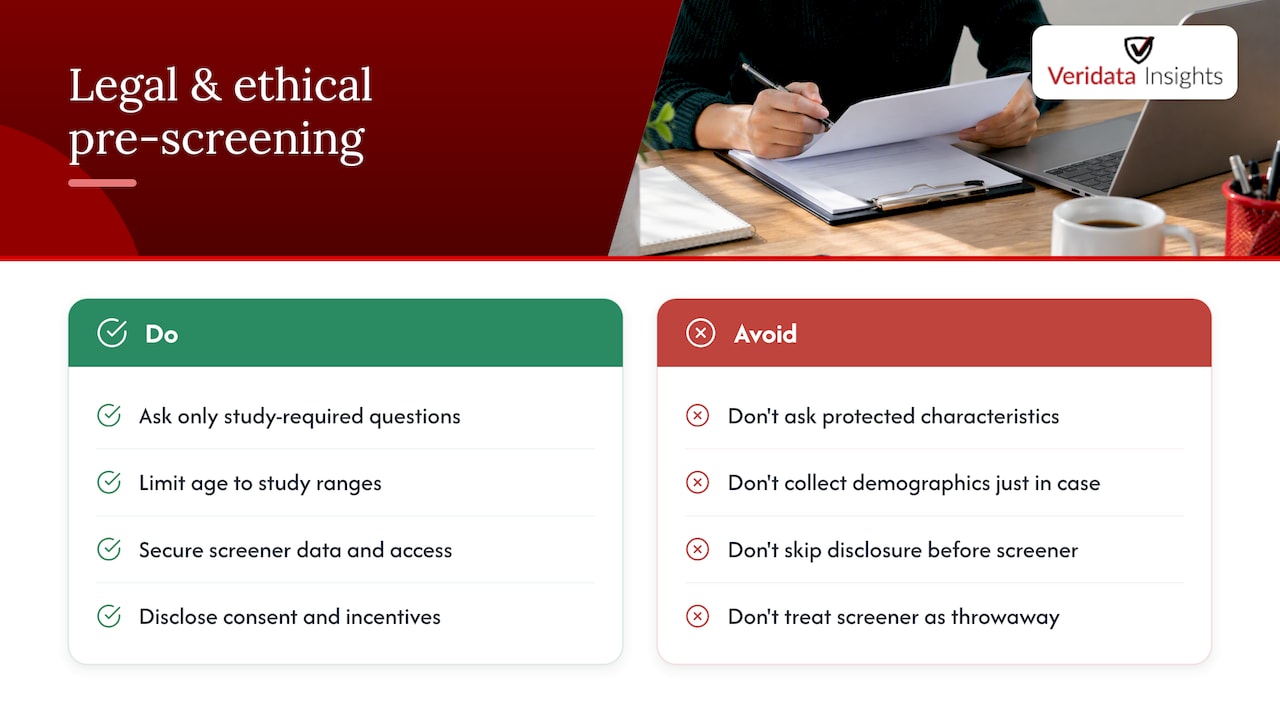
Pre-screening questions can brush up against discrimination law when they touch protected characteristics like age, disability, pregnancy, or religion, even in a research context rather than a hiring one. The safer practice is to ask only what the study design actually requires: if age matters for quota purposes, ask for an age range tied to the research question, not an open-ended demographic sweep collected “just in case.”
Privacy is the second major concern. Screener data, especially in healthcare or B2B studies where respondents can be identified by employer or diagnosis, needs the same handling discipline as the final dataset: secure storage, limited access, and a clear data retention policy communicated to respondents during consent.
Consent itself deserves specific attention in pre-screening, since many teams treat the screener as a throwaway step and skip proper disclosure until the main survey begins. Respondents should know, before answering screener questions, that their answers determine study eligibility and how that data will be used or stored if they do not qualify. Transparent incentive disclosure, including what respondents get for completing just the screener versus the full study, avoids complaints and panel attrition down the line. Treating the screener as part of the ethical surface of the study, not a pre-ethics formality, keeps both your legal exposure and your respondent relationships intact.
Common challenges and pitfalls in recruitment pre-screening
The most frequent mistake is writing a screener that telegraphs the “correct” answer, which trains savvy respondents (especially professional panel members) to answer their way into studies they do not actually qualify for. Rotating answer options, avoiding leading phrasing, and burying the key qualifying question among several plausible-sounding alternatives all reduce this risk.
A second common pitfall is treating screening as a one-time gate rather than an ongoing quality layer. Teams screen hard at entry, then stop watching for quality signals once someone is “in,” missing speeders or straight-liners who slipped past the initial checks. Running attention checks throughout the instrument, not just at the door, catches this.
Underestimating screening loss is the third recurring issue, and it is the one that blows budgets. Teams size their recruitment target to the number of completes they need, forget that layered screening can filter out a large share of initial contacts, and end up re-fielding under time pressure with weaker quality controls because the deadline has already slipped.
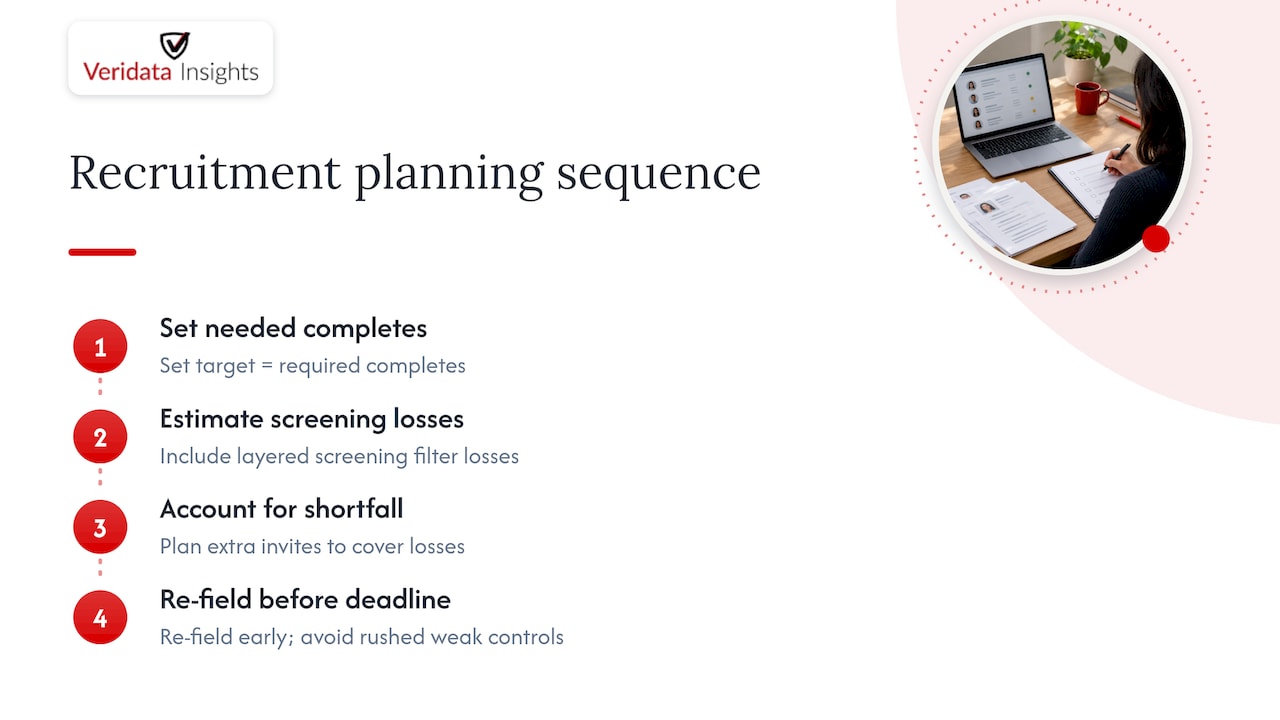
Finally, inconsistent exclusion rules create defensibility problems later. If one flagged respondent is excluded and a similar case is kept without a documented reason, your dataset becomes harder to justify under review. Writing the exclusion rule before fielding, not during data cleaning, removes that ambiguity.
Best practices for designing effective screening questions
Effective screening questions share a few traits regardless of industry or audience. They ask about behavior or fact rather than self-assessed expertise: “How many times did you purchase X in the last three months” screens more reliably than “Would you consider yourself knowledgeable about X.”
Keep screeners short relative to the overall study. A screener that feels like a second survey fatigues respondents before the real research begins and increases the chance that quality drops in the main instrument. Order matters too: put hard disqualifiers first so ineligible respondents exit quickly, which respects their time and reduces wasted partial completes in your data.
Avoid double-barreled questions that ask about two things at once, since the answer becomes impossible to interpret cleanly for quota purposes. Pilot the screener with a handful of real target respondents before full fielding. Cognitive interviews, recommended in AAPOR’s best-practices guidance, catch wording problems that look fine on paper but confuse real respondents, particularly in technical B2B or clinical populations where jargon can cut both ways.
Finally, write screening questions that match how your actual audience talks about the subject, not how your internal team talks about it. A screener written in clinical terminology will underperform with patient respondents who describe their condition in everyday language.
The impact of recruitment pre-screening on candidate experience and employer branding
For market research, “candidate experience” means respondent experience, and it shapes whether people complete your study, refer others, or come back for future waves. A screener that feels invasive, repetitive, or oddly long before any mention of compensation creates drop-off before the research even starts.
Respondents notice when a screener is well designed. Clear questions, a reasonable length, and transparent communication about what qualifying (or not qualifying) means for compensation all build trust in the organization running the study, even when that organization is a research partner rather than the end client. That trust compounds: panel providers track respondent satisfaction, and a poor screening experience can affect your standing with a panel for future projects, not just the current one.
The flip side matters too. Being disqualified gracefully, with a clear explanation and appropriate compensation for the time spent, leaves a better impression than an abrupt exit with no acknowledgment. For studies involving B2B professionals or healthcare respondents, where the same pool of qualified individuals may be recruited repeatedly across projects, a respectful screening experience protects access to that audience long term.
How Veridata Insights executes pre-screening and recruitment for your study
We build screener design, pilot testing, recruitment, and validation into a streamlined engagement to provide comprehensive support throughout the screening process. We handle consultation and study design, questionnaire review, data collection, and disclosure documentation to support your methodology requirements, whether your study calls for a probability frame or a carefully managed nonprobability panel.
- We recruit various audiences, including hard-to-reach groups, accommodating different project sizes to support studies ranging from small qualitative pilots to large quantitative waves.
- Our services are designed to maintain flexibility in timing to keep fieldwork progressing even if schedules slip.
- We handle translations, localizations, and data processing alongside recruitment to facilitate the delivery of clean, analysis-ready data.
If you have a target population and a rough sense of your quotas, that is enough to start a conversation. Reach out through our respondent recruitment page to talk through your screening plan and sample needs.
FAQ
What is recruitment pre-screening in market research?
Recruitment pre-screening is the process of checking potential respondents against eligibility criteria, quotas, and validation standards before they enter a study. It combines a screener questionnaire with attention checks and authentication steps to make sure the final sample is genuinely qualified and attentive.
How many attention checks should a survey include?
Guidance in the attention-check literature recommends using more than one type of check, such as a mix of instructed-response items and short multiple-choice checks, dispersed through the instrument rather than clustered together. Three to four checks is a reasonable range for a typical survey, with more added for longer instruments.
What should a methodology section disclose about screening?
Following AAPOR’s disclosure standards, a methodology section should report the sampling method and frame, the panel or provider name, quota structure, screening procedures, compensation details, and whether any AI-generated responses were identified or excluded.
How much oversample should I plan for a heavily screened study?
Oversample needs to vary by audience and screening intensity, and some studies with strict layered filtering have retained roughly 16% of initial respondents according to 2026 research on screening retention. Use your own pilot data or comparable past studies to set a realistic retention estimate before finalizing your recruitment target.
Can Veridata Insights handle screening for hard-to-reach or healthcare audiences?
Yes, our team specializes in recruiting B2B, B2C, healthcare, and hard-to-reach audiences as part of a full-service engagement that includes screener design and validation. Details on scope and approach are available through our healthcare market research page.
Sources
- Best Practices for Survey Research – AAPOR
- Quality & Quantity 2026 study on attention checks and screening
- Attention checks and how to use them: Review and practical recommendations