

TL;DR:
- A market research assistant manages data collection, survey programming, and report formatting throughout projects. They ensure data quality, monitor quotas, and collaborate with vendors to keep research on track. Developing technical skills and judgment with AI tools accelerates career advancement from assistant to analyst.
A market research assistant is defined as an entry-level research professional responsible for data collection, survey programming, and preliminary report preparation under the direction of senior analysts. The role is the operational backbone of any research project. Without a capable assistant, data pipelines stall, survey errors go undetected, and reports miss deadlines. Veridata Insights works alongside research teams at every scope and scale, and we know firsthand how much project quality depends on what happens at the assistant level. Whether you are hiring for this role, stepping into it, or building a team around it, understanding what a strong assistant does makes all the difference.

What does a market research assistant do every day?
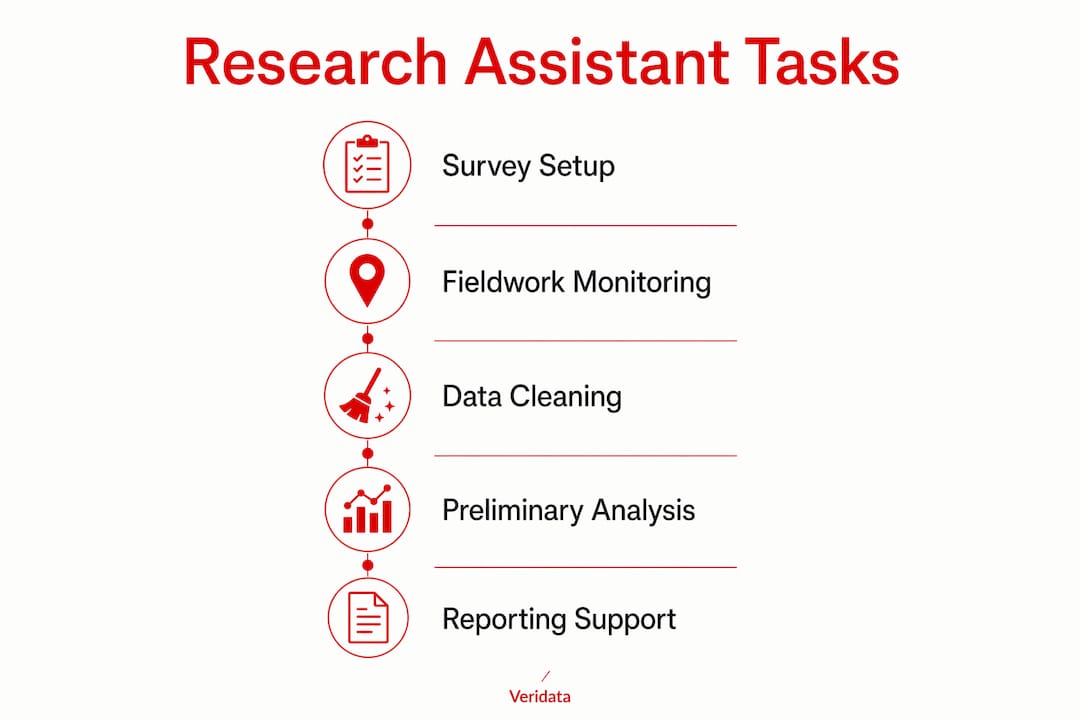
The daily tasks of a research assistant span the full project lifecycle, from setup through delivery. Assistants do not just collect data. They monitor it, clean it, and prepare it for the analysts who interpret it.
A typical day includes:
- Survey monitoring: Tracking completion rates and quota fills in real time to catch shortfalls before they become problems
- Data collection: Pulling responses from field platforms, verifying sample integrity, and flagging incomplete or inconsistent entries
- Data cleaning: Removing duplicates, correcting entry errors, and standardizing response formats so the data set is analysis-ready
- Cross-tabulations: Running basic crosstabs to show how different audience segments responded to key questions
- Report formatting: Assembling charts, tables, and written summaries into client-ready documents
Core responsibilities also include coordinating with vendors, tracking field timelines, and communicating status updates to the project team. That coordination function is often underestimated. A missed quota or a delayed vendor response can derail an entire study if no one catches it early.
Pro Tip: Set a daily check-in time, morning and afternoon, to review field progress. Catching a quota gap at noon is far easier to fix than catching it at 4 p.m. on a Friday.
Survey programming is a core assistant skill that many new professionals underestimate. Understanding why survey programming matters helps assistants catch logic errors before data collection begins, not after.
Which technical skills matter most for research assistants in 2026?
Hiring managers prioritize transferable technical skills over deep academic theory for entry-level research roles. That means Excel, SQL basics, and data visualization come before advanced econometrics or research design theory. You can learn theory on the job. You cannot afford to learn Excel on the job.
The core technical toolkit for a research assistant in 2026 includes:
- Excel: Pivot tables, VLOOKUP, conditional formatting, and basic formula logic
- SPSS or similar statistical software: Running frequencies, crosstabs, and basic significance tests
- PowerPoint: Building clear, well-structured presentation decks for client delivery
- Tableau or equivalent visualization tools: Creating charts and dashboards that communicate findings at a glance
- SQL basics: Querying databases to pull specific data subsets without relying on a developer
The role is increasingly hybrid, requiring assistants to switch between AI tools for speed and manual validation to protect data integrity. AI platforms now automate survey logic checks, quota monitoring, and even first-draft summaries. That is genuinely useful. But the assistant who blindly trusts an AI summary without checking the underlying data is the assistant who ships a flawed report.
Mastering when to trust AI versus when to run a manual check is an advanced skill. It is also what separates high-performing assistants from average ones. The AI catches patterns. The human catches context.
Pro Tip: When an AI tool flags a data anomaly, always trace it back to the raw response file before deciding how to handle it. Automated flags are a starting point, not a verdict.
Developing SQL skills early pays dividends fast. Assistants who can query their own data sets reduce turnaround time and reduce their dependence on data engineering teams for routine pulls.
How does an assistant contribute to data analysis and reporting?
The assistant’s contribution to data analysis sits between raw collection and final interpretation. Assistants do not typically draw strategic conclusions. They make sure the data is clean, organized, and presented clearly enough that analysts can draw accurate conclusions quickly.
The reporting workflow typically follows this sequence:
- Data validation: Check for out-of-range values, missing responses, and duplicate records before any analysis begins
- Frequency and crosstab runs: Generate standard output tables showing response distributions by key demographic or behavioral segments
- Chart creation: Build bar charts, pie charts, and trend lines that visualize the most important findings
- Report assembly: Combine charts, tables, and written summaries into a formatted document that matches client or stakeholder expectations
- Analyst handoff: Share the cleaned data set and draft report with the senior analyst for final interpretation and sign-off
The table below shows how assistant tasks map to project stages:
| Project stage | Assistant’s primary task |
|---|---|
| Setup | Survey programming and logic testing |
| Field | Quota monitoring and vendor coordination |
| Data processing | Cleaning, coding, and cross-tabulation |
| Reporting | Chart creation and document formatting |
| Delivery | Final quality check and file preparation |
Formatting matters more than most new assistants expect. A report that is hard to read creates doubt about the data behind it. Clear headers, consistent chart styles, and logical flow make findings land with stakeholders.
What is the career path from research assistant to analyst?
Research assistants typically advance to full analyst roles within 12–24 months by demonstrating independent task ownership and consistent analytical accuracy. That timeline is not automatic. It depends on performance, not tenure.
The milestones that accelerate advancement include:
- Independent task ownership: Completing data collection and cleaning cycles without needing step-by-step direction
- Accuracy under pressure: Delivering clean data sets and formatted reports with minimal errors, even on tight deadlines
- Proactive communication: Flagging field problems, quota gaps, or data anomalies before they escalate
- Skill expansion: Adding SQL, Tableau, or SPSS proficiency to the core Excel foundation
- Project variety: Working across qualitative and quantitative methodologies, B2B and B2C audiences, and different industry verticals
Agency experience accelerates growth faster than in-house roles in most cases. Agencies run more projects simultaneously, expose assistants to more methodologies, and reward speed and accuracy directly. An assistant who spends two years at a full-service research firm often arrives at a senior analyst role with more practical depth than a peer who spent the same time in a single-category corporate research team.
Career resources for research job seekers can help assistants identify the specific skills and experiences that hiring managers look for when promoting from within or hiring at the analyst level.
The AI-augmented research model is reshaping what advancement looks like. Assistants who develop judgment around AI tools, knowing when to use them and when to override them, are positioned for faster promotion than those who treat automation as a replacement for critical thinking.
Key Takeaways
A market research assistant’s value is defined by data accuracy, proactive communication, and the ability to balance AI tools with manual validation at every project stage.
| Point | Details |
|---|---|
| Core daily tasks | Assistants monitor quotas, clean data, run crosstabs, and format reports across the full project lifecycle. |
| Technical skill priority | Excel, SQL, SPSS, and data visualization tools matter more than theory for entry-level research roles. |
| AI balance is critical | High-performing assistants know when to trust AI summaries and when to run manual checks on raw data. |
| Advancement timeline | Most assistants reach analyst roles within 12–24 months by demonstrating independent ownership and accuracy. |
| Proactive communication | Flagging data issues and field delays early is the single most underrated skill in the assistant role. |
Why the assistant role is harder than it looks
I have worked with research teams of every size, and the pattern is consistent. The projects that run smoothly are almost always the ones with a sharp, proactive assistant running the field operations. The projects that blow up usually trace back to a missed quota flag, a data cleaning step that got skipped, or a report that went out with inconsistent formatting.
What surprises most people stepping into this role is how much judgment it requires. You are not just executing tasks. You are making dozens of small decisions every day about data quality, field timing, and what to escalate. The assistants who treat every task as mechanical tend to plateau. The ones who ask why a quota is off, or why a response pattern looks unusual, are the ones who move up fast.
AI tools have genuinely changed the daily workflow. Automated summaries and quota alerts save real time. But I have seen AI-generated summaries miss context that any experienced human would catch in 30 seconds. The skill is not using the tool. The skill is knowing when the tool is wrong.
If you are building a career in research, invest in your technical skills early and your communication skills constantly. The analyst who can clean data and explain findings clearly is far more valuable than the one who can only do one of those things well.
How Veridata Insights supports your research team
Veridata Insights offers full-service research support with no project minimums, available seven days a week, 365 days a year. Whether your team needs help with survey programming, data collection, data processing, or final reporting, Veridata Insights handles as much or as little as you need. We work across quantitative and qualitative methodologies, serving B2B, B2C, healthcare, and hard-to-reach audiences with equal depth. If your research function needs a capable, experienced partner at any stage of the project, reach out to our team and tell us what you are working on. We will figure out the best way to help.
FAQ
What does a market research assistant do?
A market research assistant handles data collection, survey programming, quota monitoring, data cleaning, and report formatting across all stages of a research project. The role supports senior analysts by preparing clean, organized data for interpretation and delivery.
What education do you need for entry-level market research?
Most entry-level market research roles require a bachelor’s degree in marketing, psychology, statistics, or social sciences. Practical skills in Excel, SPSS, and data visualization carry significant weight alongside academic credentials.
How long does it take to advance from assistant to analyst?
Research assistants typically advance within 12–24 months by demonstrating independent task ownership, consistent accuracy, and proactive communication on live projects.
What technical tools should a research assistant know?
Proficiency in Excel, SPSS, PowerPoint, and Tableau gives assistants a strong foundation. SQL basics and familiarity with AI-powered field monitoring platforms are increasingly expected in 2026.
How is AI changing the market research assistant role?
AI now automates routine tasks like survey logic checks, quota alerts, and data summarization. Assistants are shifting toward a human validator role, reviewing AI outputs for accuracy and flagging errors that automated tools miss.