


TL;DR:
- Field research involves directly collecting primary data in natural environments to observe genuine behaviors. It emphasizes ecological validity by capturing spontaneous actions and environmental factors that laboratory studies often miss. Proper planning, including pilot testing and patience, ensures accurate and trustworthy results across various methods and research objectives.
Field research is defined as the systematic, on-site collection of primary data within naturalistic environments to observe human behaviors or natural phenomena without laboratory constraints. The industry term for this practice is “fieldwork,” and it sits at the core of qualitative and mixed-methods research across social sciences, market research, and consulting. Unlike controlled experiments, field research prioritizes ecological validity, meaning your results reflect what actually happens in the real world. Techniques like participant observation, informal interviews, and document analysis give you direct access to authentic behaviors that a lab setting simply cannot replicate. Veridata Insights works with professionals across all these disciplines, and we know firsthand that the quality of your data starts with the quality of your method.
What are the main methods used in field research?
Field research methods fall into four core categories, and most strong studies combine at least two of them. Each method captures a different layer of reality, so choosing the right mix matters as much as choosing the right setting.
- Participant observation. The researcher actively joins the group being studied. Anthropologists may spend months to years immersed in study groups to gain deep understanding of social dynamics. This is the most time-intensive method, but it yields the richest data.
- Informal and formal interviews. Conversations conducted in the field, either structured or spontaneous, surface motivations and perceptions that observation alone misses. Informal interviews often produce the most candid responses because participants feel less evaluated.
- Document analysis. Photos, artifacts, written records, and environmental cues all count as data. A market researcher studying retail behavior might analyze store layouts, signage, and purchase receipts alongside direct observation.
- Life-history recording. This method captures a participant’s narrative over time, tracing how past experiences shape current behavior. It is especially common in ethnographic and academic research.
Using multiple methods together is not just good practice. It is the standard. Each method checks and enriches the others, reducing the risk that any single source of data skews your conclusions.
Pro Tip: Plan for at least two observation sessions before you begin formal data collection. Early visits let participants get used to your presence, which reduces reactivity and gives you more authentic behavior to record.

How does field research prioritize ecological validity compared to laboratory studies?
Ecological validity is the degree to which research findings apply to real-world conditions. Field research earns its place precisely because it delivers this quality at a level laboratory studies cannot match.
Laboratory studies control variables tightly, which is useful for isolating causes. The tradeoff is that artificial settings change how people behave. Participants know they are being watched, they are removed from their normal context, and the pressures of daily life are absent. The result is clean data that may not predict real behavior at all.
Field research captures spontaneous actions and environmental stressors missed in laboratory studies, offering superior ecological validity. This advantage makes it the preferred method for studying real-world phenomena authentically.
The practical difference shows up clearly in market research. A consumer tested in a focus group facility will evaluate a product differently than a shopper standing in a grocery aisle with a budget in mind and a child pulling at their sleeve. The field setting captures that full picture.
Here is how the two approaches compare on the dimensions that matter most to professionals:
- Context fidelity. Field research records behavior in its actual environment. Lab research strips that context away.
- Spontaneity. Authentic behaviors emerge naturally in the field. Lab participants often perform rather than behave.
- Environmental stressors. Real decisions happen under pressure, distraction, and competing demands. Labs eliminate these factors, which can make findings less applicable.
- Researcher role. The participant-observer shifts research from detached measurement to empathetic understanding, which is essential for grasping the internal logic of behavior.
The tradeoff is control. Field research accepts more variables in exchange for more truth. For consulting and market research professionals, that tradeoff is almost always worth making.
What is the standard step-by-step workflow for conducting effective field research?
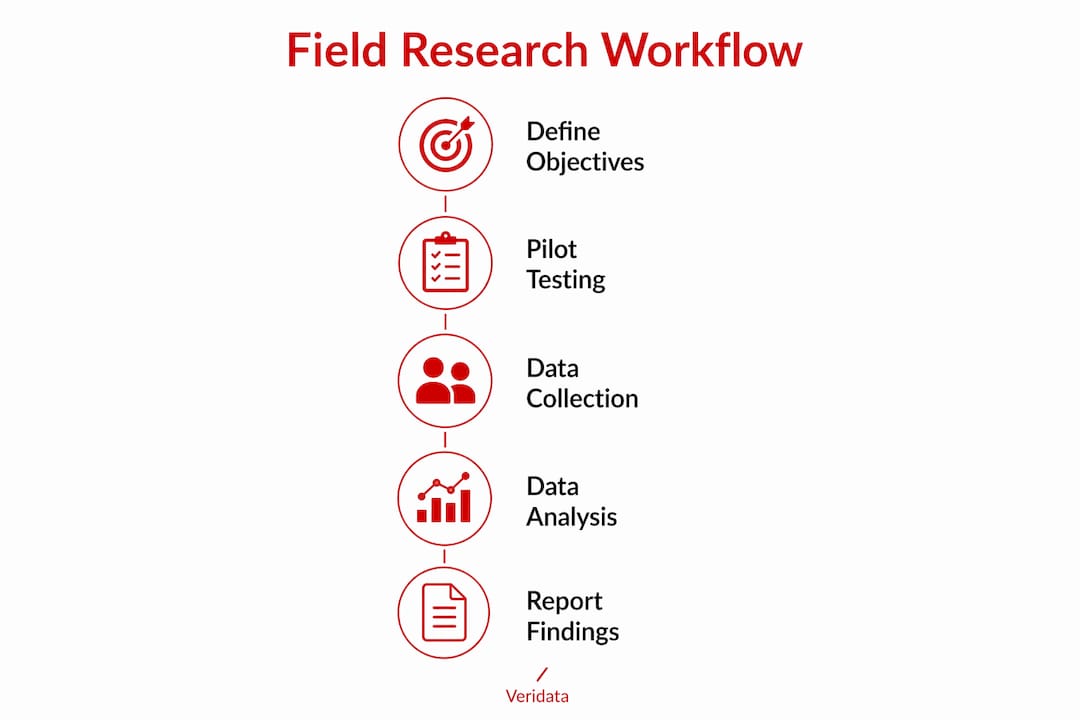
A structured research workflow separates reliable fieldwork from expensive guesswork. The standard process follows six stages, each building on the last.
- Define your research objectives. Write them as specific questions, not topics. “Why do customers abandon carts at checkout?” is a research objective. “Understand shopping behavior” is not.
- Select appropriate methods. Match your methods to your questions. Behavioral questions call for observation. Attitudinal questions call for interviews. Complex cultural questions often need both.
- Design your data collection instruments. Build observation guides, interview protocols, and documentation checklists before you enter the field. Vague instruments produce vague data.
- Pilot test your instruments. The standard field research process requires pilot testing before full data collection begins. A pilot run reveals ambiguous questions, logistical problems, and gaps in your observation guide while there is still time to fix them.
- Collect data with bias controls in place. The Hawthorne effect, where participants change their behavior because they know they are being observed, is the most common threat to data quality. Long-term immersion is the most effective counter. When subjects forget they are observed, they revert to natural behavior.
- Manage your data immediately after each session. Transcribe notes, label recordings, and code observations the same day. Memory degrades fast, and shorthand notes lose meaning within 48 hours.
| Stage | Key action | Common mistake |
|---|---|---|
| Define objectives | Write specific research questions | Setting topics instead of questions |
| Select methods | Match method to question type | Defaulting to interviews for everything |
| Design instruments | Build guides and checklists | Entering the field with no structure |
| Pilot test | Run a small trial before full collection | Skipping the pilot to save time |
| Collect data | Use immersion to reduce reactivity | Single short observation sessions |
| Manage data | Transcribe and code same day | Letting notes pile up for batch processing |
Pro Tip: Treat your pilot test as a full dress rehearsal. Run it with participants who match your target group, debrief yourself afterward, and revise your instruments before the real work begins. One good pilot saves weeks of bad data.
Industrial fieldwork professionals face similar documentation discipline. Field documentation best practices in inspection and technical contexts mirror the rigor required in social and market research fieldwork.
What types of field research exist and how do they differ?
The field research definition covers a wide range of approaches. Knowing which type fits your project prevents you from applying the wrong method to the right question.
Participant observation vs. direct observation is the most fundamental distinction. Participant observation means the researcher actively joins the group being studied. Direct observation means watching without participating. The first produces richer interpretive data. The second produces more objective behavioral records. Your research question determines which is appropriate.
Ethnographic field research goes deepest. It combines participant observation, interviews, and document analysis over an extended period to produce what anthropologist Clifford Geertz called “thick description.” Thick description explains not only what people do but why, integrating behavior with cultural context and meaning. This is the gold standard for understanding complex social systems.
Contextual inquiry is the version of field research used most often in user experience and product development. Researchers observe users in their actual work environments, asking questions as tasks unfold. It is faster than ethnography and focused on usability rather than culture.
Experimental field research introduces a controlled intervention into a natural setting. A retailer testing two different shelf layouts in live stores is running experimental field research. It retains real-world context while still measuring cause and effect.
| Type | Researcher involvement | Primary data type | Best for |
|---|---|---|---|
| Participant observation | High | Interpretive, narrative | Culture, social dynamics |
| Direct observation | Low | Behavioral, quantitative | Frequency, patterns |
| Ethnographic research | Very high | Thick description | Deep cultural understanding |
| Contextual inquiry | Medium | Usability, workflow | Product and UX research |
| Experimental field research | Medium | Causal, behavioral | Intervention testing |
Each type sits on a spectrum from high involvement to low involvement, and from interpretive to measurable data. Most professional projects draw from more than one type, especially when research questions span both behavioral and attitudinal dimensions.
Key Takeaways
Field research delivers superior ecological validity by collecting primary data directly in natural settings, making it the most reliable method for studying real-world behavior across market research, consulting, and academia.
| Point | Details |
|---|---|
| Field research definition | Systematic, on-site data collection in natural environments to observe authentic behaviors without lab constraints. |
| Core methods | Participant observation, informal interviews, document analysis, and life-history recording work best in combination. |
| Ecological validity advantage | Field settings capture spontaneous actions and environmental stressors that laboratory studies consistently miss. |
| Standard workflow | Define objectives, select methods, design instruments, pilot test, collect data, and manage notes same day. |
| Types vary by involvement | Choose participant observation, ethnography, contextual inquiry, or experimental field research based on your research question. |
Why patience is the most underrated field research skill
I have reviewed a lot of field research projects over the years, and the ones that fail rarely fail because of bad methods. They fail because of bad timing. Researchers rush into data collection before participants are comfortable with their presence, and the data they collect reflects performance, not reality. The Hawthorne effect is not a theoretical concern. It is a practical problem that shows up in almost every project that skips the immersion phase.
The other thing I have learned is that post-fieldwork data management is where most projects quietly fall apart. Researchers spend months planning their entry into the field and about 20 minutes thinking about what happens when they come out. Expanding shorthand notes into formal records is time-consuming, unglamorous work. But it is where the analysis actually lives. Practitioners who let notes pile up for batch processing lose the context that makes those notes meaningful.
The best field researchers I have worked with treat ethical research practices and rigorous documentation as the same discipline. Both require you to stay present, stay honest, and stay organized long after the exciting part of the work is done. That combination of patience and discipline is what separates good fieldwork from great fieldwork.
How Veridata Insights supports your field research projects
Veridata Insights works with market researchers, consultants, and academics who need field research done right, from study design through final reporting. We handle as much or as little as you need, with no project minimums and support available seven days a week. Whether you need help designing observation instruments, recruiting hard-to-reach participants, or processing and coding qualitative data, we bring the same precision to every stage. Our team has deep experience across B2B, B2C, healthcare, and specialized audiences. If you are ready to put better data behind your next project, reach out to our team and tell us what you are working on.
FAQ
What is the field research definition in simple terms?
Field research is the direct collection of primary data in natural, real-world settings rather than controlled environments. It prioritizes observing authentic behaviors as they occur.
What are the most common field research methods?
The most common methods are participant observation, informal interviews, document analysis, and life-history recording. Most studies combine at least two of these for richer, more reliable data.
How do you reduce bias when conducting field research?
Long-term immersion is the most effective way to reduce the Hawthorne effect. When participants forget they are being observed, they return to natural behavior, which produces more accurate data, whether it might be B2B, B2C, or healthcare.
What is the difference between participant observation and direct observation?
Participant observation means the researcher actively joins the group being studied. Direct observation means watching without participating. The choice affects both the type of data collected and the researcher’s role.
Why is pilot testing important in field research?
Pilot testing reveals gaps in your observation guides and interview protocols before full data collection begins. Catching those problems early prevents weeks of unusable data.