

There is no single LinkedIn replacement. The smarter move is to pick platforms by goal: job boards like Indeed and ZipRecruiter for high-volume hiring, GitHub or Dribbble for proof-of-work sourcing, Slack and Discord for niche community engagement, and a specialist firm like Veridata Insights when your project demands verified, quota-driven research recruitment. LinkedIn is the largest professional network by membership size, with around 1.3 billion professionals as of 2026, but size does not guarantee fit for every research or recruiting objective. making it the largest network on paper, but size does not guarantee fit for every research or recruiting objective.
Here is a quick goal-to-channel map:
- High-volume hiring: Indeed, ZipRecruiter, Glassdoor
- Research participant recruitment: Veridata Insights (specialist), SeekOut (AI-driven)
- Talent mapping / company intelligence: Glassdoor, Hired, SeekOut
- Creative sourcing: Behance, Dribbble
- Developer sourcing: GitHub
- Startup and early-stage roles: AngelList / Wellfound
- Niche community sourcing: Slack, Discord
Pro Tip: Don’t treat this as a swap. Treat it as a stack. The best outcomes come from combining one broad channel for volume with one niche channel for quality.
Table of Contents
- What are the best do.linkedin.com alternatives by use case?
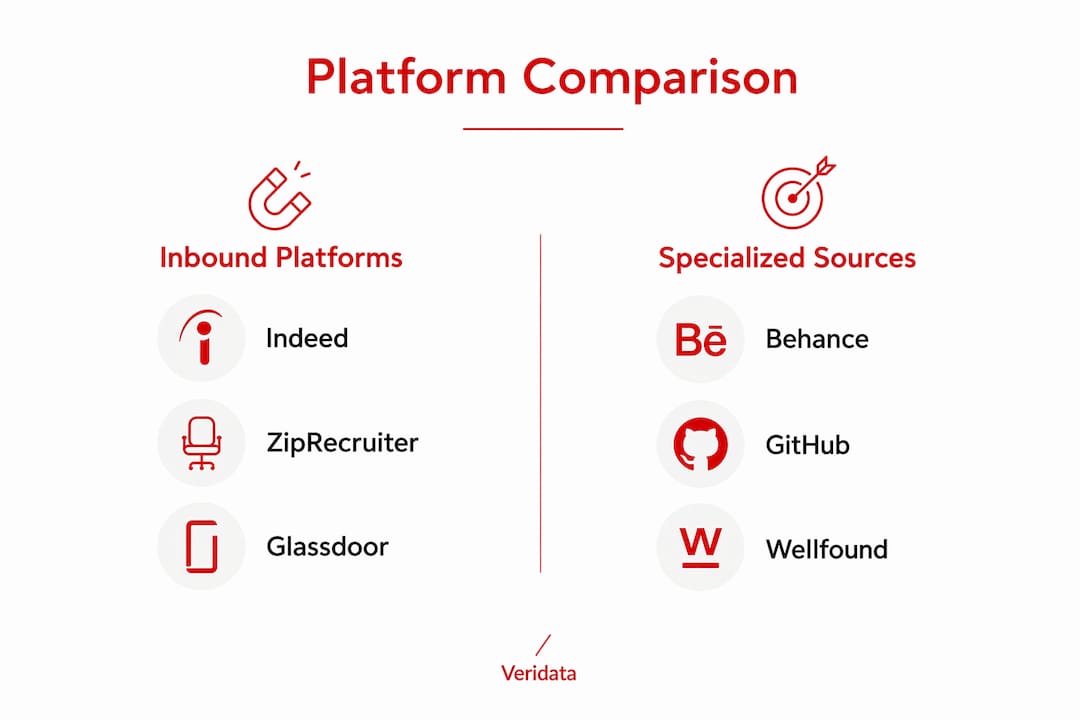
- How do these platforms compare side by side?
- How do you evaluate and choose between platforms?
- How do you run a low-risk pilot on a new sourcing channel?
- When should you hire a research recruitment specialist instead?
- What risks come with replacing LinkedIn and how do you reduce them?
- Key Takeaways
- Veridata Insights handles what platforms cannot
- Useful sources
What are the best do.linkedin.com alternatives by use case?
High-volume inbound hiring
Indeed and ZipRecruiter dominate U.S. inbound hiring at scale. Indeed aggregates postings from across the web, while ZipRecruiter uses matching algorithms to push roles to candidates. Both are pay-per-post or subscription models. The caution: volume is high, but screening burden falls entirely on you.
Glassdoor doubles as a company-review platform, which means candidates arrive with employer expectations already set. Useful for employer-brand-conscious hiring; less useful for passive sourcing.
Creative and portfolio sourcing
Behance and Dribbble are purpose-built for proof-of-work discovery in design, illustration, and UX. Behance skews broader; Dribbble is tighter and more curated. Neither has a resume database, so you are evaluating output, not credentials.

Developer sourcing
GitHub is the standard for engineering proof-of-work. You can search repositories, assess contribution history, and identify active contributors in specific tech stacks. No job-board function, but the signal quality for technical roles is hard to match.
Startup and early-stage hiring
Wellfound (formerly AngelList) is the go-to for startup roles. Equity visibility and founder access make it distinct from generic boards. Candidates here expect transparency about stage, funding, and compensation structure.
AI-driven and people-search sourcing
SeekOut and Hired aggregate profiles across data sources and apply filters for skills, demographics, and availability. AI sourcing platforms are rising fast, but they require defined vetting procedures before deployment. Without a screening layer, match volume can outpace match quality.
Community-driven sourcing
Slack and Discord communities work well for passive, highly specialized talent. The catch: community participation, not hard selling, produces results. You need to add value first, build a presence, and recruit as a natural extension of that relationship.
Pro Tip: For niche B2B or healthcare audiences, community platforms rarely deliver quota-ready samples on their own. Pair them with a structured recruitment layer or a specialist firm.
How do these platforms compare side by side?
| Platform | Best for | Audience / talent pool | Reach / scale | Pricing model | Data quality / verification | Integrations | Research recruitment suitability |
|---|---|---|---|---|---|---|---|
| Indeed | High-volume inbound hiring | Broad U.S. job seekers | National, very high | Pay-per-click / subscription | Low; self-reported | ATS integrations | Low |
| ZipRecruiter | Fast inbound matching | Active U.S. job seekers | National, high | Subscription / per post | Low; algorithm-matched | ATS integrations | Low |
| GitHub | Developer proof-of-work | Software engineers | Global, niche | Free / paid tiers | High; activity-based | API, ATS | Low |
| Behance | Creative portfolio sourcing | Designers, UX, illustrators | Global, niche | Free | Medium; portfolio-based | Limited | Low |
| Glassdoor | Employer brand + hiring | Active and passive job seekers | National, high | Subscription | Medium; review-verified | ATS integrations | Low |
| Slack | Niche community sourcing | Professionals by interest | Niche, variable | Free / paid | Low; community trust | Slack API | Low |
| Discord | Community engagement | Tech, gaming, creative | Niche, growing | Free | Low | Limited | Low |
| AngelList / Wellfound | Startup hiring | Startup-ready candidates | National, niche | Free / paid | Medium; equity-transparent | Limited | Low |
| Hired | Tech and sales talent | Vetted tech professionals | National, niche | Employer subscription | High; pre-screened | ATS integrations | Medium |
| SeekOut | AI-driven talent mapping | Aggregated multi-source | National, high | Subscription | Medium; AI-matched | ATS, CRM | Medium |
| Dribbble | Creative proof-of-work | Designers, motion, brand | Global, niche | Free / paid | Medium; portfolio-based | Limited | Low |
| Veridata Insights | Quotaed research recruitment | B2B, B2C, healthcare, hard-to-reach | U.S. and global | Project-based, no minimums | High; methodology-driven | Custom | High |
Shortlisting rule: Use a single platform when your need is straightforward and volume-driven. Run a multi-channel approach when you need specific demographics, verified respondents, or quota enforcement.
How do you evaluate and choose between platforms?
Start with your business need, not the platform’s feature list. Define the role or sample profile, set your quota targets, confirm your timeline, and establish a budget before you open any vendor page.
Then map those requirements to these criteria:
- Audience fit: Does the platform’s active user base match your target profile? Demographic skews vary sharply across platforms. Frontline workers cluster on community job boards; engineers cluster on GitHub and competition sites.
- Data quality and verification: How does the platform verify user identity and credentials? Self-reported profiles carry more risk than portfolio-based or pre-screened pools.
- Reach: National scale or niche depth? For most U.S. research projects, niche depth beats raw volume.
- Integrations: Does it connect to your ATS or CRM? Structured job markup also improves discoverability via Google for Jobs.
- Privacy and compliance: Does the platform’s terms of service permit research recruitment outreach? Consent flows matter, especially for healthcare or regulated-industry samples.
- Cost model: Subscription, pay-per-post, or managed service? Each carries different risk profiles for a pilot.
Vendor questions worth asking: Where does your data come from? How are profiles verified? What consent did candidates give for outreach? What demographic coverage do you have for my target segment? Can you integrate with our existing ATS or CRM?
Pilot metric checklist: time-to-first-qualified respondent, percentage of recruits meeting screening criteria, false-positive rate, and cost-per-qualified contact. Track all four from day one.
How do you run a low-risk pilot on a new sourcing channel?
A four-to-six-week pilot is enough to validate fit before committing budget. Here is the sequence:
- Define objective and KPIs (Week 1): Write a one-paragraph brief. State the role or sample profile, quota targets, screening criteria, and success threshold.
- Design screening (Week 1): Build a short screener. Three to five questions maximum. Test it internally before launch.
- Set pilot quotas (Week 1): Cap the pilot at 20–30 qualified contacts. Enough to measure quality without overcommitting spend.
- Recruit sample batch (Weeks 2–4): Run outreach or post the role. For community platforms, spend Week 2 on participation before any direct ask.
- Evaluate against metric checklist (Week 4–5): Score time-to-first-qualified, screening pass rate, false-positive rate, and cost-per-qualified.
- Iterate or scale (Week 6): If two or more metrics miss threshold, either adjust the channel or escalate to a specialist.
| Week | Milestone |
|---|---|
| 1 | Brief, screener, and quota targets finalized |
| 2 | Outreach or posting live; community participation begins |
| 3–4 | Recruit sample batch; track time-to-first-qualified |
| 5 | Score metric checklist; flag gaps |
| 6 | Decision: iterate, add a second channel, or hire a specialist |
Pilot budgets in the U.S. market vary by model. Pay-per-post boards (Indeed, ZipRecruiter) can run a meaningful test for a few hundred dollars. Subscription platforms (Hired, SeekOut) typically require a monthly commitment. Managed-service or specialist recruitment is project-based, with no minimums at firms like Veridata Insights.
When should you hire a research recruitment specialist instead?
Platforms are self-serve tools. They work well when your sample is broad, your timeline is flexible, and your screening is simple. When any of those conditions breaks down, a specialist pays for itself quickly.
Signs you need a specialist:
- Your sample requires hard-to-reach B2B respondents (C-suite, niche industry, regulated profession)
- You have complex quotas across multiple demographic or firmographic cells
- You need verified respondent sourcing with documented methodology
- Your timeline is short and your quality threshold is high
- Regulatory constraints apply (healthcare, financial services, government)
What a specialist like Veridata Insights actually provides goes well beyond a list of contacts. It includes methodology design and questionnaire review, quota enforcement, vetted recruiting across B2B, B2C, healthcare, and hard-to-reach audiences, quality controls, and full reporting and analytics. That is the difference between a platform that gives you access and a firm that gives you answers.
Research recruitment for a business consulting firm is a practical example of what that looks like in action: a defined sample, enforced quotas, and a methodology trail that holds up to scrutiny.
When your pilot fails to hit quota or your screening pass rate drops below acceptable thresholds, that is the signal to stop adjusting the platform and start talking to a specialist. The cost of bad data almost always exceeds the cost of professional recruitment.
Pro Tip: Use the online panel vs. custom recruitment decision as your first filter. If your study needs custom quotas or verified B2B respondents, custom recruitment wins every time.
What risks come with replacing LinkedIn and how do you reduce them?
Switching channels introduces real risks. Here are the most common ones and how to handle them:
- Uneven skill representation: Niche platforms skew toward active users, not the full talent or respondent population. Mitigate by cross-referencing two platforms before finalizing a shortlist.
- Weak verification: Most platforms rely on self-reported data. Layer in a short screener, a portfolio review, or a reference check before qualifying anyone.
- Demographic skews: Platform demographics vary significantly in the U.S. market. Developers cluster on GitHub; frontline workers on community boards. Know your platform’s actual user base before setting quotas.
- Privacy and consent issues: Research recruitment outreach on community platforms may not align with platform terms of service. Always confirm consent language and document it in your methodology notes.
- Hidden costs: Free platforms often require paid upgrades for meaningful reach or filtering. Build a total-cost estimate before committing.
Pro Tip: When using Slack or Discord for research sourcing, post a value-first message in the community before any recruitment ask. Cold outreach in community spaces gets ignored or flagged. Warm participation gets responses.
- Always document your consent and screening process, even for informal community sourcing.
- Never rely on a single platform for a quota-critical study. Build in a backup channel from day one.
- If a platform’s demographic coverage is unclear, ask the vendor directly before spending.
Key Takeaways
No single platform replaces LinkedIn for every goal. The most effective approach combines a broad inbound channel for volume, a niche or proof-of-work channel for quality, and a specialist firm when quota accuracy and verified methodology are non-negotiable.
| Point | Details |
|---|---|
| Match platform to goal | Use job boards for volume, portfolio sites for creative/dev sourcing, and communities for niche passive talent. |
| Run a structured pilot | A 4–6 week pilot with defined KPIs (time-to-first-qualified, screening pass rate, cost-per-qualified) reduces wasted spend. |
| Know when to escalate | If pilot quality or quota thresholds are not met, hire a specialist rather than adjusting the platform further. |
| Multi-channel beats single-platform | Combining one broad and one niche channel consistently outperforms any single-platform bet for research-quality sampling. |
| Veridata Insights for verified recruitment | For B2B, healthcare, or hard-to-reach samples with complex quotas, Veridata Insights provides end-to-end methodology support with no project minimums. |
Veridata Insights handles what platforms cannot
Platforms give you access. Veridata Insights gives you answers. When your research project needs quota-enforced, methodology-driven recruitment across B2B, B2C, healthcare, or hard-to-reach audiences, that distinction matters. We operate seven days a week, 365 days a year, with no project minimums, so you can engage us for a single study or a full research program.
Our services cover the full cycle: consultation and methodology design, questionnaire review, survey programming, data collection, data processing, reporting, and analytics and data visualization. We are not a job board or a self-serve panel. We are a research partner.
Ready to talk through your project? Contact Veridata Insights and let us know what you are trying to learn.
Useful sources
- Upwork: 10 Best LinkedIn Alternatives for Hiring and Finding Work in 2026 — covers platform fit by use case, including GitHub, Behance, Dribbble, and Wellfound.
- Juicebox: 29 Best Sites Like LinkedIn for Recruiters in 2026 — covers AI-driven sourcing, demographic skews, and Google for Jobs distribution.
- Search Engine Journal: 8 LinkedIn Alternatives for Professional Networking — covers community platforms (Slack, Discord) and value-first participation models.
- MagicPost: 10 LinkedIn Alternatives Worth Trying in 2026 — covers Indeed, ZipRecruiter, and freelance marketplace options.