

TL;DR:
- LinkedIn-focused outreach with email verification quickly yields qualified B2B respondents through targeted campaigns and CRM tracking.
- Social media is best for niche decision-maker panels and building engagement over time, not for rapid large-sample needs.
LinkedIn-first outreach with paid targeting and corporate email verification is the fastest path to qualified B2B respondents on social channels. Start here: run a narrowly targeted LinkedIn campaign to your exact job titles and company sizes, require a corporate email address in the screener, and tag every social touch in your CRM from day one.
The 90-day benchmark: a well-run pilot should yield a verified sample of 50–150 qualified respondents, a measurable cost per qualified respondent (CPQR), and at least one confirmed CRM attribution event tying social outreach to a research engagement. By month 6–12, social touches should appear consistently in pipeline-influence reports.
- Launch a LinkedIn paid outreach campaign targeting by job title, seniority, and company size.
- Require corporate email verification in every screener, no exceptions.
- Set UTM parameters on all recruitment links and configure CRM to log social touches as influenced opportunities.
Table of Contents
- When does social media actually work for B2B research?
- Which platforms give you the best B2B respondent reach?
- How do you balance paid ads and organic outreach for recruitment?
- How should you design screeners for socially recruited B2B respondents?
- What KPIs actually measure B2B social recruitment success?
- How do you protect sampling quality and catch fraud?
- What do B2B social recruitment projects actually cost and how long do they take?
- How do you evaluate a vendor for social B2B recruitment?
- How Veridata Insights runs social-driven B2B recruitment
- Key Takeaways
- Veridata Insights is ready to run your next B2B recruitment project
When does social media actually work for B2B research?
Social channels shine for niche decision-maker panels, account-based research, and recruiting hard-to-reach technical roles like cloud architects or procurement directors. They also work well for building qualitative communities where ongoing engagement matters. The 95/5 rule from Ehrenberg-Bass is worth keeping in mind: roughly 95% of your addressable market is not actively buying at any given moment, so social builds mental availability over time rather than delivering instant quota fills.
Know when to look elsewhere. If your project needs a large verified panel in under a week, requires strict probability sampling, or has a budget too tight to absorb platform approval cycles, a pre-recruited B2B panel or phone-based recruiting will serve you better than social channels alone.
When to avoid social as the primary recruitment channel:
- Projects requiring instant large panels of verified contacts (500+ completes in under five business days)
- Studies demanding strict probability sampling with known sampling frames
- Very short-sprint projects where platform ad approval timelines eat into fieldwork windows
Decision factors to check before committing: sample frame availability, required verification level, timeline, budget, and GDPR/CCPA compliance constraints.
Pro Tip: Before choosing a channel, map your sample frame. If your target audience is identifiable by LinkedIn job title and company, social recruitment is viable. If the frame is a known list of named contacts, direct email outreach will be faster and cheaper.
Which platforms give you the best B2B respondent reach?
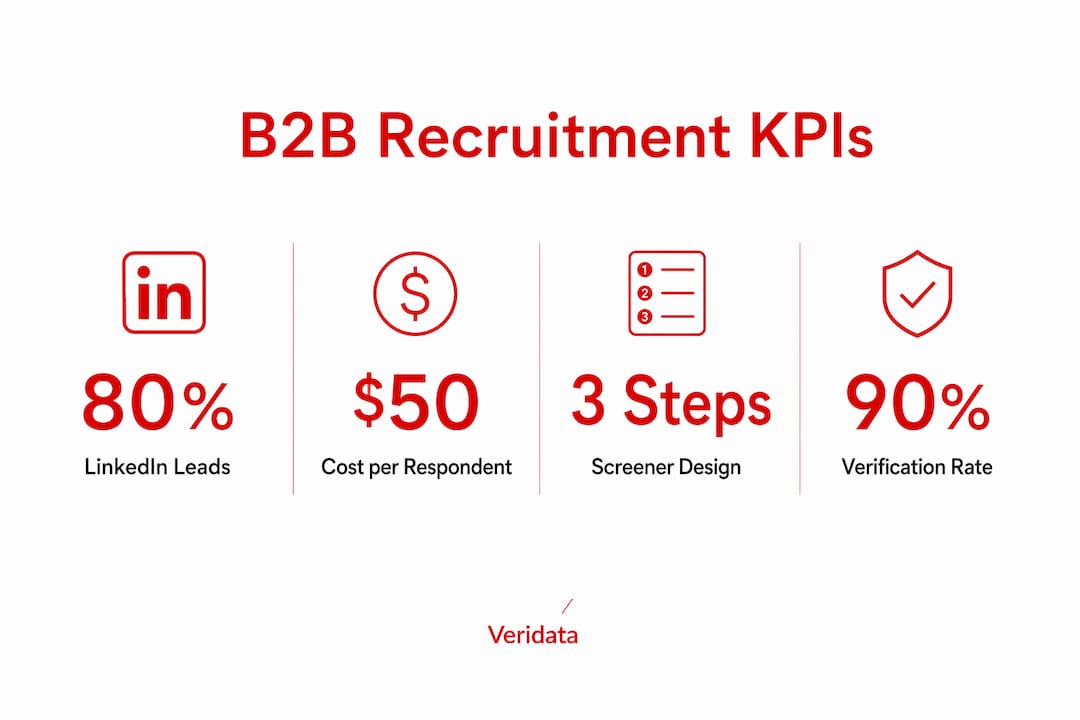
LinkedIn drives roughly 80% of B2B social-media leads, making it the non-negotiable anchor for most research recruitment. Its targeting by job title, seniority, company size, industry, and even specific company names is unmatched for reaching verified professionals. For most B2B research objectives, a two-anchor approach works well: LinkedIn as the primary channel plus one niche platform matched to your audience.

| Platform | Best for | Verification potential | Typical B2B use case |
|---|---|---|---|
| Decision-makers, all industries | High (corporate email, profile check) | Quantitative panels, executive IDIs | |
| X (Twitter) | Developers, engineers, tech buyers | Medium | Real-time category conversations |
| Reddit / Slack communities | Highly specialized technical verticals | Low to medium | Qualitative communities, niche topics |
| YouTube | Educational recruitment, evergreen screener content | Low | Awareness, pre-screener warm-up |
Executive-led content consistently outperforms company pages for engagement on LinkedIn. A named leader posting about a research topic will warm your target list far more effectively than a branded company post. Lo-fi vertical video, shot on a smartphone, can generate 2–3x more engagement than polished corporate posts for some enterprise brands. That matters for recruitment because warm audiences respond to screener invitations at higher rates.
How do you balance paid ads and organic outreach for recruitment?
Paid ads are necessary when you need scale or speed. Organic and direct outreach work well for quality-first, smaller quota fills where relationship context matters. The most efficient approach combines both: organic executive posts warm the audience, then paid amplification pushes the screener invitation to a matched or lookalike audience.
Targeting is everything. Job title alone is not enough. Layer in seniority, company size, industry, and technographic signals (the software stack a company uses) to narrow your audience to the people who will actually qualify.
Practical targeting tactics:
- Upload CRM contact lists as matched audiences on LinkedIn, then build lookalike segments.
- Use LinkedIn Message Ads (sponsored InMail) for direct screener invitations to high-priority accounts.
- Coordinate organic executive posts to publish 5–7 days before paid outreach so the audience has already seen the topic.
Employee advocacy programs can multiply reach relative to corporate pages. Activating two or three internal executives as content voices before a recruitment push is one of the highest-ROI moves available. B2B content should educate and solve problems rather than broadcast product announcements, and the same principle applies to recruitment content: a post that shares a genuine industry insight will earn more screener clicks than one that simply asks people to “participate in a survey.”
Pro Tip: For lead generation metrics tied to recruitment campaigns, a data-driven measurement playbook can help you set realistic cost-per-respondent benchmarks before you launch.
How should you design screeners for socially recruited B2B respondents?
Screener quality determines data quality. For social-recruited respondents, the screener must do double duty: qualify the respondent AND verify their identity.
Required screener fields for B2B social recruitment:
- Company name (open text, checked against domain)
- Corporate email address (required, domain-verified)
- Job title and department
- Decision authority or budget influence (e.g., “Do you influence or approve purchases of $X or more?”)
- LinkedIn profile URL (for manual or automated profile validation on high-value studies)
- Attention check question (e.g., a logic question embedded mid-screener)
Incentive guidance matters too. Cash equivalents (Visa gift cards, Amazon credits) work well for most B2B respondents. Charitable donation options appeal to senior executives who may decline personal incentives for compliance reasons. Keep incentives proportional: a 15-minute survey warrants $25–$50; a 60-minute IDI warrants $150–$300. Oversized incentives for short surveys attract fraudulent completions, so calibrate carefully.
For screener design best practices specific to B2B studies, the screener flow should move from broad qualifying questions to narrow identity-verification steps, not the reverse. Showing the corporate email field too early increases abandonment; placing it after the respondent has already invested two or three qualifying answers improves completion.
What KPIs actually measure B2B social recruitment success?
Vanity metrics like impressions and follower counts tell you nothing about research quality. The right measurement model tracks assisted pipeline, influenced opportunities, and category share of voice, configured directly in your CRM.
| KPI | What it measures | Target benchmark |
|---|---|---|
| Cost per qualified respondent (CPQR) | Total spend divided by verified, eligible completes | Varies by audience rarity |
| Completion rate | Screener starts vs. verified completes | 20% for niche B2B |
| Verification pass rate | Respondents passing corporate email + profile checks | 60% of completions |
| Time-to-quota | Calendar days from launch to quota fill | Typical range varies by project |
| Pipeline influence | Social touches logged in CRM tied to research engagements | Track monthly |
For measuring research impact on client outcomes, UTM parameters on every recruitment link are non-negotiable. Tag respondents in your CRM as “social-recruited” so you can run monthly pipeline-influence reviews. Dark social, meaning content shared privately via DMs or Slack, is a real influence channel for B2B buying decisions and is worth tracking through share-of-voice proxies even when direct attribution is impossible.
How do you protect sampling quality and catch fraud?
Social channels attract motivated fraudsters, especially when incentives are visible. A layered verification approach catches most of them before they contaminate your data.
Verification checklist:
- Corporate email domain check (flag free domains like Gmail, Yahoo, Hotmail)
- LinkedIn profile validation for senior-level respondents
- Time-on-task heuristics (flag completions under a minimum plausible time)
- Attention check questions embedded in the screener and survey body
- Device and browser fingerprinting where platform terms permit
- Duplicate IP and device detection across the respondent pool
Red flags to act on immediately: disposable email domains, role/company answers that contradict each other, quota completions in impossibly short times, and multiple submissions from the same device or IP address. Survey platforms like Qualtrics and Alchemer offer built-in fraud detection; pairing them with a CRM deduplication step catches the cases that slip through.
Pro Tip: Run a domain whitelist for your target industries before fieldwork opens. Any corporate email domain not on the list triggers a manual review rather than an automatic disqualification, which preserves legitimate respondents from smaller or newer companies.
What do B2B social recruitment projects actually cost and how long do they take?
Budget and timeline vary significantly by audience rarity and verification strictness. Here are realistic U.S. market ranges.
| Project type | Typical budget range | Typical timeline |
|---|---|---|
| Small niche panel (single vertical) | Budget and timeline vary, depending on project specifics | |
| Mid-market quota (multi-segment) | Budget and timeline vary, depending on project specifics | |
| Enterprise account-based recruitment | Budget and timeline vary, depending on project specifics |
Growth-stage B2B organizations often invest $150,000–$500,000 annually in social programs and expect 6–12 months before social touches show up meaningfully in pipeline attribution. Research recruitment projects sit within that broader investment context.
What shortens timelines: looser verification requirements, common job titles, generous incentives, and pre-warmed audiences. What lengthens them: strict corporate email verification, very senior or rare titles (C-suite at enterprise companies), slow incentive processing, and LinkedIn ad approval cycles for regulated industries.
Pro Tip: Build a 20% buffer into your timeline for platform ad review delays. LinkedIn’s approval process for research-related ads can add 3–5 business days, especially for healthcare or financial services audiences.
How do you evaluate a vendor for social B2B recruitment?
The wrong vendor costs you more than money. It costs you data quality. Ask these questions before signing anything.
Core RFP questions:
- What are your sample frame sources, and how do you verify respondent identity?
- What is your average completion rate for B2B social-recruited studies?
- How do you detect and remove fraudulent respondents?
- What is your SLA for quota fills and replacements?
- How do you deliver data, and do you support CRM/UTM attribution tagging?
The red flag that matters most: a vendor who cannot clearly describe their verification steps is not protecting your data quality. Promises of fast fills at unusually low cost are a signal, not a selling point.
Request a detailed methodology document, privacy and compliance practices covering GDPR and CCPA handling, sample quota plans, and at least two references or case studies from comparable B2B projects. For context on what strong B2B research agencies include in their methodology, look for firms that document screener logic, verification steps, and CRM attribution support as standard deliverables.
How Veridata Insights runs social-driven B2B recruitment
Veridata Insights approaches social-driven B2B recruitment as a full-service engagement: LinkedIn-first targeting, corporate email verification, screener design, CRM tagging, and reporting are all included. There are no project minimums, and the team operates seven days a week.
A typical engagement looks like this: the team scopes the sample frame and builds a LinkedIn targeting plan matched to the client’s CRM account list, launches paid and organic outreach in parallel, applies corporate email domain verification and attention checks at the screener stage, and delivers a CRM-tagged, verified dataset with a full methodology report.
Service capabilities available for social-driven projects:
- End-to-end B2B recruitment (LinkedIn-first, with niche community sourcing where needed)
- Screener design and respondent verification (corporate email, profile checks, attention checks)
- Survey programming and data collection
- CRM tagging and UTM attribution support
- Data processing, coding, and reporting with analytics and visualization
What sets a quality vendor apart is not just the tools they use but the verification discipline they apply before a single complete enters your dataset. Veridata Insights treats verification as a non-negotiable step, not an optional add-on.
For buyers exploring B2B audience research for the first time or scaling an existing program, the combination of no project minimums and seven-day availability means you can run a 90-day pilot without committing to a long-term contract.
Key Takeaways
LinkedIn-first recruitment with corporate email verification and CRM attribution is the most reliable foundation for social-driven B2B research.
| Point | Details |
|---|---|
| LinkedIn anchors every campaign | LinkedIn drives roughly 80% of B2B social-media leads; treat it as the primary recruitment channel. |
| Verification protects data quality | Require corporate email domain checks and attention checks on every social-recruited study. |
| Measure by quality, not volume | Track CPQR, completion rate, verification pass rate, and CRM pipeline influence, not impressions. |
| Expect a 6–12 month ROI window | Social attribution compounds over time; a 90-day pilot sets the baseline, not the ceiling. |
| Veridata Insights delivers end-to-end | Veridata Insights handles recruitment, verification, CRM tagging, and reporting with no project minimums. |
Veridata Insights is ready to run your next B2B recruitment project
Skip the guesswork of building a social recruitment program from scratch. Veridata Insights delivers verified B2B respondents, CRM-ready data, and full methodology documentation for research projects of any size, with no project minimums and seven-day availability.
Services available for social-driven B2B recruitment:
- LinkedIn-first paid and organic respondent recruitment
- Corporate email verification and fraud detection
- Screener design, survey programming, and data collection
- UTM and CRM attribution tagging
- Reporting, analytics, and data visualization
Ready to scope your 90-day pilot? Contact Veridata Insights with your project goals, target sample frame, and timeline, and we will put together a recruitment plan built around verified quality, not just speed.