


Poor recruitment can waste up to 38% of your research effort and lead to unreliable data that undermines decision making. Many organizations underestimate how profoundly recruitment quality affects research validity, treating participant sourcing as an afterthought rather than a strategic foundation. The reality is that every insight, recommendation, and business decision flowing from your research depends entirely on who participates and how truthfully they respond. This guide explains why professional research recruitment matters, how different approaches compare, and practical strategies to optimize your participant sourcing for maximum data integrity and actionable insights.
Table of Contents
- Key takeaways
- Why research recruitment quality is crucial for data reliability
- Benefits of partnering with professional research recruitment agencies
- Comparing research recruitment approaches: DIY, panels, and professional services
- Practical strategies for optimizing research recruitment in B2B and B2C studies
- Discover expert research recruitment solutions
- Frequently asked questions
Key Takeaways
| Point | Details |
|---|---|
| Quality recruitment matters | Who participates and how honestly they respond determine the reliability of every insight, and poor recruitment can lead to biased results. |
| Niche audience access | Professional recruitment agencies maintain vetted, niche participant databases and rigorous verification to identify true decision makers more efficiently than DIY sourcing. |
| DIY recruitment risks bias | DIY recruitment increases the risk of biased samples, low effort responses, and higher no show rates, which undermines data quality. |
| Cost versus quality | Investing in data quality and targeted sourcing delivers better insights than choosing the cheapest option. |
Why research recruitment quality is crucial for data reliability
The foundation of every research project rests on who participates and how honestly they engage. Poor recruitment dilutes data by introducing bots, dishonest respondents rushing through surveys for incentives, and participants who don’t match your target criteria. When your sample includes people outside your intended audience or those providing low-effort responses, every subsequent analysis becomes suspect.
Skewed samples produce conclusions that look statistically valid but reflect the wrong population entirely. Imagine launching a B2B software product based on feedback from freelancers when your actual buyers are enterprise IT directors. The disconnect between your research participants and real decision makers creates a dangerous illusion of insight that can derail product development, marketing strategy, and resource allocation.
Effective recruitment targets specific segments relevant to your research objectives, whether that means C-suite executives in healthcare, millennial parents shopping for sustainable products, or technical specialists evaluating industrial equipment. B2B and B2C research recruitment experts understand how to identify, verify, and engage these precise audiences rather than settling for convenient but mismatched respondents.
Expert recruitment increases the trustworthiness of market insights by implementing multi-layered verification processes that confirm participant identity, professional credentials, and genuine category experience. This rigor transforms research from guesswork into a reliable foundation for strategic decisions.
Consider these critical recruitment quality factors:
- Verification processes that confirm participant credentials and category experience
- Screening questions designed to identify authentic decision makers versus casual observers
- Engagement monitoring that flags suspicious response patterns or rushed completions
- Database hygiene practices that remove fraudulent or low-quality participants over time
Quality recruitment isn’t about filling quotas quickly. It’s about connecting with the right people who can provide genuine insights that move your business forward.
Benefits of partnering with professional research recruitment agencies
Professional agencies maintain segmented, verified participant databases built over years of careful curation and quality control. Unlike generic panel providers or DIY social media recruitment, these specialized databases include pre-screened individuals whose professional roles, purchasing authority, and category expertise have been validated through multiple touchpoints. This foundation dramatically reduces the time and uncertainty involved in finding qualified participants for specialized studies.

Professional recruitment agencies provide access to high-quality, niche participants while saving substantial time and internal resources that would otherwise go toward sourcing, screening, and coordinating participants. For organizations without dedicated recruitment staff, this efficiency advantage alone often justifies the investment, especially for time-sensitive projects where delays cost opportunities.
Agencies also reduce legal risks associated with participant data handling, consent management, and privacy regulations. GDPR compliance in European markets, CCPA requirements in California, and evolving privacy standards globally create significant liability exposure for organizations handling participant information incorrectly. Professional recruiters implement compliant data practices, proper consent workflows, and secure information handling as standard operating procedure.
Key advantages of professional recruitment include:
- Access to pre-qualified participants across specialized industries and hard-to-reach demographics
- Established relationships that improve response rates and reduce cold outreach rejection
- Quality assurance processes that catch fraudulent or low-effort participants before they contaminate data
- Compliance expertise that protects your organization from regulatory violations and reputational damage
They also improve respondent reliability and reduce last-minute no-shows that derail qualitative research schedules. When you book six executive interviews for a two-day facility visit, having two participants cancel creates expensive gaps and incomplete insights. Professional recruiters use confirmation protocols, relationship management, and backup participant strategies to minimize disruption.
The recruitment quality checklist for agency evaluation:
- Verify their participant database size and segmentation capabilities for your target audience
- Review their screening and verification processes to ensure they match your quality standards
- Confirm their compliance practices align with relevant privacy regulations in your markets
- Assess their track record with similar projects, particularly no-show rates and participant satisfaction
- Understand their backup and replacement protocols when participants cancel or prove unsuitable
While DIY recruitment costs less upfront, it often results in sampling bias, poor data quality, and hidden costs from wasted analysis effort on unreliable responses. Organizations frequently underestimate the internal labor required to source, screen, schedule, and manage participants effectively. When you factor in salary costs for staff time plus the risk of flawed insights leading to bad decisions, professional recruitment often delivers better total value.
Exploring options among top market research recruitment agencies helps you understand capability differences and find partners aligned with your specific audience needs and quality standards. Not all agencies excel at every audience type, so matching agency specialization to your research requirements matters significantly.
This case study on research recruitment compliance demonstrates how proper recruitment practices protect both data quality and legal standing while delivering insights that drive business strategy.
Comparing research recruitment approaches: DIY, panels, and professional services
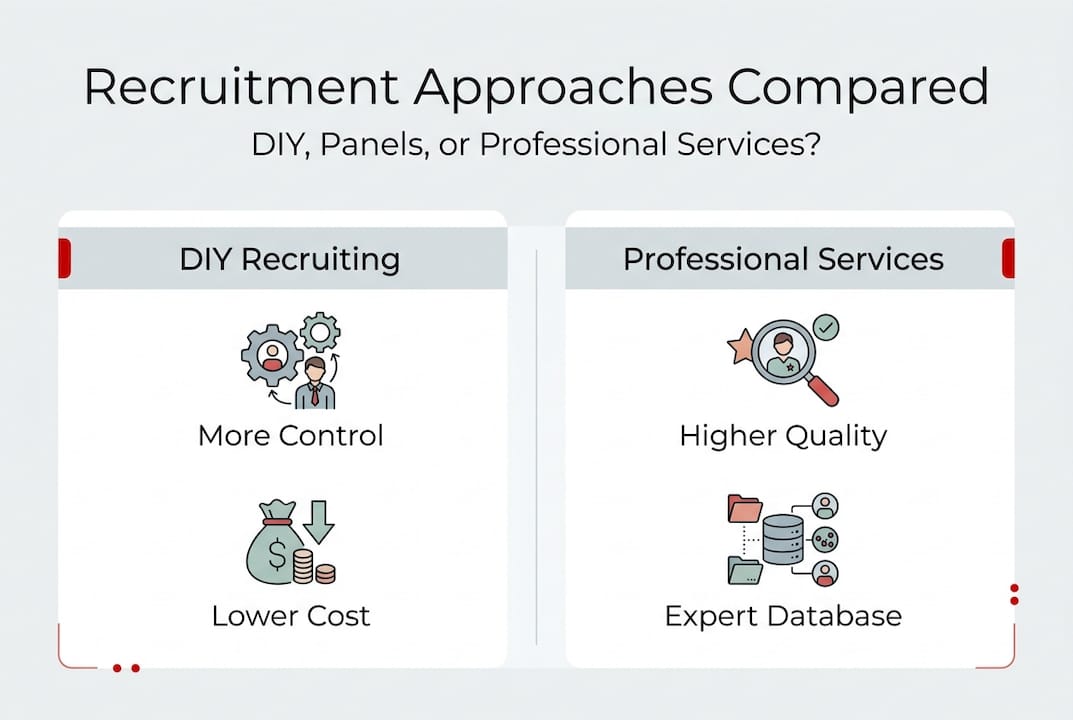
DIY recruitment offers maximum control over participant selection and messaging but demands substantial internal resources and expertise. You control every touchpoint, customize screening precisely to your needs, and build direct relationships with participants. However, this approach risks low response rates when reaching cold audiences, sampling bias toward your existing networks, and quality issues without sophisticated fraud detection.
Panel-based recruitment provides cost-effective access to large participant pools willing to complete surveys for modest incentives. Panels work well for broad consumer studies where general population samples suffice. The trade-off comes in higher fraud vulnerability as professional survey takers learn to game screening questions, less customization since panels cater to multiple clients simultaneously, and potential respondent fatigue when participants complete numerous studies monthly.
Professional agencies provide scalable, expert recruitment with significantly higher quality through specialized databases, relationship-based engagement, and rigorous verification. They excel at niche B2B audiences, hard-to-reach demographics, and studies requiring validated credentials or purchasing authority. The investment exceeds DIY or panel costs but delivers superior data reliability and reduced project risk.
| Approach | Cost | Quality | Speed | Best For |
|---|---|---|---|---|
| DIY | Low | Variable | Slow | Internal audiences, preliminary research |
| Panels | Low-Medium | Medium | Fast | Broad consumer studies, large samples |
| Professional | High | High | Medium | Niche audiences, high-stakes research, B2B |
| Hybrid | Medium | Medium-High | Medium-Fast | Projects balancing speed and quality needs |
Hybrid approaches combine methods strategically, perhaps using panels for quantitative screening surveys followed by professional recruitment for in-depth qualitative interviews with qualified decision makers. This balances speed and cost efficiency with quality where it matters most.
Pro Tip: Match your recruitment approach to research stakes and audience difficulty. Save professional recruitment for projects where flawed insights could lead to costly strategic mistakes, and reserve DIY methods for low-risk exploratory work where perfect sampling matters less than quick directional feedback.
Understanding techniques for recruiting hard-to-reach audiences becomes essential when your target includes senior executives, medical specialists, or other groups with limited availability and high gatekeeping barriers.
Practical strategies for optimizing research recruitment in B2B and B2C studies
Reserve professional recruitment for critical, high-impact research projects where data quality directly influences major business decisions, product development directions, or significant resource allocations. When your research findings will shape a multi-million dollar investment, guide market entry strategy, or determine product roadmap priorities, the incremental cost of expert recruitment provides insurance against catastrophically flawed insights from poor participant selection.
Use DIY recruitment only for preliminary, low-risk validation studies where you need quick directional feedback rather than statistically robust conclusions. Internal user testing, concept reactions from existing customers, or exploratory interviews to shape research questions all represent appropriate DIY applications. The key distinction lies in how much you’ll rely on the findings and what happens if the insights mislead you.
Integrate AI matching tools to improve efficiency in identifying potential participants from large databases, but always combine automated matching with manual fraud detection and quality verification. AI excels at processing screening criteria and flagging candidates who meet surface requirements, but human judgment remains essential for detecting subtle red flags, assessing response authenticity, and building rapport that encourages genuine participation.
Customize screening processes carefully to fit niche B2B or B2C target groups rather than relying on generic demographic filters. For B2B research, verify job titles through LinkedIn, confirm company size and industry through business databases, and validate decision-making authority through specific responsibility questions. For specialized B2C audiences, use behavioral screening that confirms actual product usage, purchase patterns, or lifestyle characteristics rather than accepting self-reported claims.
Optimization tactics for recruitment quality:
- Implement multi-stage screening that starts broad and progressively narrows to highly qualified participants
- Use verification questions that require specific knowledge only genuine category participants would possess
- Monitor completion times and response patterns to identify rushed or automated responses
- Maintain participant feedback loops that help you refine screening criteria based on actual interview quality
Pro Tip: Calculate the cost of poor recruitment by estimating wasted analysis time, flawed strategic decisions, and project delays from unreliable data. When poor recruitment wastes 20-38% of effort in niche markets, even expensive professional services often cost less than the hidden waste from DIY approaches that seem cheaper initially.
Applying B2B research best practices ensures your recruitment strategy aligns with broader research quality standards and methodological rigor that professional audiences expect.
Recognizing the importance of B2B audience research helps justify appropriate recruitment investment by connecting participant quality to business outcomes and competitive advantage.
Discover expert research recruitment solutions
Veridata Insights specializes in expert B2B and B2C recruitment services that connect you with verified, engaged participants across industries, professional roles, and hard-to-reach demographics. Our flexible service model adapts to your specific needs, whether you require comprehensive recruitment management or targeted support for challenging audience segments. We maintain rigorously verified databases, implement multi-layered screening processes, and ensure full compliance with privacy regulations to protect your research integrity.
Professional partnerships optimize recruitment quality while reducing your internal burden and project risk. When data quality directly affects strategic decisions, expert recruitment provides the foundation for insights you can trust and act on confidently.
Reach out to contact Veridata Insights to discuss how our recruitment expertise can elevate your next research project and deliver the participant quality your insights deserve.
Frequently asked questions
Why is high-quality research recruitment important?
High-quality recruitment directly determines data reliability and insight validity by ensuring participants match your target audience and provide truthful, thoughtful responses. Poor recruitment introduces sampling bias, fraudulent responses, and mismatched participants who skew findings away from reality. When your strategic decisions depend on research insights, recruitment quality becomes the foundation that either supports or undermines everything built on top of it.
What are the main advantages of using a professional recruitment agency?
Professional agencies provide specialized, reliable participant pools pre-screened and verified for quality, dramatically reducing the time and uncertainty involved in sourcing qualified respondents. They ensure legal compliance with privacy regulations like GDPR and CCPA, protecting your organization from regulatory violations. Agencies also reduce no-show rates through established relationships and confirmation protocols, while improving overall data quality through sophisticated fraud detection and quality assurance processes.
How do DIY recruitment and professional services differ?
DIY recruitment offers lower cost and maximum control but risks sampling bias, low response rates, and quality issues without expert fraud detection or verification processes. Professional services cost more but provide vetted participants from specialized databases, scalability for large or niche studies, and compliance expertise that protects legal standing. The fundamental trade-off balances upfront cost savings against data quality, project risk, and hidden costs from wasted effort analyzing unreliable responses.
When should I use professional recruitment versus DIY methods?
Use professional recruitment for high-stakes research where flawed insights could lead to costly strategic mistakes, niche audiences requiring specialized access, or studies where compliance and verification matter significantly. DIY methods work for quick validation studies, preliminary exploratory research, or internal audience projects where you already have access and relationships. The decision hinges on research stakes, audience difficulty, and the cost of getting insights wrong versus the investment in getting recruitment right.
Recommended
- Video: Veridata Insights are Research Recruitment Experts – Veridata Insights
- In-Depth Interview Recruiting: Why Veridata Insights Leads the Way in Quality Respondent Engagement – Veridata Insights
- The Best Market Research Agencies for Participant Recruitment – Veridata Insights
- How to Recruit Hard-to-Reach Audiences for Market Research – Veridata Insights
- Evidence-based recruitment steps for public safety 2026