

Focus group recruitment is the work of finding, screening, confirming and getting the right people into your session on the day. Get it right and a moderator has a lively, relevant discussion. Get it wrong and the best discussion guide in the world falls flat. The short version: define who you need in writing, screen them with a tight questionnaire, verify by phone, over-recruit, and pay participants promptly and fairly.
We recruit for B2B, consumer, healthcare and hard-to-reach audiences every day, so this guide is the practical version: what to do, in what order, and where projects usually go sideways.
TL;DR
- Write your audience definition and your “must not” criteria before you touch a screener. Everything else flows from them.
- Plan for a 6 to 10 person group and over-recruit by about 20 to 25% to cover no-shows.
- Demographic matches are not enough. Moderators need people who can talk, listen and take part in a group.
- Real studies never charge participants. Payment comes from the researcher, and timelines should be stated up front.
- Hard-to-reach audiences (physicians, executives, niche users) are where a specialist recruiter pays for itself.
Table of Contents
- What focus group recruitment actually involves
- The stages of a rigorous recruitment process
- Writing a screener that works
- Sample size: how many people, how many groups
- Over-recruit, then keep a waiting list
- Incentives: fair, prompt and clearly explained
- Recruiting hard-to-reach audiences
- In-house recruiting, a panel or a recruiter?
- What to ask a focus group recruiter before you hire
- Common mistakes that cost you the group
- A simple timeline to work backward from
- How Veridata Insights helps
- FAQ
- Sources
What focus group recruitment actually involves
A focus group is a structured discussion led by a facilitator, usually with 6 to 10 participants. That small number is exactly why recruitment matters so much. In a survey of 1,000 people, a few poor respondents wash out. In a group of eight, one wrong person can change the whole conversation.
Recruitment covers more than finding names. It includes:
- Translating your research objective into eligibility criteria.
- Writing a screener that qualifies the right people and quietly filters out the wrong ones.
- Sourcing from a database, a panel, referrals, social channels or client lists.
- Phone or video vetting to confirm answers are true.
- Scheduling, reminders and last-minute replacements.
- Incentive handling after the session.
Whether the group is in person or online changes the logistics (facility, platform, tech checks) but not the discipline. The same people-quality questions apply either way.
The stages of a rigorous recruitment process
Good recruiters follow a sequence. The exact names vary, but these seven stages, as commonly described in field guides such as the WHO’s qualitative research field guide, cover the ground:
- Define objectives and audience criteria. Who must be in the room, and who must not?
- Build a custom screening tool. One screener per study, not a recycled template.
- Choose the channel. Database, social, referrals or a mix.
- Reach out proactively. Do not wait for volunteers to appear.
- Vet by phone. Confirm eligibility and fit in a real conversation.
- Confirm and manage attendance. Reminders, calendar invites, tech checks.
- Coordinate on the day and process incentives.
Stage one is where most projects are won or lost. If you are still fuzzy on who the buyer or user really is, start with a guide on how to identify your target audience before you write criteria. A vague audience produces a vague screener, and a vague screener fills the room with whoever answered first.
Turn the objective into criteria
Take a concrete example. Your objective is to understand why small-practice dentists have not adopted a new scheduling tool. Eligibility criteria might be:
- Owns or manages a practice with fewer than five dentists.
- Involved in choosing software for the practice.
- Has evaluated, but not purchased, a scheduling tool in the last 12 months.
- Does not work for a software vendor or a market research firm.
Notice the last line. Exclusions (competitors’ employees, research industry staff, people who have been in a similar study recently) protect your data as much as inclusions do.
Writing a screener that works
A screener is a short questionnaire that decides who qualifies. It should be quick, neutral and hard to game.
Keep the qualifying answers hidden. If a question reads “Do you use project management software? Yes/No,” anyone who wants the incentive says yes. Offer a list of options, including several that disqualify, and let people pick what is true for them.
Use behavior, not self-description. “How often did you buy X in the last three months?” beats “Are you a heavy user of X?”
Add quotas. Decide the mix by age, gender, region, role or company size before fieldwork starts, and track it as screeners come in.
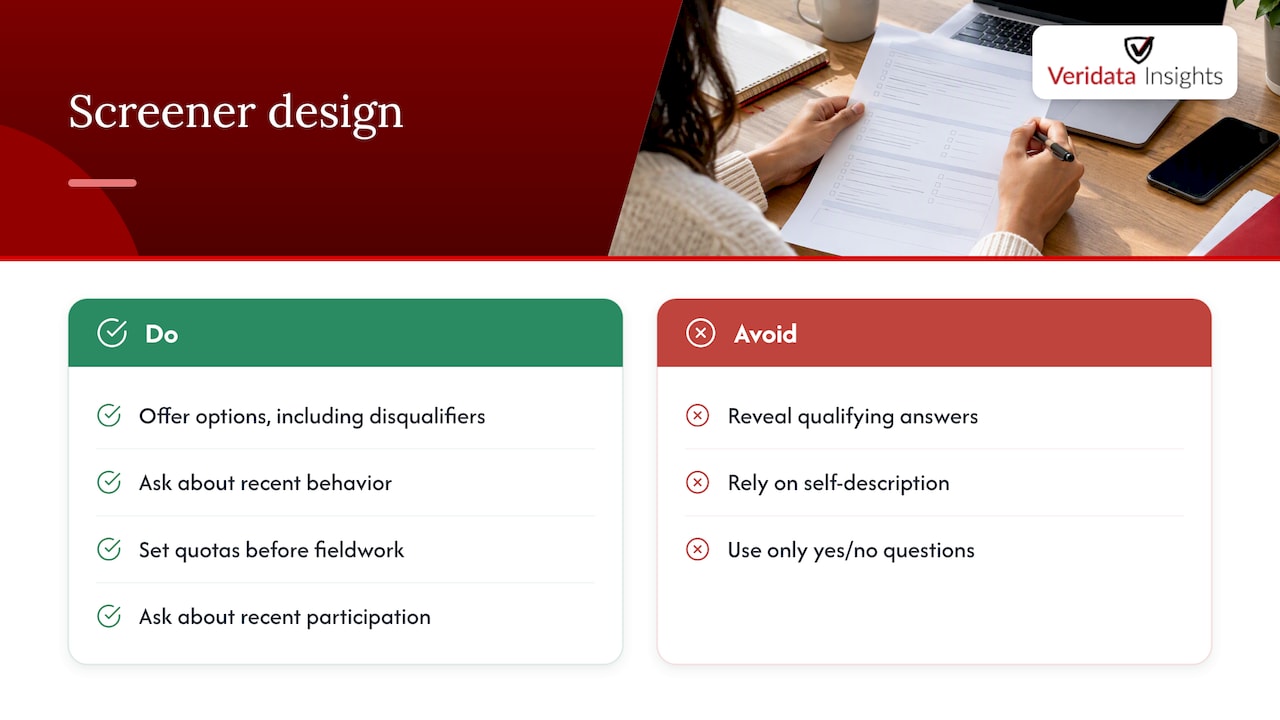
Include a short open-ended question. A sentence or two in answer to “Tell us about the last time you shopped for X” tells you quickly who can express themselves. This is where you start spotting the silent or the rambling.
Ask recent-participation questions. Many researchers exclude people who joined a study on the same topic in the past several months. Set your own window and apply it consistently.
Articulate matters as much as eligible
Moderator Joanna Chrzanowska makes the point in her focus group FAQ: recruitment is only half the job, and recruiters should supply people who are qualified and also capable of engaging in a group discussion, because silent or disruptive members can derail a well-designed study. Brief your recruiter on this directly. Ask them to flag people who gave one-word answers on the phone.
Sample size: how many people, how many groups
A single group of 6 to 10 is standard. How many groups you run is a different question. Researchers writing for the U.S. Institute of Education Sciences stress that the main marker of qualitative rigor is justifying how you sampled, not hitting a particular number. The same guidance suggests giving an expected range based on scope, then judging success by reaching saturation, the point where new sessions stop producing new themes.
In practice:
- Run one group per meaningful segment. If you suspect first-time buyers and loyal customers think differently, do not mix them.
- Start with a plan, then adjust. Selection in qualitative work is often sequential rather than pre-determined, driven by concepts that emerge as you learn.
- Do not treat a focus group as a statistical sample. If you need percentages, pair it with a quantitative study.
Over-recruit, then keep a waiting list
No-shows are the quiet budget killer. Their rate moves with the type of incentive and how sensitive the topic is, and clients tend to underestimate it. The ETR best-practices guide recommends over-recruiting by 20 to 25%. For a target of 8 to 10 attendees, that means inviting 10 to 12.
Two extras make a difference:
- A standby list. Keep a few qualified people who can step in at short notice if someone cancels in the final hours.
- Layered reminders. Confirm by email when they accept, remind them a day ahead, and make a personal call or text on the day. For online groups, add a short tech check so a broken microphone does not become a no-show.
Over-recruiting has a cost, because every extra person who shows up gets paid. Decide up front whether you will seat everyone or release extras with a thank-you incentive, and tell the recruiter.
Incentives: fair, prompt and clearly explained
Incentives should match the time asked and how hard the person is to reach. A consumer in a one-hour online group and a cardiologist in a 90-minute session are not the same ask. Published ranges vary widely by audience, topic and format, so check what comparable studies pay before you budget, and expect specialist professionals to cost much more than general consumers.
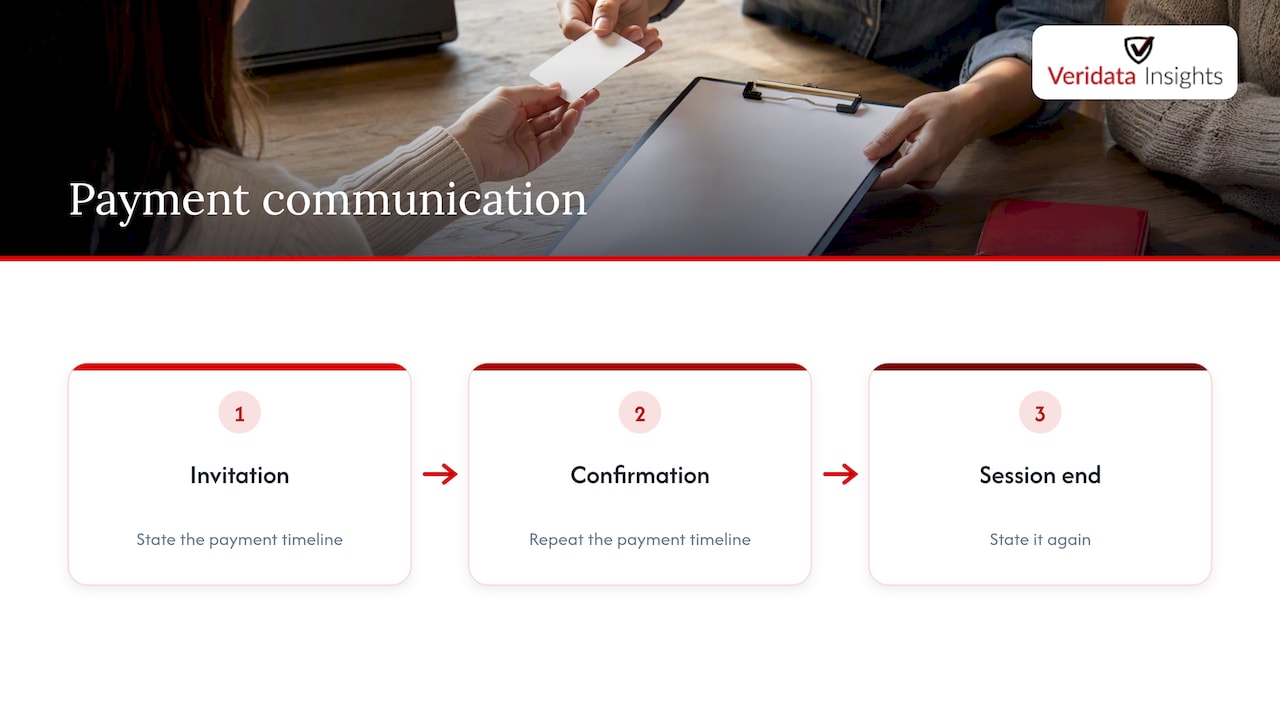
The delivery matters as much as the amount. Legitimate research companies never ask participants to pay a fee to take part, and compensation comes from the researcher by check, a digital platform or a prepaid gift card. Participants should also hear plainly when they will be paid. Some market research projects have 6 to 8 week payment windows after completion, and surprises there lead to angry emails and lower willingness to join future studies. Say the timeline in the invitation, in the confirmation and again at the end of the session.
For participants: how to spot a legitimate invitation
If you landed here wondering whether a focus group invite is real, the same source gives a simple test. A real study never asks for payment, bank login details or a Social Security number to join. If an invitation does, walk away. Those are hallmarks of a scam.
This guide is written for the people commissioning research. If you want to take part in studies, look for invitations from established research firms and read how they handle payment before you share any personal information.
Recruiting hard-to-reach audiences
Recruiting 50 mothers of toddlers in a major metro area is a different problem from recruiting 10 hospital pharmacy directors. Hard-to-reach audiences share a few traits: small populations, little free time, gatekeepers, and a low tolerance for obvious marketing.
What helps:
- Pre-qualified lists and panels with professional verification. Verification of job titles or credentials matters most in healthcare and B2B.
- Multiple channels at once. Email, direct outreach, referrals and social run in parallel instead of in sequence.
- Flexible scheduling. Early mornings, evenings and weekends for busy professionals.
- Higher incentives and shorter sessions. Respect the time, and people say yes.
- Realistic timelines. A niche audience may need several extra days of fielding.
We go deeper on this in our guide to recruiting hard-to-reach audiences, and our pages on healthcare market research and B2B market research cover those two audiences specifically.
In-house recruiting, a panel or a recruiter?
There are three broad routes. None is always right.
| Route | Best for | Watch out for |
|---|---|---|
| Your own customer list or network | Existing customers, quick internal studies | Bias toward friendly respondents, limited reach, no independent vetting |
| Self-service panel or marketplace | Simple consumer criteria, tight budgets | Less phone vetting, harder quota control, thin niche coverage |
| Specialist recruitment firm | Niche, professional or sensitive audiences, multi-market studies | Needs a clear brief; costs more than DIY |
If your criteria fit in two lines and anyone could qualify, DIY can work. When you need verified professionals, tight quotas, several markets or a very low incidence, a recruiter with a deep database and phone vetting will usually save you time and re-fielding costs. Our overview of how to recruit participants for market research walks through the trade-offs in more detail.
What to ask a focus group recruiter before you hire
Use these questions to separate a real recruiting operation from a list broker:
- How do you source participants? Own database, panel partners, social, referrals?
- How do you verify eligibility? Phone vetting, credential checks, ID checks?
- What is your no-show rate, and how do you manage it? Listen for over-recruiting and a standby list.
- Can you share the screener before fieldwork? You should approve it.
- How do you handle quotas and diversity? Ask for progress updates during recruitment.
- Who pays the participants, and when? Clear answers only.
- Can you recruit for online and in-person sessions, and across markets?
- What are the minimums? Some firms will not take small jobs.
Common mistakes that cost you the group
- Starting the screener before the audience is defined. Fix this first.
- Too many criteria. Each one shrinks the pool. Separate must-haves from nice-to-haves.
- Leading questions. If it is obvious what answer qualifies, people will give it.
- Skipping the phone vet. An online screener alone cannot tell you whether someone is articulate or truthful.
- No standby list. One cancellation an hour before start can shrink a group below useful size.
- Mixing very different segments. A group of experts and novices ends up with the experts talking and the novices nodding.
- Unclear incentive timing. Fast to fix, costly to ignore.
A simple timeline to work backward from
Exact timing depends on how niche the audience is, but this working order helps:
- Two to three weeks before: finalize the discussion guide and audience definition, approve the screener, set quotas.
- Two weeks to one week before: active recruitment and phone vetting, with regular counts against quotas.
- Five to three days before: send confirmations, finalize the list, line up standbys.
- One day before and day of: reminders, tech checks for online sessions, final headcount for the moderator.
- After the session: process incentives, thank participants, log who attended for future exclusion windows.
For very hard-to-reach professionals, add a week or more at the front. If you are working to a tight deadline, tell your recruiter on day one rather than day five.
How Veridata Insights helps
We are research recruitment specialists for B2B, B2C, healthcare and hard-to-reach audiences, and we can do as much or as little of the project as you need. Some clients hand us the screener and ask for people. Others want full service: study design and methodology, recruitment, moderation support, coding and reporting. There are no project minimums, and we are available seven days a week, 365 days a year.
If recruitment is the piece you need covered, start with our respondent recruitment team or tell us about your qualitative project. Send us your audience definition and timeline and we will tell you honestly what is feasible.
FAQ
Do you get paid to be in a focus group?
Yes, legitimate studies pay participants for their time, typically by check, a digital payment platform or a prepaid gift card. Amounts vary by audience and session length. Real studies never charge a fee to join or ask for bank logins or a Social Security number.
How many people should I recruit for one focus group?
Aim to seat 6 to 10 participants. To reach that, invite roughly 20 to 25% more than your target, so 10 to 12 invitations for a target of 8 to 10, and keep a standby list for last-minute cancellations.
How do I know my participants are the right ones?
Use a custom screener with hidden qualifying answers, then verify by phone. Check that people are not only eligible but also comfortable talking in a group, since silent or disruptive participants can undermine a session.
When should I use a focus group recruiter instead of recruiting myself?
Hire a specialist when the audience is niche (physicians, executives, specific users), when you need strict quotas or several markets, or when you lack time for phone vetting and scheduling. For broad consumer criteria and a small budget, in-house recruiting can be enough.
Sources
- Focus Groups, ETR best practices
- Focus Group FAQ’s, Qualitative Mind
- Qualitative Research Methods Overview, IES
- Data collection and sampling in qualitative research: does size matter?
- A field guide to qualitative research for new vaccine introduction, WHO
- Is User Interviews Legit? Real Pay & Reviews, Articuler