


TL;DR:
- Effective segmentation significantly boosts customer lifetime value, personalization, and marketing efficiency for brands.
- Avoiding over-segmentation and regular updates are crucial for maintaining relevant and impactful segmentation strategies.
- Ongoing, data-driven research empowers brands to adapt quickly and build lasting customer relationships through precise targeting.
Broad branding feels safe. Cast a wide net, reach more people, win more business. But the data tells a very different story. Amazon’s segmentation yields 6x higher customer lifetime value for Prime members compared to non-segmented shoppers. That is not a marginal improvement. That is a fundamental shift in how a brand creates and captures value. For brand managers and marketing strategists, the message is clear: generic strategies leave enormous revenue on the table. Segmentation is not just a tactic. It is the engine behind the brands that consistently outperform, outlast, and outmaneuver the competition.
Table of Contents
- Understanding segmentation: Foundations for modern branding
- The strategic impact: Segmentation as a branding powerhouse
- Pitfalls and challenges: Avoiding segmentation mistakes
- Application: Bringing segmentation to life in branding strategy
- Perspective: What most branding advice misses about segmentation
- Connect your segmentation strategy with expert research
- Frequently asked questions
Key Takeaways
| Point | Details |
|---|---|
| Segmentation boosts ROI | Brands using segmentation achieve higher ROI and more effective campaigns. |
| Personalized messaging | Segmented strategies allow brands to deliver relevant, personalized communications. |
| Avoid over-segmentation | Too many segments can dilute brand impact and waste resources. |
| Continuous refinement | Organizations should update their segments to reflect shifting customer behaviors. |
| Expert support matters | Brand managers benefit from professional market research to guide segmentation strategy. |
Understanding segmentation: Foundations for modern branding
Segmentation is the practice of dividing a broad market into smaller, more defined groups of customers who share common characteristics. Market segmentation divides broad markets into smaller groups based on shared characteristics, enabling brands to speak precisely to the people most likely to respond. That precision is everything.
The four core types of segmentation give brand managers a flexible toolkit:
- Demographic segmentation: Age, gender, income, education, occupation. This is often the starting point, especially in B2C markets where purchasing power and life stage shape buying decisions.
- Geographic segmentation: Region, country, city size, climate. Particularly relevant for brands with location-specific offerings or regional pricing strategies.
- Psychographic segmentation: Lifestyle, values, personality traits, attitudes. This goes deeper than who your customer is and asks why they make the choices they do.
- Behavioral segmentation: Purchase history, brand loyalty, usage frequency, benefits sought. In many ways, this is the most actionable type because it is grounded in what customers actually do, not just who they are.
“Segmentation is not about dividing your customers. It is about understanding them well enough to treat each group as if your brand was built specifically for them.”
The power of segmentation really shows up in the STP framework: Segmentation, Targeting, and Positioning. Segmentation identifies the groups. Targeting selects which groups are worth pursuing based on size, profitability, and strategic fit. Positioning crafts the specific brand message that resonates with each target group. Without segmentation, targeting is guesswork and positioning is generic. Together, the three steps turn a brand from a megaphone into a conversation.
Working with market research agencies for B2B is one of the smartest ways to build a segmentation foundation that is grounded in real data rather than assumptions. Getting the segmentation right early pays off exponentially in every campaign, product launch, and customer retention effort that follows.
The strategic impact: Segmentation as a branding powerhouse
With the basics in place, let’s look at the tangible outcomes segmentation delivers for brands.
The numbers are hard to argue with. Segmentation enhances branding by allowing personalized messaging, product tailoring, and resource optimization across every touchpoint. And strong brands leveraging segmentation outperform markets by 20% in B2B contexts and see 30% efficiency gains in how they allocate marketing spend. These are not theoretical benefits. They show up in quarterly reports.
Here is a snapshot of what segmentation-driven performance looks like across key metrics:
| Metric | Without segmentation | With segmentation |
|---|---|---|
| Customer lifetime value (CLV) | Baseline | Up to 6x higher (Amazon Prime) |
| Email revenue contribution | Standard rates | 29% increase |
| Promotional spend waste | High | 40% reduction |
| Repeat purchase rate | Baseline | 3.5x improvement |
| Marketing efficiency | Standard | 30% efficiency gains |
Those numbers tell a story. The Amazon segmentation model yields 6x higher CLV, a 29% increase in email revenue, and a 40% reduction in promotional waste. That is not luck. That is the result of deeply understanding customer segments and building every touchpoint around that understanding.
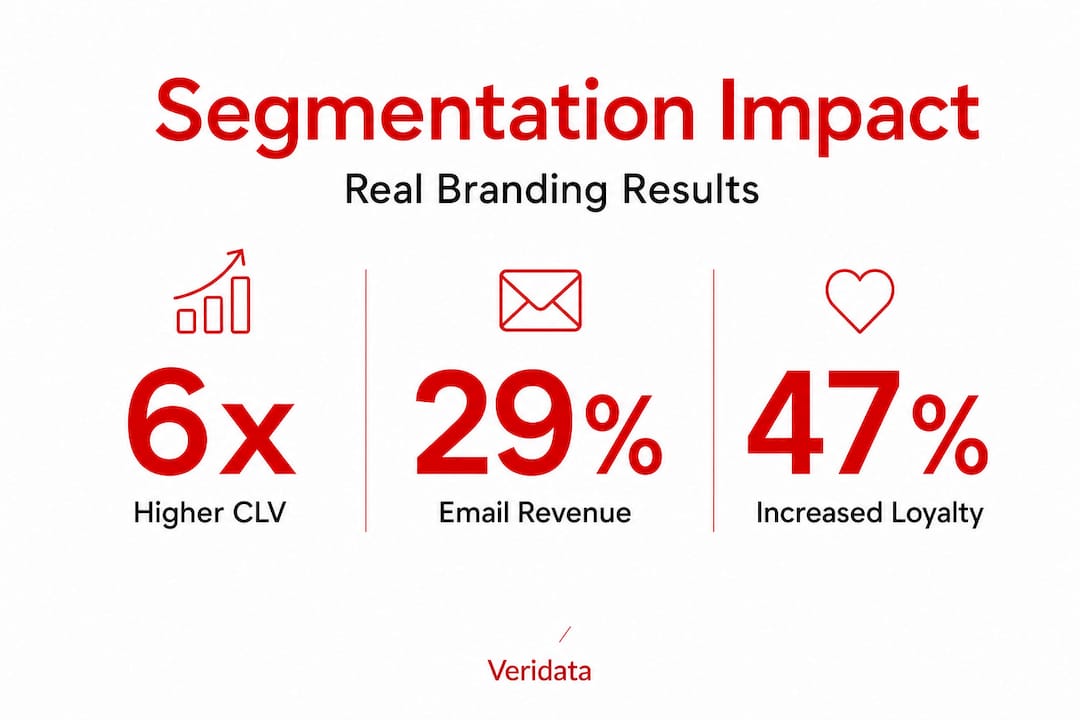
Statistic callout: Amazon’s segmentation-driven approach produces a customer lifetime value that is 6 times higher for Prime members. If your brand is not segmenting, you are not just missing out on personalization. You are missing out on the compounding returns that come from building real customer relationships.
The personalization effect matters enormously in B2C markets, but it is equally powerful in B2B. When a brand can speak directly to the specific challenges of a financial services firm versus a manufacturing company, the message lands differently. It signals that the brand understands the customer’s world. That understanding builds trust, and trust builds loyalty.

Monitoring B2B market trends is essential here. Segmentation strategies built on outdated market assumptions will underperform even with strong execution. The market shifts. Your segments need to shift with it.
Pitfalls and challenges: Avoiding segmentation mistakes
Even with huge upside, segmentation requires careful implementation. Here is what to watch out for.
The most common mistake is over-segmentation. Over-segmentation risks resource fragmentation; changing customer behaviors challenge static segments; and cold-start situations for new customers create a real lack of usable data. Each of these problems can quietly undermine a segmentation strategy that looks great on paper.
Over-segmentation happens when teams get too granular. Instead of five meaningful segments, they end up with forty micro-segments that each require their own creative, messaging, and campaign logic. The result is a stretched team, diluted focus, and inconsistent brand experiences. More segments does not always mean more precision.
Static segments are another trap. A segment that perfectly described your customer two years ago may be completely wrong today. Consumer values shift. Economic conditions change. New competitors enter the market and reshape how customers think about your category. Treating segmentation as a one-time exercise rather than an ongoing practice is a formula for irrelevance.
Here are the steps we recommend to avoid the most common segmentation errors:
- Start with clear business objectives. Segmentation should serve a strategic purpose, not exist for its own sake. Know what you are trying to achieve before you decide how to segment.
- Limit initial segments to a manageable number. Three to five well-defined segments are almost always more useful than twenty loosely defined ones.
- Validate segments with real customer data. Qualitative research, surveys, and behavioral analytics should all confirm that your segments reflect actual customer differences.
- Build in a review cycle. Revisit segments at least twice a year. Markets move fast, and your segmentation framework needs to keep pace.
- Test messaging before full deployment. Pilot campaigns with a subset of each segment before rolling out brand-wide. Small tests save big mistakes.
- Monitor for segment overlap. If customers keep appearing in multiple segments, your segmentation criteria may need sharpening.
Pro Tip: Hybrid approaches work best. Combine the stability of demographic and geographic segmentation with the responsiveness of behavioral and psychographic data. The static layers give you structure. The dynamic layers keep you relevant.
Understanding shifting consumer preferences is a core part of keeping segmentation effective. Brands that build feedback loops into their segmentation process are the ones that stay ahead.
Application: Bringing segmentation to life in branding strategy
Now that you know what works and what to avoid, let us explore how to actually apply segmentation to your branding strategy.
The difference between traditional branding and segmentation-driven branding is stark. Take a look:
| Dimension | Traditional branding approach | Segmentation-driven branding |
|---|---|---|
| Audience targeting | Broad, demographic-based | Specific, needs-based and behavioral |
| Messaging | One message for all | Tailored by segment |
| Product development | Category-focused | Customer-problem-focused |
| Campaign ROI | Difficult to attribute | Measurable by segment |
| Brand positioning | Single brand voice | Adaptive within a consistent identity |
| Resource allocation | Spread evenly | Weighted toward high-value segments |
The contrast is clear. Segmentation-driven branding treats the audience as a collection of distinct communities rather than a single mass market. That shift changes everything from creative development to media buying to customer service scripts.
Segmentation is foundational for STP in branding, and the brands that execute this best show us what is possible. Nike is one of the clearest examples. Nike pivoted to needs-based segmentation for its turnaround, emphasizing performance over lifestyle to restore relevance with core athletes. Rather than marketing broadly to “sports fans,” Nike focused on specific performance needs: the marathon runner, the basketball player training for the next level, the everyday athlete trying to beat their personal record. That specificity made the brand feel personal again.
Here is a practical action list for applying segmentation to your branding strategy:
- Conduct a segmentation audit. Map your current audience against the four core segmentation types and identify gaps.
- Prioritize segments by lifetime value, not just size. A smaller segment with high loyalty and high spend is often more valuable than a large segment with low engagement.
- Develop distinct value propositions for each key segment. Your core brand promise stays consistent. The way you express it should flex by segment.
- Align your creative assets to segment needs. Imagery, tone, channel choice, and offer structure should all reflect segment-specific insights.
- Use qualitative research to pressure-test assumptions. Focus groups and in-depth interviews often surface needs that quantitative data misses entirely.
- Track segment-level performance separately. Aggregate metrics hide what is actually working. Segment-specific reporting tells the real story.
Investing in B2B audience research is particularly valuable here. B2B purchase decisions involve multiple stakeholders, longer cycles, and higher stakes. Segmentation that maps to roles, industries, and pain points gives your brand a real edge.
If you are designing research to support your segmentation work, a customized market research survey built specifically for B2B audiences will give you the clean, actionable data that generic survey tools simply cannot deliver.
Perspective: What most branding advice misses about segmentation
Having mapped out execution, let us step back for a fresh perspective grounded in field experience and research.
Here is the uncomfortable truth: most segmentation fails not because of bad data, but because of rigid thinking. Teams invest in a segmentation study, build a model, create personas, and then treat those personas as fixed truths for the next three years. The market moves. The personas do not. And gradually, the branding strategy built on those segments starts to feel off, even if no one can quite articulate why.
We see this pattern repeatedly. Brands that were sharp and relevant two years ago start to lose resonance. Campaigns that used to convert stop working. And when you dig into why, the answer is almost always the same: the segments were never updated.
Hybrid approaches and continuous refinement are not just best practices. They are survival requirements in fast-moving markets. The brands that get this right treat segmentation as a living system, not a filing cabinet. They blend the structural stability of demographic data with the real-time responsiveness of behavioral signals. They run small tests constantly. They listen to segment-level feedback and act on it quickly.
Nike’s turnaround is instructive here. The brand did not just update its messaging. It fundamentally rethought which customer needs it was organizing itself around. That is a much deeper kind of segmentation work. It requires courage, because it means being willing to walk away from segments that no longer fit the brand’s strategic direction.
Amazon does something similar, but at a different scale. The sophistication of its behavioral segmentation means that the brand is essentially running thousands of micro-experiments at any given time, constantly learning what each segment responds to and adjusting accordingly.
For most B2B and B2C brands, that level of scale is not realistic. But the principle is. Treat your segments as hypotheses, not facts. Test them. Challenge them. Update them. When you are ready to bring a new product to market or enter a new segment entirely, new product launch research can give you the grounded insights you need to move with confidence rather than guesswork.
The brands that thrive long-term are the ones that resist the temptation to lock in a segmentation model and coast. Flexibility is not weakness. It is precision in motion.
Connect your segmentation strategy with expert research
Ready to take action? Translating segmentation insight into real brand results requires more than a good framework. It requires quality data, expert methodology, and research that is designed around your specific objectives. That is exactly what we do at Veridata Insights.
We work with brand managers and marketing strategists across B2B and B2C sectors to design and execute research that powers smarter segmentation decisions. Whether you need a full segmentation study or targeted research to validate one key assumption, our consultancy can support you at whatever scope makes sense. No project minimums. Seven days a week. Explore the market research agencies for B2B landscape or go straight to the source and contact Veridata Insights to start a conversation about your segmentation research needs. We are ready when you are.
Frequently asked questions
What is segmentation in branding?
Segmentation in branding means dividing your audience into smaller groups based on traits like demographics, behavior, and needs to make your brand messaging more relevant. As market segmentation defines, these groups share characteristics that make targeted communication possible.
How does segmentation enhance brand loyalty?
Segmentation enables brands to deliver tailored experiences, leading to higher satisfaction, repeat purchases, and long-term loyalty. Amazon’s approach drives a 3.5x repeat purchase rate compared to non-segmented approaches.
What are the main types of market segmentation?
The four main types are demographic, geographic, psychographic, and behavioral segmentation. Each type captures a different dimension of customer characteristics and serves different strategic purposes depending on your brand objectives.
Can over-segmentation hurt branding efforts?
Yes, absolutely. Over-segmentation fragments resources and dilutes brand focus by spreading creative and budget efforts too thin across too many small groups.
How can brands adapt segmentation to changing customer behaviors?
Brands should use hybrid segmentation approaches, monitor market shifts consistently, and build regular review cycles into their research calendar. Continuous refinement and hybrid approaches are the most reliable way to keep segmentation strategies accurate and effective over time.
Recommended
- Unlocking Growth with Market Segmentation – Veridata Insights
- Why You Should Run Brand Tracking – Veridata Insights
- What Are the Benefits of Running Brand Tracking to Monitor My Company’s Market Reputation? – Veridata Insights
- Why You Should Conduct Customer Research and Segmentation – Veridata Insights