


TL;DR:
- Data quality in litigation revolves around accuracy, completeness, and provability, outweighing sheer volume and emphasizing structured, auditable evidence. Courts increasingly demand native format production, comprehensive metadata, and rigorous chain of custody, especially for AI outputs, to avoid sanctions and admissibility issues. Building continuous governance, immutable storage, and clear documentation before litigation ensures defensible evidence and reduces costly reactive measures.
More data is not better data. That’s the misconception quietly undermining litigation strategies across corporate legal departments right now. The role of data quality in litigation has never been more consequential: courts are scrutinizing evidence at the metadata level, judges are sanctioning broken chains of custody, and AI-generated outputs face gatekeeping requirements that most legal teams aren’t prepared for. This guide cuts through the noise and gives you a clear, practical framework for what data quality actually means in a legal context, why it shapes case outcomes, and what your team should be doing about it in 2026.
Table of Contents
- Key takeaways
- The role of data quality in litigation, defined
- What courts actually expect from your data
- Litigation data management best practices
- Legal data vs. general business data
- AI evidence and the data quality stakes
- My take: data quality is a practice, not a project
- How Veridatainsights supports your litigation data needs
- FAQ
Key takeaways
| Point | Details |
|---|---|
| Quality beats volume | Courts prioritize accuracy, provenance, and completeness of data over sheer quantity when evaluating evidence. |
| Legal standards are tightening | FRCP rules and proposed FRE 707 demand structured, validated, and auditable data for admissibility. |
| AI evidence needs human oversight | AI-generated outputs require documented human review and timestamped audit trails to survive discovery. |
| Immutable storage is non-negotiable | Offline, tamper-proof archives protect chain of custody and withstand both cyberattacks and judicial scrutiny. |
| Governance closes the gap | Data quality without governance policy is just good luck. Consistent documentation transforms luck into defensible practice. |
The role of data quality in litigation, defined
Not all data problems are created equal. Before your team can fix anything, you need to know exactly what “data quality” means when evidence is on the line.
Data quality in a legal context refers to five distinct properties: accuracy, completeness, timeliness, relevance, and reliability. A dataset can fail on any one of these dimensions and still look perfectly fine on the surface. A spreadsheet full of transaction records, for example, may appear complete but contain timestamps from the wrong time zone, making them legally useless for establishing a liability timeline.
It helps to separate three concepts that legal professionals often conflate:
- Data quality refers to whether data is fit for its intended legal purpose, including evidence production, expert analysis, and compliance reporting.
- Data integrity refers to the consistency and accuracy of data across its entire lifecycle, protected against unauthorized modification. Flawed data operationalized into analytics causes long-term damage that compounds over time.
- Data volume refers to how much data exists. Volume is legally irrelevant without quality.
Courts are now treating evidence admissibility as a quality question, not a quantity question. Digital evidence weight has shifted from screenshots to metadata, including modification logs, timestamped access records, and telematics data. A poorly labeled file with missing provenance will not survive a challenge, no matter how many gigabytes accompany it.
The risks of poor data quality in legal settings are concrete. Incomplete discovery productions lead to sanctions. Inaccurate data used in expert reports invites Daubert challenges. Stale data relied upon for damages calculations creates exposure on appeal. Data integrity in legal cases is not a back-office IT concern. It is a front-line litigation asset.
What courts actually expect from your data
Legal standards for data quality are not static, and 2026 has brought sharper expectations.
Judges are compelling native-format data production with increasing regularity. Courts reject arguments that structured data discovery violates Rule 34, and sanctions under FRCP 37(e) are applied when chains of custody are broken or data pipelines show integrity gaps. The message from the bench is clear: produce clean, structured, auditable data or face consequences.
Chain of custody is where many corporate legal teams stumble. The standard two-hash protocol for digital evidence requires a source hash upon acquisition and a verification hash during analysis. This bit-for-bit integrity check is the accepted method in U.S. courts for proving data has not been altered. If your IT department cannot produce these logs on demand, you have a gap worth addressing now.
Here are the current judicial expectations your team needs to account for:
- Native format production. Courts increasingly require structured data in its original system format, not exported CSV files stripped of context.
- Metadata completeness. Modification logs, access records, and creation timestamps are treated as substantive evidence, not administrative details.
- Chain of custody documentation. Every handoff point in the data lifecycle must be logged. Gaps invite adverse inference motions.
- AI output accountability. Under FRE 104, judicial gatekeeping applies rigorous reliability standards to machine-generated evidence, requiring expert human validation and transparent data provenance.
- Provenance records for third-party data. If your evidence originates from a vendor or cloud platform, the contractual and technical record of data custody must be producible.
The Lokken ruling illustrates what happens when these standards are not met. In that case, AI-generated claim denials became discoverable in bad-faith suits precisely because the organization lacked documentation of how those outputs were generated and reviewed. The impact of data quality on lawsuits like this one is not hypothetical. It translates directly to sanctions, adverse rulings, and settlement pressure.
Courts no longer accept “we had the data” as a defense. The question is whether you had defensible data.
Litigation data management best practices
Getting your data house in order before litigation hits is the only strategy that actually works. Reactive data cleanup during discovery is expensive, slow, and often incomplete.
Map your data flows first
Early mapping of IT data flows and clear contractual roles reduce litigation exposure significantly, especially in technology disputes where fragmented vendor responsibilities complicate liability. Fragmentation of vendor responsibilities in multi-party IT supply chains is one of the most common and underaddressed sources of data quality failure in corporate legal work.
Start by documenting which systems hold legally relevant data, who owns each data pipeline, and what service-level agreements govern third-party data custody. Ambiguous agreements create targeted claims during disputes. Clarity prevents them.
Build around governance, not just technology
Many legal teams invest in AI tools and discovery platforms without the governance layer that makes those tools defensible. The table below captures the practical difference:
| Approach | What it looks like | Litigation outcome |
|---|---|---|
| Technology without governance | AI tools deployed, no audit trail policy | Outputs challenged, human review undocumented |
| Governance without technology | Manual logs, slow data retrieval | Chain of custody intact, but production delays |
| Technology with governance | Structured data, documented AI review, immutable backups | Defensible evidence, efficient discovery |
Corporate legal departments adopting AI-ready frameworks prioritize clean, structured data before deploying any AI-driven analysis. That sequencing matters. Garbage in, garbage out is a cliché, but in litigation it becomes garbage in, sanctions out.
Prioritize immutable, offline storage
Immutable, offline backups provide auditable, tamper-proof evidence that satisfies chain-of-custody requirements. Physical immutability through optical media offers stronger guarantees against cyberattacks than software-based cloud solutions. This is one of the most overlooked elements of legal data integrity in mid-size corporate legal departments.

Pro Tip: Set up your immutable archive before litigation is reasonably anticipated, not after a litigation hold is issued. Courts look at when preservation obligations were triggered, and a retroactive archive won’t protect you from spoliation arguments.
Additional practices that hold up under judicial scrutiny include:
- Documenting every human and AI review action with timestamps and reviewer identifiers
- Separating data intake processes from verification to avoid confirmation bias in evidence preparation
- Running regular data quality audits against your litigation hold inventory, not just at the time of the hold
- Maintaining a data quality log that tracks corrections and the reason for each change
How data quality affects court outcomes often comes down to whether these logs exist and whether they are consistent. Judges read discovery records carefully.
Legal data vs. general business data
Here is where many corporate attorneys underestimate the stakes. The error tolerance acceptable in a sales database or a marketing analytics report is fundamentally incompatible with legal data handling.
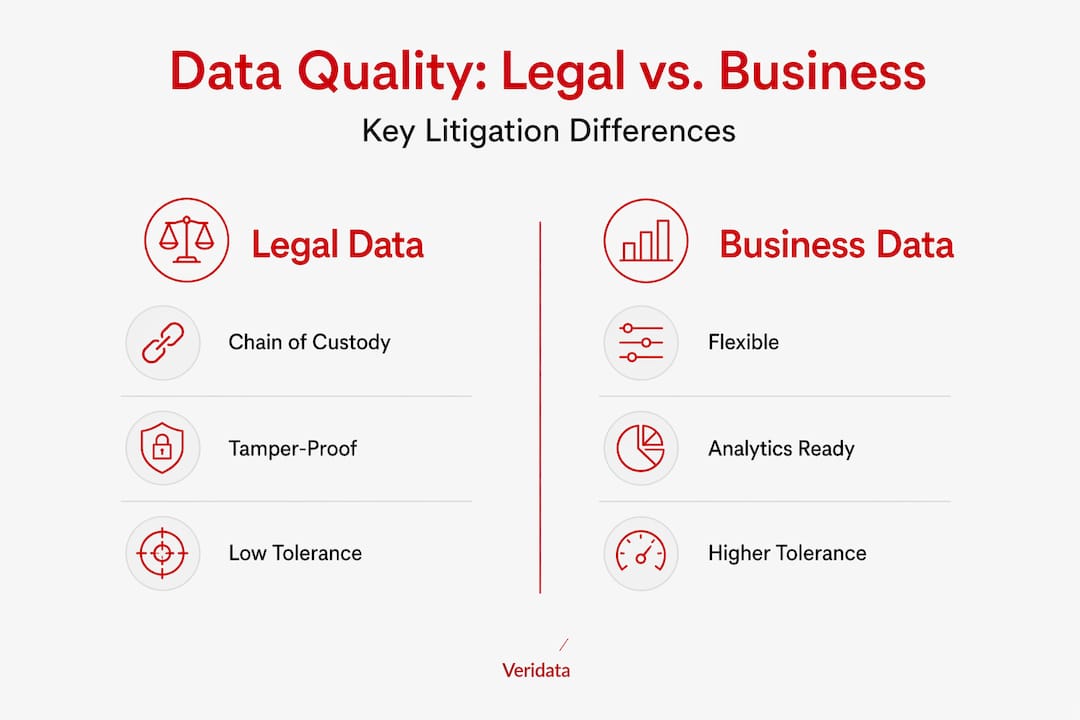
In business contexts, a 95% accuracy rate on a customer list is fine. In a legal context, that 5% error rate could mean producing incorrect communications records, misidentifying the custodian of a key document, or triggering a malpractice claim. Data with poor quality or unclear provenance increases the risk of malpractice claims and ethical breaches for law firms and attorneys.
Legal data also carries obligations that business data does not:
- Attorney-client privilege requires that data handling practices do not inadvertently waive privilege through improper disclosure or inadequate access controls.
- Confidentiality duties extend to how data is stored, transmitted, and shared with third-party vendors during discovery.
- Ethical obligations under Model Rules require attorneys to supervise the data practices of non-attorney staff and technology vendors.
Pro Tip: When onboarding a new e-discovery vendor, require a written data quality protocol that addresses error rates, validation procedures, and chain-of-custody documentation. Verbal assurances are not defensible.
The impact of AI-driven legal analytics on decision-making reliability depends entirely on the quality of the underlying data. Low-quality inputs produce predictions and risk assessments that feel authoritative but are structurally unsound. In litigation strategy, that is a dangerous combination.
AI evidence and the data quality stakes
AI is now a fixture in legal work, from contract analysis to claims adjudication. The courts are catching up fast, and the requirements for data reliability for legal evidence derived from AI are getting stricter.
Here is what defensible AI evidence requires in 2026:
- Transparent data provenance. Every AI output used in litigation must trace back to its source data, with documentation of when that data was collected, validated, and processed.
- Timestamped audit trails. AI outputs need to be tracked with timestamped records linking human reviewers to final decisions.
- Human review attestation. Failure to document human engagement with AI outputs creates records that are highly vulnerable to adverse rulings in discovery.
- Discrepancy cataloging. Detailed tables cataloging AI discrepancies on a filing-by-filing basis strengthen motions for evidentiary exclusion and are increasingly expected in AI-related disputes.
AI hallucinations are not just embarrassing. They are a litigation liability when they stem from outdated or low-quality training data. Incorrect AI inputs can produce actionable claims including wrongful termination and breach of contract. Pre-validation of AI-driven insights is the only way to mitigate that risk before it reaches a courtroom.
“The question is not whether AI was used. The question is whether the AI was fed clean data, supervised by humans, and documented throughout.” That framing captures exactly what courts are beginning to demand.
My take: data quality is a practice, not a project
I’ve worked alongside enough legal teams to know the pattern. Data quality becomes a priority during the first major discovery crisis, gets addressed reactively, and then fades back to a back-burner concern until the next crisis hits.
That cycle is expensive. It’s also unnecessary.
What I’ve found works is treating evidence authenticity as a continuous lifecycle issue rather than something you manage at trial time. The firms that survive discovery cleanly are not the ones with the best technology. They are the ones with governance policies that their people actually follow, including paralegals, associates, and vendor contacts.
The uncomfortable truth is that technology alone will not protect you. I’ve seen legal departments deploy sophisticated AI platforms on top of poorly governed data environments and then watch those investments become liabilities in court. The tool is only as good as the data underneath it, and the data is only as good as the human processes surrounding it.
My recommendation: audit your data governance documentation before you need it. If you cannot produce a clear record of how your evidence was collected, preserved, and reviewed, you already have a problem. Build the audit trail proactively. Train your team on why it matters. And treat every litigation hold as a data quality checkpoint, not just a legal formality.
— Daniel
How Veridatainsights supports your litigation data needs
At Veridatainsights, we know that data quality in legal work is not a one-size-fits-all problem. Our team brings the same rigor we apply to market research methodology directly to the data challenges legal professionals face. Whether you need structured data validation, compliance preparation, or guidance on building AI evidence governance frameworks, we offer flexible support with no project minimums.
We work with legal teams across B2B, corporate, and compliance-focused sectors to build data processes that hold up under judicial scrutiny. 2026 litigation standards require more than good intentions. They require documented, defensible data practices.
Ready to strengthen your data foundation before your next case demands it? Reach out to our team and let’s talk through what you need.
FAQ
What is data quality in litigation?
Data quality in litigation refers to how accurate, complete, timely, and provable your evidence data is. Courts assess whether data is fit for its legal purpose, not just whether it exists.
How does data quality affect court outcomes?
Poor data quality leads to sanctions, evidentiary exclusions, and adverse inference rulings. Clean, well-documented data strengthens admissibility and supports credible expert testimony.
What are the FRCP requirements for data production?
Under FRCP 37(e) and Rule 34, courts compel native-format production and apply sanctions for broken chains of custody or incomplete data pipelines. Structured, auditable data is the standard.
Do AI-generated outputs need special documentation for court use?
Yes. AI outputs used in litigation must include timestamped audit trails, human review attestation, and transparent data provenance to be defensible under FRE 104 standards.
What is the biggest data quality mistake legal teams make?
Relying on technology without a supporting governance policy. Tools do not create defensible records. Documented human processes and consistent audit trails do.