

TL;DR:
- Consumer research today involves combining qualitative, quantitative, and biometric methods to reveal deeper customer insights beyond just self-reported answers.
- AI-driven tools enable faster, scalable, and more emotional testing, but human interpretation remains essential for understanding true consumer behavior.
Most business professionals think consumer research means sending a survey and tallying the results. It’s a reasonable assumption. It’s also incomplete. Real consumer research goes far deeper than self-reported answers, and the gap between what consumers say and what they do is where decisions get made or missed. In 2026, the tools available to close that gap have expanded dramatically. AI-moderated interviews, digital consumer twins, biometric cues, and rapid qualitative methods are reshaping how companies understand their markets. This guide walks you through the methods, the pitfalls, and the practical steps to get genuine consumer understanding working for your business.
Table of Contents
- Key takeaways
- What consumer research really covers
- Modern consumer research methods transforming insights in 2026
- Interpreting data: closing the stated vs. actual behavior gap
- Practical strategies for applying consumer research in your business
- My take on why depth still matters more than speed
- How Veridata Insights makes consumer research work for you
- FAQ
Key takeaways
| Point | Details |
|---|---|
| Methods shape your insight quality | Mixing qualitative and quantitative methods gives you a fuller, more reliable picture of consumer behavior. |
| AI accelerates without replacing depth | AI-moderated research compresses timelines while preserving qualitative richness that surveys alone cannot deliver. |
| Stated behavior is not actual behavior | Consumers regularly say one thing and do another. Biometrics and neuromarketing help close that gap. |
| Social media is discovery, not validation | Relying on social sentiment to predict purchase decisions is a common and costly mistake. |
| Continuous research beats one-time studies | Embedding consumer research into ongoing business cycles produces insights that stay current and drive smarter strategy. |
What consumer research really covers
Consumer research is the structured process of gathering, analyzing, and interpreting information about your customers and prospects. That sounds straightforward. Where it gets interesting is in the range of methods available and how differently each one performs depending on what you’re trying to learn.
At the broadest level, consumer research methods break into two camps:
- Qualitative research: Explores the why behind consumer behavior. Tools include in-depth interviews, focus groups, diary studies, and ethnographic observation. Qualitative methods are rich in context but harder to scale.
- Quantitative research: Measures the what and how many at scale. Surveys, conjoint analysis, and behavioral tracking fall here. These methods are scalable and statistically reliable, but they lack the texture of human experience.
- Neuromarketing and biometric research: A growing third category that measures physiological responses. Eye tracking, facial coding, EEG, and galvanic skin response capture subconscious reactions that neither surveys nor interviews can access directly.
No single method is the right choice by default. The smartest research programs combine approaches. You run a quantitative survey to identify patterns in a large sample, then follow up with qualitative interviews to understand the stories behind those numbers. Add biometrics when you need to test packaging or advertising that triggers emotional responses consumers may not articulate. The combination consistently produces richer consumer insights than any single method used in isolation.
Modern consumer research methods transforming insights in 2026
The methodology toolkit has changed significantly. The biggest shift is speed combined with scale, and AI is the engine driving that shift.
Generative AI and digital consumer twins compress traditional research timelines from months to days, enabling frequent and cost-efficient studies that were impractical just a few years ago. The $153 billion consumer research industry is adapting fast.
Here’s what’s reshaping how serious research teams work right now:
- AI-moderated interviews: These run asynchronously by phone, achieving high completion rates without a dedicated human moderator. You can conduct 100+ interviews weekly at a fraction of traditional costs while still capturing real qualitative depth. That’s not a rounding error. It’s a fundamental change in what’s operationally possible.
- Diary studies and in-context intercepts: These methods capture consumer behavior in real environments rather than artificial research settings. Participants log experiences as they happen, which produces far more accurate behavioral data than post-hoc recall.
- Segmented concept testing: Rather than testing a product concept with a generic audience, you test it with specific consumer segments that mirror your actual or intended market. The result is feedback with context and commercial relevance.
- Win/loss and churn research: AI-moderated qualitative interviews with former customers uncover fixable retention issues that cohort analytics consistently miss. Most B2C teams focus too heavily on dashboards and not enough on direct feedback from customers who left.
Large language models also assist qualitative data analysis, reducing manual workload while preserving the depth and nuance that makes qualitative research worth doing in the first place.
Pro Tip: Don’t default to a single methodology because it’s familiar. Define your research objective first, then let that objective determine your method. Mixing AI-moderated interviews with traditional quantitative surveys often produces faster and more reliable results than either approach alone.
Interpreting data: closing the stated vs. actual behavior gap
This is where consumer research marketing efforts most commonly fall apart. Consumers are not reliable narrators of their own behavior. They tell you they prioritize sustainability, then buy on price. They say brand trust matters, then switch for a discount. This is not dishonesty. It’s human psychology.
The stated vs. actual behavior gap is one of the most documented and most underestimated pitfalls in research. Integrating neuromarketing and biometric cues is the most direct way to surface subconscious drivers that standard surveys miss entirely. Eye tracking during a product review reveals what genuinely captures attention before a consumer has formed a conscious opinion. Facial coding during an ad shows emotional reactions that would never appear in a post-exposure survey.
Social media data compounds this problem when misused. Social channels drive discovery, but relying on social sentiment to predict purchase conversion is a recurring strategic failure. In the beauty category, for example, scientific and medical validation consistently outperforms influencer endorsement for actual purchase decisions, even when influencers dominate discovery. The consumer who finds your product on social media is not necessarily the consumer who buys it.
Self-reported data also carries inherent recall bias. People remember peaks and endpoints, not averages. A customer satisfaction survey administered two weeks after an experience captures a distorted version of it.
Pro Tip: Whenever possible, pair self-reported survey data with behavioral data from the same respondents. Click patterns, purchase history, or app usage logs give you a reality check against stated preferences and dramatically sharpen your interpretations.
The antidote is triangulation. Use qualitative interviews to form hypotheses. Test those hypotheses with quantitative methods at scale. Validate the emotional dimensions with biometric tools when stakes are high. No single data stream is trustworthy on its own.
Practical strategies for applying consumer research in your business
Understanding methods is one thing. Building a functioning consumer research program that produces decisions is another.
Step 1: Define what decision this research needs to support. Research without a clear business question produces interesting reading and little else. Before designing any study, identify the specific decision that depends on this insight. Product positioning? Pricing? Market entry? Your research design follows from the answer.
Step 2: Match your recruitment to your audience. Research quality depends entirely on talking to the right people. This is especially true for hard-to-reach segments like healthcare professionals, B2B decision-makers, or niche consumer groups. Poor recruitment produces misleading data regardless of how good your methodology is. You can review streamlined research workflows to see how structured recruitment practices improve output quality.
Step 3: Run continuous research, not one-time studies. Consumer behavior shifts. Competitive pressures change. Quarterly pulse studies, ongoing qualitative panels, and regular win/loss interviews create a living picture of your market rather than a snapshot that ages quickly.
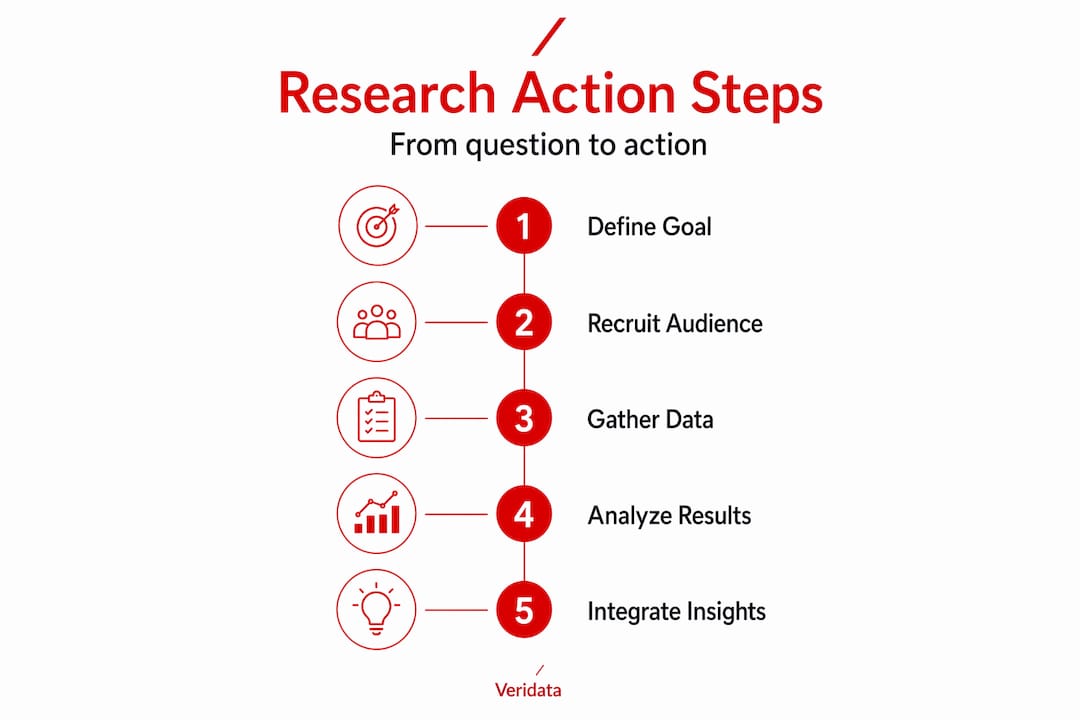
Step 4: Integrate findings into operational decisions. The final step is the one most organizations skip. Findings get presented, appreciated, and filed. Build a process that connects research output to product, marketing, and retention decisions on a recurring schedule.
Here’s how different research methods align to business objectives:
| Research method | Primary business use | Best for |
|---|---|---|
| AI-moderated interviews | Retention and churn analysis | Understanding exit reasons at scale |
| Online surveys | Market sizing and segmentation | Quantifying attitudes across large samples |
| Diary studies | Product development and UX | Capturing real-world usage behavior |
| Biometric testing | Marketing and packaging | Measuring subconscious emotional response |
| Concept testing | New product launches | Validating product-market fit by segment |
Note that only 14% of shoppers trust AI recommendations alone, and 39% are more carefully comparing prices due to economic uncertainty. That kind of finding, sourced from properly designed consumer research, changes how you allocate your marketing budget. It tells you where credibility needs to be built and where persuasion needs to happen. That’s research working as it should.
For teams exploring how AI fits into their research operations, the AI in market research applications available today offer a practical starting point.
My take on why depth still matters more than speed
I’ve worked on enough research projects to know that the fastest insight is not always the most useful one. The pressure to move quickly is real. Deadlines are tight. Budgets are constrained. AI tools now make it genuinely possible to run a hundred interviews in a week, which is remarkable and worth using.

But here’s what I’ve seen happen when speed becomes the only priority. Teams get confident on thin data. They trust AI-generated summaries without reading the transcripts. They see a pattern in a quantitative result and stop asking why.
The consumers I’ve seen most misunderstood are always the ones companies thought they understood best. The loyal customers who suddenly churn. The segment that responded enthusiastically in concept testing and ignored the product at launch. The gap between what research tells you and what actually happens in market almost always traces back to a methodology choice made too quickly.
What I’ve learned is that human nuance still matters, even when AI is doing heavy analytical lifting. An AI interview can capture what a consumer says. A skilled researcher reviewing that transcript catches what the consumer meant. That interpretive layer is where real competitive advantage lives. Don’t outsource it entirely.
My advice: embed research into your strategic planning cycle, not just your product launches. The organizations that build continuous consumer understanding into their culture make better decisions consistently, not just occasionally.
How Veridata Insights makes consumer research work for you
If you’re ready to move beyond basic surveys and build a research program that actually informs decisions, at Veridata Insights our consultancy is built for exactly that. Whether you need a quick qualitative study or a full research program with recruitment, design, data collection, analysis, and reporting, Veridata Insights offers flexible service with no project minimums, available seven days a week.
Their team handles B2B, B2C, healthcare, and hard-to-reach audiences, which means your recruitment challenges are already accounted for. From AI-assisted qualitative work to quantitative tracking studies, Veridata Insights can cover the full scope of your research needs without locking you into rigid packages. Ready to get started? Talk to the Veridata Insights team and describe what you’re trying to learn. They’ll handle the rest.
FAQ
What is consumer research and why does it matter?
Consumer research is the process of gathering and analyzing information about customer attitudes, behaviors, and motivations. It matters because decisions made without reliable consumer data consistently underperform against those grounded in real market insight.
What are the main consumer research methods?
The core methods are qualitative research (interviews, focus groups, diary studies), quantitative research (surveys, behavioral analytics), and biometric or neuromarketing tools (eye tracking, EEG). Most strong research programs combine two or more methods.
How do AI-moderated interviews work?
AI-moderated interviews run asynchronously by phone or digital platform, allowing respondents to complete them on their own schedule. They combine qualitative depth with scale, enabling 100+ interviews weekly without a human moderator in every session.
Why do consumers say one thing and do another?
The stated vs. actual behavior gap reflects how conscious preferences differ from subconscious drivers. Integrating biometrics and neuromarketing into your research captures the emotional and automatic responses that surveys and interviews miss.
How often should businesses conduct consumer research?
Continuous research programs outperform one-time studies. Quarterly pulse surveys, ongoing qualitative panels, and regular win/loss interviews produce current, decision-ready insights rather than snapshots that go stale within months.
Recommended
- Market Research 101 for Consulting Firms: What You Need to Know – Veridata Insights
- Real-World Examples of Research Audiences That Work – Veridata Insights
- Data analysis step by step for market researchers in 2026 – Veridata Insights
- The Business Case for Investing in Market Research – Veridata Insights