


TL;DR:
- Effective legal research begins by clearly defining the legal issue and understanding jurisdictional authority before consulting sources.
- Verifying primary sources with citators and thoroughly documenting each step ensures research reliability and strengthens courtroom credibility.
Unstructured research doesn’t just waste time. It loses cases. When litigators work without a clear methodology, they miss controlling authority, cite overruled cases, and produce findings that opposing counsel can pick apart at the seams. This litigator research methodology guide exists to fix that. It covers everything from framing your legal issue at the outset to managing litigation holds, verifying sources with citators, and building a research process that holds up in court. Whether you’re deep in discovery or preparing a motion, this guide gives you a defensible framework to work from.
Table of Contents
- Key takeaways
- Litigator research methodology guide: the foundations
- Executing your research step by step
- Managing litigation holds correctly
- Common pitfalls in litigation research
- What good research actually produces
- My perspective on where litigation research actually goes wrong
- How Veridatainsights supports litigation research
- FAQ
Key takeaways
| Point | Details |
|---|---|
| Define the issue first | Precise issue framing before you open any database prevents unfocused research and wasted hours. |
| Start with secondary sources | Secondary sources orient your research toward the right primary authority faster than jumping straight to case law. |
| Always verify with citators | KeyCite and Shepard’s are non-negotiable for confirming a case remains good law before you rely on it. |
| Act fast on litigation holds | The 24 to 72 hours following a hold notice is the most critical window for preventing evidence spoliation. |
| Document everything | Meticulous audit trails protect you from sanctions and support every argument you make about your research process. |
Litigator research methodology guide: the foundations
Before you run a single search query, you need to know exactly what you’re searching for. That sounds obvious. It isn’t. The most frequent mistake in legal research is failing to define the legal issue with enough clarity upfront, and the downstream costs compound fast.
Setting your research objectives
Start by writing out the legal question in one clear sentence. Not a paragraph. Not a list of possibilities. One sentence that identifies the legal issue, the relevant jurisdiction, and the outcome you’re trying to support. This discipline alone will cut your research time significantly.
From there, determine your jurisdictional framework. Federal courts operate differently from state courts, and a case that controls in the Ninth Circuit may be persuasive but not binding in the Fifth. Know where you are and what authority structure governs before you build your source list.
Here’s a quick breakdown of source types and their roles:
| Source type | Examples | Role in research |
|---|---|---|
| Primary authority | Statutes, regulations, case law | Binding or persuasive law you rely on directly |
| Secondary sources | Law review articles, treatises, practice guides | Context, issue framing, and pointers to primary authority |
| Citators | KeyCite, Shepard’s | Verification that primary sources are still good law |
| Legal databases | Westlaw, LexisNexis, Bloomberg Law | Platforms for accessing all source types efficiently |
Secondary sources are not filler. They are where experienced litigators start, because a well-written treatise or practice guide tells you which statutes and cases actually matter in your area before you spend two hours reading tangentially relevant opinions.
The tools you choose matter too. Legal databases provide access, but knowing how to construct a targeted search query is a separate skill. Spend time learning the Boolean operators and field-specific searches within your platform of choice.
Pro Tip: Write your core legal question on a sticky note and keep it next to your monitor during research. When your results start drifting, that note pulls you back on track.
Executing your research step by step
Effective litigation research follows a recognized seven-step methodology. Here’s how to work through it in practice, not just in theory.
- Frame the legal problem. Translate the facts of your case into a discrete legal question. Use the who, what, where, and under what law structure to get specific.
- Identify jurisdiction-specific primary authority. Controlling statutes come before case law. Find the applicable statutory or regulatory framework first, then look for cases interpreting it.
- Consult secondary sources for context. A relevant law review article or Restatement section will often map the territory for you, naming the landmark cases and identifying unresolved circuit splits. This is where you build your research vocabulary.
- Conduct a layered analysis of primary sources. Read cases in full, not just the headnotes. Pay attention to the facts, the holding, and the reasoning. A case that looks helpful on the headnote level may distinguish itself from your facts in the opinion.
- Verify using citators. Shepard’s analytical treatment covers approximately 96% of cases compared to about 18% for KeyCite in a recent study. Both tools use signal flags, but manual review of citing references is still necessary, because a case can be partially overruled or negatively distinguished without losing its core holding.
- Organize and document your sources. Use a spreadsheet, a research management tool, or a dedicated memo. Record the citation, the relevant holding, how it applies to your issue, and its current validity status. You will thank yourself during brief writing.
- Draft and refine your findings. The research memo is not a formality. It forces you to test whether your analysis actually holds together. Gaps become visible on paper in a way they don’t on a screen full of tabs.
Pro Tip: When you stop finding new cases and start seeing the same authorities cited repeatedly across multiple sources, you’ve likely reached saturation. That’s your signal the core research is complete.
Compare the two most common citator tools before you commit to one:
| Feature | Shepard’s (LexisNexis) | KeyCite (Westlaw) |
|---|---|---|
| Analytical treatment coverage | ~96% of cited cases | ~18% of cited cases |
| Signal flag system | Yes | Yes |
| Negative treatment alerts | Yes | Yes |
| Integration with source database | LexisNexis native | Westlaw native |
| Best use case | Deep analytical review | Quick status checks within Westlaw workflow |
Managing litigation holds correctly
Litigation hold obligations do not wait. The moment you have a reasonable anticipation of litigation, the duty to preserve is triggered, and the 24 to 72-hour window that follows is where most spoliation problems begin. Act slowly, and you may be answering to a judge about it later.
Getting this right requires more than sending an email to a few custodians. Here’s what a defensible hold process looks like:
- Define scope immediately. Identify custodians, relevant data types, systems involved, and the time period the hold covers. Vague holds create preservation gaps.
- Issue formal written notices. Every custodian receives a notice. Every notice gets an acknowledgment. Track both.
- Coordinate with IT on day one. Automated suspension of data deletion is more reliable than relying on individual employees to remember not to delete files. Automated in-place preservation reduces human error and strengthens your defensibility argument significantly.
- Map non-custodial data sources early. Transaction logs, structured databases, SharePoint sites, and backup systems all qualify as potentially relevant data. Failing to map these sources risks spoliation claims even when custodian data is perfectly preserved.
- Maintain a centralized hold log. Document every notice, every acknowledgment, every reminder, and every modification in one place. This audit-ready documentation is what separates a defensible hold from an expensive sanctions hearing.
Hold management is not a one-time task. As the case evolves, the scope of the hold may need to expand, contract, or shift to new custodians. Every modification gets documented, authorized in writing, and logged.
Pro Tip: Set calendar reminders to send hold reminder notices every 60 to 90 days. Custodians forget. Regular reminders demonstrate ongoing good faith and close one of the most common defensibility gaps.

| Hold management task | Timing | Documentation required |
|---|---|---|
| Issue hold notice | Within 24 to 72 hours of trigger | Written notice, custodian list |
| Collect acknowledgments | Within 5 business days | Signed acknowledgments logged |
| Coordinate IT preservation | Concurrent with notice | IT confirmation, suspension records |
| Send reminder notices | Every 60 to 90 days | Dated reminders, acknowledgment logs |
| Modify or lift hold | As case scope changes | Written authorization, modification log |
Common pitfalls in litigation research
Even experienced litigators fall into patterns that quietly undermine their research quality. Here are the ones worth watching.
- Jumping to primary sources too fast. Skipping secondary sources because you feel like you know the area well enough is a common shortcut with real consequences. Secondary sources orient your research. Don’t bypass them.
- Ignoring jurisdictional nuance. A federal circuit split matters. A state court that hasn’t adopted a majority position matters. Treating all authority as interchangeable is a citation waiting to embarrass you.
- Over-relying on AI tools. Generative AI is unreliable for legal citations and must be verified against authoritative sources every single time. AI is genuinely useful for brainstorming issues, summarizing long opinions, and identifying research angles you hadn’t considered. It is not a substitute for verified legal research. For a closer look at how AI fits into legal workflows, AI in legal research deserves a careful read.
- Inconsistent documentation. If you can’t reconstruct your research trail six months later, it wasn’t documented well enough. Courts, supervisors, and future you will all want that trail.
- Not knowing when to stop. Research rabbit holes are real. Build time limits into your workflow and use saturation as a signal, not an excuse to keep digging.
Pro Tip: Use a simple research log template on every case. Date, query used, sources reviewed, findings, and validity status. It takes five extra minutes per session and saves hours during brief writing.
The legal research methods that hold up in court are not necessarily the most elaborate. They’re the most documented and the most verified.
What good research actually produces
Thorough research is measurable. You know you’re done when you keep finding the same cases cited across multiple independent sources, when secondary sources no longer reveal new primary authority, and when your analysis can answer the legal question you started with without hedging.
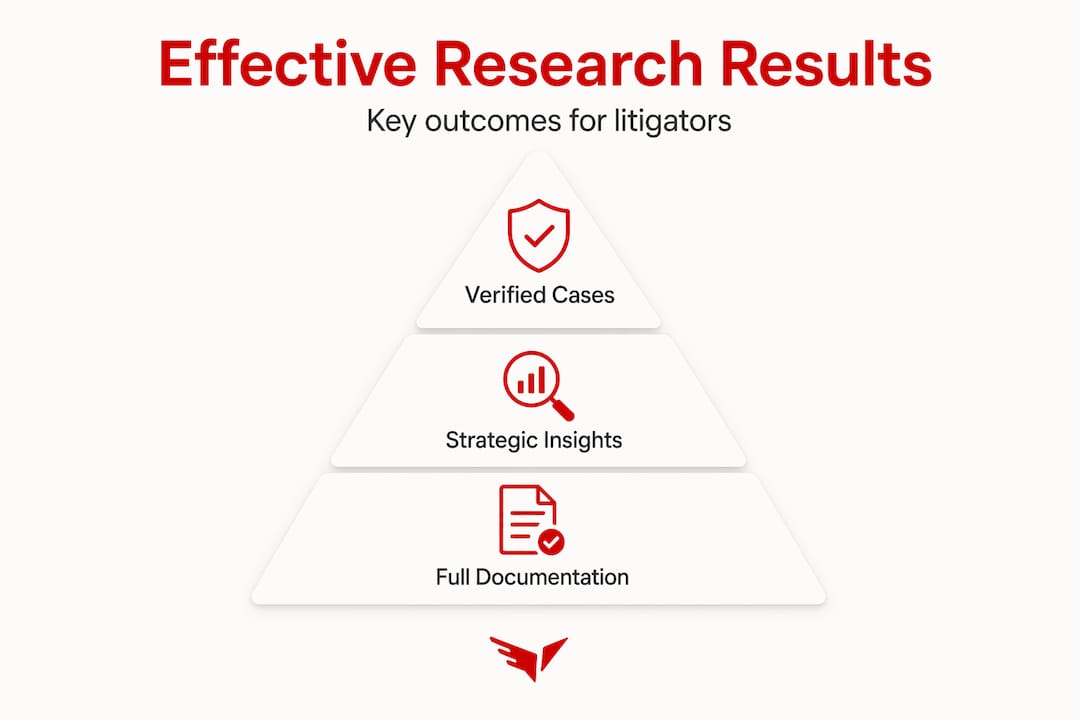
Systematic documentation supports litigation strategy in ways that go beyond the immediate case. A well-maintained research memo becomes a starting point for related matters. A solid litigation hold log protects you against sanctions motions. A properly verified source list makes brief writing faster and more confident.
The qualitative methods that win cases are grounded in exactly this kind of structure. Strategy built on verified, well-documented research holds up under pressure. Strategy built on speed and guesswork rarely does.
Set up automated alerts in your legal database for new cases and statutory amendments affecting your key authorities. The law moves, and a case you relied on in January may look different by October.
Pro Tip: At the close of every major research project, write a one-page summary of the key authorities, the current state of the law, and any open questions. This becomes your reference document for every related motion and brief in the case.
My perspective on where litigation research actually goes wrong
I’ve watched litigators do every step technically right and still produce research that doesn’t serve the case. The common thread isn’t a missing step. It’s a missing question: what does winning look like from this research?
When you don’t know what you’re building toward, even thorough research produces a pile of information instead of a strategic argument. I’ve found that the litigators who get the most out of their research process are the ones who connect every source back to a theory of the case from the start.
The AI question is real, and I understand the appeal. It’s fast, and it surfaces patterns quickly. But I’ve seen AI outputs present plausible-sounding citations that don’t exist. Every single output needs verification against an authoritative database. Full stop. There’s no shortcut here that doesn’t carry serious professional risk.
Litigation hold management is the area I’d push hardest on. Most problems don’t come from bad faith. They come from disorganization and delay. A well-run hold log with documented reminders and scope updates has saved organizations from sanctions that had nothing to do with the underlying merits. That’s the kind of protection that good research design builds in from the start.
The future of litigation research is going to involve more technology, not less. The litigators who use it well will be the ones who treat AI as a research assistant with a good memory and no professional license. Useful. Not trusted blindly.
— Daniel
How Veridatainsights supports litigation research
At Veridatainsights, we know that every litigation matter has its own scope, timeline, and evidentiary demands. That’s why we don’t offer a one-size-fits-all approach. We offer the right approach for your case. Whether you need support designing a defensible research methodology, managing documentation for a litigation hold, or integrating data analysis into your litigation strategy, we work with you at whatever level you need. No project minimums. Seven days a week.
Our team brings deep expertise in research methodology, qualitative and quantitative analysis, and litigation support that’s built to hold up under scrutiny. If you’re ready to work with a team that treats precision as a baseline and not a bonus, contact our team to talk through your research needs. We’d love to help.
FAQ
What is the first step in a litigation research methodology?
The first step is defining the legal issue precisely before opening any database. Starting with a clear legal question and then consulting secondary sources prevents unfocused research and saves significant time.
How do citators like Shepard’s and KeyCite differ?
Shepard’s provides analytical treatment in roughly 96% of cases compared to about 18% for KeyCite. Both tools offer signal flags, but manual review of citing references is still required to accurately assess a case’s validity.
When does a litigation hold need to be issued?
A litigation hold must be issued as soon as there is a reasonable anticipation of litigation. The first 24 to 72 hours are critical for halting data deletion, notifying custodians, and beginning documented preservation steps.
Can AI tools replace traditional legal research methods?
No. Generative AI is useful for summarizing material and identifying research angles, but it is not reliable for legal citations and every AI output must be verified manually against authoritative legal databases.
What does a defensible litigation hold log include?
A defensible hold log documents every notice issued, every custodian acknowledgment received, all reminder communications, and any scope modifications or releases, all with dates and written authorization.
Recommended
- Survey methodology for attorneys: A practical guide
- Qualitative Research in Legal Cases: Strategy That Wins – Veridata Insights
- Why reliable research methodology is critical in court
- Financial and Insurance Activities: How Market Research Empowers Investment, Litigators, and Economic Consultants – Veridata Insights