


TL;DR:
- Questionnaire programming involves transforming written survey specifications into interactive, logic-driven digital instruments. Proper execution ensures high data quality by reducing errors, missing responses, and bias, ultimately improving research outcomes. Clear specifications, collaboration, and platform expertise are essential for efficient and accurate survey deployment.
If you think questionnaire programming is just copying questions into a survey tool, you are not alone – and you are not quite right either. What is questionnaire programming, really? It is the technical process of transforming a written questionnaire document into a fully functional, interactive survey instrument with logic, routing, validation, and data structure built in. For researchers and data professionals, understanding this process is the difference between clean, usable data and a costly mess you discover only after fieldwork closes.
Table of Contents
- Key takeaways
- What is questionnaire programming
- The technical process and its real challenges
- Questionnaire programming tools and platforms
- Benefits of questionnaire programming done right
- How to approach questionnaire programming as a researcher
- My take on why programming gets underestimated
- Let Veridatainsights handle your survey programming
- FAQ
Key takeaways
| Point | Details |
|---|---|
| More than digitizing questions | Questionnaire programming converts written specs into logic-driven surveys, not just online forms. |
| Logic drives data quality | Skip patterns, loops, and quotas prevent irrelevant routing and reduce missing or biased data. |
| Platform choice matters | Qualtrics, Decipher, and Confirmit each use unique scripting formats that affect how logic is built and exported. |
| Specs clarity saves time | Detailed, unambiguous specifications before programming reduce errors and cut turnaround significantly. |
| Collaboration is non-negotiable | Researchers and programmers working closely together produce surveys that actually match research objectives. |
What is questionnaire programming
The definition of questionnaire programming is precise. It is the process of translating a questionnaire document into a functioning, interactive survey complete with conditional logic, text piping, validation rules, and question routing. The source document is typically a Word or PDF file, full of prose descriptions, routing tables, and programming notes that a software platform cannot read on its own. A programmer reads those instructions and builds the survey by hand, or increasingly with specialized tools, so that the final instrument behaves exactly as the researcher intended.
This is worth distinguishing from two concepts researchers often conflate with it.
Questionnaire design is the research craft of writing good questions, choosing the right scales, and structuring the flow so respondents understand what is being asked. That happens before programming begins.
Survey coding, on the other hand, happens after data collection. Survey coding categorizes open-ended responses into structured groups for analysis, turning raw verbatim text into a codeable data variable. It is sometimes called verbatim coding.
Questionnaire programming sits squarely in the middle of those two activities. Common programming tasks include:
- Skip logic and branching: routing respondents to different questions based on prior answers
- Text piping: pulling a respondent’s earlier answer into a later question (e.g., “You mentioned Brand X. How long have you used it?”)
- Loops: repeating a question block for each item a respondent selected earlier
- Randomization: rotating the order of answer choices or question blocks to reduce order bias
- Quota management: automatically closing survey access when a demographic cell is full
- Validation rules: requiring a response or capping how many items a respondent can select
Each of these features requires precise configuration. None of them build themselves.
The technical process and its real challenges
Understanding the technical depth of questionnaire programming starts with the spec document. Researchers hand programmers a document that describes what the survey should do. Sounds simple. In practice, specifications often contain ambiguous instructions that require clarification before a single line of code is written. Does “randomize brands” mean fully random or random within category? Does the satisfaction follow-up fire only when a respondent rates below a 3, or at a 3 as well? These are not trivial questions. They directly affect what data you collect.
Here is a practical walkthrough of how programming unfolds on a real project:
- Parse the specification. Read every question, note, and routing instruction. Flag every ambiguity before starting.
- Map the logic architecture. Sketch out the branching paths, loop structures, and quota cells before touching the platform.
- Build the survey in the platform. Configure each question type, apply piping, set skip conditions, and build loops.
- Implement quotas and screening. Set up the logic that terminates or redirects respondents who do not qualify or whose demographic cell is already full.
- Program randomization and anchoring. Randomize where needed, but anchor items like “None of the above” that must always appear last.
- Run a full internal test. Test every path through the survey, including edge cases like respondents who select no brands or skip optional questions.
- Distribute a test link. Share with the research team for review and collect feedback systematically.
- Resolve issues and re-test. Fix flagged items and test again before a final sign-off.
Complex surveys, such as brand tracking studies with loops for each brand a respondent recognizes, can have dozens of conditional paths. Missing one creates a data gap that no amount of post-processing can fix.
Pro Tip: Before you hand off a spec to a programmer, walk through your own survey as three different respondent types: someone who qualifies, someone who does not, and someone who gives borderline answers. If you get confused, your programmer will too.

Questionnaire programming tools and platforms
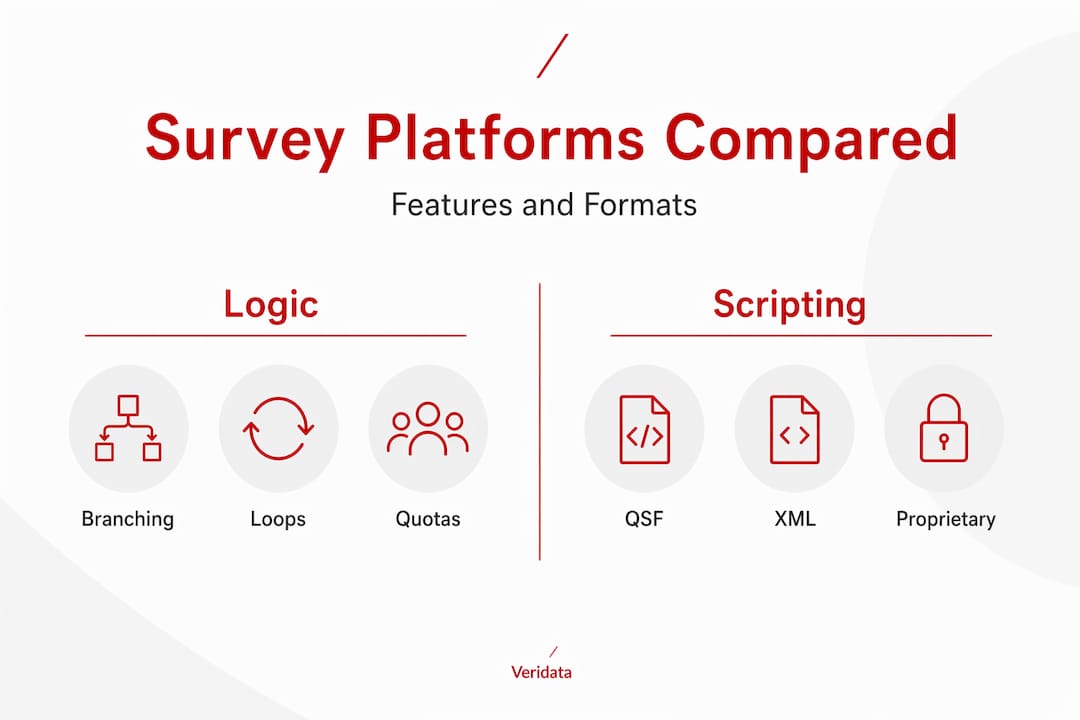
Not all survey platforms are created equal. The same logical survey becomes a different technical artifact depending on which platform you use. Here is a quick comparison of the three platforms researchers encounter most:
| Platform | Scripting format | Logic capabilities | Best for |
|---|---|---|---|
| Qualtrics | JSON-based QSF | Visual builder plus JavaScript for advanced logic | Academic and corporate research |
| Decipher | XML-based scripting | Deep custom scripting, very flexible | Full-service market research agencies |
| Confirmit | Script-based configuration | Complex B2B and tracking studies | Enterprise and longitudinal research |
Each platform uses its own scripting language and file format, which means programmer expertise is platform-specific. A researcher moving from Qualtrics to Decipher is not just changing a tool. They are working in a different technical environment with a different logic syntax.
Here is what to keep in mind when choosing or working within a platform:
- Data export formats matter. Qualtrics exports QSF and CSV. Decipher outputs XML and tab-delimited data files. Your data processing team needs to know what is coming before the project starts.
- Visual builders have limits. Most platforms offer point-and-click logic builders that work for simple surveys. Advanced features like branching and loops require direct scripting on every major platform.
- AI-assisted programming is emerging. Several platforms and third-party tools are experimenting with natural language-to-survey generation, where you describe a logic condition in plain English and the tool writes the code. It is promising, but still requires a skilled programmer to review and validate the output.
The platform comparison is not just academic. If your research partner programs in a platform you cannot access for data review, you need to build in extra time for testing and export validation.
Benefits of questionnaire programming done right
When questionnaire programming is executed well, the downstream impact on your research is significant. Professional survey programming supports advanced logic that improves both data quality and the respondent experience. Here is what that looks like in concrete terms:
- Fewer missing data points. Proper routing logic means respondents only see questions relevant to them. They do not skip questions out of confusion or frustration.
- Cleaner data files. Validation rules catch errors at the point of entry instead of during analysis. You do not discover that respondents typed letters into a numeric field after 2,000 completes.
- Higher response rates. Surveys that feel logical and relevant to a respondent move faster and experience less dropout.
- Faster turnaround. Automated tooling can compress programming from two to three days down to under an hour for well-documented surveys. That is time back in your project timeline.
- Auditability. When data anomalies surface, a well-programmed survey has a clear logic trail. You can trace exactly what condition triggered a specific routing decision.
The flip side is worth naming directly. A programming error in a quota cell can oversample one demographic while locking out another. A broken pipe can expose a respondent’s name or a previous answer to someone who should not see it. These are not hypothetical problems. They happen on real projects and they compromise the validity of findings.
Pro Tip: Always build your quality assurance check against the original spec document, not the survey as it was built. The goal is to verify that the programmed survey matches the researcher’s intent, not just that it technically runs.
How to approach questionnaire programming as a researcher
Knowing how to create questionnaires that program cleanly is a skill that pays off on every project. You do not need to be a programmer. You do need to be a thoughtful specifier.
- Write a complete specification document. Every question should include the question text, answer options, question type, and any routing or display conditions. Do not leave logic notes scattered in comments or email threads.
- Define all branching logic before programming begins. Draw a flowchart if you need to. Clear, detailed specifications reduce ambiguities and the rework that follows.
- Communicate proactively about ambiguous conditions. If your programmer flags a question, answer it in writing. That answer becomes part of the project record.
- Schedule at least two rounds of testing. One internal round by the programmer, one by the research team. Do not combine them.
- Run a soft launch before full fieldwork. Collect 10 to 20 responses with live routing and review the data file. Confirm the structure matches what your analysis plan expects.
- Sign off on the final test link before opening to respondents. No exceptions. A fix after 500 responses is a far larger problem than a fix before the first one.
Following these steps will not make programming simple. It will make it predictable, which for a research project is far more valuable.
My take on why programming gets underestimated
I have seen researchers treat questionnaire programming as a checkbox, something that happens in the background between design and fieldwork. In my experience, that framing causes more project failures than almost any other single assumption.
The challenge is that when programming works perfectly, it is invisible. Respondents flow through the survey, data arrives clean, and no one thinks twice about what made that possible. When it breaks, everyone notices.
What I find most interesting is the collaboration gap. Researchers are trained in theory, sampling, and question design. Programmers are trained in platform logic and code structure. Those skill sets barely overlap. The best research projects I have been part of had researchers who wrote specs that programmers could actually follow, and programmers who pushed back on ambiguous logic instead of making assumptions. That back-and-forth is not a sign of a troubled project. It is a sign of a well-run one.
The future here is genuinely exciting. AI tools are getting better at reading natural-language specs and generating survey code, which could shrink the gap between design and deployment. But the judgment layer, knowing when a logic condition does not match the research objective, still requires a human who understands both sides of the table.
— Daniel
Let Veridatainsights handle your survey programming
Questionnaire programming is too important to leave to chance or a rushed internal process. At Veridatainsights, our experienced programming team handles everything from simple surveys to complex multi-loop tracking studies, across platforms and audiences. We work 7 days a week, 365 days a year, with no project minimums. Whether you need expert programming support from spec to launch or a full research partnership covering design, programming, data collection, and reporting, we are ready to help. Reach out to our team and start a conversation about your next project.
FAQ
What is the definition of questionnaire programming?
Questionnaire programming is the process of converting a written questionnaire document into a functional, interactive survey with conditional logic, text piping, validation, and routing rules built into a survey platform.
How is questionnaire programming different from survey design?
Survey design is the process of writing questions and structuring the research instrument. Questionnaire programming is the technical step that follows, translating that design into a working digital survey with all logic and behavior configured.
What are common questionnaire programming tools?
The most widely used platforms are Qualtrics, Decipher, and Confirmit. Each uses its own scripting format, so programmer expertise and data export requirements vary by platform.
Why does questionnaire programming matter for data quality?
Poor programming creates routing errors, missing data, and biased samples. Proper logic design prevents irrelevant question exposure and catches input errors at the point of entry, before they reach your data file.
How long does questionnaire programming take?
Turnaround depends on survey complexity and specification quality. Simple surveys can be programmed in hours. Complex studies with loops, quotas, and multilingual requirements may take several days, though automated tools are shrinking that timeline.