

An expert interview is a semi-structured conversation with someone who holds specialized knowledge, and it exists to surface information you cannot get from surveys, documents, or observation alone. Researchers use it to explore new territory before building a theory, to test a mechanism they suspect drives an outcome, and to capture tacit knowledge that never makes it into a policy document or annual report.
The single best-practice rule that governs everything else: build a semi-structured guide around a small number of core topics, deliberately mix “inside” experts (those embedded in the process you’re studying) with “outside” experts (observers with distance and comparative perspective), and plan from day one to triangulate what you hear against documents or other interviews. Skip any one of those three and your findings get shakier.
Pro Tip: Draft your one-page guide before you contact a single expert. It forces you to know what you’re actually asking, and it makes screening calls faster because you already know which topics matter most.
Before you schedule anything, get these steps in order:
- Screen candidates for role, tenure, and potential conflicts of interest.
- Draft a one-page topic guide with 3 to 5 core themes.
- Run one pilot interview and revise the guide based on what falls flat.
- Line up at least one outside expert alongside your inside sources.
Key Takeaways
Expert interview research works best when a semi-structured guide, a deliberate inside/outside sampling mix, and systematic triangulation operate together rather than in isolation.
| Point | Details |
|---|---|
| Use 3 to 5 core topics | A guide with this range balances depth against interview fatigue for both parties. |
| Mix inside and outside experts | Combining embedded and outside-observer perspectives reduces the bias either group carries alone. |
| Triangulate every finding | Cross-check expert claims against documents, secondary data, or other experts before treating them as conclusions. |
| Code as you collect | Iterative analysis during fieldwork lets you spot themes early and adjust remaining interviews. |
| Consider a managed partner | Veridata Insights runs recruitment, screening, transcription, and analysis for teams that need expert-interview projects moved faster. |
Table of Contents
- What Types of Expert Interviews Serve Different Research Goals?
- When Should You Use Expert Interviews Instead of Other Methods?
- How Do You Select and Sample Experts Without Building in Bias?
- How Do You Design a Semi-Structured Interview Guide?
- What Makes an Expert Interview Go Well in the Room?
- What Ethical Standards and Reflexivity Practices Apply?
- How Do You Analyze and Triangulate Expert Interview Data?
- What Does Veridata Insights’ Field Checklist Look Like?
- Ready to Run Your Expert Interview Project With Support?
- Sources
What Types of Expert Interviews Serve Different Research Goals?
Not every expert interview does the same job, and picking the wrong type wastes a scarce resource: a busy expert’s time.

Theory-generating interviews treat the expert as a source of interpretive knowledge, not just facts. You’re trying to build or refine a conceptual framework, so the conversation stays loose and exploratory. Problem-centered interviews (PCI) blend narrative and semi-structured techniques to draw out implicit reasoning behind a specific decision or process, and researchers have found this hybrid format particularly effective at revealing knowledge experts don’t consciously articulate. Informational or technical interviews aim narrower: you need a fact, a process detail, or a technical verification, and the expert functions closer to a knowledgeable source than a theorist. Elite interviews target people with disproportionate influence over decisions, where the goal is understanding not just what happened but why someone with power chose that path.
The inside versus outside distinction cuts across all four types. Inside experts sit within the system you’re studying, a compliance officer inside a regulated bank, a nurse inside a hospital ward, and they bring granular, ground-level detail. Outside experts, consultants, academics, former practitioners, bring comparative range and a critical distance that insiders sometimes lack.
Match the type to your research aim:
- Building a new theoretical framework: lean toward theory-generating or PCI formats.
- Tracing how a specific decision or policy unfolded: elite interviews with the actual decision-makers.
- Verifying a technical claim or process detail: informational interviews with subject-matter specialists.
- Testing a causal mechanism: a mix of inside and outside experts, cross-checked against each other.
When Should You Use Expert Interviews Instead of Other Methods?
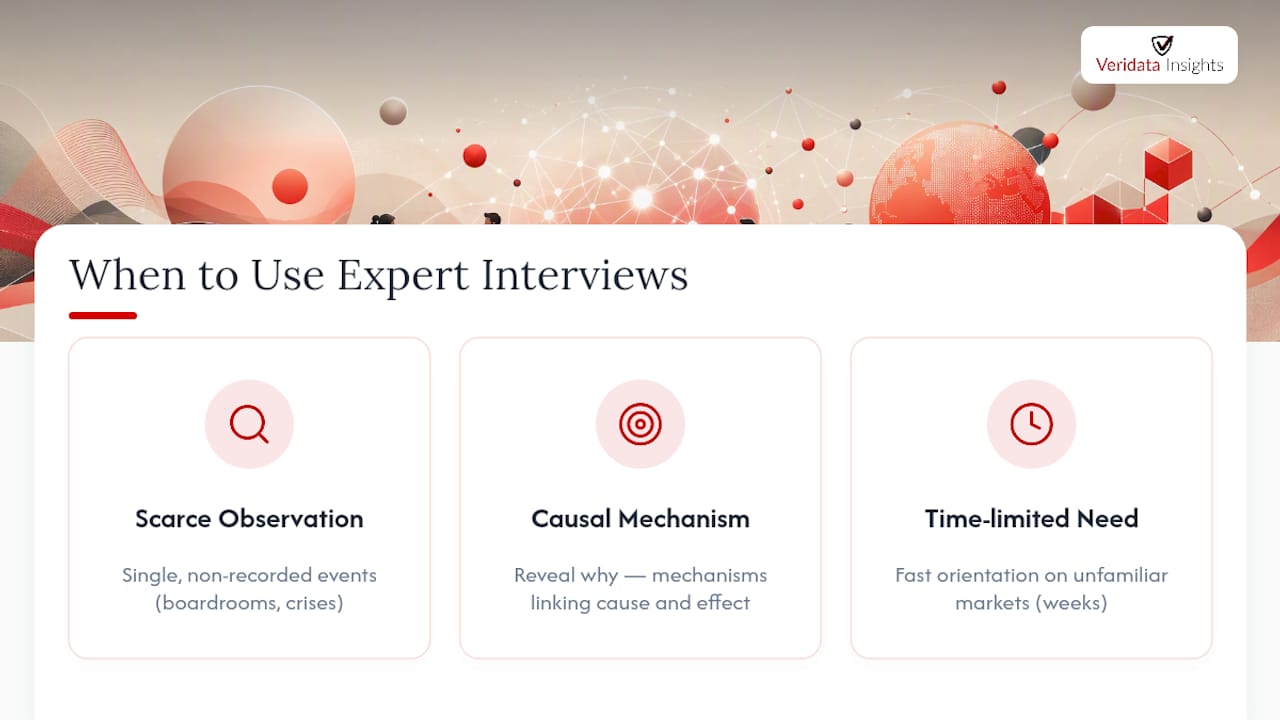
Expert interviews earn their place when observation is scarce, when you’re chasing a mechanism rather than a frequency, or when you’re working against a deadline that rules out a full-scale study.
Three scenarios stand out. First, scarce-observation contexts: some events, boardroom decisions, regulatory negotiations, crisis responses, happen once and leave no public record. An expert who was in the room is often your only window in. Second, causal mechanism exploration: surveys tell you what correlates with what, but they rarely tell you why. An expert who has watched a process unfold repeatedly can explain the mechanism connecting cause to effect. Third, time-limited intelligence needs: when a client or research sponsor needs orientation on an unfamiliar market or issue fast, a handful of well-chosen expert conversations often gets you further in a week than a commissioned survey would in two months.
The benefits follow from those use cases. Expert interviews deliver depth that broad-sample methods can’t match, access to tacit and implicit knowledge that respondents rarely write down, and a way to link micro-level detail (what one practitioner actually does) with macro-level patterns (how an industry or policy area behaves). Practitioner guidance on sequencing interviews logically, starting broad and narrowing as intelligence builds, comes directly from workflows tested by researchers running staged expert-interview projects.
But keep expectations realistic. Expert interview evidence is not representative in the statistical sense, one expert’s account is one perspective, shaped by their position and interests. That’s precisely why triangulation isn’t optional. If you’re building a case study or informing a strategic decision, treat expert interviews as one strong evidence stream among several, not the whole answer. Consulting clients increasingly expect research-driven recommendations to show that cross-checking explicitly, not just cite an expert and move on.
How Do You Select and Sample Experts Without Building in Bias?
Expert interviews use purposeful, non-probability sampling, meaning you’re not trying to represent a population statistically. You’re trying to assemble the smallest group of people whose combined knowledge covers your research question thoroughly. That’s appropriate here in a way it wouldn’t be for a consumer survey, but it also means the burden of avoiding bias falls entirely on your selection process, not on random assignment.
Here’s how to build that sample deliberately:
- Map the stakeholder landscape first. List every role that touches your research question, decision-makers, implementers, critics, regulators, before you contact anyone. This map becomes your target list, not a convenience sample of whoever answers your email.
- Deliberately include both inside and outside experts. Research on the expert interview method is clear that combining insider accounts with outsider perspective is what reduces bias and captures decision-making mechanisms more completely than either group alone.
- Write screening criteria before you start recruiting. Define minimum tenure, specific role experience, or subject exposure so you’re not adjusting the bar mid-recruitment to fill a quota.
- Use snowball referrals carefully. Ask each expert for two or three names, but track referral chains so you can see if everyone is pointing you toward the same small clique.
- Verify roles before scheduling. A title on LinkedIn isn’t proof of the access or knowledge you need; a two-minute verification call or email exchange catches this early.
Vetting matters as much as mapping. Confirm each candidate’s actual decision-making authority or technical exposure, not just their job title. Build two or three screening questions that surface confidentiality constraints or conflicts of interest before the main interview, something as simple as asking whether they’re bound by a nondisclosure agreement related to your topic. Firms doing this at scale, including recruitment work Veridata Insights has run for consulting engagements, build these checks directly into the screener rather than discovering the constraint mid-interview.
Pro Tip: Keep a running log of who declined and why. A pattern of declines from one stakeholder group is itself a data point, it might mean that group feels reputational risk your research needs to account for.
How Do You Design a Semi-Structured Interview Guide?
Three to five core topics is the range that shows up consistently in methodological guidance on in-depth interviewing, and there’s a practical reason it works. Fewer than three topics leaves you without enough structure to compare across interviews. More than five fragments the conversation and exhausts the expert before you reach your best questions.
Build the guide in layers:
- Opening narrative prompt. Ask the expert to describe their role or a recent relevant experience in their own words. This warms up the conversation and often surfaces topics you hadn’t planned to ask about.
- Targeted probes under each core topic. For each of your 3 to 5 themes, prepare two or three follow-up questions that push past a generic answer toward specifics.
- Contrast and example requests. “Can you walk me through a time that went differently?” does more work than “What’s your general process?”
- Timeline requests. Asking an expert to sequence events chronologically often reveals causal links they wouldn’t state directly if asked “why” outright.
Run two versions of the guide side by side. Keep a one-page topic map in front of you during the interview, just headers and key probes, so you’re not visibly reading a script. Keep a fuller reference version nearby (or open on a second screen) with backup questions for topics that need more depth than expected.
Watch your phrasing carefully:
- Avoid leading questions (“Wouldn’t you agree that X caused the delay?”) in favor of open ones (“What factors contributed to the delay?”).
- Never ask about confidential financial performance, insider trading information, or anything that could cross securities disclosure lines, practitioner guidance is explicit that questions should target trends and practices, not privileged data.
- Frame sensitive topics as general patterns (“How do teams typically handle this?”) rather than direct accusations.
Experienced interviewers can work from a leaner guide and improvise more; if you’re newer to qualitative interviewing, design guidance for interview studies recommends a more detailed guide with more written-out probes until you’ve built the instinct for live follow-up.
What Makes an Expert Interview Go Well in the Room?
Open with three things in the first two minutes: a concise statement of what your research is about, explicit consent to record (or a note that you won’t), and a clear statement of how long you’ll need. Experts are busy people, and confusion about time expectations is the fastest way to lose the second half of your best questions.
Once you’re into the substance, four probing techniques do most of the work:
- Ask for a concrete example. Nearly every general claim gets sharper when you ask “can you give me a specific instance?”
- Ask for the sequence. “What happened first, and then what?” often surfaces mechanisms the expert wouldn’t volunteer if asked directly about causation.
- Probe contradictions gently. If something doesn’t square with an earlier answer, say so plainly but without accusation: “Earlier you mentioned X, how does that fit with what you just described?”
- Follow the detail that surprises you. If an offhand comment catches your attention, chase it immediately rather than waiting for your next scripted question. Flexibility here is what separates a good expert interview from a survey read aloud, and research on qualitative interviewing technique treats this willingness to follow unanticipated directions as the defining skill of a strong interviewer.
Practicalities matter more than most guides admit. Record whenever consent allows it, note-taking alone misses tone and hesitation that often carry meaning. Test your platform (Zoom, Teams, or a phone recorder) fifteen minutes before the call, not when the expert joins. Keep a backup recording method running, a phone voice memo alongside your laptop is cheap insurance against a dropped connection. If an expert starts to withdraw from a topic or hits a legal or confidentiality red line, don’t push, note it, move to the next topic, and follow up afterward in writing if appropriate.
Pro Tip: If an expert says “I probably shouldn’t say this, but…”, stop and ask if they want that comment off the record before they continue. It protects them and your study’s integrity equally.
What Ethical Standards and Reflexivity Practices Apply?
Informed consent needs to cover more than a signature: tell the expert how their words will be used, whether they’ll be quoted by name or anonymized, and how long you’ll retain the recording. A sample line that works well: “I’d like to quote you by role title rather than name unless you’d prefer otherwise, is that acceptable?”
Watch for legal and confidentiality red flags in real time:
- Stop recording immediately if an expert begins describing information covered by a nondisclosure agreement they haven’t cleared with their employer.
- Decline to press further if a question edges toward material nonpublic information relevant to securities law.
- Confirm in writing, not just verbally, if an expert asks for a section of the interview struck from your notes.
Reflexivity is the part researchers skip most often, and it shouldn’t be. Document your own position relative to the experts you interviewed: did you approach them as a peer, a student, a client’s representative? That relational context shapes what people tell you, and scholarship reviving the expert interview method as a rigorous tool argues that disclosing this context is what separates transparent expert-interview research from anecdote collection. Veridata Insights builds this disclosure directly into ethical research practices shared with consulting partners.
Pro Tip: Write your positionality note the same day as the interview, not weeks later during analysis. You’ll forget the subtle dynamics that mattered by the time you’re coding transcripts.
How Do You Analyze and Triangulate Expert Interview Data?
Start coding while you’re still collecting interviews, not after the last one wraps. This lets you spot emerging themes early and adjust your remaining interviews to probe them more deliberately.
Follow this sequence:
- Code iteratively as data comes in. After each interview, note two or three emerging themes before moving to the next conversation.
- Watch for saturation signals. When new interviews stop surfacing fresh themes and mostly confirm what you’ve already heard, you’re approaching the point where additional interviews add diminishing value, though a genuinely divergent voice can still justify one more.
- Build a transparent codebook. Whether you’re using thematic coding or a grounded approach, write memos explaining why each code exists so another researcher could follow your logic.
- Triangulate systematically. Compare what different experts say about the same event, check claims against documents or secondary data where available, and situate quotes within the full corpus rather than lifting the most quotable line in isolation.
A single high-status expert, however senior or confident, is rarely sufficient evidence on its own. The value of expert interview research comes from the pattern across sources, not the authority of any one voice. Work comparing systematic evidence-capture practices in political science research backs this up directly: triangulation and disclosure of relational context strengthen validity far more than accumulating more interviews with similar people. When you’re presenting findings to a consulting client or research sponsor, showing that triangulation explicitly tends to build more confidence in your conclusions than the raw interview count ever will.
What Does Veridata Insights’ Field Checklist Look Like?
We’ve run enough expert-interview recruitment to know where projects actually break down, and it’s rarely the interview itself. It’s the logistics around it.
Our recruitment checklist covers four things every time: screening questions that verify role and tenure before scheduling, a verification step that confirms the expert’s stated background matches reality, scheduling windows wide enough to accommodate senior experts’ calendars, and clear, consistent handling of honoraria so compensation never becomes a point of friction mid-recruitment.
On the fieldwork side, our teams run a pre-call tech check on every session, capture consent on a recorded preamble before substantive questions begin, run redundant recording (never a single point of failure), and hand off clean transcripts to analysts within an agreed turnaround window rather than letting transcription become a bottleneck.
We sequence interviews so early conversations shape later ones, starting broad with a few outside experts to map the terrain, then narrowing toward inside experts who can confirm or complicate what we’ve already heard. Triangulation isn’t a step we add at the end; it’s built into the order we schedule people.
That sequencing logic came directly out of a consulting recruitment engagement where staging interviews this way cut weeks off the client’s timeline without sacrificing depth.
- Confirm role and tenure before scheduling, not after.
- Run tech checks fifteen minutes ahead, every time.
- Build honoraria policy once and apply it consistently.
- Hand off transcripts with a firm turnaround commitment.
Ready to Run Your Expert Interview Project With Support?
Running a rigorous expert-interview study in-house takes real time: recruiting the right mix of inside and outside experts, screening for conflicts, scheduling around busy calendars, transcribing, coding, and triangulating findings into something a client or stakeholder can act on. If your team has the research design skills but not the recruitment bandwidth, or the reverse, that’s exactly where a specialist partner earns its keep.
Veridata Insights handles the full chain: expert recruitment across B2B, B2C, healthcare, and hard-to-reach audiences, screening and scheduling, transcription, coding and analysis, and reporting that connects back to your original research question. Outsourcing makes the most sense when your timeline is tight, your target experts are hard to reach through standard channels, or you need a partner who’s already solved the scheduling and consent-logistics problems this guide walks through. Projects run with no minimums, seven days a week, all year, so a two-interview pilot and a fifty-interview study get the same methodological attention. Reach out through our contact page to scope your project and get a straight answer on timeline and approach.
Sources
For readers who want to go deeper into the methodology behind this guide, these sources cover the academic and practical ground:
- In-depth interviews primer (LSE/Nature preprint)
- Why Do We Speak to Experts? Reviving the Strength of the Expert Interview Method (Cambridge Core, 2022)
- How to Effectively Conduct an Expert Interview (GLG)
- Designing an interview study (chapter extract)
Recommended
- Best Ways to Engage Market Research Respondents – Veridata Insights
- In-Depth Interview Recruiting: Why Veridata Insights Leads the Way in Quality Respondent Engagement – Veridata Insights
- Case Study: Recruiting YouTubers For Market Research – Veridata Insights
- How to Recruit Hard-to-Reach Audiences for Market Research – Veridata Insights