

In market research, informed consent means a freely given, specific, informed, and documented agreement. Researchers must both obtain that agreement and keep evidence of it before collecting a single data point from a participant. That duty holds whether you’re running a five-minute online survey or a six-month biospecimen study, and it applies across every mode: phone, online, in-person, and passive.
Before you field anything, run three checks:
- Purpose disclosure: Does the consent language state, in plain terms, what the study is about and why the participant’s data matters?
- Data use and sharing: Have you named who touches the data, how long you keep it, and whether any third party (client, vendor, AI tool) will see it?
- Withdrawal mechanism: Can the participant skip a question or stop entirely, and does the script or form say so explicitly?
If any of those three is missing, the consent isn’t finished yet.
Key Takeaways
Consent in market research succeeds only when it is freely given, specific, informed, and documented in a form the researcher can produce on demand.
| Point | Details |
|---|---|
| Define consent correctly | Confirm it is freely given, specific, informed, and recorded before any data collection begins. |
| Follow ICC/ESOMAR and Common Rule | Use ICC/ESOMAR as your baseline code and check Common Rule/IRB applicability for academic or health-linked work. |
| Cover all mandatory elements | Include purpose, data use, voluntariness, withdrawal rights, and contact information in every form or script. |
| Flag special cases early | Plan parental permission for minors and tiered or recontact consent for biospecimen studies. |
| Write for comprehension | Lead with a short key-information summary and pilot-test the copy before full fielding. |
Table of Contents
- The codes and rules that govern consent in market research
- What a compliant consent form or script must include
- Minors, biospecimens, and other special cases
- Consent for digital, passive, and AI-enabled research
- Documenting consent so it holds up to an audit
- Writing consent people actually understand
- Building your consent checklist and reusable snippets
- How Veridata Insights builds consent into every project
- Ready to build consent into your next study?
- Frequently Asked Questions
- Sources
The codes and rules that govern consent in market research
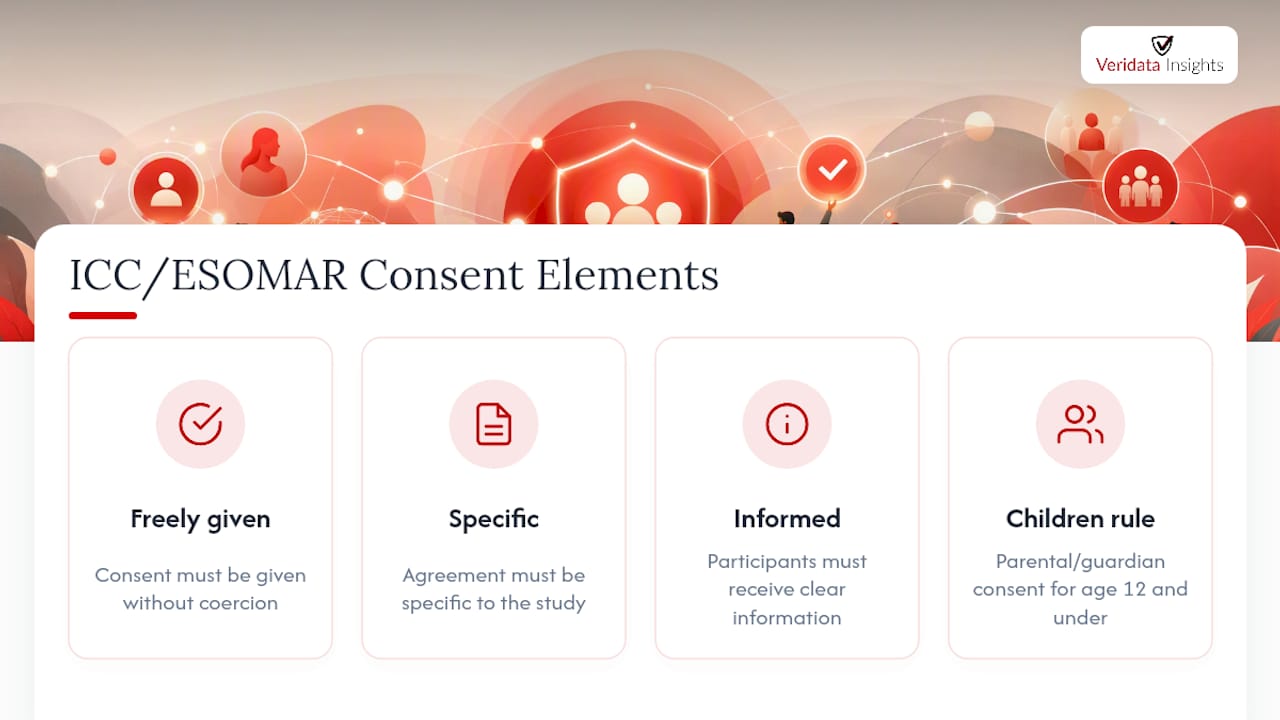
The ICC/ESOMAR International Code defines informed consent as a freely given, specific, and informed indication of agreement, and it puts the responsibility for securing that agreement squarely on the researcher, not the participant. The Code also sets a bright line for children: parental or guardian consent is required for anyone age 12 and under.
In the United States, the Common Rule governs federally funded human-subjects research and requires Institutional Review Board (IRB) review of consent documents. Most commercial market research falls outside Common Rule jurisdiction, but if your study touches an academic partnership, a government contract, or health outcomes research, an IRB may need to review your consent language, including a concise “key information” summary at the top. Professional bodies like the Insights Association and EPHMRA reinforce the same expectations through their own codes of conduct, which is worth knowing when a client asks which standard you follow.
What a compliant consent form or script must include
A consent document isn’t a formality. It’s the record that proves you told participants what they needed to know before they said yes. Every version, whether it’s a checkbox on a landing page or a script read aloud on a phone screener, needs these elements:
- Purpose and procedures. What the study covers, what tasks the participant will complete, and roughly how long it takes.
- Data collected and its use. What information you’re gathering, why, where it’s stored, how long you keep it, and who gets access, including any third-party processors.
- Voluntariness and withdrawal. A clear statement that participation is optional, that skipping questions is fine, and how to withdraw, plus compensation terms if any apply.
- Anonymous-data caveat. If responses are anonymous, say plainly that submitted answers cannot be deleted later because you cannot link them back to a person, per survey research guidance from the University of Kentucky.
- Contact and oversight information. A named contact for questions, plus how and where consent itself is recorded.
Skip any one of these and you’ve built a form that looks complete but isn’t.
Minors, biospecimens, and other special cases
Recruiting anyone under the ICC/ESOMAR threshold of 12 requires parental permission, and older minors typically need their own assent layered on top of that parental sign-off. Document both separately, with the age and method recorded.

Biospecimen and genomic studies raise a harder problem: future uses of the sample are often unknown at the time of collection. The National Academies’ analysis of biospecimen consent lays out the trade-off plainly. You can recontact participants every time a new use arises, which is ethically cleaner but operationally slow, or you can seek broader consent upfront, which moves faster but asks participants to trust you with less specificity. Sensitive categories, health status, sexual orientation, immigration status, generally call for explicit, standalone consent language rather than a line buried in a general disclosure.
Consent for digital, passive, and AI-enabled research
Online studies need layered disclosure: a short “key information” block up front, with a link to the full privacy notice for anyone who wants detail. That structure satisfies both comprehension and completeness without forcing every participant through a wall of text.
Passive data collection, tracking clicks, dwell time, device signals, doesn’t always require explicit consent, but it does require a lawful basis and prompt de-identification when consent isn’t feasible, a position the ICC/ESOMAR Code addresses directly. Vendors and subprocessors don’t get a pass either; the Code assigns responsibility back to the primary researcher even when a third-party platform handles collection. AI-enabled methods add a newer disclosure layer: participants deserve to know when AI is analyzing their responses, generating synthetic data from their input, or replacing human review, a concept explored in AI Twin’s overview of the AI consent layer.
Documenting consent so it holds up to an audit
A signed PDF, a timestamped checkbox, and a recorded oral script are all acceptable, provided you can produce them later. What matters is the metadata around each one: which version of the consent text was shown, when, through what channel, and who obtained it.

Store the consent version alongside the response data, not separately in a folder nobody checks six months later. For anonymous surveys, be upfront in the consent text that deletion requests can’t be honored once a response is submitted, because there’s no way to trace it back to the person who asked. That limitation, drawn from university guidance on anonymous survey templates, should never be a surprise to a participant after the fact.
Writing consent people actually understand
Consent fatigue is a real problem. Hand someone three paragraphs of legal boilerplate and most will click “agree” without reading a word, which defeats the entire point of asking.
Lead with a short key-information summary, two or three sentences a reasonable person would want to know before saying yes. Then layer the fuller detail underneath for anyone who wants it. Use simple verbs: “we collect,” “we store,” “you can stop,” instead of passive legal phrasing that hides who’s doing what. Industry guidance on research transparency backs this approach as the more effective route to genuine comprehension, not just a signature.
Pro Tip: Before a full field launch, run your consent copy through a five-person pilot and ask each person to explain, in their own words, what they just agreed to. If two out of five can’t summarize it correctly, the copy needs another pass, not just a shorter word count.
Building your consent checklist and reusable snippets
A consistent process beats reinventing consent language for every new study. Build a short internal checklist and keep it next to your questionnaire templates:
- Draft consent language using the mandatory-elements checklist above.
- Check it against ICC/ESOMAR and any applicable Common Rule or client-specific code.
- Pilot it with a handful of real participants and test comprehension.
- Version and date the final text before fielding.
- Store it with metadata (version, timestamp, method, collector) tied to the response set.
- Keep an audit trail accessible for at least as long as your data retention window.
Three snippets worth keeping on file, adapted to your study each time:
Online checkbox: “I understand this survey collects [data type] for [purpose], that my participation is voluntary, and that I can stop at any time. I agree to participate.”
Oral script: “Before we begin, I want to let you know this call is about [purpose], it’ll take about [time], and you can stop or skip any question. Is that okay with you?”
Parental permission line: “As the parent or guardian of [child’s name], I give permission for them to participate in this study about [purpose], understanding I can withdraw this permission at any time.”
Keep a master file with version history so you’re never guessing which language was live during a given fielding window.
How Veridata Insights builds consent into every project
We write consent checks directly into recruitment scripts, especially for hard-to-reach and healthcare audiences where a missed disclosure can end a partnership. That includes bilingual consent flows for multilingual samples and, when a project calls for it, tiered consent planning around biospecimen collection.
Every vendor we bring into a project gets held to the same documentation standard we hold ourselves to. That consistency is what protects your data quality and your participant recruitment pipeline at once.
Ready to build consent into your next study?
Consent language is easy to get wrong in small ways that create big problems later, a missing withdrawal line, an undisclosed vendor, a biospecimen plan with no recontact strategy. Veridatainsights handles methodology consultation, questionnaire review, and recruitment for B2B, B2C, healthcare, and hard-to-reach audiences with consent built into the process from the first draft, not bolted on after the fact. Our full-service model means you get exactly as much support as the project needs, seven days a week, with no minimum project size.
If you want a second set of eyes on your consent documentation before your next field launch, reach out to Veridata Insights and we’ll walk through it with you.
Frequently Asked Questions
What is the difference between a privacy notice and a consent form?
A privacy notice describes how you handle data generally. A consent form secures specific, voluntary agreement to participate in a particular study. Treating them as interchangeable is a common compliance gap.
Do I need IRB approval for a standard commercial survey?
Usually not, unless the project involves federal funding, an academic partner, or health-related outcomes. When in doubt, check whether your client or partner institution requires Common Rule review.
Can a participant withdraw consent after submitting an anonymous survey?
Not in a way you can act on. Once a response is anonymous, you cannot trace it back to delete it, so your consent language needs to say that upfront rather than promise something you can’t deliver.
What age requires parental consent in market research?
The ICC/ESOMAR Code sets the threshold at 12 and under for parental or guardian consent, with assent from older minors often layered on top depending on the study.
How do I disclose AI use in a consent form?
State plainly when AI is analyzing responses, generating synthetic data, or replacing a human reviewer, and note what oversight remains. Participants deserve to know when a machine, not a person, is processing what they share.
Sources
- ICC/Esomar International Code on Market, Opinion and Social Research and Data Analytics
- Common Rule (HHS/OHRP)
- Informed consent for survey research (University of Kentucky)
- Informed consent and biospecimens (National Academies / NCBI)
Recommended
- How to Recruit Participants for Market Research: Best Practices – Veridata Insights
- Data Security in Market Research: Safeguarding Client Information – Veridata Insights
- Market Research Buyers: What Agencies and Panels Should Deliver – Veridata Insights
- Best Ways to Engage Market Research Respondents – Veridata Insights