

Yes, you can recruit physicians reliably for surveys and interviews if you combine fair prepaid incentives, minimized respondent burden, flexible contact modes, and IRB-compliant processes. Physician response rates without incentives often sit at 30% or lower, but the right mix of design choices can push that number much higher without blowing your budget. We can run this entire process for you.
TL;DR:
- Physicians are about 2.13 times more likely to respond when offered money, but doubling the payment rarely doubles response, so avoid simply raising payments.
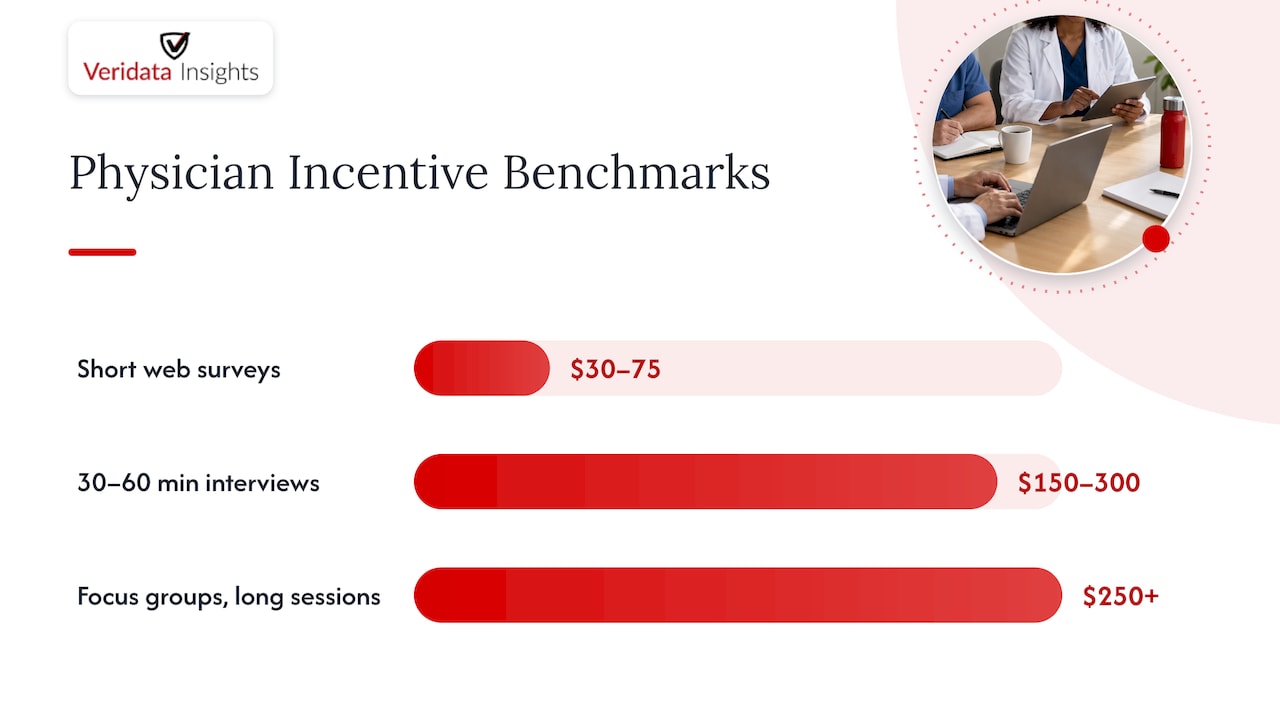
- Offer $30 to $75 for short surveys, $150 to $300 for 30 to 60 minute interviews, and $250 or more for focus groups; pay promptly.
- Choose physician networks whose members have already agreed to research, and rotate panels between studies to limit fatigue and repeat respondent bias.
- For clinical studies, confirm IRB review, disclose payment in consent materials, and tie compensation to documented time rather than referrals or enrollment.
- Keep web surveys under 10 to 15 minutes and send three to six reminders over several weeks, using individually addressed mail for critical quotas.
Table of Contents
- A Checklist for Tactics That Move Physician Response Rates
- Designing a Physician Recruitment Plan: Sampling, Screening, and Timeline
- IRB, Ethics, and Legal Guardrails for Physician Recruitment
- Execution Details: Incentives, Scheduling, and Privacy
- When to Hire a Full-Service Recruiter
- Keeping Physicians Engaged Across a Longitudinal Study
- Customizing Recruitment Messaging by Specialty and Setting
- Protecting Physician Confidentiality During Recruitment
- Reaching Physicians Through Digital and Social Channels
- Contact Veridata Insights to Recruit Physicians for Your Study
- FAQ
- Sources
A Checklist for Tactics That Move Physician Response Rates
Physicians are busy, skeptical of cold outreach, and tired of generic survey requests. The tactics that actually move the needle are well documented, and most of them cost less than simply raising your incentive.
Response rates without any incentive tend to land at 30% or lower, while studies offering incentives of $20 or more frequently report rates near 50% or higher. That single data point should shape your entire budget conversation before you write a single screener question.
Here’s what the evidence supports:
- Set realistic baseline expectations: plan for response rates at or below 30% with no incentive, and budget incentive dollars to push toward 50%.
- Use incentive benchmarks by task type: $30 to $75 for short web surveys, $150 to $300 for 30 to 60 minute interviews, and $250 or more for focus groups or longer in-depth sessions, a range consistent with what incentive research across physician studies reports.
- Prefer prepaid or immediate cash incentives over promised payments. Immediate delivery consistently outperforms a promise of payment later.
- Space multiple reminders across several weeks, let physicians pick their preferred contact mode, and reserve hand-addressed mail for late non-responders.
Statistic: Offering a monetary incentive increases the odds of physician response by roughly 2.13 times compared with no incentive, though the gains shrink as incentive size grows. Doubling your payment rarely doubles your response rate, so pairing a modest, well timed incentive with genuine burden reduction gets you further than chasing a bigger check.
Designing a Physician Recruitment Plan: Sampling, Screening, and Timeline
A solid recruitment plan starts before the first invitation goes out. Four decisions shape everything that follows: where your sample comes from, how you screen it, how you stratify it, and how much time you give yourself to field it.
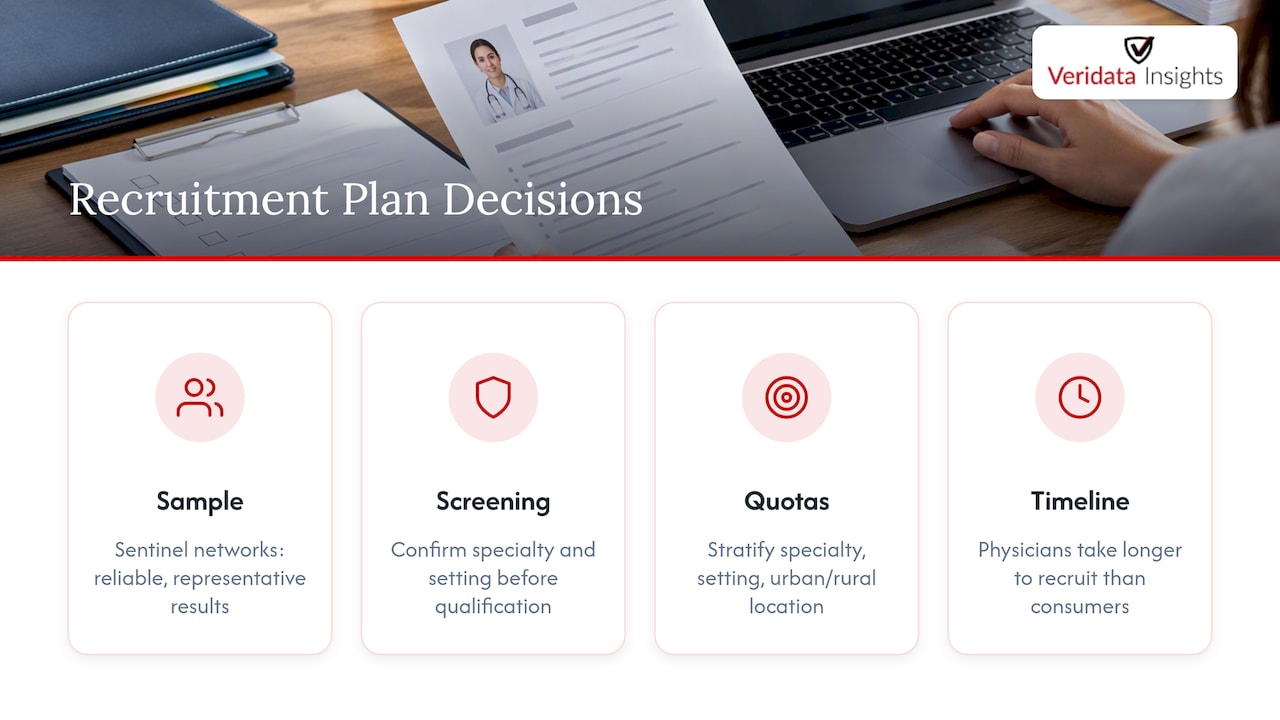
1. Choose your sample frame. Pre-recruited sentinel networks of physicians who have already agreed to participate in research tend to produce more reliable, representative results than cold-purchased lists, according to research on national physician survey programs. Purchased lists move faster but carry more risk of inaccurate contact data and lower engagement.
2. Build screener logic that protects data quality. Exclude market research company employees, set a minimum window since a physician’s last study participation, and confirm specialty and practice setting before counting someone as qualified. This guards against the professional respondent bias that incentive and sampling research flags as a quiet threat to validity when the same small pool answers every survey that comes along.
3. Stratify your quotas deliberately. Specialty, practice setting, and urban versus rural location are the variables that most often determine whether your findings hold analytic power. A sample skewed toward urban primary care physicians will not tell you much about rural specialists, even if your total count looks healthy.
4. Build in fielding time and a backup plan. Recruiting physicians takes longer than recruiting general consumers. Give yourself lead time for outreach, realistic time-to-complete estimates, and a plan for replacing slow-responding strata before they threaten your deadline.
Pro Tip: Rotate which pre-recruited network you tap for each new study. Reusing the same panel too often causes fatigue and quietly drags your response rate down over time.
IRB, Ethics, and Legal Guardrails for Physician Recruitment
Every incentive decision you make has a compliance dimension, and skipping this step creates risk that outlasts any single project. FDA guidance on payment and reimbursement to research subjects calls for IRB review of payments and recruitment materials wherever applicable, with payments disclosed in consent and structured to avoid coercion.
Build these checks into procurement and protocol from day one:
- Confirm whether your project triggers IRB review for payments and recruitment materials, and disclose the incentive amount and purpose in the consent language.
- Set payments at fair market value, never contingent on how many other physicians a participant refers.
- Avoid finder’s fees or volume bonuses entirely. Legal and ethical guidance on clinical trial recruitment payments warns these structures create conflicts of interest that are hard to unwind later.
- Write contract language that ties payment to documented time and services, not to enrollment outcomes.
- Keep documentation of IRB approvals, consent forms, and payment justification in your project files, especially when the work touches clinical trials or chart reviews.
When a project edges into clinical trial or chart review territory, loop in legal or ethics review early rather than after fielding starts.
Execution Details: Incentives, Scheduling, and Privacy
Good strategy falls apart without clean execution. These are the operational habits that keep a physician recruitment effort running smoothly from first contact to final completion.
- Use prepaid incentives whenever your process allows it. When prepayment is not feasible, a time-limited or early-finish bonus captures some of the same effect, since experiments on incentive timing show immediate cash consistently beats promised payment.
- Choose delivery methods that protect privacy. Gift codes avoid the tax documentation hassle that checks requiring a Social Security number create, and physicians notice the difference.
- Keep web surveys under 10 to 15 minutes whenever possible, and quote a completion time you can actually back up. An honest time estimate builds trust before the first question even loads.
- For interviews, offer narrow scheduling windows and several session times rather than one rigid slot. A concierge style booking process respects a packed clinical calendar.
- Sequence your reminders: an initial invite, then 2 to 4 reminders that get more personalized as you go, with a hand-addressed mailing or phone push reserved for quotas you are at risk of missing.
- Track which reminder touch actually converts each response. That data makes your next study’s cadence sharper.
- Watch for signs of professional respondent behavior and avoid leaning on the same small group of repeat participants, a pattern that incentive research ties to weaker data quality. Run brief validation checks to catch it early.
Pro Tip: A short, hand-addressed envelope for your final reminder wave often outperforms an entire extra round of email, especially with physicians who ignore everything that looks like mass outreach.
When to Hire a Full-Service Recruiter
Outsourcing makes sense when your timeline is tight, you need a narrow specialty sample, or the IRB, consent, and incentive logistics have gotten more complicated than your team can manage in house. A managed recruitment service typically covers consultation, questionnaire review, sampling, IRB-ready consent language, incentive fulfillment, reminder sequencing, and the data processing and reporting that follow.
Before you sign with any vendor, check for 7-day availability, no project minimums, genuine healthcare recruitment experience, and clear protocols for confidentiality and payment handling. We built Veridata Insights around exactly that combination: full flexible service, no project minimums, and deep experience recruiting hard-to-reach healthcare audiences, backed by the kind of panel strength that turns a stalled field period into a finished dataset.
Keeping Physicians Engaged Across a Longitudinal Study
A single survey is one ask. A longitudinal study is a relationship, and physicians drop out of long studies faster than almost any other professional audience once the novelty wears off.
The fix starts with transparency at enrollment: tell participants exactly how many waves to expect, how long each one takes, and what the total incentive adds up to across the study. Surprises at wave three are what trigger silent attrition.
Space your touchpoints so physicians never go so long between waves that they forget why they joined, but not so often that the study feels like a second job. A brief, warm reminder a week before each wave opens, paired with a short summary of what their input has shown so far, keeps the relationship feeling collaborative rather than transactional.
Vary your incentive structure to reward the commitment itself. A modest completion bonus for finishing every wave, on top of per-wave payment, acknowledges that longitudinal participation costs more time than a one-off survey.
Make it easy to resume after a missed wave. A physician who skips wave two because of a busy week should not feel locked out of wave three. Low-friction re-entry keeps your sample size intact and avoids the kind of attrition bias that quietly skews results toward whoever has the most spare time, which is rarely representative of the specialty you set out to study.
Customizing Recruitment Messaging by Specialty and Setting
A recruitment message that works for a primary care physician in a solo practice often falls flat with a hospital-based surgical specialist, and treating them the same is one of the more common mistakes we see in physician recruitment.
Primary care physicians tend to respond to messaging that emphasizes relevance to their day-to-day patient population and respects the reality of back-to-back appointments. A short subject line and a clear time estimate matter more here than almost anywhere else.
Specialists, particularly in surgical or procedural fields, often respond better to messaging that establishes the study’s clinical relevance up front and offers scheduling flexibility around procedure days. Their calendars are less predictable week to week, so a narrow single time slot is more likely to get ignored than answered.
Practice setting matters just as much as specialty. A physician in a large hospital system may expect a different level of formality and institutional framing than one in an independent rural practice, where a more personal, direct tone tends to land better.
The channel matters too. Hospital-based physicians often check institutional email less reliably than independent practitioners, which makes mode choice, covered in the checklist above, a direct extension of this same customization work. Tailoring a handful of message variables by specialty and setting costs little and consistently improves the odds that your invitation gets opened instead of deleted.
Protecting Physician Confidentiality During Recruitment
Physicians are protective of their time and even more protective of their professional reputation, which makes confidentiality a recruitment issue as much as a data handling one.
Separate identifying contact information from survey response data as early in your process as possible, so that even internal teams reviewing results never need to see who said what. This separation should be built into your data architecture before fielding starts, not added afterward as a cleanup step.
Be explicit in your outreach and consent materials about who will see a physician’s individual responses, whether results will be reported only in aggregate, and how long you retain identifying information after the study closes. Vague language here is one of the fastest ways to lose a physician’s trust before they even open your survey.
Payment delivery is a quieter confidentiality risk. Methods that require a Social Security number or detailed tax documentation expose more personal information than most physicians are comfortable sharing for a market research study, which is part of why incentive timing research points toward privacy-sensitive payment methods as both a response driver and a trust signal. Gift codes and similar low-documentation options solve two problems with one choice.
Document your confidentiality protocol in writing and reference it in your consent language. A physician who can see exactly how their information will be handled is far more likely to say yes.
Reaching Physicians Through Digital and Social Channels
Traditional panel and email outreach still carries most physician recruitment, but digital and social channels have become a legitimate supplement, particularly for specialties that are hard to reach through conventional lists.
Professional networking platforms built for physicians allow targeted outreach by specialty and practice setting, often with better self-reported credential verification than a purchased contact list offers. These platforms work especially well for niche specialties where the total eligible population is small and traditional panels run thin.
Specialty-specific online communities and forums, where physicians already gather to discuss clinical topics, can supplement recruitment for studies that fit naturally into those conversations. This approach requires a light touch: physicians notice and resent outreach that feels like it is exploiting a professional space for commercial research.
Paid social advertising targeted by professional credential and specialty can extend reach for studies with larger budgets, though it works best as a supplement to pre-recruited networks and email outreach rather than a replacement for them.
Whatever digital channel you add, the same fundamentals from the checklist above still apply: a believable sponsor, a realistic time estimate, and a incentive that matches the task. Digital channels widen your funnel, but they do not change what makes a physician decide to click through and finish a survey.
Contact Veridata Insights to Recruit Physicians for Your Study
We offer full flexible service, with no project minimums, which means we can take on a single physician interview wave or a full longitudinal healthcare study with equal attention. Our team handles sampling, screening, IRB-ready consent language, incentive fulfillment, and reporting, so your study moves from design to data without the recruitment bottleneck slowing you down.
Reach out through our respondent recruitment page to talk through your physician sample, or visit our healthcare market research page to see how we approach clinical and provider audiences.
FAQ
What response rate should I expect from a physician survey?
Expect 30% or lower without any incentive, and plan for rates closer to 50% or higher when you offer an incentive of $20 or more. Exact rates still depend heavily on survey length, topic relevance, and how many reminders you send.
How much should I pay physicians to participate in research?
Typical ranges run from $30 to $75 for short web surveys up to $250 or more for focus groups and longer in-depth interviews, based on incentive benchmarks from physician survey research. Prepaid or immediate cash generally outperforms a promised payment at the same dollar amount.
Do physician survey incentives require IRB approval?
In many clinical and research contexts, yes: FDA guidance calls for IRB review of payment structures and recruitment materials, with amounts disclosed in informed consent. Requirements vary by project type, so check with your IRB or legal counsel before finalizing incentive amounts.
How many reminders should I send physicians who have not responded?
Most successful physician studies use 3 to 6 reminders spaced across several weeks, often adding a hand-addressed mailing for late non-responders in critical quotas. Research on national physician survey programs found this approach, combined with letting respondents choose their contact mode, produced response rates as high as 66 to 83% in established physician networks.
Should I hire a vendor to recruit physicians or manage it internally?
Managing recruitment internally can work for small, straightforward studies, but outsourcing makes more sense when timelines are tight, you need a narrow specialty sample, or incentive and IRB logistics have grown complex. Veridata Insights offers full-service recruitment with no project minimums and availability 7 days a week for teams that would rather hand off that complexity.
Sources
- Getting physicians to respond: the impact of incentive type and timing on physician survey response rates
- FDA guidance: payment and reimbursement to research subjects (relevant guidance and considerations)
- Legal and ethical considerations for offering clinical trial recruitment payments and enrollment incentives (FDLI, 2024)