

Most commissioned studies land somewhere between $3,000 for a lean online survey and several tens of thousands of dollars for a multi-method program with qualitative and quantitative phases. In-depth interviews typically run from low to mid hundreds of dollars per completed interview, and focus groups often land between $6,000 and $15,000 per group once recruitment and facility costs are included. The single rule that beats every spreadsheet: put your money where it protects data integrity first, meaning recruitment quality, incentives, and processing, and trim everywhere else before you trim there.
TL;DR:
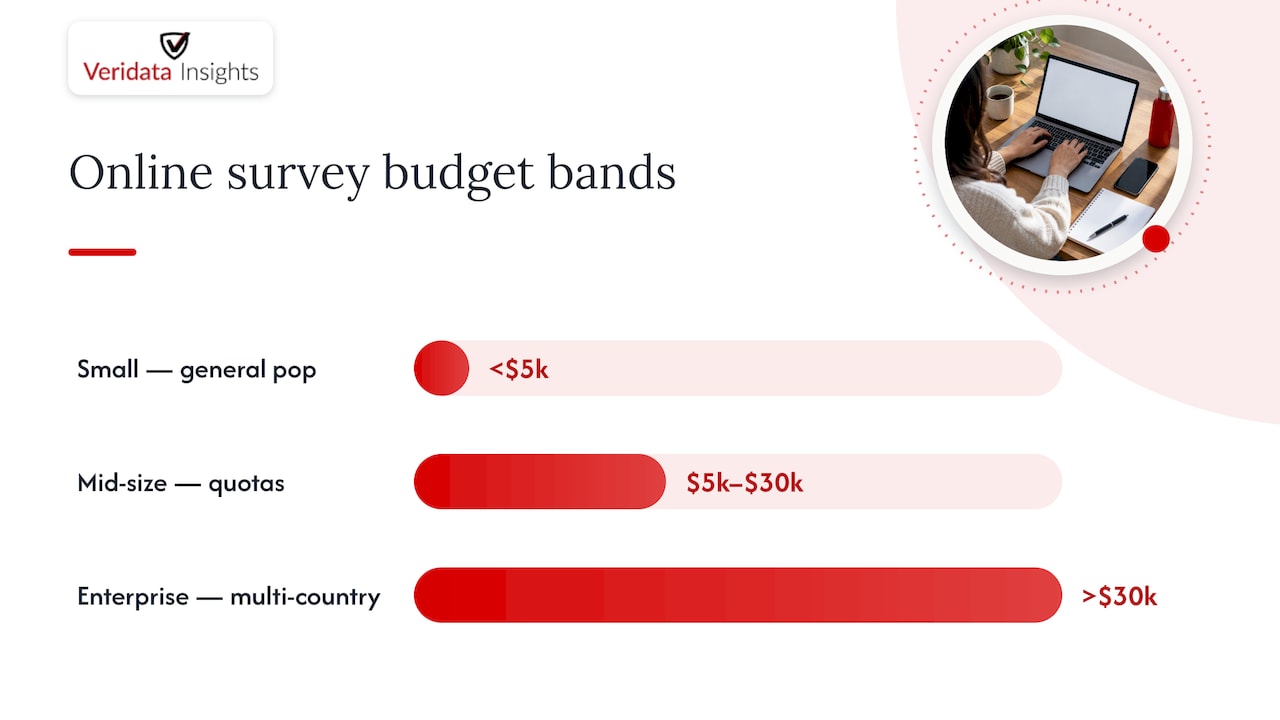
- Online surveys cost between $5,000 and $30,000 for mid-size projects, with larger, multi-country programs exceeding this range.
- Participant incentives, usually around 10% of total interview costs, can be increased to 20% to significantly boost response quality and panel replenishment.
- Sample difficulty, size, and language requirements are primary factors that push study costs into higher budgets.
- Automation and AI tools have reduced processing costs, but recruitment for niche or hard-to-reach populations remains a major expense.
- Comparing vendor quotes requires itemized costs and clear scope details to ensure accurate budget assessments.
Table of Contents
- Cost breakdown by study type: realistic ranges and what drives them
- Major cost drivers and line items you must budget for
- Sample budget scenarios (small, mid, large) with worked examples
- How to allocate a study budget across phases (percent guidelines)
- Ways to reduce costs without sacrificing data quality
- Panel vs custom recruitment: cost, speed, and quality trade-offs
- Vendor budgeting checklist: what to ask and how to compare quotes
- How Veridata Insights budgets and ensures value
- Benchmarking market research budgets by industry sector
- Regional or geographic variations in market research costs
- Impact of sample size on budget benchmarks
- Effect of research methodology innovations on cost benchmarks
- Veridata Insights as an option: how we help with budgets and quotes
- Sources
- FAQ
Cost breakdown by study type: realistic ranges and what drives them
Budgets swing hard depending on methodology, and knowing the bands helps you spot a lowball or an inflated quote before it lands on your desk.
Online surveys (CAWI) are the most predictable line item. A small project with a general-population sample and a short questionnaire often runs under $5,000. A mid-size study with quotas, screening criteria, and a 15 to 20 minute questionnaire typically lands between $5,000 and $30,000. Enterprise programs with multi-country fielding, complex quotas, or hard-to-reach B2B audiences regularly exceed $30,000.
Phone surveys (CATI) add interviewer labor on top of programming and sample costs, which matters most when your audience will not respond well online, such as older populations or specialized professionals. In-depth interviews (IDIs) with consumers generally run $150 to $400 per completed interview, while expert or executive interviews can run higher given scheduling difficulty and interviewer skill required. Focus groups, whether in-person or remote, usually cost $6,000 to $15,000 per group once you add moderation, facility or platform fees, and respondent incentives. Ethnography and diary studies sit at the top of the range because they require sustained fieldwork, specialized moderators, and heavier analysis, often making them bespoke engagements priced per project rather than per unit.
What actually pushes a project into a higher band:
- Sample difficulty, meaning how rare or hard to reach the target respondent is.
- Sample size and the number of subgroups you need statistically reliable data for.
- Questionnaire length, since every added minute raises both cost and dropout risk.
- Number of languages or markets requiring translation and localization.
Major cost drivers and line items you must budget for
Every quote breaks down into the same handful of buckets, and understanding each one lets you compare vendors on equal footing instead of just eyeballing a bottom-line number.
- Programming and platform fees, which can be a one-time build cost or a recurring subscription depending on the tool and complexity.
- Recruitment sourcing, including panel access fees and premiums for custom screening against tight criteria.
- Participant incentives, which directly affect response rates and panel retention.
- Data processing, covering verbatim review, open-end coding, and data cleaning before analysis starts.
- Analysis, reporting, and visualization, which can range from a basic topline deck to an interactive dashboard.
- Project management, translation and localization, and a contingency line for scope changes.
Incentives often represent about 10% of total interview cost, and raising that to roughly 20% can meaningfully improve panel replenishment and response quality, according to Insights Association. That single line item is small relative to the whole budget, but it has an outsized effect on whether your fieldwork finishes on time with clean data. Programming examples for smaller teams have ranged from $700 to $15,000 depending on complexity. So it pays to ask vendors exactly what their programming quote includes before you compare it to anyone else’s.
Sample budget scenarios (small, mid, large) with worked examples
These are illustrative worked examples, not market averages, meant to show how the line items above actually stack up.
- Small study: Say you need 400 to 800 online completes from a general-population panel with light quotas. Programming runs around a few thousand dollars, panel sample and incentives around a couple thousand more, processing and basic tabulation add some additional costs, and a simple topline report contributes further. Total lands in the low thousands.
- Mid-size study: Say you need 1,000 to 2,000 completes with multiple quota groups, modest incentives, basic weighting, and a dashboard deliverable. Programming costs several thousand dollars, sample and incentives roughly double that, processing and weighting add more, and analysis with a dashboard is a significant portion. Total lands in the lower tens of thousands.
- Large or blended study: Say your brief calls for a quantitative survey plus 20 in-depth interviews, full reporting, and translation into two additional languages. Quant programming and fielding might run $20,000, the 20 IDIs at $300 average plus moderation and transcription around $10,000, translation and localization around $5,000, and full reporting with visualization around $10,000. Total lands near $45,000.
Each of these assumes a standard eight to twelve week timeline. Compress the schedule and every line item above gets more expensive, sometimes sharply.
How to allocate a study budget across phases (percent guidelines)
Treat it as a flexible guide, not a rule, since qualitative-heavy projects shift more weight toward fieldwork and analysis.
- Planning deserves real time because a flawed questionnaire design costs far more to fix mid-field than to catch upfront.
- Fieldwork and incentives get the largest share because that is where data integrity is won or lost.
- Processing and analysis each need a fifth of the budget because raw numbers without clean coding and real interpretation are just noise.
Pro Tip: When a timeline gets compressed, expect fieldwork costs to rise first, since rushed recruitment usually means paying premiums for faster turnaround or wider sample sourcing.
Ways to reduce costs without sacrificing data quality
Cutting corners on sample size or incentives is the fastest way to end up with data nobody trusts, but there are real levers that save money without touching quality.
- Tighten questionnaire length and screening logic, since shorter surveys reduce both field time and respondent dropout.
- Reuse validated modules or benchmark questions across projects instead of rebuilding programming from scratch each time.
- Blend panel sample with targeted custom recruitment so you only pay the premium rate for the hardest-to-reach segment.
- Choose project-based tools over open-ended subscriptions when a study is a one-off rather than part of an ongoing program.
- Decide deliberately between accepting slightly wider margins of error on soft metrics versus protecting sample size on your primary measures.
Panel vs custom recruitment: cost, speed, and quality trade-offs
Commercial panels are faster and often cheaper for general consumer samples, but they can struggle with deep profiling needs and carry some risk of professional-respondent bias. Custom recruitment costs more per respondent but becomes necessary for niche B2B roles, rare medical conditions, or any audience that needs verified screening beyond a panel’s self-reported profile data.
- Use commercial panels when your target population is broad and well represented in existing panel pools.
- Use custom recruitment when you need verified job titles, rare conditions, or audiences panels simply do not reach in sufficient numbers.
- Expect deeper profiling and richer incentives to add time to recruitment, but also to improve the quality of who actually shows up.
- A practical rule of thumb: if screening criteria eliminate more than roughly eight in ten panel candidates, custom sourcing is usually worth the premium.
Vendor budgeting checklist: what to ask and how to compare quotes
Before you sign off on any quote, get these answered in writing so you are comparing like for like across vendors.
- Ask for itemized costs for incentives, programming, translation, processing, and sample sourcing separately.
- Request detail on where the sample comes from and how the vendor verifies respondent identity and eligibility.
- Confirm the timeline, key milestones, and exactly what triggers additional fees.
- Clarify deliverable formats, rights to raw data, and whether visualization or dashboards are included or extra.
- Watch for vague scope language, unexplained “other” fees, or incentive amounts the vendor will not specify upfront.
How Veridata Insights budgets and ensures value
Veridata Insights works as a full flexible-service partner, scoping full-service market research with no project minimums and availability 365 days a year. Sample sourcing, incentive levels, and processing intensity each get discussed upfront during scoping, because those choices are exactly what move a quote from one budget band to the next.
Benchmarking market research budgets by industry sector
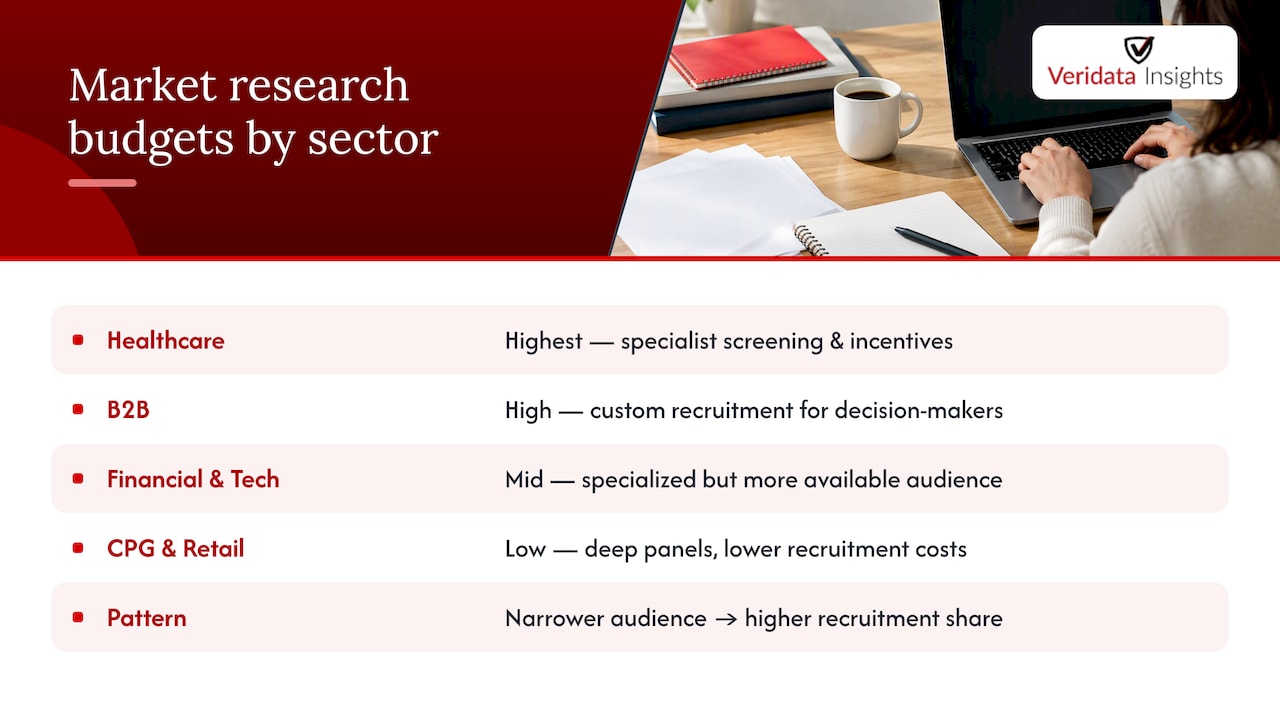
Budgets vary by sector mostly because of who you need to reach and how hard that audience is to find. Healthcare research tends to run higher than general consumer work because recruiting physicians, specialists, or patients with specific diagnoses requires verified screening and often higher incentives to compensate for professionals’ time. Healthcare market research projects frequently blend quantitative surveys with qualitative interviews, which compounds the cost relative to a single-method consumer study.
B2B research carries its own premium, since decision-makers and technical buyers are a small, busy population compared to general consumers. B2B market research often leans on custom recruitment rather than panels precisely because panels rarely have deep enough B2B representation to hit tight quotas.
Consumer packaged goods and retail studies tend to sit at the lower end of the spectrum because panels are deep and well-profiled for general demographics, which keeps recruitment costs down even at larger sample sizes. Consumer market research for mainstream products can often use existing panel infrastructure without much customization.
Financial services and technology research sit somewhere in between: audiences are more specialized than general consumers but more available than rare medical populations, so budgets usually track closer to mid-range B2B numbers than to healthcare premiums. The pattern across sectors is consistent: the narrower and more specialized the audience, the more of your budget goes toward recruitment and screening rather than fieldwork volume.
Regional or geographic variations in market research costs
Where your respondents live changes the budget as much as who they are. Fielding a study across multiple countries multiplies translation, localization, and in-market recruitment costs, and timezone differences can extend fieldwork timelines for anything involving live interviewing or moderation.
Labor costs for interviewers and moderators also vary by market, which affects CATI and qualitative budgets more than self-administered online surveys. A multi-country quantitative study typically costs more per completed interview than a single-market study of the same size, partly because translation and localization get added per language and partly because sample sourcing in smaller or less-penetrated panel markets commands a premium.
Qualitative work shows the widest regional swings, since moderator availability, facility costs, and even respondent incentive expectations differ by market. A focus group budget that works comfortably in one country may need a meaningfully different incentive structure elsewhere to hit the same recruitment quality. Vendors with established in-market recruitment networks, rather than ones subcontracting sample sourcing on the fly, tend to produce more predictable regional quotes.
Impact of sample size on budget benchmarks
Sample size has a nonlinear relationship with cost, and that surprises a lot of first-time buyers. Doubling your sample size rarely doubles your budget, because programming, project management, and a chunk of the analysis cost are fixed regardless of how many people you survey. The marginal cost per respondent usually drops as sample size grows, which is why enterprise studies with thousands of completes can still land at a reasonable per-interview rate.
The flip side matters just as much: small samples do not save as much as people expect, because the fixed costs of programming, questionnaire design, and basic reporting stay roughly the same whether you field 200 completes or 800. If your budget is tight, the better lever is usually trimming scope, fewer subgroups, a shorter questionnaire, rather than cutting sample size below what you need for statistically usable subgroup data.
Qualitative sample size works differently, since each interview or group adds a near-linear cost in moderation, incentives, and transcription. Transcription costs in particular scale directly with interview count and length, so a jump from 15 to 25 IDIs adds cost in a way that a jump from 500 to 800 survey completes usually does not.
Effect of research methodology innovations on cost benchmarks
Automation has changed where the money goes more than it has changed the total. Automated survey programming platforms and AI-assisted coding of open-ended responses have cut processing time on many studies, which shows up as a smaller processing line item relative to what it would have cost a few years ago. Research tool pricing itself varies widely: event materials from Insights Association list examples ranging from roughly $33 to $135 per month for some platforms, per-seat prices around $24 to $124, one-off project fees near $50, and enterprise license fees running into the thousands, which means tooling choice alone can meaningfully shift a budget.
AI-assisted analysis has made dashboard-style visualization more accessible at lower price points than fully custom reporting used to command, which is reshaping the analysis and reporting line item on mid-size studies. A Tableau consultant engaged for a one-off visualization build carries its own separate cost structure worth comparing against an in-house dashboard tool subscription.
What has not changed is the premium on recruitment and incentives for hard-to-reach populations. No amount of automation replaces a verified screener for a rare B2B role or a specific medical condition, which is why those lines still deserve the lion’s share of attention regardless of how much faster programming and processing have become.
Veridata Insights as an option: how we help with budgets and quotes
Scoping a study from scratch is where most budgets go sideways, and that is exactly where a flexible, full-service partner earns its keep. Some market research firms handle scoping, recruitment, programming, processing, analysis, and visualization under one roof, with no project minimums standing between you and a quote that fits your brief.
- Review your scope, sample targets, and timeline together before any pricing is locked in.
- Get quantitative and qualitative services scoped separately or combined into one program.
- Lean on respondent recruitment built for B2B, B2C, healthcare, and hard-to-reach audiences.
Before reaching out, jot down your target sample, methodology preference, and rough timeline. Request a full-service market research quote directly or start with our contact page if you are still shaping the brief.
Sources
- One Way to Improve Survey Quality in the U.S.: Properly Valuing Participants – Insights Association
- Research repositories and platform pricing examples – Insights Association (event materials PDF)
FAQ
What is a reasonable budget for a basic online survey?
A basic online survey with a general-population sample and a short questionnaire often costs under $5,000, while mid-size studies with quotas and longer questionnaires typically run $5,000 to $30,000. The exact figure depends heavily on sample size and how hard your target audience is to reach.
How much should I budget for focus groups?
Focus groups generally cost $6,000 to $15,000 per group once moderation, facility or platform fees, and respondent incentives are included. Remote groups can sometimes trim facility costs, but moderation and recruitment remain the biggest drivers either way.
Why do participant incentives matter so much to the budget?
Incentives often represent about 10% of total interview cost, and raising that share toward 20% can meaningfully improve panel replenishment and response quality. Underpaying respondents is one of the fastest ways to end up with slow fieldwork and weaker data.
Should I use a commercial panel or custom recruitment?
Commercial panels tend to be faster and cheaper for broad consumer samples, while custom recruitment costs more per respondent but is usually necessary for niche B2B roles, rare populations, or studies requiring verified screening. The right choice depends on how specialized your target audience is.
What does Veridata Insights charge for a market research project?
Some market research providers price projects individually based on scope, methodology, and sample needs, offering full-service market research without fixed packages. Reach out through the full-service market research page to get a quote tailored to your specific brief.