

TL;DR:
- Building a structured audience recruitment workflow is essential for nonprofit growth, yet often overlooked.
- Effective organizations define personas, craft mission-driven messages, choose targeted channels, and track results systematically.
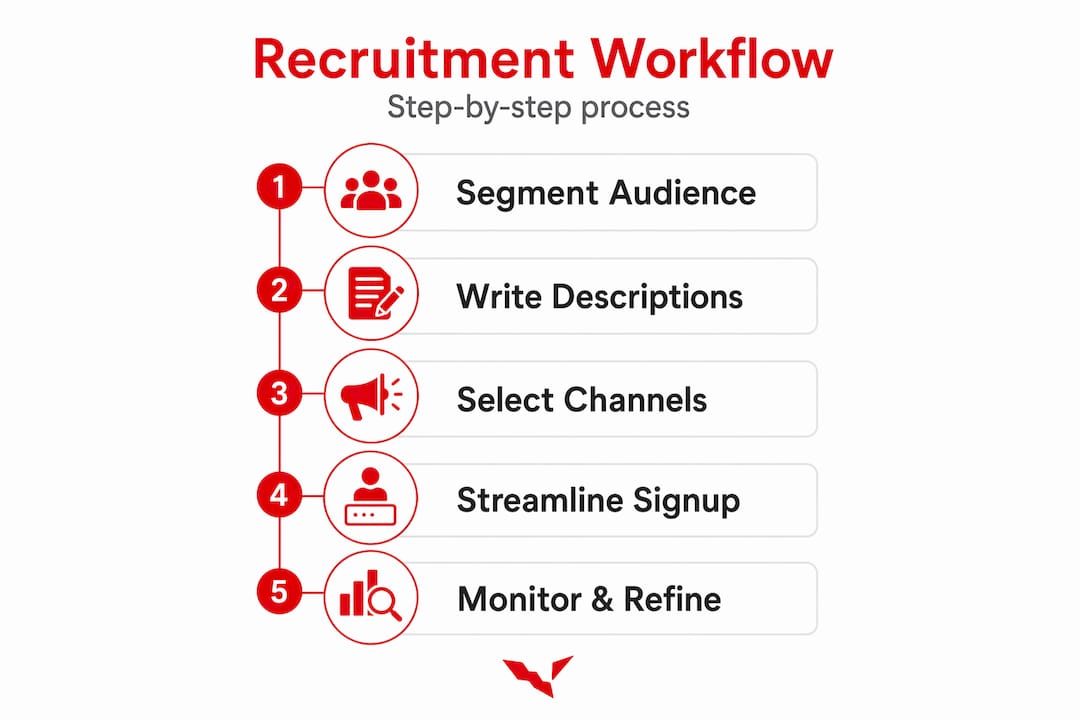
Building an effective non-profit audience recruitment workflow is one of the most overlooked drivers of organizational growth. Most nonprofits either wing it with a scattered social media post or rely on word of mouth and hope for the best. Neither approach scales. The organizations that consistently attract passionate volunteers, loyal donors, and engaged supporters are not lucky. They follow a deliberate process: define who they want, craft a compelling invitation, meet people where they are, and track what works. This article walks you through exactly that process, step by step.
Table of Contents
- Key takeaways
- Defining your non-profit audience recruitment workflow
- Writing role descriptions that actually motivate
- Selecting and optimizing your recruitment channels
- Streamlining signup and onboarding
- Monitoring and refining your recruitment workflow
- My honest take on what most nonprofits get wrong
- How Veridatainsights can power your recruitment workflow
- FAQ
Key takeaways
| Point | Details |
|---|---|
| Segment before you recruit | Build 3 to 4 detailed audience personas before writing a single message or choosing a channel. |
| Lead with mission impact | Role descriptions convert better when they open with purpose, not task lists. |
| Match channels to personas | Effective non-profit outreach strategy targets people on the platforms they already use, not just the ones you prefer. |
| Reduce signup friction | Simplified forms and mobile-friendly applications directly increase volunteer conversion rates. |
| Measure and refine weekly | Tracking funnel metrics weekly lets you cut what is not working and scale what is before you waste budget. |
Defining your non-profit audience recruitment workflow
Before you write a single email or design a single flyer, you need to know who you are trying to reach. This sounds obvious. But it is the step most nonprofits skip, or do so superficially, and then wonder why their outreach produces poor results.
Start with your past recruitment data. Look at your highest-retention volunteers and most engaged donors. What do they have in common? Age range, profession, motivation, how they first heard about you? That information is gold. It tells you what a good fit actually looks like, rather than what you hope it looks like.
From there, build 3 to 4 detailed volunteer and supporter personas. A persona is not a vague description. It includes demographics, what motivates this person to give time or money, what platforms they use, and what kind of ask lands well with them. Effective audience segmentation into these focused profiles is one of the clearest predictors of recruitment success. Common segments for nonprofits include:
- Retired professionals looking for purposeful use of their skills
- College students seeking experience and resume-building opportunities
- Corporate employees whose employers offer volunteer matching programs
- Parents engaged in community-centered causes that affect families
Segmenting your audience this way lets you tailor your messaging and your asks. A retired attorney and a 20-year-old student are not moved by the same words. Treating them as if they are is a fast track to low response rates. Tailored recruitment messaging and channels tied to specific segments significantly increase recruitment efficiency.
Pro Tip: Ask your existing volunteers and supporters directly. A short survey asking “why did you get involved” and “how did you hear about us” gives you real data to build personas from, not assumptions.
Writing role descriptions that actually motivate
Once you know who you are recruiting, you need to give them a reason to say yes. That starts with role descriptions that are honest, specific, and mission-driven.

Most volunteer role descriptions read like HR job postings. They lead with tasks. “The volunteer will sort donations, greet visitors, and assist with data entry.” That is not a conversation starter. That is a list of chores. Role clarity using the Who/What/When/Where/Why/How framework is proven to improve both engagement and retention, but the key is leading with why the role matters before getting to the what and when.
A strong role description opens with impact. Something like: “As a mentor in our afterschool program, you will directly shape how a child sees their future.” That sentence answers the most important question a potential volunteer asks: “Will this matter?” After that, you can include specifics: time commitment, location, skills needed, and support provided.
Building a case for support is equally important for fundraising audience development. Connect your mission impact to the personal benefit your supporter receives. Recognition, community, professional growth, and the feeling of being part of something real are all legitimate motivators. Specific, urgent asks consistently outperform general appeals because they lower the psychological barrier to participation.
Pro Tip: Include one short volunteer testimonial in every role description. A real person saying “this changed how I spend my weekends” does more persuasive work than any amount of organizational copy.
Selecting and optimizing your recruitment channels
You now know who you want and what you are offering them. The next question is where to find them. This is where many nonprofits either spread themselves too thin across every platform or default to the channels they are already comfortable with, regardless of whether their audience is there.
The rule is simple: go where your personas live. Here is a practical framework for matching channels to audience segments:
- Email works best for mid-career professionals and existing supporters who already know you.
- LinkedIn reaches corporate employees, skilled volunteers, and professionals who want to give back in structured ways.
- Instagram and TikTok are where younger audiences, particularly Gen Z, spend their attention. Gen Z demands authentic, transparent communication, which means your content needs to feel real, not polished.
- Volunteer platforms like VolunteerMatch or Idealist attract people already searching for opportunities, making them high-intent channels.
- Local media and community boards still work for hyperlocal campaigns targeting retirees and older community members.
On the influencer question: this is not just a brand tactic anymore. About 50% of nonprofits surveyed in 2024 collaborated with social media influencers to reach younger audiences. A trusted voice in your community sharing why they volunteer for your cause reaches an audience you would never find through a Facebook ad.
Here is a quick channel comparison by audience segment:
| Persona | Best channels | Content style |
|---|---|---|
| Retired professionals | Email, Facebook, local media | Informational, mission-focused |
| College students | Instagram, TikTok, campus boards | Visual, authentic, short-form |
| Corporate employees | LinkedIn, email, workplace portals | Professional, impact-driven |
| Parents/community members | Facebook, local newsletters, events | Community-oriented, personal stories |
Automated email sequences also belong in your non-profit marketing workflow. A series of 4 to 6 automated welcome emails builds trust before you make any direct ask. Share your story, introduce your team, show your impact. By the time you ask someone to volunteer or donate, they already feel connected.
Streamlining signup and onboarding
Interest without conversion is wasted effort. Once someone clicks your link or fills out an interest form, the clock starts. If the process is confusing, slow, or asks for too much too soon, you lose them.
Simplified application forms with fewer fields consistently lead to higher conversion rates. The practice of progressive disclosure works well here: ask for name, email, and availability first. Get deeper information once someone has committed. This also builds trust incrementally rather than demanding it upfront.
A few non-negotiable practices for your volunteer recruitment process:
- Make every form mobile-friendly. Most people will find you on their phone.
- Sync your intake forms with a volunteer management system so no one falls through the cracks.
- Send a confirmation email within 24 hours of signup. Every hour of silence after a signup is a chance for someone to talk themselves out of it.
- Offer virtual and flexible volunteer options where possible. Accessibility broadens your pool significantly.
- Use workflow automation tools for nurturing, screening, and onboarding so your staff can focus on high-impact relationship work.
Hosting a short virtual information session for new recruits also works well. It answers questions before they become reasons to drop out, and it builds a sense of community before someone has even shown up.
Pro Tip: Track your drop-off points. If 60% of people start your form but never finish, the form is your problem, not your audience.
Monitoring and refining your recruitment workflow
A workflow you never measure is just a habit. The difference between a good non-profit audience recruitment workflow and a great one is a commitment to ongoing improvement through data.
The metrics that matter most:
| Metric | What it tells you |
|---|---|
| Source effectiveness | Which channels drive the most qualified applicants |
| Application completion rate | Where your funnel is losing people |
| Volunteer-to-active conversion | How well your onboarding converts interest to action |
| 90-day retention rate | Whether your role descriptions and experience match expectations |
| Cost per recruit | How efficient each channel is relative to your budget |
Tracking your recruitment funnel weekly gives you enough data to make real decisions without waiting until the end of a campaign to realize something did not work. Double down on your highest-performing channels. Cut or rethink the ones underperforming.
A/B testing is underused in nonprofit outreach. Test two versions of a subject line. Try two different call-to-action phrases. Change one variable at a time and let the data tell you what resonates. Authentic, two-way engagement that includes impact updates and behind-the-scenes content builds the kind of long-term supporter relationships that make your next recruitment campaign cheaper and easier.
Incorporate volunteer feedback formally, not just informally. A short survey at the 30-day mark asking what is working and what is not gives you qualitative data that no metric can capture. That feedback loop is what separates organizations that keep improving from those that repeat the same campaign every year and wonder why results plateau.
My honest take on what most nonprofits get wrong
I’ve worked alongside nonprofits long enough to notice a pattern. The ones struggling with recruitment are not struggling because of a bad cause or a small budget. They are struggling because they treat recruitment as a task rather than a system.
The most common mistake I see is skipping audience segmentation entirely. Organizations blast the same message to everyone on their list and then conclude that “people just are not interested.” That conclusion is wrong. The message was wrong for most of the audience it reached.
I’ve also seen organizations lose genuinely motivated volunteers at the signup stage. A 12-field form with no mobile optimization is not just inconvenient. It communicates that your organization has not thought about the person’s experience. First impressions matter, even in the digital space.
What actually works is leading every single communication with mission impact first. Not the organization’s history. Not the list of tasks. The impact. That is what moves people from passive interest to active commitment.
And here is the part most guides skip: stewardship is part of your recruitment workflow, not separate from it. Engagement must be a multi-stage partnership, not a single ask. The volunteers and supporters who feel genuinely seen and valued become your best recruiters. They bring in people you never could have reached through a paid ad.
Build the system. Measure it. Treat your audience as the complex, motivated individuals they are. That is how you recruit for real.
— Daniel
How Veridatainsights can power your recruitment workflow
At Veridatainsights, we know that the hardest part of building an effective non-profit audience recruitment workflow is often just getting the audience definition right. When you are not sure who you are looking for, every downstream decision gets harder.
We specialize in audience recruitment for hard-to-reach groups, including nonprofit volunteers, donors, and community supporters across B2C and specialized segments. We can help you identify and profile your ideal audience segments, assess which channels hold the best potential for your mission, and set up a data-backed foundation for your outreach strategy.
Whether you need a full-service research partnership or just targeted support on one piece of the puzzle, there are no project minimums and we are available every day of the year. Curious about what a data-driven approach could do for your charity audience engagement? Connect with our team and let’s find out together.
FAQ
What is a non-profit audience recruitment workflow?
A non-profit audience recruitment workflow is a structured, repeatable process for identifying, attracting, and converting potential volunteers and supporters. It typically covers audience segmentation, role messaging, channel selection, signup processes, and performance tracking.
How many audience segments should a nonprofit target?
Most effective volunteer recruitment plans use 3 to 4 focused audience profiles. More than that tends to dilute messaging; fewer risks missing important segments with different motivations and preferred channels.
Which recruitment channels work best for nonprofits?
The best channels depend on your audience. Email and LinkedIn work well for professionals, while Instagram and TikTok connect better with younger supporters. Matching channels to your specific personas is what drives results in a non-profit outreach strategy.
How can nonprofits reduce volunteer dropout after signup?
Send a confirmation email within 24 hours, keep onboarding steps short and mobile-friendly, and offer a virtual info session early in the process. Automated nurture workflows that stay in contact between signup and first shift significantly reduce dropout rates.
What metrics should nonprofits track in their recruitment funnel?
Focus on source effectiveness, application completion rate, volunteer-to-active conversion, and 90-day retention. Weekly tracking of these metrics lets you refine messaging and channel spend before a full campaign cycle ends.