


Most executives admit they’ve made at least one major strategic call based on gut feeling alone. That’s a risky game. Quantitative research is a systematic investigation that collects and analyzes numerical data to identify patterns, test relationships, and generalize findings, and it exists precisely to replace guesswork with evidence. In this guide, you’ll get a clear breakdown of core definitions, practical methodologies, real business applications, and expert best practices. Whether you’re an executive, a researcher, or someone responsible for strategic decisions, this is the foundation you need.
Table of Contents
- Defining quantitative research
- Key methodologies in quantitative research
- Advantages and limitations for business strategy
- Expert insights: Getting the most out of quantitative research
- Applying quantitative research: Business scenarios and next steps
- Drive smarter decisions with expert quantitative research
- Frequently asked questions
Key Takeaways
| Point | Details |
|---|---|
| Objective data analysis | Quantitative research enables objective, reliable evaluation for informed business decisions. |
| Methodology variety | Choose from surveys, experiments, and regression to answer different business questions. |
| Sampling importance | Accurate sampling methods ensure results reflect your broader target audience. |
| Strategic business impact | Applying quantitative research directly improves decision-making, resource allocation, and strategy. |
| Balance with qualitative | Combining quantitative and qualitative approaches gives the fullest picture for complex strategy. |
Defining quantitative research
Quantitative research is built on one core idea: measure it, analyze it, and let the numbers speak. It’s objective by design. You’re not interpreting feelings or impressions. You’re working with structured data that can be counted, compared, and statistically tested.
“Quantitative research is a systematic investigation that collects and analyzes numerical data to identify patterns, test relationships, and generalize findings.”
The real power here is generalizability. When you survey a well-constructed sample, you can draw conclusions about a much larger population. That’s what makes it so valuable for business strategy. You don’t need to talk to every customer. You need the right data from the right sample.
It’s worth noting that quantitative research is not the same as qualitative research. Qualitative methods explore meaning, context, and experience. Quantitative methods measure and quantify. Both have a role, but they answer different questions. For organizations that need scalable research approaches, quantitative methods are often the starting point.
Key methodologies in quantitative research
Knowing the definition is one thing. Knowing which tool to pick is where strategy gets real. Here are the primary methodologies you’ll encounter.
Survey research is the most widely used approach. Customer satisfaction surveys, Net Promoter Score (NPS) programs, and market segmentation studies all fall here. Surveys are fast, scalable, and cost-effective when designed well.
Experimental designs, like A/B testing in marketing, let you isolate variables and measure cause and effect. You change one element, hold everything else constant, and measure the outcome. Clean, direct, and actionable.

Correlational and regression methods explore relationships between variables. Regression analysis, for example, can tell you how changes in ad spend predict changes in conversions. Empirical benchmarks like surveys for customer satisfaction, A/B tests for ad performance, and regression for ad spend versus conversions are standard tools in applied business research.
Sampling strategy matters just as much as the method itself. Here’s a quick comparison:
| Sampling type | Approach | Best for |
|---|---|---|
| Simple random | Every unit has equal chance | General population studies |
| Stratified random | Population divided into subgroups | Comparing segments |
| Systematic | Every nth unit selected | Large, ordered populations |
| Convenience | Easiest to reach | Exploratory or pilot work |
| Purposive | Specific criteria-based selection | Niche or expert audiences |
For most business decisions, probability sampling methods (random, stratified) give you the most defensible results. Non-probability methods like convenience sampling are fine for early-stage exploration, but they carry generalizability risks.
- Surveys: best for measuring attitudes, satisfaction, and behavior at scale
- A/B tests: best for optimizing marketing, UX, and product decisions
- Regression analysis: best for forecasting and resource allocation
- Correlational studies: best for identifying relationships before testing causation
Pro Tip: When working with quantitative research agencies, always ask how they handle sampling design. A weak sample undermines even the most sophisticated analysis.
Advantages and limitations for business strategy
Quantitative research has real strengths. It also has real limits. Knowing both makes you a smarter buyer and a better decision-maker.
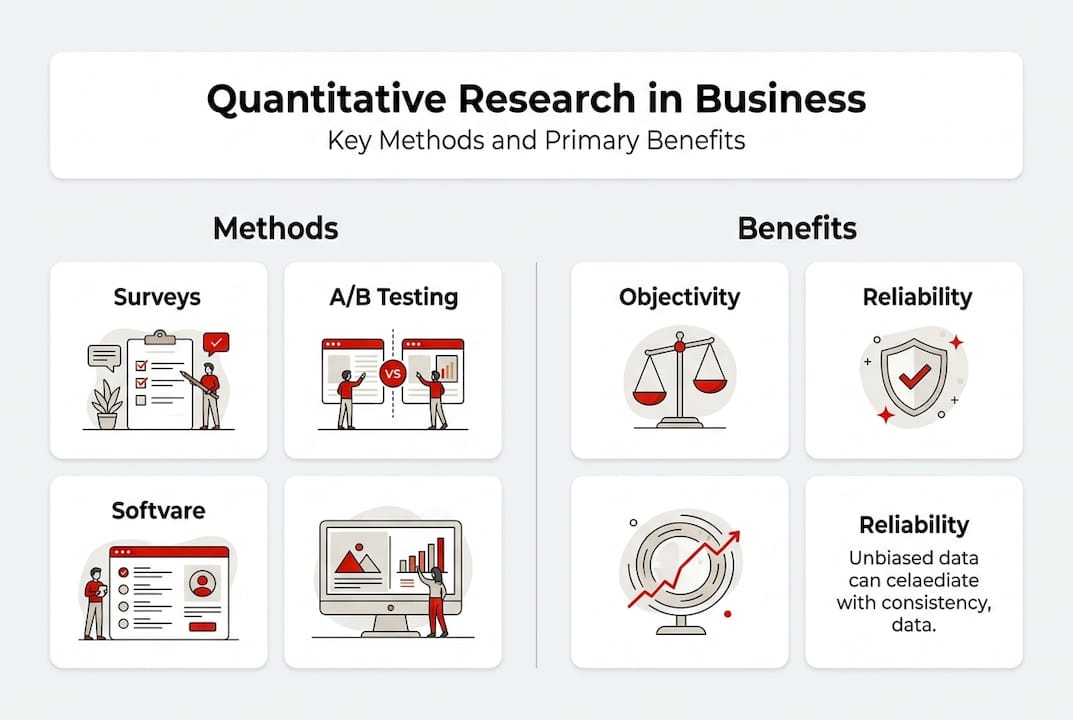
The advantages are significant. Objectivity, reliability, replicability, generalizability, speed, and statistical rigor are all core strengths of well-executed quantitative research. You get results that can be replicated, compared across time periods, and presented to stakeholders with confidence.
Here’s how those strengths play out in practice:
| Business application | Method used | Key metric |
|---|---|---|
| Customer loyalty tracking | NPS survey | Net Promoter Score |
| Ad creative optimization | A/B test | Click-through rate, conversion rate |
| Pricing sensitivity | Conjoint analysis | Willingness to pay |
| Market segmentation | Cluster analysis | Segment size and profile |
| Sales forecasting | Regression analysis | Revenue prediction accuracy |
The limitations are equally real. Quantitative methods can be rigid when populations are small or rapidly shifting. Poor questionnaire design leads to garbage data, no matter how sophisticated your analysis is. And there’s a subtler risk called the ergodic fallacy: assuming that group-level trends predict individual-level outcomes. They often don’t.
Here’s a numbered breakdown of the most common pitfalls:
- Overgeneralizing from a non-representative sample
- Treating correlation as causation without experimental validation
- Ignoring measurement error in survey instruments
- Applying group averages to individual predictions (ergodic fallacy)
- Failing to account for rapidly changing market conditions
Avoiding these market research pitfalls is not optional. It’s the difference between research that drives strategy and research that misleads it.
Pro Tip: Test the robustness of your findings by adding small amounts of noise to your dataset and re-running your analysis. If your conclusions change dramatically, your findings may not be as solid as they appear.
Expert insights: Getting the most out of quantitative research
Good data is not enough on its own. How you collect, interpret, and apply it determines whether your research investment pays off.
One of the most important expert recommendations is to combine quantitative and qualitative methods. Numbers tell you what is happening. Qualitative research tells you why. For nuanced strategic decisions, you need both. Combining qualitative and quantitative research consistently produces richer, more actionable insights than either method alone.
Prioritize probability sampling for generalizability and combine with qualitative research for strategic context.
The ergodic fallacy deserves special attention. It’s a trap that catches even experienced researchers. Group-level data shows that a marketing campaign increased average purchase frequency. But that average masks the reality: some customers bought much more, others stopped entirely. Person-oriented analyses help you avoid this error and ensure your inferences are valid at the individual level, not just the aggregate.
Here’s a practical robustness testing checklist:
- Re-run your analysis on subgroups to check consistency
- Add controlled noise to your dataset and observe result stability
- Test edge cases: what happens at the extremes of your data?
- Cross-validate predictive models on held-out data
- Compare findings against external benchmarks or prior studies
These steps are not bureaucratic. They’re what separates research you can act on from research that looks good in a slide deck but falls apart under scrutiny.
Applying quantitative research: Business scenarios and next steps
Theory is useful. Application is where value gets created. Here’s how quantitative methods translate into real business action.
Customer satisfaction surveys, A/B tests, and regression analysis for ad spend are among the most widely used quantitative tools in business settings. Each one follows a similar logic: define the question, design the measurement, collect clean data, and act on the findings.
For launching a high-impact survey, follow this sequence:
- Define your research objective before writing a single question
- Identify your target population and choose your sampling method
- Design your questionnaire with clear, unbiased language
- Pilot test with a small group before full launch
- Build your analysis plan before data collection begins, not after
For A/B testing in marketing, the setup matters as much as the result. Run tests long enough to reach statistical significance. Don’t stop early because one variant looks better. Interpret results in context, and always ask whether the winning variant is practically significant, not just statistically significant.
For regression analysis in resource allocation, start with a clear hypothesis. Which variables do you believe drive the outcome? Collect historical data, build your model, validate it, and use it to inform decisions like ad budget allocation or pricing adjustments.
For organizations piloting a new quantitative approach, market research for decision-making works best when it’s tied directly to a specific business question. Don’t research in the abstract. Start with a decision you need to make, and work backward to the data you need.
Drive smarter decisions with expert quantitative research
You now have a solid grasp of what quantitative research is, how its methods work, and where it delivers the most value for business strategy. The next step is putting it into practice. At Veridata Insights, we specialize in exactly this. We blend quantitative and qualitative methods, tailor every project to your industry and audience, and handle everything from questionnaire design to data visualization. No project minimums. Seven days a week. Whether you need a full-service engagement or just a piece of the puzzle, we’re ready. Connect with our team through expert research consultation or explore our full-service market research solutions to see how we can support your next strategic decision.
Frequently asked questions
What is the main difference between quantitative and qualitative research?
Quantitative research analyzes numerical data to find patterns and support predictions, while qualitative research explores meaning, context, and lived experience through non-numerical data. Both serve distinct strategic purposes.
Why should businesses use probability sampling in quantitative studies?
Probability sampling increases accuracy and ensures your findings can be generalized to the broader population you care about, making your research investment far more defensible.
What are common quantitative research methods in business?
Surveys, A/B tests, and regression analysis are the most widely used quantitative methods for business decisions, each suited to different types of questions and data environments.
What is the ergodic fallacy, and why does it matter?
The ergodic fallacy is the error of assuming group-level trends predict individual outcomes, which can lead to seriously flawed business decisions when averages mask important variation across customers or segments.
Recommended
- What Is Quantitative Research and Why Is It Important? – Veridata Insights
- What is quantitative analysis? Market research guide 2026 – Veridata Insights
- The Benefits of Combining Qualitative and Quantitative Research for Client Success – Veridata Insights
- The Best Market Research Agencies for Quantitative Research – Veridata Insights