



Marketing analytics has become the defining factor separating high-performing teams from the rest. By 2026, 81% of high-performing marketing teams rely on data-driven marketing and advanced analytics platforms to outperform competitors. This guide demystifies the complex landscape of marketing analytics, clarifying how data infrastructure, predictive models, and attribution systems transform raw information into strategic advantages. You’ll discover practical frameworks for leveraging analytics to enhance decision-making, optimize campaigns, and maximize ROI in an increasingly competitive marketing environment.
Table of Contents
- Understanding Marketing Analytics: Foundations And Importance
- Data Infrastructure In Marketing Analytics: Data Lakes Vs Data Warehouses
- Advanced Marketing Analytics: Predictive Models, Ai, And Attribution Challenges
- Avoiding Pitfalls: Data Quality, Imbalanced Data, And Evolving Analytics Models
- Enhance Your Marketing Strategies With Veridata Insights
- Frequently Asked Questions
Key takeaways
| Point | Details |
|---|---|
| Analytics drives strategic advantage | Marketing analytics transforms raw data into actionable insights that directly improve campaign performance and customer engagement. |
| AI amplifies marketing ROI | Predictive models and AI-powered analytics can boost marketing ROI by up to 30% through personalization and proactive decision-making. |
| Attribution complexity impacts budgets | Multi-touch attribution models are essential but challenging, requiring careful data quality management to allocate budgets effectively. |
| Data infrastructure matters | Understanding data lakes versus warehouses is crucial for managing diverse marketing data types and enabling comprehensive analysis. |
| Quality determines outcomes | Poor data quality and imbalanced datasets undermine even the most sophisticated analytics models and lead to flawed marketing decisions. |
Understanding marketing analytics: foundations and importance
Marketing analytics has become a central tool for managerial decision-making, enabling organizations to transform large volumes of data into actionable insights. At its core, marketing analytics applies statistical and computational methods to understand consumer behavior, predict market trends, and optimize marketing investments across channels.
The scope extends far beyond simple campaign tracking. Marketing analytics uses data, statistical and computational methods to understand, predict, and influence consumer behavior and market dynamics, forming the backbone of strategic planning. Marketing professionals leverage analytics to answer critical questions about customer acquisition costs, lifetime value, channel attribution, and campaign effectiveness.
Modern marketing analytics draws from multiple data sources:
- Customer relationship management systems capturing interaction histories
- Web analytics platforms tracking digital behavior patterns
- Social media monitoring tools measuring engagement and sentiment
- Sales data revealing purchase patterns and revenue trends
- Email marketing metrics showing open rates and conversion paths
These diverse data streams require sophisticated integration and analysis techniques. The goal is not just to collect data but to extract meaningful patterns that inform strategic decisions. Marketing teams use descriptive analytics to understand what happened, diagnostic analytics to determine why it happened, predictive analytics to forecast future outcomes, and prescriptive analytics to recommend optimal actions.
A common misconception suggests that effective marketing analytics requires massive budgets or specialized data science teams. In reality, the foundation lies in asking the right questions and systematically collecting relevant data. Starting with clear business objectives allows teams to focus analytics efforts on metrics that directly impact performance rather than drowning in vanity metrics.
“The most successful marketing analytics programs begin with specific business questions rather than generic data collection. Define what decisions you need to make, then build the analytics infrastructure to support those decisions.”
Understanding marketing analytics foundations positions teams to move beyond intuition-based marketing toward evidence-based strategies that consistently deliver measurable results.
Data infrastructure in marketing analytics: data lakes vs data warehouses
The technical foundation of marketing analytics rests on how organizations store and structure their data. Two primary architectures dominate: data lakes and data warehouses. Understanding their differences is essential for building effective analytics capabilities.
Marketing data lakes store structured, semi-structured, and unstructured data from various sources like CRM systems, social media analytics, and website metrics. Think of a data lake as a vast repository that accepts data in its raw, native format without requiring upfront transformation. This flexibility makes data lakes ideal for exploratory analysis and machine learning projects where the analytical questions may evolve over time.

In contrast, data warehouses are structured repositories optimized for data analysis and reporting, with data cleaned, transformed, and loaded into predefined schemas. Warehouses excel at supporting consistent, repeatable reporting and business intelligence dashboards. They provide faster query performance for standard reports because the data structure is optimized for specific analytical patterns.
Here’s how these systems compare for marketing applications:
| Feature | Data Lake | Data Warehouse |
|---|---|---|
| Data structure | Raw, unprocessed formats | Cleaned, structured schemas |
| Flexibility | High, supports exploratory analysis | Lower, optimized for known queries |
| Query speed | Slower for complex aggregations | Faster for standard reports |
| Cost efficiency | Lower storage costs | Higher due to processing overhead |
| Best use case | Machine learning, data science | Business intelligence, dashboards |
Marketing teams increasingly adopt hybrid approaches, using data lakes for raw data storage and experimental analytics while maintaining warehouses for production reporting. This combination provides both flexibility and performance.
The choice between architectures depends on several factors:
- Team technical capabilities and data science maturity
- Volume and variety of data sources being integrated
- Speed requirements for reporting and dashboards
- Budget constraints for storage and processing
- Regulatory compliance and data governance needs
Pro Tip: Start with a data warehouse if your primary need is standardized reporting and dashboards. Add a data lake later when you’re ready to explore advanced analytics like predictive modeling or when you need to store large volumes of unstructured data like social media content or customer service transcripts.
Proper data infrastructure in marketing analytics ensures that analytical insights are built on a solid technical foundation, enabling both current reporting needs and future analytical capabilities.
Advanced marketing analytics: predictive models, AI, and attribution challenges
Predictive analytics represents a quantum leap beyond descriptive reporting. Instead of merely understanding past performance, predictive models for customer churn have shown strong improvements in retention strategies by allowing proactive interventions. These models analyze historical patterns to forecast which customers are likely to disengage, enabling targeted retention campaigns before churn occurs.
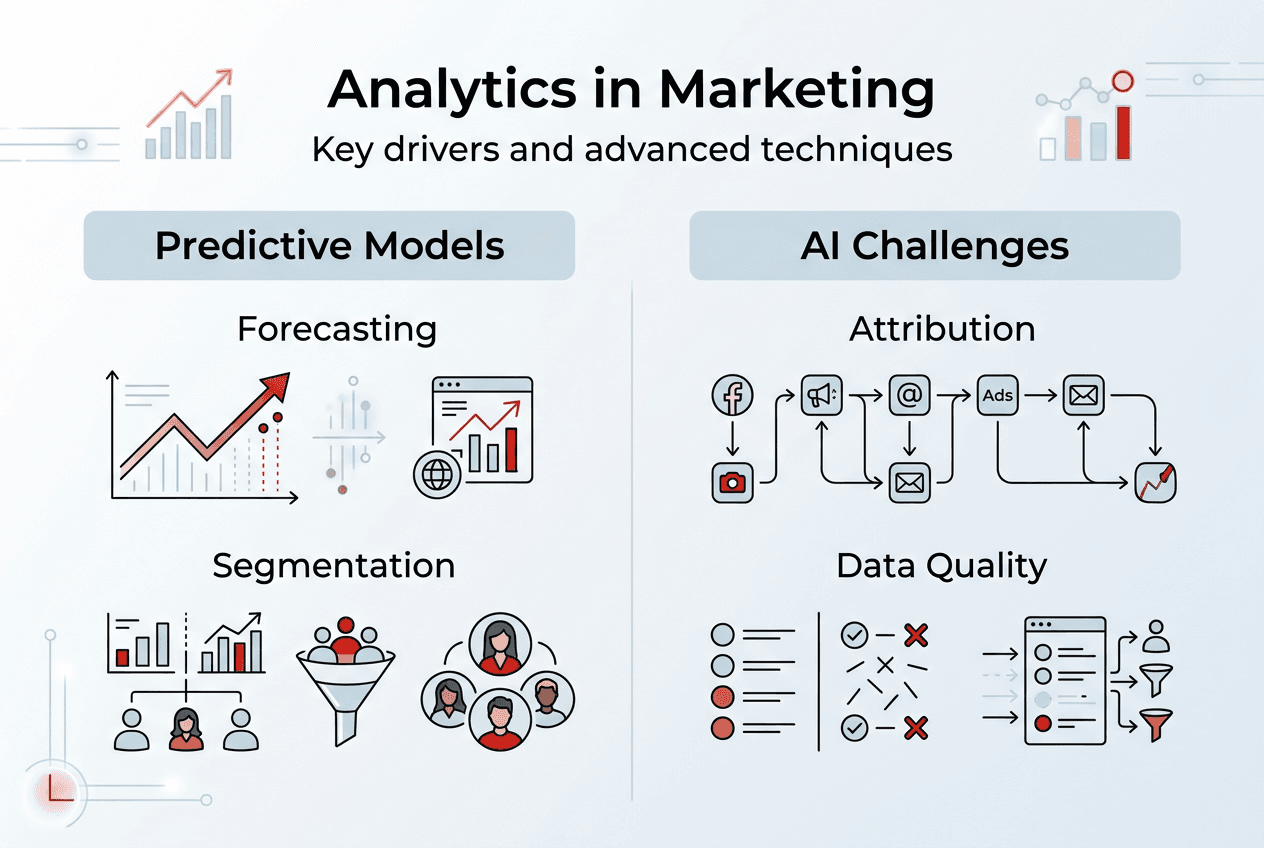
The integration of artificial intelligence amplifies these capabilities dramatically. AI-powered marketing analytics can improve marketing ROI by up to 30% by enabling proactive decision-making and hyper-personalization. Machine learning algorithms process vast datasets to identify subtle patterns that human analysts might miss, from optimal email send times to product recommendation sequences that maximize conversion rates.
AI excels at several marketing applications:
- Customer segmentation based on behavioral patterns and predicted lifetime value
- Dynamic pricing optimization responding to demand signals and competitive positioning
- Content personalization tailoring messaging to individual preferences and contexts
- Campaign performance forecasting predicting outcomes before full budget deployment
- Anomaly detection identifying unusual patterns that signal problems or opportunities
However, the path to effective predictive marketing analytics is fraught with challenges. Marketing attribution, the process of assigning credit to touchpoints along the customer journey, remains particularly complex. Organizations implementing comprehensive marketing attribution models see 37% higher marketing ROI, yet many struggle to implement these systems effectively.
The fundamental attribution challenge stems from increasingly complex customer journeys. A single conversion might involve dozens of touchpoints across multiple channels: social media ads, organic search, email campaigns, retargeting, direct visits, and offline interactions. Determining which touchpoints deserve credit for the conversion requires sophisticated modeling.
Attribution models range from simple to complex:
- First-touch attribution assigns all credit to the initial interaction
- Last-touch attribution credits the final touchpoint before conversion
- Linear attribution distributes credit equally across all touchpoints
- Time-decay attribution gives more weight to recent interactions
- Algorithmic attribution uses machine learning to assign credit based on actual influence
Yet even sophisticated models face limitations. Workflows designed to automate marketing tasks can inadvertently destroy the very data needed for accurate attribution. Common culprits include tracking parameters stripped by email clients, cookies blocked by privacy settings, and cross-device journeys that fragment user identity.
“Attribution accuracy depends entirely on data integrity. A single broken tracking tag or misconfigured automation can corrupt weeks of attribution data, leading to budget misallocations that compound over time.”
To mitigate these challenges, marketing teams must implement rigorous data quality monitoring. Regular audits of tracking implementations, validation of data flows between systems, and anomaly detection for sudden metric changes help maintain attribution accuracy. Combining quantitative attribution models with qualitative customer research provides additional validation and context.
Leveraging AI in marketing analytics requires not just technical implementation but also careful attention to marketing data quality challenges that can undermine even the most sophisticated analytical systems.
Avoiding pitfalls: data quality, imbalanced data, and evolving analytics models
Data quality stands as the single most critical factor determining analytics success or failure. 30% of CMOs say improving data quality is the single biggest lever they can pull to improve marketing performance. Poor data quality manifests in multiple ways: duplicate records inflating audience counts, inconsistent naming conventions preventing proper aggregation, missing values creating gaps in analysis, and outdated information leading to misguided targeting.
The consequences extend beyond inaccurate reports. Flawed data feeds directly into automated systems, causing campaigns to target wrong audiences, budgets to flow to underperforming channels, and personalization engines to deliver irrelevant content. These errors compound over time, eroding trust in analytics and reverting teams to gut-based decision-making.
A particularly insidious data quality issue involves imbalanced datasets. Imbalanced data in marketing can lead to models with high accuracy that fail to make better decisions. This occurs when one outcome vastly outnumbers another in training data. For example, if only 2% of website visitors convert, a model that simply predicts “no conversion” for everyone achieves 98% accuracy while providing zero value.
The impact of data imbalance on model performance:
| Dataset Type | Overall Accuracy | Conversion Detection Rate | Business Value |
|---|---|---|---|
| Severely imbalanced | 98% | 5% | Minimal, misses most opportunities |
| Moderately imbalanced | 92% | 45% | Limited, catches less than half |
| Balanced dataset | 87% | 85% | High, identifies most conversions |
Balancing techniques include oversampling minority classes, undersampling majority classes, or using synthetic data generation. The goal is training models that accurately predict the outcomes that matter for business decisions, not just achieving high overall accuracy scores.
Attribution models face their own limitations beyond data quality issues. Data-driven marketing attribution models often fail to deliver on their promises due to the complexity of user journeys and the limitations of the models themselves. Attribution assumes that touchpoints influence conversion in measurable ways, but reality is messier. External factors like word-of-mouth, offline advertising, and competitive actions affect decisions without leaving digital traces.
Modern marketing requires updated analytics operating models that address these limitations:
- Implement continuous data quality monitoring with automated alerts for anomalies
- Combine multiple attribution approaches rather than relying on a single model
- Integrate qualitative research to validate quantitative attribution findings
- Use incrementality testing to measure true causal impact of marketing activities
- Build cross-functional data governance teams to maintain standards
Pro Tip: Detect data imbalance by calculating the ratio of your target outcome to total observations. If your conversion rate, churn rate, or other key metric falls below 10%, implement balancing techniques before training predictive models. Use stratified sampling to ensure test datasets reflect real-world proportions even when training on balanced data.
Marketing teams that prioritize improving marketing data quality and address fundamental modeling challenges position themselves to extract genuine value from analytics investments rather than generating misleading insights that drive poor decisions.
Enhance your marketing strategies with Veridata Insights
Navigating the complexities of marketing analytics requires both technical expertise and strategic insight. Veridata Insights specializes in helping marketing professionals and data analysts transform raw data into competitive advantages. Our team brings deep experience in implementing advanced predictive models, optimizing attribution strategies, and ensuring data quality across complex marketing technology stacks.
We understand that every organization faces unique analytics challenges. Whether you need help designing a data infrastructure that supports both current reporting and future AI capabilities, or you’re struggling with attribution accuracy and data quality issues, Veridata provides flexible, tailored solutions. Our approach combines rigorous methodology with practical implementation, ensuring that analytics insights translate directly into improved marketing performance and ROI.
Ready to elevate your marketing analytics capabilities? Contact Veridata Insights to discuss how our digital marketing strategy services can help you make smarter, data-driven decisions. Discover how our expertise in strategic market data insights can transform your marketing outcomes in 2026 and beyond.
Frequently asked questions
What is marketing analytics and why is it critical today?
Marketing analytics applies data analysis, statistical methods, and computational techniques to understand consumer behavior and optimize marketing performance. It’s critical because modern marketing operates across multiple digital channels generating vast data volumes that require systematic analysis to extract actionable insights. Organizations using comprehensive analytics consistently outperform competitors by making evidence-based decisions about budget allocation, audience targeting, and campaign optimization rather than relying on intuition.
How do data lakes differ from data warehouses in marketing?
Data lakes store raw, unstructured data from diverse sources in native formats, providing flexibility for exploratory analysis and machine learning projects. Data warehouses store cleaned, structured data optimized for fast querying and standardized reporting. Marketers use lakes when they need flexibility to explore new analytical questions and warehouses when they need consistent, fast performance for production dashboards and regular reports.
What challenges do marketers face with attribution models?
Attribution models struggle with increasingly complex multi-channel customer journeys where dozens of touchpoints precede conversion. Broken tracking implementations, privacy restrictions blocking cookies, and automated workflows that corrupt data integrity create gaps in attribution accuracy. These challenges lead to misallocated budgets and flawed optimization decisions. Marketers must implement rigorous data quality monitoring and combine quantitative models with qualitative research to maintain attribution accuracy.
How can AI improve marketing analytics performance?
AI enables advanced predictive and prescriptive insights by processing large, diverse datasets to identify patterns human analysts might miss. Machine learning models forecast customer churn, optimize pricing dynamically, personalize content at scale, and predict campaign performance before full deployment. AI-powered analytics can improve marketing ROI by up to 30% through proactive decision-making and hyper-personalization. Success depends on maintaining clean, unified data and defining clear business objectives that guide model development.