


Marketing teams often struggle with disorganized research workflows that slow decision-making and dilute insights. Without a clear structure, valuable data gets lost in translation, budgets stretch thin, and strategic opportunities slip away. A well-designed market research analysis workflow transforms scattered efforts into a systematic process that delivers reliable insights when you need them. This guide walks you through an efficient step-by-step workflow for 2026 and beyond, helping you maximize research ROI while minimizing costly mistakes.
Table of Contents
- Understanding Problem And Preparation Phase
- Executing The Data Collection And Analysis Workflow
- Verifying Findings And Avoiding Common Pitfalls
- Summary Of Market Research Workflow Approaches
- How Veridata Insights Can Streamline Your Market Research Workflow
- Frequently Asked Questions
Key takeaways
| Point | Details |
|---|---|
| Structured workflows reduce errors | Following a systematic approach speeds insights and improves decision quality |
| Preparation sets the foundation | Defining clear objectives and selecting appropriate methods prevents costly rework |
| Data analysis tools improve accuracy | Automation and collaboration platforms enhance result reliability |
| Common pitfalls are avoidable | Following best practices eliminates typical mistakes that compromise research |
| Verification ensures actionable insights | Validation steps confirm findings are reliable and ready for implementation |
Understanding problem and preparation phase
Marketing professionals frequently encounter chaos at the start of research projects. Unclear objectives create confusion, poor planning wastes resources, and wrong data sources produce misleading conclusions. These problems compound quickly, turning what should be a strategic advantage into a frustrating liability.
Effective preparation including defining objectives sets the foundation for successful market research analysis. Before collecting a single data point, you need a rock-solid plan.
Essential preparation tasks include:
- Define clear research questions and objectives that align with business goals
- Identify target audience segments for data collection with precision
- Choose appropriate data collection techniques based on your needs
- Assemble a capable research team and assign specific roles
- Establish realistic timeline and budget constraints upfront
Each preparation step builds on the previous one. Your research questions drive audience selection, which informs methodology choices, which determine team requirements. Skip a step and the entire workflow weakens.
Pro Tip: Early alignment with stakeholders on business goals increases research impact and avoids costly rework later. Schedule a kickoff meeting where decision-makers articulate what success looks like, then translate those expectations into measurable research outcomes.
The market research process simplified starts with understanding what you truly need to learn. Vague goals like “understand our customers better” doom projects from the start. Instead, frame specific questions: “What features would increase retention among enterprise clients by 20%?” or “Which messaging resonates most with healthcare decision-makers aged 35 to 50?”
Your team composition matters enormously. You need people who understand research methodology, know your industry context, and can translate data into business recommendations. Assign clear ownership for each workflow stage so nothing falls through the cracks.
Executing the data collection and analysis workflow
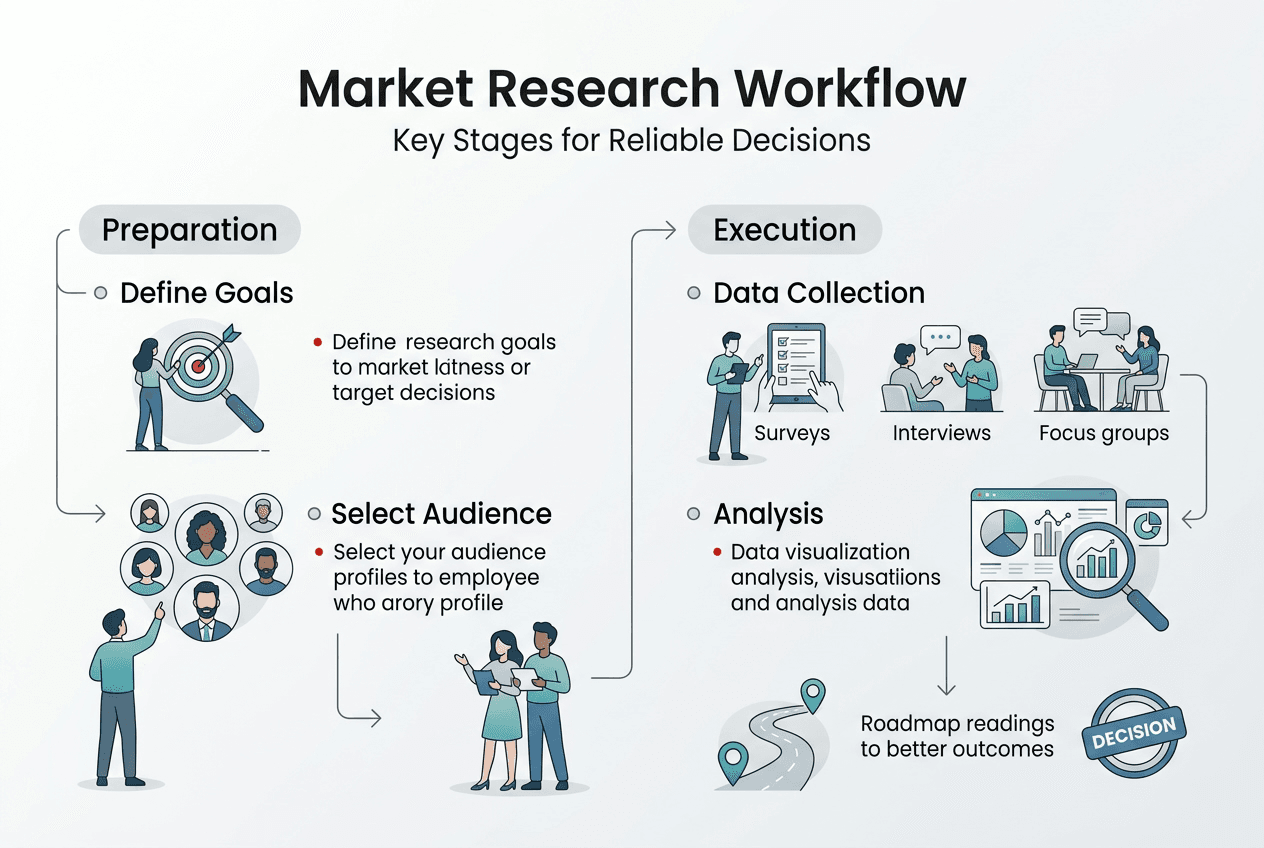
Once preparation is complete, execution demands precision and discipline. Following a data analysis step by step approach enables efficient interpretation and actionable insights.
Implement these key steps in order:
- Execute chosen data collection methods accurately, whether surveys, interviews, or secondary research
- Clean and prepare data by removing duplicates, fixing errors, and standardizing formats
- Apply descriptive, diagnostic, and predictive analysis techniques appropriate to your questions
- Visualize data through charts and dashboards to identify trends and patterns quickly
- Interpret results within your specific business context and competitive landscape
Data collection method selection directly impacts result quality. Each approach offers distinct advantages and limitations.
| Method | Pros | Cons | Ideal Application |
|---|---|---|---|
| Surveys | Cost effective, scalable, quantifiable | Limited depth, potential bias | Measuring satisfaction, preferences across large audiences |
| Focus Groups | Rich qualitative insights, interactive | Small sample, groupthink risk | Exploring reactions to concepts, understanding motivations |
| Interviews | Deep individual perspectives, flexible | Time intensive, harder to scale | Executive decision-making processes, complex B2B dynamics |
| Observational | Natural behavior, unbiased by self-reporting | Resource heavy, interpretation challenges | User experience research, retail behavior analysis |
Implementation quality separates mediocre research from exceptional insights. When conducting surveys, test questions with a small group first to catch confusing wording. For interviews, develop a discussion guide that balances structure with flexibility to explore unexpected themes.
Data cleaning consumes more time than most teams anticipate. Budget at least 20% of your analysis timeline for this critical step. Dirty data produces unreliable conclusions, no matter how sophisticated your analysis techniques.

Visualization transforms numbers into stories. A well-designed chart reveals patterns that spreadsheets hide. Choose visualization types that match your data: bar charts for comparisons, line graphs for trends over time, scatter plots for correlations.
Pro Tip: Automate repetitive analysis tasks with software tools to save time and reduce errors. Modern platforms handle data cleaning, statistical testing, and basic visualization automatically, freeing your team to focus on interpretation and recommendations.
Partnering with top market research companies accelerates execution when internal resources are stretched. Experienced firms bring proven methodologies and specialized tools that deliver faster, more reliable results.
Context drives interpretation. A 15% response rate might be excellent for cold outreach but terrible for customer surveys. Industry benchmarks and historical performance provide the reference points you need to evaluate findings accurately.
Verifying findings and avoiding common pitfalls
Validation separates confident decisions from costly mistakes. After analysis, verification ensures your insights withstand scrutiny and drive real business value.
Verify data accuracy through multiple approaches:
- Cross-check findings against alternative data sources and industry benchmarks
- Conduct repeat measurements on key metrics to confirm consistency
- Test statistical significance to distinguish real patterns from random noise
- Challenge assumptions by actively seeking contradictory evidence
Peer review and stakeholder feedback test whether conclusions make practical sense. Share preliminary findings with colleagues who understand your business but weren’t involved in the research. Fresh eyes catch logical gaps and questionable interpretations.
Beware of confirmation bias, the tendency to favor information supporting preexisting beliefs. This cognitive trap undermines even experienced researchers. Actively search for data that contradicts your hypotheses. If you can’t find any, you’re probably not looking hard enough.
Overgeneralization represents another common pitfall. Results from 200 urban millennials don’t necessarily apply to rural baby boomers. Document sample characteristics and limitations clearly so decision-makers understand where insights apply and where they don’t.
Many research projects fail due to avoidable mistakes like poor data quality and biased interpretation. Understanding common pitfalls in market research helps you sidestep these traps.
Ignoring validation steps can lead to costly marketing failures and misinformed strategy decisions. A single flawed insight can waste millions in misdirected campaigns or product development.
Document assumptions and limitations transparently. Every research project involves trade-offs and constraints. Acknowledging them upfront builds credibility and helps stakeholders make informed decisions about how to apply insights.
Sample size matters more than many realize. Small samples produce unreliable results with wide confidence intervals. Calculate required sample sizes before data collection begins, not after you realize your findings lack statistical power.
Timing affects validity too. Consumer preferences shift, competitive landscapes evolve, and economic conditions change. Research conducted six months ago might not reflect current reality. Plan regular updates for critical insights that inform ongoing strategy.
Summary of market research workflow approaches
Different projects demand different workflow methodologies. Selecting the right approach depends on your specific circumstances and constraints.
Common workflow approaches include agile iterative methods, waterfall sequential processes, and hybrid models combining elements of both. Each offers distinct advantages for particular situations.
| Approach | Advantages | Disadvantages | Best Use Cases |
|---|---|---|---|
| Agile Iterative | Flexible, adapts to new insights, faster initial results | Can lack structure, scope creep risk | Exploratory research, rapidly changing markets |
| Waterfall Sequential | Clear milestones, comprehensive documentation, predictable | Inflexible, slow to adjust, delayed insights | Regulatory compliance, large-scale tracking studies |
| Hybrid | Balances structure and flexibility, customizable | Complexity in coordination, requires experience | Complex projects with mixed research needs |
Selecting the right workflow depends on project goals, complexity, and resource availability. The steps for conducting market research vary based on these factors.
Choose your workflow systematically:
- Assess project timeline and flexibility needs based on decision deadlines
- Evaluate data complexity including number of variables and analysis depth required
- Consider team skills and available tools to match methodology to capabilities
- Align with organizational decision-making style and stakeholder expectations
Agile approaches work brilliantly when you’re exploring unfamiliar territory or markets shift rapidly. Breaking research into short sprints lets you adjust questions and methods as you learn. Early findings inform later stages, creating a learning loop that refines focus progressively.
Waterfall methods suit situations requiring rigorous documentation and regulatory compliance. When you need to demonstrate exactly how conclusions were reached, sequential stages with formal sign-offs provide the audit trail stakeholders demand.
Hybrid models offer the best of both worlds for complex projects. You might use waterfall structure for core tracking metrics while running agile sprints for exploratory questions. This combination delivers both consistency and innovation.
Your organizational culture influences which approach succeeds. Companies comfortable with ambiguity and rapid iteration embrace agile methods. Organizations valuing predictability and control prefer waterfall structure. Match methodology to culture or expect friction.
Tool availability constrains choices too. Agile workflows benefit from collaborative platforms enabling real-time updates and rapid communication. Waterfall processes need robust project management systems tracking dependencies and milestones.
How Veridata Insights can streamline your market research workflow
Implementing an efficient research workflow requires expertise, tools, and experience that many marketing teams lack internally. Veridata Insights offers tailored market research consulting to optimize your workflow from preparation through final recommendations.
Our team provides expert guidance on data collection, analysis, and validation methods specific to your industry and objectives. We bring advanced tools and collaborative platforms that marketing teams use to accelerate insights while maintaining rigorous quality standards.
Whether you need support for a single project phase or end-to-end research management, our flexible service model adapts to your needs. We work 365 days a year with no project minimums, handling everything from consultation and design through data visualization and reporting.
Partner with us to enhance data-driven decision-making and maximize ROI from your research investments. Contact Veridata Insights to discuss how we can streamline your specific workflow challenges.
Frequently asked questions
What is a market research analysis workflow?
A market research analysis workflow is a structured sequence of steps that guides teams from initial research questions through final actionable insights. It typically includes preparation, data collection, analysis, verification, and reporting phases. Following a systematic workflow reduces errors, speeds delivery, and ensures insights align with business objectives. Think of it as a roadmap that keeps research projects on track and stakeholders aligned.
Why does a structured workflow matter for market research?
Structured workflows prevent common problems like missed deadlines, budget overruns, and unreliable conclusions. They ensure critical steps aren’t skipped and quality standards are maintained throughout the project. Teams using defined workflows collaborate more effectively because everyone understands their role and responsibilities. The result is faster, more reliable insights that decision-makers trust and act upon.
What are the key stages in a market research workflow?
Most effective workflows include five core stages: problem definition and preparation, research design and planning, data collection and fieldwork, analysis and interpretation, and reporting and implementation. Each stage builds on the previous one, creating a logical progression from questions to answers. Some workflows add verification and validation as distinct stages to emphasize quality control. The specific stages may vary based on methodology and project complexity.
How do I choose the best data collection method for my research?
Match your method to research objectives, budget constraints, and target audience characteristics. Quantitative methods like surveys work well for measuring preferences across large populations, while qualitative approaches like interviews excel at understanding motivations and decision processes. Consider practical factors like timeline, respondent accessibility, and required sample size. The top market research companies for data collection can help you select and implement the most appropriate methods for your specific needs.
What are common mistakes to avoid in market research analysis?
Avoid data contamination by maintaining rigorous quality controls during collection and cleaning. Watch for confirmation bias where you unconsciously favor information supporting preexisting beliefs. Ensure adequate sample sizes to support statistical validity of conclusions. Many research failures stem from neglecting data quality and bias issues. Understanding common pitfalls in market research helps you implement safeguards that protect research integrity.
How can market research workflows improve decision-making?
Structured workflows enhance accuracy by ensuring data quality and appropriate analysis methods. They speed insights by eliminating redundant work and keeping projects on schedule. Clear workflows improve collaboration by defining roles and communication protocols. Most importantly, systematic approaches produce actionable insights aligned with strategic goals rather than interesting but irrelevant findings. Organizations with mature research workflows make faster, more confident decisions backed by reliable evidence.
Recommended
- Data analysis step by step for market researchers in 2026 – Veridata Insights
- The Market Research Process Simplified for Consulting Teams – Veridata Insights
- How Market Research Drives Strategic Decision-Making in Consulting – Veridata Insights
- Market Research FAQs – Veridata Insights
- Business Intelligence Archívum – AI tanácsadás és megvalósítás