

TL;DR:
- Flexible research services are modular and adapt to evolving project needs quickly.
- They enable rapid decision-making in fast-changing markets, providing a competitive edge.
- Choosing the right partner requires proven agility, no minimums, and strong communication skills.
Most organizations believe a tightly structured, long-term research plan is the gold standard. Lock it in. Follow the steps. Collect the data. Done. But markets don’t wait for your timeline. Consumer behavior shifts overnight, competitors pivot unexpectedly, and entire product categories can be disrupted in months. Flexible research services provide the agility to pivot strategies quickly in dynamic markets, enabling rapid, informed decisions. The truth is, rigid research frameworks often produce answers to questions that no longer matter. This article breaks down what flexible research services really are, why they outperform traditional models, and how to choose the right partner to make them work for you.
Table of Contents
- Understanding flexible research services
- The business value of flexibility: Why it matters
- Healthcare and specialized research: Greater value through customization
- Choosing the right flexible research partner
- Flexible research: What most companies still get wrong
- Ready to transform your research approach?
- Frequently asked questions
Key Takeaways
| Point | Details |
|---|---|
| Agility unlocks opportunity | Flexible research enables organizations to pivot quickly, seizing market advantages ahead of slower competitors. |
| Customization drives results | Tailoring research methods and timing delivers clearer, more actionable insights than one-size-fits-all approaches. |
| Healthcare demands nuance | Flexible research reveals patient and clinician needs that traditional analytics may miss, improving brand outcomes. |
| Partner selection is crucial | A truly flexible research provider adapts rapidly and collaborates openly to meet your business goals. |
Understanding flexible research services
Let’s start with what flexibility actually means in a research context, because it’s not just a buzzword.
Flexible research services are modular, on-demand market research solutions that adapt to your project’s scope, timeline, and deliverables as needs evolve. Unlike traditional research, which typically follows a rigid, sequential methodology from kickoff to final report, flexible research meets you where you are. Need only questionnaire design and data collection? Done. Need the full pipeline from consultation through data visualization? Also done. No project is too small or too specific.
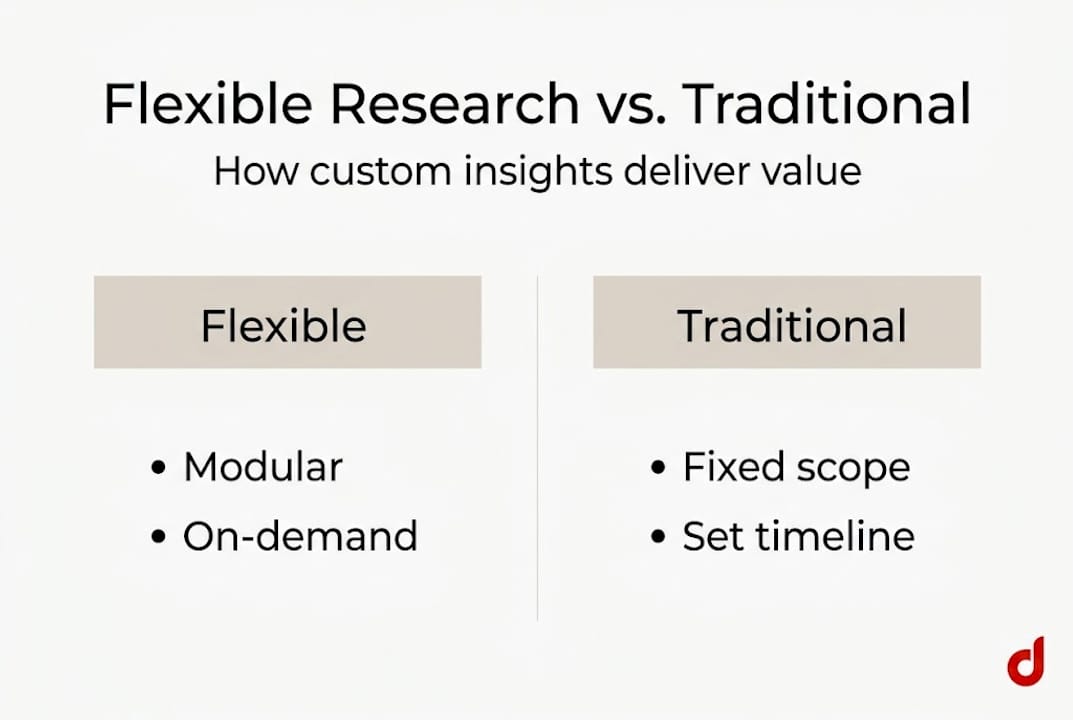
This modular approach is a real shift from legacy research models. Traditional market research tends to lock clients into a predefined sequence: discovery, design, fieldwork, analysis, reporting. Change your mind mid-process and you’re often looking at delays, added costs, and a lot of frustrated project managers. Flexible services remove those friction points entirely.
When choosing a research agency, it helps to understand the core features that separate flexible from traditional approaches:
| Feature | Flexible research | Traditional research |
|---|---|---|
| Project minimums | None | Often required |
| Methodology adjustments | Anytime | Limited or costly |
| Turnaround speed | Rapid, on-demand | Fixed timelines |
| Reporting format | Custom to client needs | Standardized |
| Availability | 7 days a week, 365 days a year | Business hours only |
| Service scope | As much or as little as needed | Full-package or nothing |
The use cases for flexible research are broad. Brand managers testing a new campaign message. Consultants needing fast competitive intelligence. Healthcare marketers seeking patient or provider insights. B2B organizations exploring new market segments. The common thread is a need for precise, timely insights without the overhead of a one-size-fits-all contract.
Key use cases for flexible research services:
- Rapid concept testing before a product launch
- Ad hoc qualitative research to explain unexpected sales trends
- Targeted B2B or B2C audience recruitment for specialized studies
- Healthcare research with hard-to-reach patient or provider populations
- Real-time strategy validation during M&A or market entry decisions
You can see a fully flexible research approach in action and understand how it translates into real deliverables. The bottom line: flexible research isn’t about cutting corners. It’s about applying the right methodology to the right problem at the right time.
The business value of flexibility: Why it matters
With a clear definition in mind, the next logical question is: why does flexibility actually matter for business outcomes?
Historical data is useful. But in fast-moving industries, you need insights that reflect what’s happening now, not six months ago. Consultants advising clients on market entry can’t afford to wait for a three-month research cycle. Brand managers launching seasonal campaigns need answers in days, not quarters. Flexibility directly accelerates the decision-making cycle, and that speed creates a measurable competitive edge.
“Flexible market research services provide agility to pivot strategies quickly in dynamic markets, enabling rapid, informed decisions.”
The strategic decision-making impact of this cannot be overstated. Organizations that can gather, interpret, and act on fresh insights faster than competitors consistently outperform them over time. Flexibility isn’t a convenience feature. It’s a strategic asset.
Here’s how the flexible research cycle actually drives action:
- Identify the need. A sudden shift in customer sentiment, a competitor move, or a failed product test signals that you need new data, fast.
- Adjust the research approach. Instead of restarting a stalled traditional study, you modify methodology, sample, or scope in real time to address the specific question at hand.
- Drive action. With targeted, timely insights, your team makes decisions grounded in current reality, not outdated assumptions.
This three-step loop is what rapid research solutions are built for. It keeps consulting firms, brand teams, and healthcare organizations moving forward without losing research rigor.
Pro Tip: Schedule a brief quarterly review of your active research priorities. Markets shift fast, and what was a pressing question in January may be irrelevant by April. Realigning your research agenda regularly ensures every dollar of research spend is answering a question that still matters.
The flexibility advantage is real, and it compounds over time. Teams that build adaptable research practices into their workflow stop reacting to market changes and start anticipating them.
Healthcare and specialized research: Greater value through customization
The concept of flexibility becomes even more critical and nuanced in specialized fields like healthcare.
Standard data analytics tools can tell you what is happening in a healthcare market. They struggle to tell you why. That gap between correlation and causation is exactly where flexible primary research delivers its greatest value. Flexible primary research uncovers nuanced patient and HCP insights beyond data analytics, driving brand repositioning and sales growth.
Consider a real-world scenario: a pharma brand experiencing flat sales despite strong clinical data. Standard reports show no major competitor movement. But flexible qualitative research with actual patients and physicians reveals a tolerability concern that wasn’t being surfaced in the quantitative data. The brand pivots its messaging to emphasize tolerability, and sales performance improves. That’s the power of research that can adapt to the question behind the question.

| Approach | Standard data analytics | Custom qualitative research |
|---|---|---|
| Insight depth | Surface-level trends | Nuanced behavioral and attitudinal drivers |
| Audience specificity | Broad market segments | Hard-to-reach patients, HCPs, specialists |
| Speed of pivot | Slow, reliant on existing datasets | Fast, designed around evolving questions |
| Strategic impact | Describes the market | Shapes brand and clinical strategy |
Key applications for healthcare and specialized research:
- Patient journey mapping for chronic disease management
- HCP perception studies for new drug launches
- Payer and formulary decision-maker research
- Competitive landscape analysis for biotech and pharma brands
- Community health research for non-profit and public health organizations
Healthcare marketers and brand managers know that their audiences are among the hardest to reach and the most important to understand. The ability to strengthen client relationships through richer, more relevant insights is a direct byproduct of customized research design. Flexibility isn’t optional in healthcare research. It’s essential.
Choosing the right flexible research partner
Understanding the impact of flexibility brings us to the crucial decision: how do you actually choose a partner that delivers these benefits?
Not every firm that claims to offer flexible research actually delivers it. Some simply offer a menu of services with no real ability to adapt mid-project. Others require project minimums that make small or rapid studies cost-prohibitive. The right partner should pass a simple but powerful set of criteria.
What to look for when evaluating a flexible research partner:
- No project minimums. You should be able to engage for exactly what you need, nothing more.
- Full-spectrum capability. From consultation and questionnaire design to programming, data collection, coding, and reporting, the partner should handle any slice of the process.
- Availability and responsiveness. Research needs don’t follow a Monday-to-Friday schedule. Look for partners available 7 days a week.
- Proven agility. Ask for examples of projects where scope or methodology shifted mid-stream, and how the team handled it.
- Transparent communication. You need a partner who flags issues early and keeps you informed at every stage.
- Measurable results. The best partners connect research outputs to business outcomes, not just deliverables.
Enabling consulting firm agility requires a partner who can match your pace and your ambition. Before signing any agreement, ask directly: “Can you show me a case where you pivoted a project significantly and still delivered on time?” The answer will tell you a lot.
Pro Tip: Prioritize research partners with direct experience in your specific audience type, whether that’s B2B decision-makers, healthcare professionals, or hard-to-reach consumer segments. Audience familiarity dramatically shortens ramp-up time and improves data quality.
Establishing clear collaboration practices from day one also reduces friction and keeps projects on track, even when the scope changes.
Flexible research: What most companies still get wrong
Here’s the uncomfortable truth: most organizations misunderstand what flexibility actually requires.
The biggest misconception is that moving fast means cutting methodological corners. Teams assume that a rapid-turnaround study must sacrifice rigor for speed. We’ve seen this belief kill perfectly good research programs. In reality, true flexible research is built on strong methodologies that are adapted, not abandoned. The framework is sound. The application is fluid.
The second mistake is treating flexibility as a reactive tool rather than a proactive strategy. Companies call for flexible research when something goes wrong. The ones who see outsized returns treat it as an always-on capability, continually aligning research priorities with shifting business goals. Measuring the impact of your market insights consistently is what separates organizations that learn from their research from those that simply collect data.
Knowing when to pivot and when to stay the course is the real skill. Flexibility without discipline is just chaos. Flexibility paired with clear business goals is a genuine competitive advantage.
Ready to transform your research approach?
You now understand what flexible research services can do and how to make them work. The next step is finding a partner who can actually deliver.
At Veridata Insights, we do as much or as little as you need, with no project minimums, 7 days a week, 365 days a year. From qualitative to quantitative, B2B to healthcare, we bring the methodology expertise and the service commitment to match your pace. Whether you need one component or the full pipeline from design through data visualization, we are ready to meet you where you are. Contact Veridata Insights today and let’s talk about what your research goals actually require.
Frequently asked questions
What are flexible research services?
Flexible research services are adaptable market research solutions that customize methodologies, timing, and scope to fit your evolving business needs. They allow you to engage for exactly what your project requires, with no fixed structure or minimum commitments, giving you agility to pivot as your market changes.
How do flexible research approaches benefit healthcare organizations?
They reveal deeper patient and provider insights that standard analytics miss, enable rapid strategy pivots when new data surfaces, and drive measurable improvements in outcomes. Flexible primary research has directly driven brand repositioning and sales growth in pharma markets.
When should a business choose flexible research over traditional research?
Choose flexible research when your market is shifting quickly, your timeline is short, or you need to adjust scope mid-project without starting over. Dynamic markets demand the kind of rapid, informed decision-making that rigid methodologies simply cannot support.
What should I look for in a flexible research partner?
Look for proven agility, no project minimums, transparent communication, availability beyond standard business hours, and clear examples of past rapid pivots that still delivered quality results. Experience with your specific audience type is also a critical factor that directly affects data quality and project speed.
Recommended
- Video: Veridata Insights’ Fully Flexible Research Services – Veridata Insights
- Custom Market Research Solutions: Turning Data Into Strategy with Veridata Insights – Veridata Insights
- Case Study: Custom Research at the Speed of Now! – Veridata Insights
- How Veridata Insights’ Rapid Research Solutions Keep Consulting Firms on Track – Veridata Insights
- Top localisation strategies: 5 examples for EU success