

Expect to pay anywhere from free (DIY tools) to well over $150,000 (custom enterprise platforms) for survey programming, but most small-business projects land between $700 and $15,000 depending on scope. Budget for three line items every time: the programming or subscription fee, panel access plus respondent incentives, and a 15%–25% annual reserve for maintenance and hosting. The sections below break down each budget band, the billing models behind them, and how to spot padding in a vendor quote.
TL;DR:
- Project costs vary widely, from free DIY tools to over $150,000 for custom enterprise survey platforms, with small-business projects typically costing $700 to $15,000.
- Budgeting should include programming or subscription fees, respondent incentives, and a 15%–25% annual reserve for maintenance and hosting.
- Pricing models differ, with flat fees, per-complete response, hourly billing, subscription tiers, and pay-for-performance, making quotes challenging to compare directly.
- Complexity from skip logic, quotas, multilingual support, API integrations, and compliance requirements mainly drives up survey programming costs, not number of questions.
- For small-scale or simple surveys, DIY tools or low-cost subscriptions are sufficient, but complex, recurring, or regulated surveys benefit from professional programming or custom platforms.
Table of Contents
- What Does Survey Programming Cost Look Like in Practice?
- How Are Survey Programming Fees Actually Billed?
- What Actually Drives Survey Programming Prices Up?
- What Do Real Survey Programming Budgets Look Like?
- DIY, Subscription, or Programmer: Which Fits Your Project?
- How Long Does Survey Programming Take, and What Speeds It Up Cost?
- How Does Veridata Insights Scope and Price Complex Programming?
- How Do You Write an RFP That Gets You a Comparable Quote?
- Get a Programming Quote Scoped to Your Actual Project
- Sources
What Does Survey Programming Cost Look Like in Practice?
Survey costs show up in three distinct shapes, and confusing them is the fastest way to blow a budget. You’re either paying for a subscription (access to a tool you program yourself), a one-off programming job (someone else builds it, you own the results), or a custom build (someone develops a platform you’ll use repeatedly).
Subscription software is the cheapest entry point. Small-business plans commonly run $9.90 to $129 per month, with free tiers capped at basic question types and small response limits. That price gets you the software, not the labor. You’re still writing the logic, testing the branching, and fixing your own mistakes, which is fine for a simple ten-question customer satisfaction survey and a real problem for anything with quotas or skip patterns.
One-off programming is a different animal. Published vendor benchmarks show minimum project fees around $1,000 to $2,000 for straightforward surveys, scaling up from there based on complexity. You’re paying someone else’s team to script the logic, load the sample, and run quality checks before fielding. Public per-survey rate tables from established service providers confirm this same pattern: a flat baseline fee, then adjustments for length and logic.
Custom builds are the outlier, and they’re rarely the right call for a single project. You’re commissioning a platform, not a survey, and the price reflects that.
When each option actually makes sense:
- Subscription tools fit repeat, simple surveys where you have someone in-house who can program logic and troubleshoot.
- One-off programming fits a single complex project, a one-time client deliverable, or any survey with branching you don’t want to debug yourself.
- Custom builds fit organizations running dozens of surveys a year with proprietary panel integrations or compliance requirements that off-the-shelf tools can’t handle.
Here’s a quick way to translate advertised subscription pricing into something you can compare against a project quote. Take the monthly fee, multiply by the number of months you’ll actually need the tool (not twelve, unless you’re running surveys year round), and add the hours you or your staff will spend programming and testing at your own hourly rate. A “$49/month” tool that eats fifteen hours of a $40/hour employee’s time just cost you $649 for one project, not $49. That math is exactly why a lot of small teams end up paying a programmer instead once they’ve priced their own time honestly.
How Are Survey Programming Fees Actually Billed?
Vendors don’t all charge the same way, and that’s where quote comparison gets messy. Here are the five billing models you’ll run into, in order of how often small businesses encounter them.
- Per-survey flat fee. A fixed price for programming one specific instrument, typically including one round of testing. This is the easiest model to budget against because there’s no ambiguity about what you’ll pay.
- Per-complete pricing. You pay per finished response rather than per survey build. This model bundles programming, hosting, and often sample into one number, which makes it popular for market research projects with a defined completion target.
- Hourly billing. Common for scope that keeps shifting, custom logic, or ongoing consultation work. It’s fair to the vendor when requirements are unclear, but it’s the hardest model for you to budget against.
- Subscription tiers. A recurring fee for platform access, sometimes bundled with a set number of “programming credits” or support hours per month.
- Outcome or pay-for-performance pricing. Newer AI-assisted workflows can price around specific deliverables, and AI-assisted approaches have cut costs 60 to 90% on tasks like programming setup and transcription in some vendor comparisons, though the savings usually require added QA to validate the output.
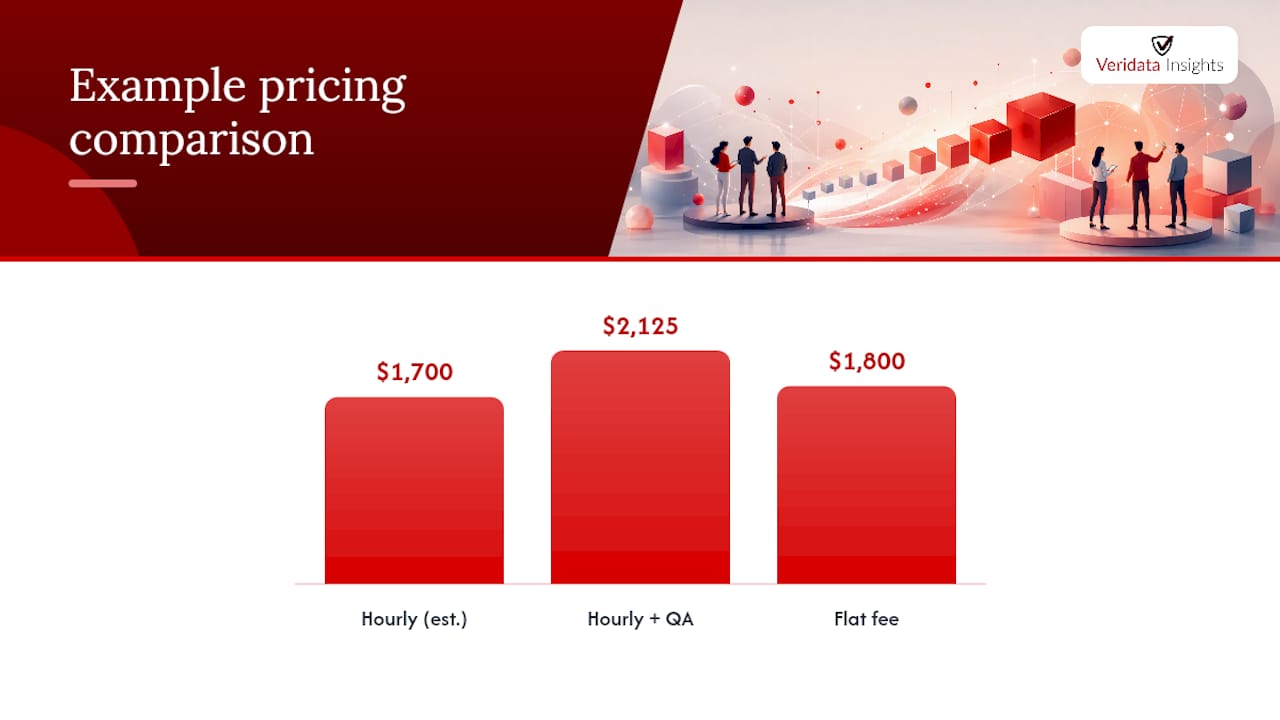
Here’s how the hourly model translates into a real number. Say a vendor quotes $85 per hour and estimates 20 hours for a 30-question survey with moderate branching. That’s $1,700 before testing. Add another 5 hours for QA and revision rounds at the same rate, and you’re at $2,125. Compare that against a competing flat-fee quote of $1,800 that explicitly includes two revision rounds, and the flat fee wins even though the sticker number looked higher at first glance.
Watch for four fees that routinely get left off the initial quote: setup or account activation charges, third-party integration costs (CRM syncs, panel APIs), QA and testing cycles beyond the first pass, and hosting once the survey is live. None of these are unreasonable to charge for. The problem is when they show up after you’ve already signed.
Pro Tip: Ask every vendor to quote “all-in, per completed response” even if their default model is hourly or subscription-based. Forcing the number into one shape is the only way to compare three different pricing structures honestly.
What Actually Drives Survey Programming Prices Up?
Question count matters less than most people assume. What actually moves the price is logic density.
The AAPOR Survey Cost white paper documents this directly: complexity does not scale linearly with question count. Branching and quota interdependencies create testing work that multiplies rather than adds. A 50-question linear survey with no skip logic is often cheaper to program than a 20-question survey with dense branching and multi-level quotas, because every conditional path needs its own test case.
Here’s how the major cost drivers rank by typical impact:
- Skip logic and branching (high impact): each conditional path multiplies QA time, not just programming time.
- Quota management (high impact): live monitoring across multiple demographic cells requires backend configuration most subscription tools handle poorly without add-ons.
- Multilingual programming (medium to high impact): each language is effectively a parallel build requiring its own translation review and testing pass, explored further in Veridata Insights’ guide to questionnaire programming.
- API integrations (medium to high impact): connecting to a panel provider or CRM can run $2,500 to $20,000 per integration depending on how custom the connection needs to be.
- Custom scripting (medium impact): conjoint analysis, max-diff, or other advanced methodologies require programming expertise beyond standard survey logic.
- Multimodal delivery (medium impact): building the same instrument to work identically on mobile, desktop, and IVR triples the testing matrix.
- Security and compliance (variable, but can be high): regulated studies need explicit budget for HIPAA-safe hosting, audit logging, and validation tasks, which can add discrete certification fees and extend timelines compared with a generic consumer survey.
None of these costs disappear once the survey goes live, either. Hosting fees continue for as long as the survey is fielding. Panel access and per-invite messaging costs scale with your sample size, not your question count. And any survey that needs a mid-field fix, a broken skip pattern discovered on day three, for instance, generates change-order costs that rarely make it into the original quote. Build a maintenance line into your budget even for a one-time project; the AAPOR white paper’s point about fieldwork protocols being a major cost driver applies just as much to a two-week fielding window as a year-long tracking study.
What Do Real Survey Programming Budgets Look Like?
Numbers on a pricing page are one thing. Seeing how they stack up on an actual project is what turns a budget from a guess into a plan. Here are four templates you can adapt.
Template 1: DIY basic survey. Free or low-cost subscription tool, self-programmed. The advertised cost is $0 to $49 per month, but the real cost is your time: expect 5 to 15 hours for anything beyond a simple ten-question form, plus the risk of losing data if you hit a free-tier response cap mid-field. This route works when the survey is simple, internal, and low-stakes.
Template 2: Small outsourced project (about 400 completes). This is the most common shape for a small business commissioning outside help. An online survey at this scale typically runs $5,000 to $15,000 total, covering programming, panel access, incentives, and QA.
Template 3: B2B or niche audience project. Recruiting doctors, IT directors, or other hard-to-reach professionals costs substantially more per complete than general consumer panels, because specialist recruitment requires targeted outreach and often screening calls. Phone or in-person collection for this kind of audience runs $15,000 to $50,000 total depending on method, with specialist recruitment fees layered on top of standard programming costs.
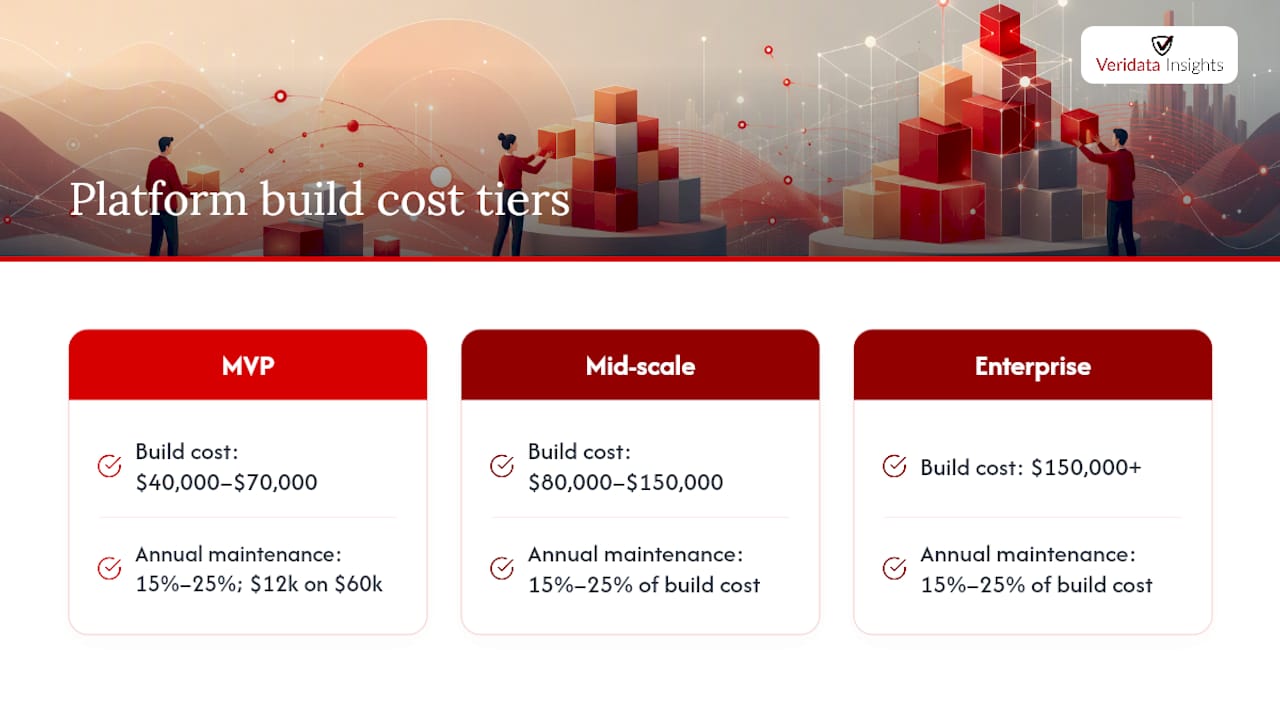
Template 4: Custom platform, total cost of ownership. If you’re building rather than commissioning a single survey, expect an MVP build around $40,000 to $70,000, a mid-scale platform at $80,000 to $150,000, and enterprise-grade systems at $150,000 or more. Annual maintenance runs 15% to 25% of the build cost every year after launch. Run the math before committing: a $60,000 MVP with 20% annual maintenance costs $12,000 a year to keep running, so you’d need to be fielding enough surveys annually that a $200 to $500 per-project agency fee would have cost you more over three to four years. For most small businesses running fewer than a dozen surveys a year, that breakeven point never arrives, which is exactly why phased builds, starting with a core engine and adding integrations later, tend to protect cash flow better than committing to the full platform up front.
DIY, Subscription, or Programmer: Which Fits Your Project?
Three variables decide this faster than any pricing table: how often you survey, how sensitive the data is, and whether you need the result to plug into something else.
If you’re running one survey a quarter with simple questions and no integrations, a subscription tool you program yourself is the obvious choice. You’re not paying for capability you won’t reuse.
If you’re running one complex survey, healthcare screening logic, a multi-country study, anything with branching that would eat a weekend of your time to debug, hiring a programmer for that single project usually costs less than the hours you’d burn learning to do it yourself, and it comes with QA you can’t easily replicate solo.
If you’re running dozens of surveys a year with recurring panel integrations or compliance needs, a custom build or an ongoing managed relationship starts to pay for itself, but only past a real volume threshold.
Three questions to pick your route:
- Will I run this exact type of survey again within twelve months?
- Does a data error here carry real financial or reputational risk?
- Do I need this survey to talk to another system (CRM, panel, data warehouse)?
Two or more “yes” answers point toward professional programming or a managed platform. Mostly “no” answers mean a subscription tool is the more sensible spend.
How Long Does Survey Programming Take, and What Speeds It Up Cost?
A simple survey with no branching typically programs and tests in three to five business days. Add moderate skip logic and quotas, and that stretches to one to two weeks. Multilingual or multimodal builds, or anything requiring compliance validation, commonly run three to four weeks once you include translation review and full QA cycles.
Structuring the statement of work around milestones, rather than a single delivery date, is the single best defense against both scope creep and payment disputes.
- Draft logic sign-off. Approve the question flow and branching map before any programming starts, so changes here don’t trigger a rebuild later.
- Programmed build for internal review. The vendor delivers a testable link; you check logic, not just wording, before moving forward.
- QA and revision round. One structured revision pass, clearly scoped, catches errors before the survey goes live rather than mid-field.
- Field launch and monitoring sign-off. Confirm quotas and tracking are live and reporting correctly before respondent invitations go wide.
Rushed timelines carry a real premium, often 20% to 40% on top of standard pricing, because compressed QA windows mean the vendor is absorbing more risk of a mid-field error. The cheaper way to shorten a schedule is to lock your question logic early and skip the mid-project “just one more question” requests that force a rebuild of the branching map.
How Does Veridata Insights Scope and Price Complex Programming?
Some of the clearest lessons in survey pricing come from watching a genuinely complex project get built. Veridata Insights recently handled survey programming and consultation for a medical company, where the scope included specialized branching logic tied to clinical screening criteria and a compressed delivery window. That kind of engagement shows exactly why healthcare and other regulated projects carry the compliance and validation line items discussed earlier: the logic complexity and the audit trail requirements both add real hours before the survey ever fields.
A few things worth knowing about how Veridata Insights operates on pricing and procurement:
- Full-service capability across consultation, questionnaire review, programming, data collection, coding, and reporting, so you’re not stitching together three vendors for one project.
- No project minimums, which matters if your survey is small but still needs professional logic and QA.
- Available seven days a week, 365 days a year, which shortens the calendar time between scoping a project and getting it into field.
- Specialized recruitment experience across B2B, B2C, healthcare, and other hard-to-reach audiences, the exact category where per-complete costs run highest.
Readers who want a closer technical look can review the survey programming consultation video for a walkthrough of how scoping conversations actually unfold before a quote gets written.
How Do You Write an RFP That Gets You a Comparable Quote?
Every vendor quote should answer the same set of questions before you compare price. If a proposal skips one of these, that’s your first negotiation point, not a detail to let slide.
- Line-item labor breakdown. How many hours (or what flat fee) covers programming versus QA versus project management, listed separately.
- Number of included revision rounds. Ask exactly what happens, and what it costs, if you need a change after round two.
- Testing and QA methodology. What does their testing cycle actually check: every branch path, every device, every language version?
- Hosting and post-launch support. Who fixes a mid-field bug, and is that covered or billed separately?
- Compliance and security costs, itemized separately if your project touches health data, financial data, or any regulated category.
Negotiation levers that actually work: ask for capped, fixed-scope pricing instead of open hourly billing whenever the requirements are stable. Ask for phased delivery, MVP logic first, integrations second, so you’re not paying for capability you won’t use in month one. And treat any quote that bundles “unlimited revisions” as a red flag; unlimited anything usually means the vendor has priced in the ambiguity by padding the base fee.
Pro Tip: Send the exact same one-paragraph scope description to every vendor you’re comparing, word for word. Quotes that come back wildly different in structure usually mean the vendors interpreted vague scope differently, not that one is overpriced.
A simple phrase that works well in an RFP: “Please provide fixed-scope, capped pricing for the scope described, with hourly rates quoted separately for any out-of-scope requests.” That single sentence eliminates most of the ambiguity that turns a $2,000 quote into a $4,500 invoice.
Get a Programming Quote Scoped to Your Actual Project
Veridata Insights prices programming engagements around the same variables covered here: logic complexity, audience difficulty, compliance needs, and timeline. There’s no project minimum, so a small single survey gets the same consultative scoping as a multi-country tracking study, and the team is available seven days a week to keep a rushed timeline from turning into a rushed price. The medical company case study shows how that scoping process plays out on a project with real branching complexity and a compressed schedule. If you have a project in mind and want a quote built around your actual logic map rather than a generic per-question rate, reach out through Veridata Insights’ contact page and describe your scope the same way you’d write it into an RFP: question count, branching, audience, and timeline. That’s the fastest path to a number you can actually budget against.
Sources
- Survey Software Price Comparison Guide: A Capterra Value Report
- How Much Does Market Research Cost? 2026 Pricing Guide
- Survey Cost White Paper (AAPOR workshop summary)
- Market Research Software Development Cost: 2026 Breakdown