

The fastest way to avoid costly rework and bad data is to treat survey programming as its own phase, separate from design but coordinated with it. Map your logic in pseudo-code or a template before you write a single line of code, pretest with cognitive interviews and a field pilot, build in constraints and real-time QA, and encrypt and version every form. Standards from DIME, J-PAL, and AAPOR all point the same direction.
TL;DR:
- Conduct thorough pretesting with cognitive interviews and pilots to identify wording issues, skip logic errors, and device incompatibilities before full deployment.
- Map all survey logic and skip patterns in pseudo-code or a programming sheet and review with a second person to prevent costly field bugs.
- Use constraints, calculated fields, and dynamic choice lists to minimize data cleaning efforts and reduce entry errors during collection.
- Monitor real-time paradata such as timestamps and response times to detect and address data quality issues during data collection.
- Encrypt, version, and document every instrument iteration and consent process to ensure data security, reproducibility, and compliance.
Table of Contents
- Getting the Design Right Before You Touch a Script
- Writing Questions and Sequences That Don’t Bias the Data
- Programming as Its Own Discipline: Pseudo-Code, Templates, and Version Control
- Coding Constructs That Prevent the Most Common Bugs
- Testing in Stages: Cognitive Interviews, Pilots, and Edge Cases
- Watching Data Quality While Collection Is Live
- Securing the Instrument and Keeping a Reliable Version History
- The Programmer’s Launch and Early-Field Checklist
- When It Makes Sense to Hand Programming to a Research Partner
- FAQ
- Sources
Getting the Design Right Before You Touch a Script
Programming a flawed instrument just produces flawed data faster. Before a single question gets coded, the design itself needs to hold up.
Start with clear goals. Every question should trace back to a measurable objective; if it doesn’t, cut it. Surveys bloated with “nice to know” items take longer to complete and cost you respondents halfway through.
Length matters more than most teams admit. Give respondents a realistic time estimate in the intro, and hold yourself to it. A questionnaire that runs 25 minutes when you promised 10 will show up in your drop-off rate.
Favor closed-ended questions wherever you can. Open-ended items are valuable for nuance, but they slow data entry and coding, so keep them few and place them near the end. The Handbook of Survey Research recommends grouping questions by topic and moving from general to specific, which keeps respondents oriented and reduces fatigue.
A few design habits pay off repeatedly once programming begins:
- Group related questions into logical modules instead of scattering topics.
- Place sensitive questions (income, health, behavior) near the end, after trust is established.
- Include “not applicable” and neutral middle options where a forced answer would misrepresent the respondent.
- Write a short intro that states purpose, length, and confidentiality in plain language.
Get this right first, and programming becomes a matter of execution rather than a running negotiation with a half-finished questionnaire.
Writing Questions and Sequences That Don’t Bias the Data
Wording problems are the hardest bugs to catch because the survey runs fine. It just produces answers nobody can trust.
Avoid double-barreled questions (“How satisfied are you with the price and service?”) and leading phrasing (“Don’t you agree that…”). Keep syntax simple: short sentences, common words, one idea per question. Pew Research Center uses cognitive interviews specifically to catch these failures before fielding, since respondents often misread a question in ways the writer never anticipated.
Response options need the same scrutiny. Make categories exhaustive and mutually exclusive, label every scale point rather than just the ends, and balance positive and negative options evenly. A 5-point scale with three positive labels and one negative one isn’t neutral, it’s a thumb on the scale.
Randomization and rotation matter too. Rotating response order controls for primacy and recency effects; randomizing item blocks reduces order effects across a battery of questions. Pew’s testing work shows randomized rotation measurably reduces these order effects, so decide up front which items need it and document the rule for your analysts, since rotated items require different handling at the cleaning stage.
Two quick comparisons show the gap between weak and strong wording:
- Weak: “How often do you use social media and shop online?” Strong: split into two separate questions.
- Weak: “Please select your income and age range.” Strong: ask income and age as two distinct items with clear brackets.
Forced-choice and select-all questions carry different analytical weight, so pick deliberately and note the reasoning in your programming sheet.
Pro Tip: Read every question draft out loud. If it sounds awkward spoken, it will confuse a respondent reading it silently.
Programming as Its Own Discipline: Pseudo-Code, Templates, and Version Control
Survey programming works best as a distinct phase with its own planning documents, not an improvisation layered on top of a Word document. DIME’s Questionnaire Programming guidance is direct about this: starting to program before the questionnaire content is finalized is one of the most common drivers of bugs and rework.
The workflow that avoids that trap looks like this:
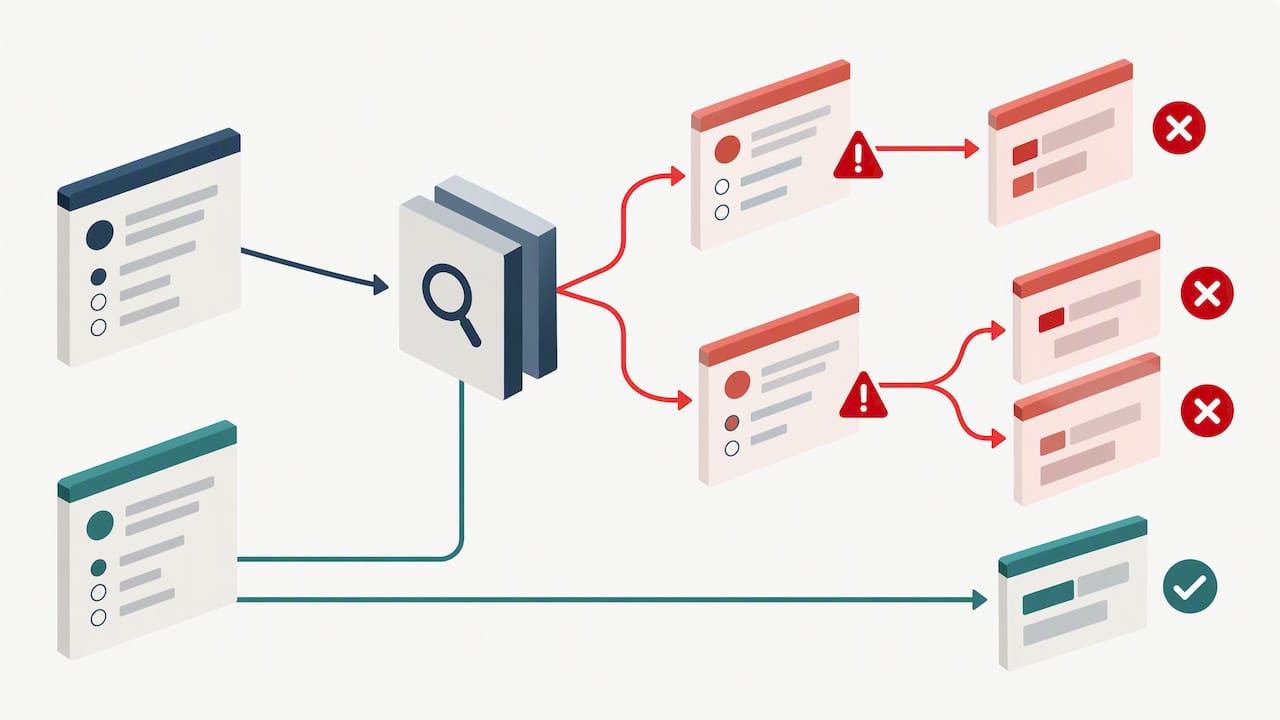
- Map every skip pattern, repeat group, and calculation in pseudo-code or an Excel programming sheet first.
- Review that logic map with a second person before any code gets written.
- Build the form in modular sections using standardized variable and choice-list names.
- Freeze the code at a defined point, then version every subsequent change with a change log.
- Coordinate the programming window with QA development and enumerator training so testing isn’t rushed at the end.
This separation lets a methodologist review the logic on paper, catching missing branches or contradictory skips, without wading through syntax. J-PAL’s survey programming resource frames this as a three-stage process: plan, program, test, with iteration expected rather than treated as a failure.
A few habits keep the handoff between planning and coding clean:
- Use consistent variable naming across modules so cleaning scripts can run without manual lookups.
- Reuse choice lists instead of retyping them, which eliminates a common source of inconsistent coding.
- Log every post-freeze change with a date, reason, and who approved it.
Teams that skip this planning step tend to find their bugs in the field, which is the most expensive place to find them.
Coding Constructs That Prevent the Most Common Bugs
Specific programming choices determine whether your data needs heavy cleaning or almost none. SurveyCTO’s best practices guidance outlines several that consistently cut down on errors.
- Use hard constraints to block impossible values (a household size of negative two) and soft constraints with a confirmation message for unusual but possible ones (a household size of twenty).
- Apply relevance conditions at the group level rather than repeating the same logic question by question.
- Use calculate fields for derived values instead of asking respondents to do math themselves.
- Record timestamps on every section to measure completion timing and flag rushed responses later.
- Build dynamic choice lists that populate from prior answers, and reuse the same list across related questions.
- Pre-fill known data carefully, then test how that pre-fill interacts with downstream relevances and weighting, since a quietly wrong pre-fill can cascade through an entire form.
None of these are complicated individually. Applied consistently, they’re the difference between a dataset that needs a week of cleaning and one that needs a day.
Testing in Stages: Cognitive Interviews, Pilots, and Edge Cases
Pretesting is not optional, and no single method catches everything. The Census Bureau’s pretesting guidance recommends combining methods because each one surfaces different problems.
- Expert review: a methodologist reads the instrument for structural or logical issues.
- Cognitive interviews: a small group talks through their understanding of each question, exposing wording confusion.
- Small field pilot: a handful of real interviews catch skip-logic errors and interviewer issues.
- Full pilot: a larger run under field conditions confirms timing and device behavior.
Edge-case testing deserves its own pass: try entering negative numbers, absurdly large values, and back-navigation through skip patterns to see what breaks. Budget time and money for at least one full reprogramming cycle after pilot feedback comes in, because it will.
Pro Tip: Run your pilot on the actual tablets or phones enumerators will use, not a desktop browser. Screen size changes how people answer.

Watching Data Quality While Collection Is Live
Paradata, the data about how data was collected, gives you a live read on quality. Timestamps, durations, and where consent allows, audio audits and sensor metadata, reveal problems no amount of pretesting can fully predict. SurveyCTO’s coding practices build this kind of monitoring directly into the form.
- Watch for spikes in item nonresponse, unusually high “don’t know” rates, or completion times far below the median.
- Set automated alerts so a triage team reacts within the day, not at the end of fielding.
- Log every fix with a version note so changes stay traceable.
AI tools now sometimes support this monitoring layer, but AAPOR’s guidance on responsible AI integration is clear that any such tool needs fit-for-purpose validation for performance, sensitivity, and reliability before you trust its output. That validation step matters as much as the alert itself.
Securing the Instrument and Keeping a Reliable Version History
Respondent data and the instrument itself both need protection, and that protection needs to be documented, not assumed.
- Encrypt questionnaires and stored data, and restrict server access by role on a least-privilege basis.
- Keep versioned archives of every instrument iteration alongside a searchable change log.
- Document consent for any audio or sensor collection and store those records as carefully as the data itself.
- Follow AAPOR’s disclosure standards when reporting methodology publicly, so your published study holds up to scrutiny.
These aren’t bureaucratic extras. They’re what lets you reconstruct exactly what happened in the field six months later, when someone asks.
The Programmer’s Launch and Early-Field Checklist
Pulling the previous sections into a single reference makes it usable on a real project timeline.
- Prelaunch: code-freeze, peer review, edge-case tests, translation checks, and device tests on enumerator hardware.
- First week: daily high-frequency checks, paradata review, and any fixes locked in with a documented version.
- Ongoing: quarterly audits, archived versions, and scheduled updates as panels age or instruments drift.
| Phase | Core actions | Primary goal |
|---|---|---|
| Prelaunch | Code-freeze, peer review, edge-case and translation testing | Catch bugs before they reach respondents |
| First week | Daily checks, paradata review, versioned fixes | Catch field problems early |
| Ongoing | Quarterly audits, version archiving | Keep the instrument current and traceable |
Our survey skip logic guide walks through the QA deliverables that pair naturally with this checklist, and our breakdown of what survey programming actually involves covers the planning templates referenced above in more depth.
When It Makes Sense to Hand Programming to a Research Partner
Some projects justify building this expertise in-house. Plenty of others don’t, especially when a deadline is close and the sample is hard to reach. We offer survey programming and consultation, alongside respondent recruitment for B2B, B2C, healthcare, and other hard-to-reach audiences, with no project minimums and availability 365 days a year.
Complex CAPI or CATI deployments, multi-language fieldwork, or tight timelines are exactly where outsourcing this work tends to pay off: you get the QA rigor above without hiring and training a programming team for a single project. Our full-service market research covers everything from questionnaire review through data processing and visualization. If your next project needs that kind of hand, reach out for a quote.
FAQ
What’s the difference between survey design and survey programming?
Design decides what to ask and in what order; programming turns that design into a working instrument with logic, constraints, and validation. The DIME Wiki treats these as separate tasks precisely because mixing them tends to produce more bugs and more rework.
How many rounds of pretesting does a survey actually need?
There’s no single fixed number, but methodological guidance favors combining at least a cognitive interview round with a small field pilot before full launch. The Census Bureau’s pretesting appendix notes that no single method catches every category of problem.
What is paradata and why does it matter for survey quality?
Paradata is data about the data collection process itself: timestamps, durations, and sometimes audio or sensor metadata. SurveyCTO’s coding practices use it to flag rushed interviews, satisficing, or possible interviewer fraud while fieldwork is still running.
Should AI tools be used for survey programming or data checks?
AI tools can support tasks like monitoring or drafting, but AAPOR’s guidance on responsible AI integration requires that any such tool be validated for fit-for-purpose performance before you rely on its output. Treat it as a supplement to QA, not a replacement for it.
Can a research partner handle survey programming for a project already underway?
Yes. We provide survey programming and consultation as part of our full-service offerings, and projects can be picked up mid-stream for programming, QA, or recruitment support without a minimum project size.
Sources
- Questionnaire Programming | Dime Wiki
- Census pretesting appendix (Appendix A2)
- Testing survey questions ahead of time | Pew Research Center
- AAPOR Responsible AI Integration in Survey Research