

Rapid concept testing means using fast, directional research, short surveys, quick qualitative interviews, or synthetic simulations, to filter and sharpen ideas before committing real budget to development. We recommend using these fast methods to screen and prioritize, then escalating to full human-respondent validation when the decision involves regulatory, sensory, or high-stakes claims. Both approaches earn their place when matched to how much certainty the decision actually requires.
TL;DR:
- Concept surveys are best for quickly measuring purchase intent, relevance, and uniqueness across many ideas with a simple stimulus.
- Synthetic respondent methods speed iteration and can filter concepts but require validation with real humans when testing regulatory claims or sensory attributes.
- Pilot every stimulus on five people before full launch to catch confusing phrasing or low-quality responses that distort results.
- Define the decision KPI and threshold upfront, keep sample sizes manageable (100-150 per group for quantitative), and field short periods with interim quality checks.
- Use qualitative interviews or soft-launch tests to understand language, objections, and behavioral evidence, reserving detailed human validation for high-risk decisions.
Table of Contents
- What rapid concept testing is and when to use it
- Practical methods and workflow options
- Step-by-step playbook: a repeatable rapid concept-test protocol
- Choosing between synthetic and human-respondent testing
- Quality controls, common pitfalls, and a practical checklist
- Turning rapid results into product decisions
- What successful rapid testing looks like in practice
- Analyzing rapid concept testing data for actionable insights
- Run your next rapid concept test with us
- FAQ
- Sources
What rapid concept testing is and when to use it
Rapid concept testing is built for speed. Instead of a six-week quantitative study, you get a directional read in days, enough signal to rank ideas, sharpen positioning, or decide whether a concept deserves more investment. It is not a replacement for rigorous validation when the stakes are high. It is a filter.
Teams reach for rapid methods for a handful of recurring goals:
- Prioritization: narrowing ten concepts to the two or three worth developing further.
- Positioning: testing which message or framing resonates before locking creative direction.
- Execution checks: confirming that a concept statement or prototype communicates what it intends to.
- Go/no-go screening: deciding quickly whether an idea is dead on arrival.
The common methods fall into a few buckets: short concept surveys with buy-intent questions, written concept statements tested head-to-head, rapid qualitative interviews for texture and language, soft-launch landing page tests that use real clicks as a demand proxy, and increasingly, synthetic or simulated respondent approaches that generate directional signal without fielding a live sample. Each has a place depending on what you are trying to learn and how much risk you can absorb if the read is wrong. Our concept testing guidance covers why this upfront filtering step matters before full development spend.
Practical methods and workflow options
Each rapid method has its own setup, and picking the right one matters more than picking the fastest one.
Quick concept surveys work best when you need a numeric read fast. Keep the stimulus simple: a short pitch paragraph plus one supporting image, nothing elaborate. Ask three question types: a buy-intent question (“How likely are you to purchase this?”), a consideration question (“How does this compare to what you currently use?”), and a relevance question (“How well does this fit your needs?”). Track purchase intent, uniqueness, and relevance as your core metrics.
Concept statements work best for comparing framing or positioning. Write 2 to 3 variations, a conservative version close to the current product line, a core version representing your best guess, and a boundary version that pushes further than you think you should. Test all three in parallel rather than sequentially. AI-assisted tools can now generate multiple research-ready concept variations in minutes, which speeds up stimulus creation, but every variation still needs a short pilot before fielding.
Rapid qualitative interviews, run as a tight 5 to 8 interview sprint, surface the “why” behind survey numbers. A practical interview sprint framework for small teams is a useful reference for structuring probing questions around hesitation, confusion, and unexpected enthusiasm.
Soft-launch tests use a simple landing page with a waitlist or pre-order button. Clicks, email signups, or time on page become your demand proxy, no survey required.
- Use concept surveys when you need a numeric prioritization signal across many ideas.
- Use concept statements when the question is about framing or claims, not the underlying product.
- Use rapid qual when you need language, objections, or emotional reaction.
- Use soft-launch tests when you want behavioral evidence rather than stated intent.
Pro Tip: Pilot every stimulus on five people before full fielding, typos and confusing phrasing kill more concept tests than bad ideas do.
Step-by-step playbook: a repeatable rapid concept-test protocol
A rapid concept test holds together when you define the decision before you touch a sample. We break the process into five phases.
Phase 0, define the decision. Name the single primary KPI (purchase intent, message preference, task completion) and the minimum threshold that would trigger a go decision. Skipping this step is the single most common reason rapid tests produce ambiguous results.
Phase 1, audience and quotas. Define who qualifies, how many respondents you need per cell, and what quality checks (screener logic, duplicate detection) apply. For most directional screens, 100 to 150 respondents per concept cell is a workable range for a quantitative read; qualitative sprints need far fewer.
Phase 2, stimulus and pilot. Finalize the concept statement or prototype, randomize exposure order across cells, build in at least one attention check, and run a small pilot before full launch.
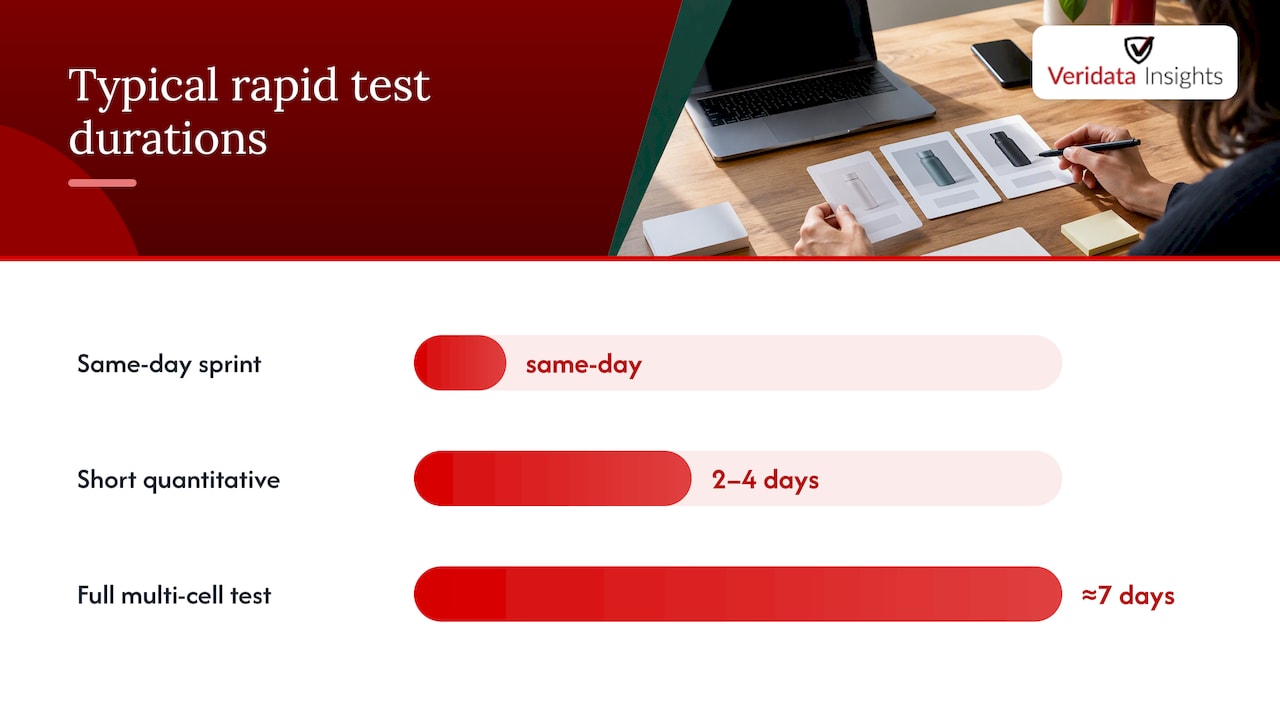
Phase 3, fielding and monitoring. Set a target field window, often 2 to 4 days for a rapid quantitative test, and check interim completes at the 24-hour mark to catch quota or quality issues early.
Phase 4, analysis and action. Apply your pre-set threshold, tag qualitative responses against recurring themes, and translate the output into one of three decisions: advance, iterate, or kill.
- Phase 0: lock the KPI and the go/no-go threshold before writing a single question.
- Phase 1: define audience, sample size per cell, and quality screens.
- Phase 2: finalize stimulus, randomize, pilot with a small group.
- Phase 3: field for a short, fixed window with interim quality checks.
- Phase 4: analyze against the pre-set threshold and decide next steps.
Common rapid-test timelines run from same-day qualitative sprints to a full week for a multi-cell quantitative screen with analysis. Budget bands scale with sample size, number of concept variants, and whether translation or specialty recruitment is involved; our quantitative research services page walks through how these variables affect scope.
- Keep the KPI singular: one primary metric prevents post-hoc rationalization.
- Treat the pilot as mandatory, not optional, even under deadline pressure.
- Document the threshold before you see any data.
Choosing between synthetic and human-respondent testing
Synthetic and simulated respondent approaches have earned a real place in rapid testing because they remove the biggest bottleneck: waiting on a live field. They let teams iterate on multiple concept variants in parallel, at a lower marginal cost per additional test, since there is no incremental recruitment or incentive cost once a simulation framework exists.
They have real limits too. ESOMAR and ANA guidance on synthetic data notes that synthetic approaches can speed iteration and produce useful directional signal, but recommends validation against primary data and attention to ethical safeguards, especially representativeness and confidentiality, for decisions that carry real consequences. Regulatory claims, sensory product attributes, and nuanced purchase motivations are places where a simulation is a poor substitute for a real human response.
A simple decision checklist helps:
- Low risk and tight timeline: synthetic or rapid survey is appropriate.
- Regulatory or health claim involved: human-respondent validation is required.
- Sensory attribute (taste, scent, feel): human testing only.
- High development cost if wrong: escalate to human validation before committing.
A staged pipeline often works best: synthetic methods filter a large set of concepts down to the strongest two or three, then targeted human-respondent follow-up confirms the finalists before full development. This sequencing captures the speed benefit of simulation while reserving rigor for the decision that actually carries risk.
Quality controls, common pitfalls, and a practical checklist
The fastest way to get a rapid test wrong is to over-interpret a directional signal as if it were confirmatory. A small sample pointing one direction is a hypothesis, not a verdict. Weak stimuli (vague copy, low-resolution images, confusing framing) and poorly sourced samples compound the problem, producing numbers that look precise but mean little.
A handful of controls catch most of these issues before they reach a report:
- Build in attention checks to flag inattentive respondents.
- Validate respondent identity and screen for duplicates across cells.
- Balance quotas so no single demographic skews the read.
- Pilot every stimulus with a small group before full fielding.
- Set minimum sample thresholds per cell before launch, not after seeing early results.
Pro Tip: If your pilot group flags confusion about the concept, fix the stimulus before fielding, don’t try to interpret around it later.
A full-service partner supports each of these steps directly: consultation on study design, questionnaire programming, speeded recruitment for hard-to-reach or niche audiences, and analysis that applies the same rigor to a four-day test as to a twelve-week one. Our methodology checklist covers these controls in more depth for teams building their own internal process.
Turning rapid results into product decisions
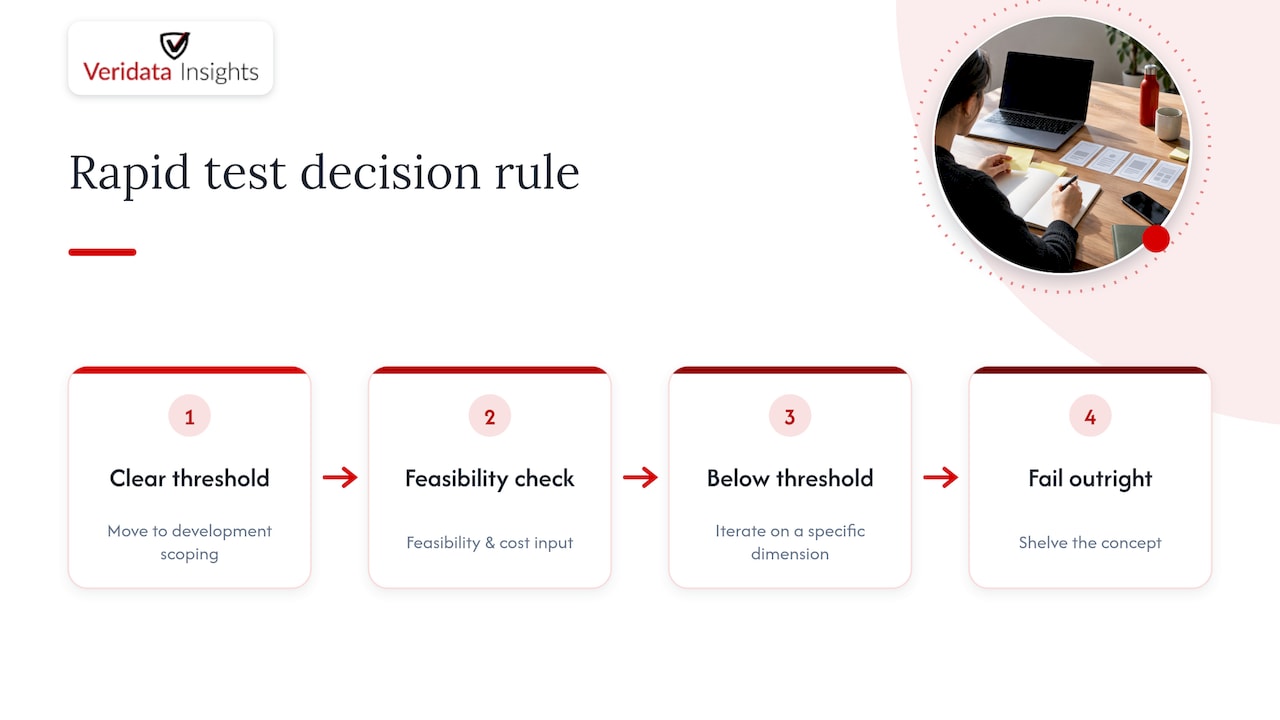
A rapid concept test only pays off when its output changes something downstream. The cleanest way to make that happen is to write the decision rule before the data arrives: a concept that clears the purchase-intent threshold moves into development scoping, one that falls short gets iterated on a specific dimension, and one that fails outright gets shelved.
Product and innovation teams that integrate rapid testing well tend to treat the result as one input alongside feasibility and cost, not a standalone verdict. A concept with strong purchase intent but a steep production cost still needs a feasibility conversation. A concept with modest numbers but strong qualitative enthusiasm among a target segment might warrant a second, more targeted round rather than an outright kill.
The hand-off from research to product teams matters as much as the test itself. A one-page summary with the KPI result, the threshold it was measured against, and the specific next action (advance, iterate, escalate to human validation, kill) travels better through a product roadmap meeting than a full report. Keeping that summary consistent across every rapid test you run also builds a track record: after a handful of cycles, you start to see which concept types reliably clear the bar and which categories of ideas tend to need the extra step of human validation before leadership trusts the result.
What successful rapid testing looks like in practice
The pattern that shows up across teams that use rapid concept testing well is consistent: they run many small, cheap tests early and reserve expensive, high-fidelity research for the handful of ideas that survive the first cut.
A consumer packaged goods team evaluating five new flavor concepts might run a quick concept survey across all five to rank purchase intent and uniqueness, then move only the top two into a sensory human taste test, since taste is exactly the kind of attribute no synthetic method can substitute for. A B2B software team testing three positioning angles for a new feature might skip the survey entirely and run a rapid qualitative sprint, since the goal is language and objection-handling, not a numeric score.
A healthcare-adjacent team testing patient-facing messaging has to be especially careful here: claims and comprehension both need human-respondent validation given the regulatory environment around health communication, so rapid synthetic screening at most narrows the message options before the real test. The common thread across these examples is not the specific method. It is the discipline of matching the method’s fidelity to the decision’s actual risk.
Analyzing rapid concept testing data for actionable insights
Analysis for a rapid test should be simpler than analysis for a full tracking study, not because rigor matters less, but because the question is narrower. Start with the primary KPI against the threshold you set in Phase 0. If purchase intent clears the bar, you have your answer. If it falls short, look at the secondary metrics (uniqueness, relevance, comprehension) to understand why, rather than re-running the same test hoping for a different number.
For qualitative data, tag responses against a small set of recurring themes rather than building an elaborate coding scheme, speed is the point, and over-engineering the analysis undercuts it. Look for patterns that repeat across at least three of your five to eight interviews before treating them as a real signal rather than one person’s opinion.
Segment cuts deserve caution in small-sample rapid tests. A subgroup breakdown on an n of 120 can produce cells too small to support a confident read, so hold off on demographic deep dives until a confirmatory round with a larger sample. The output of a good rapid analysis is not a dense report. It is a short, specific recommendation tied directly to the decision rule you set before the data came in.
Run your next rapid concept test with us
We handle every piece of a rapid concept test under one roof: study design consultation, survey programming, qualitative moderation, recruitment for hard-to-reach or specialized audiences, and analysis that turns raw responses into a clear go or no-go recommendation. We offer flexible engagement scopes tailored to your decision timeline. A typical fast concept test moves from kickoff to fielded data in days, with turnaround options scaled to your timeline and sample needs. Start a conversation about your concept through our full-service market research page.
FAQ
What is a commonly used method for concept testing?
A commonly used method is the concept survey: respondents see a short written or visual concept statement, then answer structured questions on purchase intent, relevance, and uniqueness. It is popular because it produces a numeric, comparable read across multiple concepts quickly.
Can you provide an example of concept testing?
A typical example is testing three flavor variations for a new snack product by showing each concept statement to a separate respondent group and comparing purchase intent scores. Teams also run rapid qualitative interviews, 5 to 8 conversations, when the goal is understanding reactions rather than ranking them numerically.
What is the difference between a usability test and a concept test?
A concept test checks whether an idea is worth pursuing before it exists in finished form, measuring appeal, relevance, and purchase intent. A usability test evaluates an existing product or prototype, measuring whether people can actually use it as intended.
What is the concept of testing?
Testing, in a research context, means systematically gathering feedback on an idea, message, or product before committing full resources to it. Rapid concept testing applies that same principle with compressed timelines and lighter-weight methods suited to early-stage decisions.
Sources
- Unleashing innovation in market research – ANA / ESOMAR
- Concept Statement Builder: From idea to research-ready prototype in seconds – Highline Beta