



Poor data quality causes financial losses estimated at $12.9M annually per organization. For market researchers and data analysts, this staggering figure reveals a critical truth: data quality fundamentally determines research validity, business decisions, and bottom-line results. Many organizations underestimate the cascading costs of flawed data, from wasted resources to misguided strategies. This article explores data quality’s essential role in research methodologies, examining core dimensions, proven frameworks, fraud prevention tactics, and the delicate balance between accuracy and privacy. You’ll discover actionable best practices to elevate your research outcomes and protect your investment in data-driven insights.
Table of Contents
- Key takeaways
- Understanding data quality and its dimensions in research
- Frameworks and methodologies to ensure high-quality data
- The impact of data quality on market research outcomes and fraud prevention
- Balancing data quality with privacy and analytical complexities
- Discover expert data quality solutions at Veridata Insights
- Frequently asked questions
Key Takeaways
| Point | Details |
|---|---|
| Data quality drives validity | Poor quality data leads to misleading insights and costly decisions across research and business outcomes. |
| Core dimensions guide assessment | Understanding accuracy completeness timeliness and other dimensions helps prioritize improvements and control data quality across projects. |
| Frameworks enable proactive governance | Adopting measurable dimensions metrics rules and KPIs shifts teams from reactive fixes to proactive data quality management. |
| Fraud and privacy balance | Implement proactive controls to detect fraud while preserving context and privacy for research subjects. |
Understanding data quality and its dimensions in research
Data quality in research is not a single attribute but a multifaceted concept with distinct yet interrelated dimensions. Each dimension contributes uniquely to the overall reliability and validity of research findings. Understanding these dimensions helps you identify weaknesses in your data collection and processing workflows.
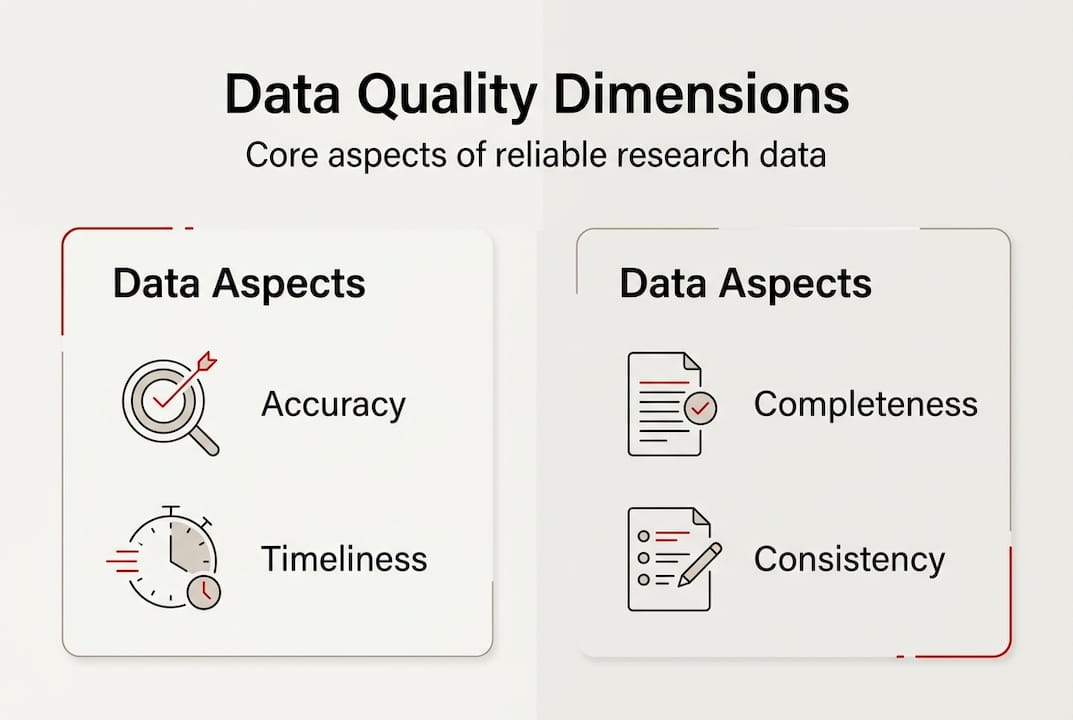
Accuracy ensures that data correctly represents the real-world phenomena you’re measuring. When survey responses misrepresent actual behaviors or opinions, your conclusions will mislead stakeholders. Completeness addresses whether all required data points exist, as missing values can skew analyses and reduce statistical power. Consistency maintains uniformity across datasets, preventing contradictions that emerge when the same entity appears differently in multiple records.
Timeliness means your data reflects current conditions rather than outdated information. In fast-moving markets, yesterday’s data may produce irrelevant insights today. Validity confirms that your measurements actually capture what you intend to measure, a cornerstone of sound customized market research survey design. Uniqueness eliminates duplicate records that artificially inflate sample sizes and distort frequency calculations.
Accessibility ensures authorized users can retrieve data when needed for analysis. Relevancy filters out extraneous information that clutters datasets without adding analytical value. Precision defines the granularity of your measurements, determining whether you can detect subtle patterns or only gross trends. Core data quality dimensions include accuracy, completeness, consistency, timeliness, validity, uniqueness, accessibility, precision, and relevancy.
These dimensions interact in complex ways. High accuracy means little if data arrives too late for decision making. Complete datasets lose value when inconsistencies make integration impossible. Recognizing these interdependencies helps you prioritize improvements based on your specific research objectives and constraints.
Key dimensions to monitor:
- Accuracy for correctness of values and representations
- Completeness to avoid analytical gaps from missing data
- Consistency for uniformity across sources and time periods
- Timeliness to ensure current relevance for decisions
- Validity to confirm measurements align with research constructs
- Uniqueness to eliminate duplicate records and inflated counts
- Accessibility for authorized retrieval and analysis
- Precision for appropriate measurement granularity
- Relevancy to focus on information that serves research goals
Frameworks and methodologies to ensure high-quality data
Structured frameworks transform abstract data quality concepts into concrete actions you can implement across research projects. Data quality frameworks and governance provide structured methodologies: define dimensions and metrics, assess and monitor via rules and KPIs, implement controls, and establish governance. These systematic approaches help you move from reactive problem solving to proactive quality management.
Effective frameworks start by defining measurable quality dimensions tailored to your research context. You establish specific KPIs for each dimension, such as acceptable error rates for accuracy or maximum allowable missing data percentages for completeness. These metrics create objective standards that guide quality assessment and improvement efforts.
Assessment processes include rules-based profiling that automatically flags anomalies, validation routines that check data against expected patterns, and cleaning procedures that correct identified issues. Modern data quality measures in surveys combine statistical analysis with behavioral pattern recognition. You can detect impossible values, logical inconsistencies, and suspicious response patterns before they contaminate your analysis.
Governance establishes clear data stewardship and ownership roles within your organization. Someone must be accountable for data quality at each stage, from collection through final reporting. Without defined responsibilities, quality issues slip through gaps between teams. Governance also includes documented standards, procedures, and escalation paths for quality problems.
Monitoring is continuous rather than episodic, integrating automated tools with human review. Automated systems can process vast data volumes quickly, flagging potential issues for expert examination. However, human judgment remains essential for interpreting context and making nuanced quality decisions that algorithms miss.
Implementing controls prevents data issues early in collection and processing workflows. Input validation at the point of data entry stops many errors before they enter your systems. Standardized coding schemes reduce inconsistencies. Version control prevents confusion about which dataset represents the current truth. These tips for designing b2b surveys build quality into your methodology from the start.
Pro Tip: Combine automated checks with expert oversight for best results. Algorithms excel at scale and speed, detecting patterns across massive datasets. Experts provide contextual understanding and creative problem solving for ambiguous cases. This hybrid approach delivers superior quality outcomes compared to purely automated or purely manual methods.
Implementation steps:
- Define measurable quality dimensions and establish KPIs for your research context
- Deploy rules-based profiling and validation tools to assess current data quality
- Create data cleaning and correction procedures for identified issues
- Assign clear stewardship roles and document quality standards
- Implement continuous monitoring combining automated alerts with expert review
- Build quality controls into data collection and processing workflows
- Regularly review and refine your framework based on emerging challenges
The impact of data quality on market research outcomes and fraud prevention
Data quality preserves survey integrity, ensuring you generate reliable insights that drive sound business decisions. In market research, data quality’s role in market research and fraud detection ensures valid insights through robust survey design, sampling, monitoring, and fraud prevention. Poor quality data leads to flawed segmentation, inaccurate demand forecasts, and misguided product development that wastes resources and damages competitive positioning.

Fraud represents one of the most pernicious threats to data quality in survey research. Professional respondents game screening questions to qualify for studies, providing dishonest answers to maximize participation fees. Bots generate synthetic responses at scale, flooding your sample with meaningless data. Some respondents copy and paste answers across open-ended questions, contributing no genuine insight. These fraud patterns undermine the validity of your findings and erode stakeholder confidence in research.
Multiple detection methods help you identify and remove fraudulent responses. Real-time monitoring tracks completion times, flagging suspiciously fast submissions that indicate insufficient attention. Consistency checks compare answers across related questions, identifying logical contradictions that reveal careless or dishonest responding. Behavioral analysis examines response patterns, such as straight-lining where respondents select the same option repeatedly regardless of question content.
Survey design must prioritize data validity through stratified sampling that ensures representative coverage of your target population. Controls like attention checks and trap questions help you identify low-quality respondents. Randomizing question and response option orders prevents order effects from biasing results. These design elements, when combined with robust monitoring, create multiple barriers against fraud and carelessness.
Working with best market research agencies gives you access to sophisticated fraud detection systems and experienced analysts who recognize subtle fraud patterns. The power of b2b survey research depends fundamentally on data quality, as business decisions based on flawed insights can cost far more than the research itself.
Pro Tip: Regularly refresh fraud detection techniques as fraudsters evolve their methods. What worked last year may miss today’s sophisticated fraud schemes. Stay current with industry best practices and invest in continuous improvement of your quality assurance processes.
Common fraud types and mitigation:
| Fraud Type | Detection Method | Mitigation Strategy |
|---|---|---|
| Professional respondents | Cross-study participation tracking, demographic consistency checks | Maintain exclusion lists, limit study participation frequency |
| Bot responses | CAPTCHA challenges, behavioral biometrics, impossible speed flags | Multi-layer verification, human review of suspicious patterns |
| Straight-lining | Response pattern analysis, variance calculations | Embed attention checks, randomize scales, flag low variance |
| Copy-paste answers | Text similarity algorithms, duplicate content detection | Require unique responses, use anti-plagiarism tools |
| VPN/proxy fraud | IP geolocation validation, device fingerprinting | Block suspicious IPs, verify geographic consistency |
Implementing strategies for data validity requires vigilance at every research stage:
- Deploy real-time monitoring to catch fraud during data collection, not after
- Use consistency and behavioral checks to identify illogical or careless responses
- Implement attention checks and trap questions to filter inattentive respondents
- Apply device fingerprinting and IP validation to detect duplicate or fraudulent participants
- Maintain exclusion databases to prevent repeat fraudsters from entering new studies
Balancing data quality with privacy and analytical complexities
Analyst perspectives vary significantly on identical datasets, leading to divergent conclusions even when everyone follows sound methodology. Expert nuances and privacy challenges in data quality show that the same data can lead to different conclusions across analysts, and high-quality data risks privacy breaches requiring degradation. This variability stems from legitimate differences in analytical approaches, variable selection, and interpretation frameworks. You cannot eliminate this subjectivity entirely, but understanding it helps you appreciate why research findings sometimes conflict.
Merging datasets enhances coverage and analytical power by combining information from multiple sources. However, integration introduces risks when datasets have different quality standards, measurement approaches, or temporal coverage. Low-quality data from one source can contaminate high-quality data from another. Conflicting definitions of the same variable create inconsistencies that complicate analysis. Careful data harmonization and quality assessment of each source become essential before integration.
Excessive data quality measures may risk privacy through re-identification of supposedly anonymous subjects. Highly detailed, accurate data makes it easier to identify individuals by combining multiple attributes. A dataset showing a 42-year-old female surgeon in a small city becomes identifiable even without names. This tension between quality and privacy requires thoughtful trade-offs.
Intentional data degradation sometimes becomes necessary for ethical and privacy compliance. Techniques like data aggregation, generalization, and noise addition reduce re-identification risks while preserving analytical utility. You might report age ranges instead of exact ages, or add statistical noise to sensitive variables. These modifications sacrifice some precision to protect subject privacy, a trade-off mandated by regulations like GDPR and ethical research standards.
Temporal data degradation affects longitudinal studies as information becomes outdated or subjects drop out. Missingness patterns influence causal inference, as data missing not at random can bias effect estimates. Understanding why data is missing helps you choose appropriate analytical techniques and interpret results cautiously.
The data-driven insights in consulting depend on navigating these complexities skillfully. Consultants must balance client needs for detailed insights against privacy obligations and analytical limitations.
| Quality Aspect | Privacy Consideration | Analytical Impact |
|---|---|---|
| High granularity | Increases re-identification risk | Enables detailed segmentation and targeting |
| Complete records | May expose sensitive attributes | Maximizes statistical power and reduces bias |
| Longitudinal tracking | Creates identifiable patterns over time | Supports causal inference and trend analysis |
| Multi-source integration | Compounds privacy risks through linkage | Enriches context and validates findings |
Key privacy versus quality trade-offs:
- Detailed demographic data improves segmentation but increases re-identification risk
- Longitudinal tracking enables causal analysis but creates identifiable behavioral patterns
- Multi-source data integration enriches insights but compounds privacy exposure through linkage
- High-precision measurements support nuanced analysis but may reveal sensitive information
- Complete records maximize statistical power but can expose private attributes
- Real-time data offers timeliness but reduces opportunity for privacy-preserving aggregation
You must weigh data accuracy against ethical standards and legal mandates. Regulations increasingly require privacy by design, meaning you build protections into data collection and processing from the start rather than adding them later. This proactive approach helps you maintain both quality and compliance. Transparency with research subjects about data use and protection measures builds trust and supports ethical practice.
Discover expert data quality solutions at Veridata Insights
Elevating data quality in your research projects requires specialized expertise and proven frameworks that address the multifaceted challenges we’ve explored. Veridata Insights offers tailored solutions designed specifically for market researchers and data analysts who demand reliable, actionable insights. Our team combines advanced fraud detection systems with expert human oversight to protect your research investment.
Access comprehensive consulting services covering survey design, sampling strategies, data governance, and quality assurance processes. We help you implement the frameworks and methodologies that prevent quality issues before they compromise your findings. Our approach balances rigorous data standards with privacy protection and ethical compliance, ensuring your research meets both analytical and regulatory requirements.
Improve decision accuracy and maximize return on your research investments through our proven quality management systems. Whether you need assistance with a specific project or want to build lasting quality capabilities within your organization, we provide flexible support scaled to your needs. Contact Veridata Insights to explore custom strategies that address your unique data quality challenges. Our experience working with leading market research agencies and implementing sophisticated data quality measures in online surveys positions us to deliver solutions that work in real-world research environments.
Frequently asked questions
What are the most important dimensions of data quality in research?
Accuracy, completeness, consistency, and timeliness form the foundational dimensions for reliable research data. Accuracy ensures your measurements correctly represent reality, while completeness prevents analytical gaps from missing values. Consistency maintains uniformity across datasets and time periods, enabling valid comparisons. Timeliness guarantees data reflects current conditions relevant to your research questions. These four dimensions interact closely, so weakness in one area often compromises others.
How can market researchers detect and prevent fraud in surveys?
Use real-time monitoring to track completion times, response patterns, and behavioral anomalies that indicate fraud or carelessness. Behavioral checks identify straight-lining, impossibly fast completions, and contradictory answers across related questions. Consistency analyses compare demographic information and responses to detect professional respondents gaming screening criteria. Combine automated detection tools with manual review by experienced analysts who recognize subtle fraud patterns. Implement forensic markers in online surveys to create multiple verification layers that catch fraudsters algorithms might miss.
What challenges arise when balancing data quality with privacy concerns?
High-quality, detailed data increases re-identification risks even when names and obvious identifiers are removed. Combining multiple accurate attributes can uniquely identify individuals, especially in smaller populations or specialized segments. Privacy protection often requires intentional data degradation through aggregation, generalization, or noise addition that reduces precision. Researchers must weigh the analytical value of detailed, accurate data against ethical obligations and legal mandates to protect subject privacy. This trade-off becomes particularly challenging in longitudinal studies where tracking individuals over time creates identifiable behavioral patterns.
How do data quality frameworks improve research methodology?
Frameworks provide structured, repeatable processes for defining quality standards, assessing current data, implementing controls, and monitoring ongoing quality. They transform abstract quality concepts into measurable KPIs and concrete actions embedded throughout your research workflow. Governance components assign clear accountability for quality at each stage, preventing issues from falling through organizational gaps. Continuous monitoring catches problems early when they’re easier and cheaper to fix. By building quality into methodology from initial design through final reporting, frameworks shift you from reactive problem solving to proactive quality management that consistently delivers reliable insights.