

TL;DR:
- Effective healthcare participant recruitment requires ethical messaging, leveraging digital tools, and community partnerships to ensure diversity and efficiency. Proper planning includes comprehensive materials, continuous informed consent, and adjusting outreach based on screening success rates. Building personal relationships with participants remains essential for long-term study success and data integrity.
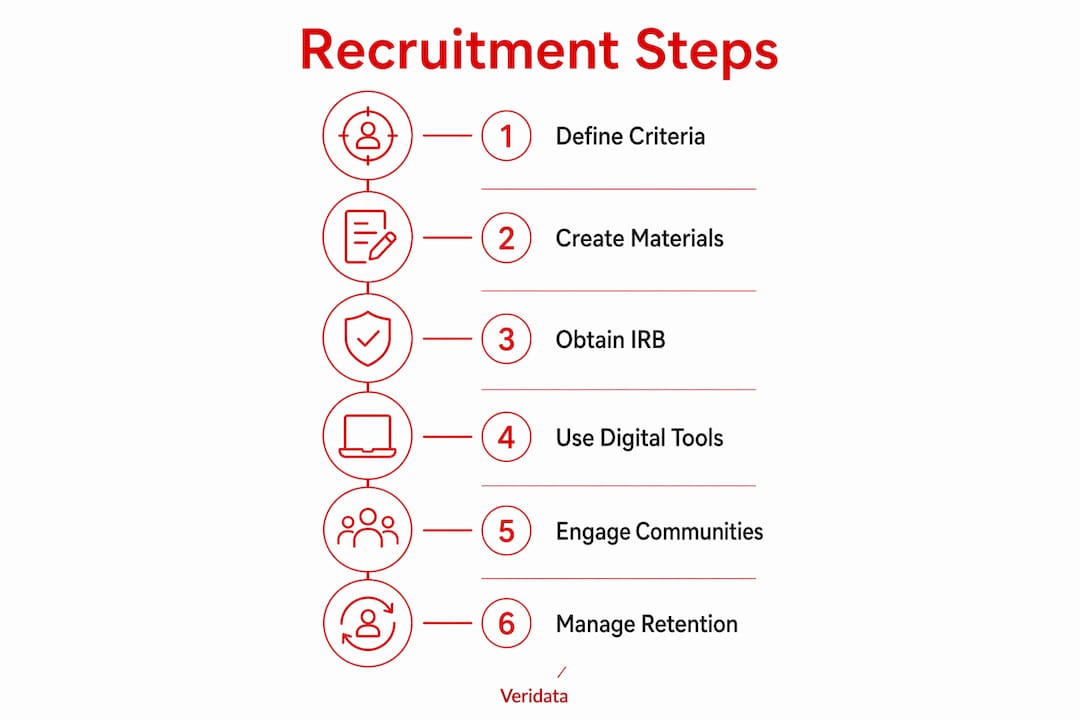
Recruiting healthcare participants is the process of attracting, informing, and enrolling appropriate individuals into research studies through ethical communication and targeted outreach. Done well, it protects volunteers, supports equitable selection, and produces data you can actually trust. Done poorly, it stalls timelines, skews results, and creates regulatory headaches that no IRB wants to untangle. The strategies that separate successful studies from stalled ones come down to three things: clear messaging, the right channels, and a participant experience worth showing up for.
How to recruit healthcare participants: essential content elements
Recruitment is the first real contact a potential participant has with your study. Brown University’s Division of Research defines this moment as a foundational communication opportunity that shapes volunteer understanding and drives equitable selection. That framing matters. It means your recruitment materials are not marketing copy. They are an ethical obligation.
Every piece of recruitment content, whether a flyer, email script, or social media post, must include these core components:
- Study purpose: What the research is investigating and why it matters
- Eligibility criteria: Who qualifies and who does not, stated plainly
- Time commitment: Number of visits, duration, and any follow-up requirements
- Compensation details: Payment, reimbursement, or non-monetary incentives
- Contact information: A named person or team with a direct phone number or email
- Privacy protections: How participant data will be stored and who can access it
- Study identifiers: Protocol number, sponsoring institution, and physical location
Language matters as much as content. Materials written at a college reading level or higher create barriers for large segments of the population you may be trying to reach. Plain language, short sentences, and culturally appropriate framing are not optional extras. They are part of equitable participant selection and directly affect your IRB submission.
IRB approval requires submitting recruitment materials as a complete, consistent set. That means all media formats, targeting criteria, scripts, and privacy protocols must align. A mismatch between your email script and your social ad copy can trigger a revision request and delay your study start date by weeks.
Pro Tip: Submit a full recruitment package to your IRB at once, including every format you plan to use. Piecemeal submissions are the single most common cause of preventable approval delays.
How do digital tools and registries enhance healthcare participant recruitment?
Digital platforms have changed the speed and scale at which researchers can connect with willing volunteers. ResearchMatch, an NIH-funded registry, connects researchers with a pool of over 186,000 individuals across 9,300 studies from 250 institutions. Registration takes five to ten minutes for volunteers, which means the barrier to entry is low and the pool stays active. That kind of reach used to require months of community outreach.

Patient portals like MyChart offer another direct channel. When a healthcare system partners with a research team, providers can flag eligible patients during routine care and send recruitment messages through the portal. This approach works because the contact comes from a trusted source, the patient’s own care team, rather than a cold outreach.
| Digital channel | Primary strength | Key consideration |
|---|---|---|
| ResearchMatch | Large volunteer pool, NIH-backed credibility | Requires regular study listing updates |
| MyChart / patient portals | Trusted source, existing patient relationship | Requires institutional partnership |
| Social media advertising | Broad reach, demographic targeting | Must comply with IRB-approved ad copy |
| Online patient communities | High engagement, condition-specific audiences | Requires community moderator buy-in |
| ClinicalTrials.gov | Standard registry, high researcher visibility | Listing accuracy affects search results |
Social media platforms like Facebook and Instagram allow demographic and interest-based targeting that can reach condition-specific communities at scale. The catch is that every ad variation must be IRB-approved before it runs. Researchers who treat social media as a fast, informal channel often find themselves in a compliance problem. Treat it like any other recruitment material.
eConsent platforms, such as those integrated into REDCap or dedicated tools like Veeva Vault, allow participants to review, ask questions about, and sign consent documents remotely. This reduces scheduling friction and supports recruitment of participants who cannot easily travel to a site.
Pro Tip: Update your ClinicalTrials.gov listing every time your eligibility criteria or contact information changes. Outdated listings are one of the most common reasons qualified volunteers self-screen out before ever contacting your team.
What strategies effectively engage diverse and underrepresented healthcare populations?
Diversity in clinical research is not a compliance checkbox. It is a scientific requirement. A study population that skews toward one demographic produces findings that may not generalize to the broader patient population. Peer-reviewed research from 2025 confirms that snowball sampling, social media advertising, and direct mail are the most effective methods for recruiting underrepresented groups. Each method works for a different reason, and combining them multiplies the effect.
Here is a practical sequence for building a diverse recruitment strategy:
- Map your gaps first. Before launching outreach, identify which demographic groups are underrepresented in your current pool. Age, race, ethnicity, geography, and health literacy level are the most common gaps in clinical research.
- Partner with community organizations. Federally Qualified Health Centers, faith-based organizations, and patient advocacy groups already have trust with the communities you are trying to reach. A warm introduction from a trusted community partner converts far better than a cold flyer.
- Adapt materials linguistically and culturally. Translation alone is not enough. A Spanish-language flyer that uses clinical terminology unfamiliar to a non-specialist audience will not perform. Work with community liaisons to review tone, imagery, and framing.
- Use snowball sampling deliberately. Ask enrolled participants to refer others in their social network who may qualify. This method works especially well for rare conditions and tight-knit communities where word-of-mouth carries more weight than advertising.
- Remove logistical barriers. Transportation reimbursement, on-site childcare, and flexible appointment times are not perks. They are recruitment barriers that, when removed, directly increase enrollment from working-class and rural populations.
- Vary your outreach formats. Some communities respond to print mail. Others engage through WhatsApp groups or community Facebook pages. Social networks and varied outreach formats materially improve recruitment success. Do not default to a single channel because it is easiest for your team.
Matching participants to studies based on genuine fit, rather than just filling a quota, also improves retention and data quality. A 2025 ethnographic study found that recruitment improves when researchers prioritize participant interest and alignment with study goals over raw enrollment numbers.
How to plan and manage recruitment timelines and participant retention
Recruitment timelines that do not account for screen failures are timelines that will fail. Johns Hopkins ICTR recommends building buffer outreach volumes into every recruitment plan to prevent bottlenecks at the eligibility and enrollment stages. If your study needs 100 enrolled participants and your screen failure rate is 40%, you need to contact at least 170 qualified candidates, not 100.
Practical retention tactics that actually work include:
- Clear onboarding instructions: Send a welcome packet before the first visit that explains what to expect, what to bring, and who to contact with questions.
- Automated reminders: Text and email reminders sent 48 hours and 24 hours before each visit reduce no-show rates significantly.
- Flexible scheduling: Offering evening and weekend appointment slots removes a major barrier for employed participants.
- Transparent compensation: Pay participants on time and communicate the payment timeline upfront. Delays in reimbursement are a leading cause of dropout.
- Ongoing communication: Brief check-in messages between study visits signal that the research team values the participant’s contribution, not just their data.
Multi-channel outreach coordination matters at the planning stage too. Clinical site staff, community health workers, and digital outreach teams need to operate from the same eligibility criteria and the same messaging. Inconsistency across channels confuses potential participants and creates compliance risk.
Pro Tip: Track your screen failure rate weekly from the first day of recruitment. If it exceeds your projected rate by more than 10%, adjust your outreach volume immediately rather than waiting for a formal review cycle.
For teams working with hard-to-reach audiences, building in extra lead time and community relationship-building before formal recruitment begins is the difference between hitting enrollment targets and missing them.
What are the best practices for obtaining and maintaining informed consent?
Informed consent in clinical research is a continuous process, not a one-time signature. ICH GCP guidelines define consent as an ongoing, participant-centered obligation requiring clear communication of risks, benefits, alternatives, and the right to withdraw at any time without penalty. A signed form at enrollment is the beginning of that process, not the end.
The core elements every consent document must include are:
- A plain-language description of the study’s purpose
- A clear explanation of all foreseeable risks and discomforts
- A description of expected benefits to the participant or to others
- Disclosure of alternative treatments or procedures available
- A statement on confidentiality and data handling
- An explanation of compensation for injury, if applicable
- Contact information for the principal investigator and the IRB
- A statement confirming participation is voluntary and withdrawal carries no penalty
Advarra notes that incomplete consent forms are one of the most common causes of IRB approval delays. Missing a single required element, even a minor one, sends the entire submission back for revision.
Consent is not a checkbox. It is the foundation of the participant relationship. Every interaction after enrollment is an opportunity to reinforce understanding and confirm continued willingness to participate.
The principal investigator holds ultimate responsibility for consent, but delegation to trained study coordinators is standard practice. Whoever conducts the consent discussion must be listed on the delegation log and trained on the current protocol version. eConsent platforms reduce errors by embedding required elements into a structured workflow that cannot be submitted incomplete.
Key takeaways
Effective healthcare participant recruitment combines ethical messaging, digital tools, community partnerships, and rigorous consent practices to produce enrollment that is both efficient and equitable.
| Point | Details |
|---|---|
| Recruitment content requirements | Every material must include study purpose, eligibility, time commitment, contact info, and privacy protections. |
| Digital platforms accelerate outreach | ResearchMatch, MyChart, and ClinicalTrials.gov connect researchers with qualified volunteers at scale. |
| Diversity requires deliberate strategy | Snowball sampling, community partnerships, and barrier removal are the most effective methods for underrepresented populations. |
| Timeline planning must include screen failures | Build buffer outreach volumes into every recruitment plan to prevent enrollment stalls. |
| Informed consent is ongoing | ICH GCP requires continuous communication of risks, benefits, and voluntariness throughout the study. |
What I have learned from years of watching recruitment plans succeed and fail
After working across dozens of healthcare studies, the pattern is clear. The teams that struggle with recruitment treat it as a logistics problem. The teams that consistently hit enrollment targets treat it as a relationship problem.
The shift I have seen in recent years is real and worth paying attention to. Researchers who invest in community partnerships before a study opens, not after enrollment stalls, consistently outperform those who rely entirely on digital channels and registries. ResearchMatch and patient portals are powerful, but they reach people who are already looking. Community health workers and advocacy groups reach people who would never have found the study on their own.
The other thing I would push back on is the assumption that more outreach volume solves a slow recruitment problem. Sometimes the issue is the message, not the reach. If your screen failure rate is high, check your eligibility criteria and your recruitment copy before you double your ad spend. Clarity in the first contact saves time, money, and participant goodwill downstream.
Technology helps. eConsent platforms, digital registries, and targeted social advertising have genuinely improved what is possible. But the studies I have seen perform best are the ones where a real person, a coordinator, a community liaison, a trusted clinician, made a personal connection with a potential participant. That still matters more than any platform.
How Veridatainsights supports your healthcare recruitment goals
Recruiting the right participants for healthcare studies takes more than a good protocol. It takes expertise, the right tools, and a team that knows how to reach audiences that are genuinely hard to find. Veridatainsights specializes in healthcare research recruitment for exactly this reason. Whether you need support building a recruitment strategy from scratch, sourcing participants for a niche clinical population, or managing outreach across multiple channels, we work with you at whatever scope your study requires. No project minimums. Seven days a week. Contact our team to talk through your recruitment challenge and get a plan that actually works.
FAQ
What must be included in healthcare study recruitment materials?
Recruitment materials must include the study purpose, eligibility criteria, time commitment, compensation, contact information, and privacy protections. Brown University’s research guidelines also require study identifiers such as protocol number and institution name.
How does ResearchMatch help with finding healthcare study participants?
ResearchMatch is an NIH-funded platform with over 186,000 registered volunteers across 9,300 studies from 250 institutions. Volunteers register in five to ten minutes, making it one of the fastest ways to connect with qualified, willing participants.
What are the most effective strategies for recruiting underrepresented populations?
Snowball sampling, social media advertising, and direct mail are the methods with the strongest evidence base for reaching underrepresented groups. Removing logistical barriers like transportation costs and childcare further improves enrollment from these communities.
When does informed consent need to be completed in a clinical study?
Informed consent must be completed before any study procedures begin, and it must be treated as an ongoing process throughout the study. ICH GCP guidelines require continuous communication of risks, benefits, and the participant’s right to withdraw at any time.
How should recruitment timelines account for screen failures?
Recruitment plans should calculate the expected screen failure rate and build buffer outreach volume accordingly. Johns Hopkins ICTR recommends flexible scheduling and contingency planning to prevent enrollment bottlenecks when more candidates than expected do not meet eligibility criteria.