


TL;DR:
- Choosing the right data collection method is critical because it directly affects the validity of research findings. Using appropriate techniques for your questions and population ensures reliable and meaningful results. Technology improves data collection speed and scale but requires careful planning for privacy and security.
Data collection methods are the systematic procedures researchers use to gather information that answers specific research questions and supports evidence-based decisions. These methods split into two primary categories: quantitative approaches like surveys, experiments, and sensor measurements, and qualitative approaches like interviews, focus groups, and document analysis. Choosing the wrong method does not just slow your project down. It corrupts your findings at the source. This guide covers the major types, how to select among them, best practices for implementation, and how technology is reshaping the field in 2026.
What are the main types of data collection methods?

Data collection methods divide into quantitative and qualitative approaches, each designed for a different kind of research question. Quantitative methods target large samples and produce numerical data suitable for statistical analysis. Qualitative methods work with smaller groups to generate detailed, contextual understanding.
Quantitative data collection techniques include:
- Surveys and questionnaires: Structured instruments delivered online, by phone, or in person. They produce standardized responses across large populations.
- Experiments: Controlled studies where researchers manipulate one variable and measure its effect on another. These are the gold standard for causal inference.
- Sensor and passive measurement: Wearables, environmental monitors, and digital tracking tools that capture behavioral or physiological data without direct participant input.
- Secondary data analysis: Using existing datasets, government records, or published statistics. This method is cost-effective but requires careful evaluation of source quality.
Qualitative data collection techniques include:
- In-depth interviews: One-on-one conversations that explore attitudes, motivations, and experiences. They yield rich narrative data that surveys cannot capture.
- Focus groups: Moderated group discussions that reveal shared beliefs and social dynamics within a target population.
- Observation: Researchers watch and record behavior in natural or controlled settings. Ethnographic fieldwork is a classic example.
- Document and content analysis: Systematic review of texts, reports, social media posts, or archival records to identify patterns and themes.
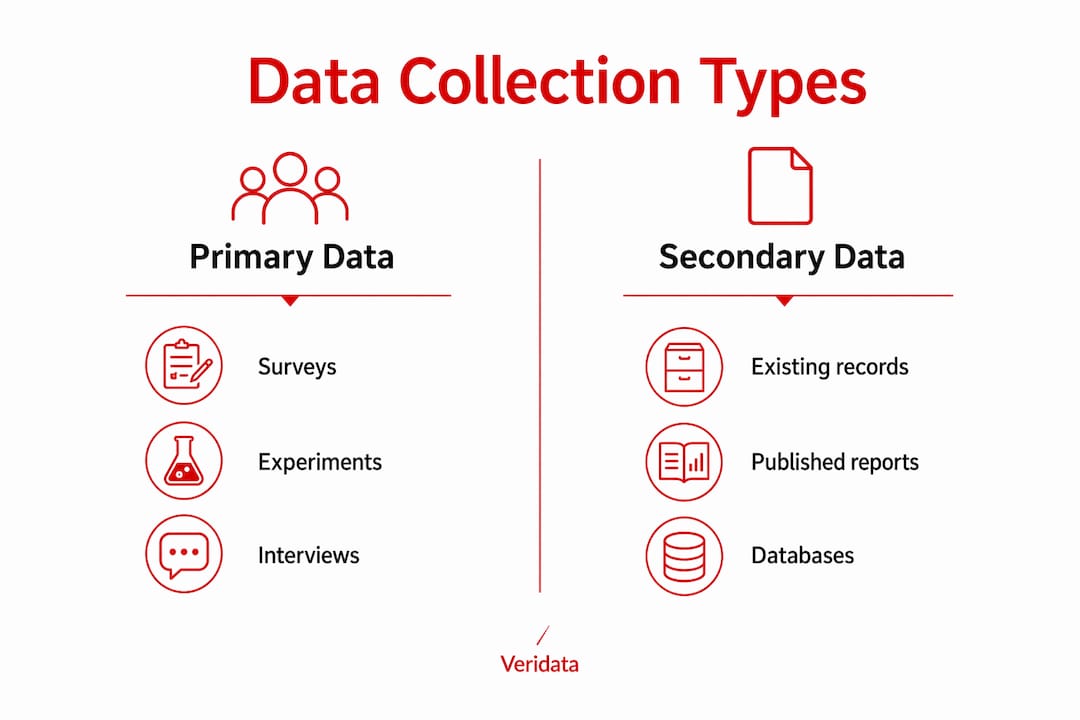
Primary data collection means gathering new information directly from participants or environments. Secondary data collection means analyzing information someone else already gathered. Both have a place in well-designed research, and the choice between them often comes down to time, budget, and the specificity of your research question.
How do you choose the right data collection method?
Method selection depends on four core factors: the nature of your research question, the depth of data you need, your available resources, and the characteristics of your study population. These factors directly shape the validity, reliability, and relevance of your findings.
Start by asking whether your research question calls for measurement or meaning. If you need to quantify a behavior or test a hypothesis across a large group, a quantitative method fits. If you need to understand why people behave a certain way, a qualitative method gives you the texture that numbers cannot.
- Define your research objective clearly. A vague objective produces a vague method choice. Write your research question in one sentence before selecting any instrument.
- Assess your population. Hard-to-reach audiences, such as healthcare professionals or niche B2B segments, often require specialized recruitment and tailored instruments.
- Run a power analysis before any quantitative study. Power analysis determines the minimum sample size needed to detect a real effect. Key parameters include an expected effect size, a target power of 80–90%, and a significance level of 5%. Skipping this step risks an underpowered study that cannot confirm or deny your hypothesis.
- Evaluate your resources. In-depth interviews cost more per data point than online surveys. Sensor-based collection requires technical infrastructure. Budget and timeline constrain your options in ways that theory does not.
- Consider a mixed-methods approach. Combining quantitative and qualitative methods improves study quality by capturing both scale and depth. A survey can map the size of a trend; follow-up interviews can explain it.
Pro Tip: The most common research mistake is choosing methods by popularity rather than by fit. Online surveys are everywhere, but they are the wrong tool for studying rare clinical populations or complex organizational behavior. Match the method to the question, not to what is convenient.
Best practices and common challenges in implementing data collection
Standardizing your collection protocols is the single most effective way to reduce errors and ensure your data is comparable across sites, time points, and researchers. Failures in data collection most often trace back to poorly written guidelines that lack validation steps and error-checking procedures. The fix is straightforward: document everything before you collect anything.
“Comprehensive instrument manuals covering every step of data collection, from participant engagement to equipment calibration and handling of missing data, are the foundation of consistent, high-quality research. Without them, variability in procedure becomes variability in data.”
Detailed instrument manuals reduce variability by giving every team member the same reference point. This matters especially in multi-site studies where different interviewers or field workers may interpret ambiguous instructions differently.
Quality assurance practices that protect your data:
- Pre-collection: Pilot test your instruments with a small sample. Identify ambiguous questions, technical failures, and procedural gaps before full deployment.
- During collection: Use real-time monitoring where possible. Flag outliers, incomplete responses, and data entry errors as they occur rather than after the fact.
- Post-collection: Run data validation checks, document any deviations from protocol, and back up all files immediately. Data stewardship does not end when collection stops. It includes calibration records, labeling, and secure archiving.
- Observer bias: Researchers who know the study hypothesis can unconsciously influence participant responses. Blind or double-blind designs reduce this risk.
- Data security: Participant information requires encryption, access controls, and clear retention policies. A breach does not just harm participants. It invalidates your IRB approval and your findings.
Check your data collection best practices against a quality assurance checklist before you go into the field. The cost of fixing bad data after collection is always higher than the cost of preventing it.
How is technology changing data collection methods?
Technology has expanded what researchers can collect, how fast they can collect it, and from how many sources simultaneously. Sensor-based and digital tools improve scale and efficiency but introduce new ethical and privacy responsibilities that researchers cannot ignore.
Key technological developments reshaping data gathering:
- Automated online surveys and adaptive questionnaires: These tools adjust question flow based on prior answers, reducing respondent burden and improving data quality.
- Passive data capture: GPS tracking, app usage logs, and wearable biosensors collect behavioral data continuously without requiring active participant input.
- Big data integration: Researchers now pull from social media streams, electronic health records, and transaction databases. The volume is unprecedented. The quality controls required are equally demanding.
- Real-time dashboards: Cloud-based platforms let research teams monitor incoming data, spot anomalies, and adjust field protocols without waiting for a full data dump.
Early integration of data security protocols and standard ontologies is critical before any data gathering begins. Retrofitting privacy safeguards after collection is technically difficult and often legally insufficient. Plan your data management architecture at the same time you design your instruments.
Technological advances in data collection bring efficiency gains, but they also increase the ethical assessment burden on research teams. Institutional review boards are paying closer attention to passive data collection and AI-assisted analysis. Build your ethics review into your project timeline, not as an afterthought.
Practical examples of data collection methods in research
Seeing how methods apply in real contexts makes the selection decision much clearer. The table below shows common research scenarios alongside the method that fits best and why.
| Research scenario | Primary method | Why it fits |
|---|---|---|
| Measuring customer satisfaction across 5,000 respondents | Online survey | Large sample, standardized responses, fast turnaround |
| Understanding why patients delay seeking care | In-depth interviews | Explores motivations and barriers with contextual depth |
| Testing whether a new training program improves performance | Controlled experiment | Isolates the training variable and measures causal effect |
| Analyzing public sentiment on a policy change | Content analysis of social media | Captures organic, unsolicited opinion at scale |
| Studying team communication patterns in a workplace | Ethnographic observation | Records natural behavior without self-report bias |
| Estimating national health trends over a decade | Secondary data analysis | Uses existing government datasets for longitudinal scope |
Method triangulation, using two or more methods on the same research question, is the most reliable way to validate findings. A survey might show that 70% of employees report feeling disengaged. Follow-up focus groups explain the specific management behaviors driving that disengagement. Neither method alone tells the full story. For a deeper look at applying quantitative techniques in practice, the principles of power analysis and sampling design apply across all of these scenarios.
Key Takeaways
Selecting the right data collection method, matched precisely to your research question and population, is the single most important decision in any research project.
| Point | Details |
|---|---|
| Match method to question | Quantitative methods measure; qualitative methods explain. Choose based on your research objective, not convenience. |
| Run power analysis early | Determine minimum sample size before quantitative data collection to avoid underpowered, inconclusive studies. |
| Standardize every protocol | Detailed instrument manuals reduce variability and protect data comparability across sites and researchers. |
| Plan data security upfront | Integrate privacy safeguards and validation procedures before collection begins, not after. |
| Use mixed methods for depth | Combining quantitative and qualitative approaches captures both scale and context, improving overall study quality. |
What I’ve learned from years of watching research go wrong
Most research failures I’ve seen do not happen in the analysis phase. They happen in the planning phase, specifically in the moment when a researcher picks a method because it’s familiar rather than because it fits. A well-designed survey sent to the wrong population is just expensive noise. An interview protocol that lacks a clear guide produces data you cannot compare across respondents.
The researchers who produce the most reliable work share one habit: they spend more time designing their collection approach than they spend collecting data. They run pilots. They write instrument manuals that a new team member could follow without any verbal explanation. They treat data stewardship as a continuous responsibility, not a box to check before moving on to analysis.
Mixed-methods designs get underused because they feel complicated. They are not. They are just two well-designed studies that talk to each other. When you see a quantitative finding that surprises you, the qualitative follow-up is not extra work. It is the explanation you need to make the finding useful.
Technology is genuinely changing what is possible in data collection. Passive sensors and real-time dashboards give researchers capabilities that did not exist a decade ago. But the ethical responsibilities grow at the same rate as the capabilities. The researchers who will do the best work in 2026 and beyond are the ones who treat privacy and data security as core methodology, not compliance overhead.
How Veridata Insights supports your research from design to data
Veridata Insights works with researchers and analysts across B2B, B2C, healthcare, and hard-to-reach audiences to build research programs that hold up under scrutiny. Whether your project calls for a large-scale quantitative study or a targeted qualitative deep dive, the team at Veridata Insights handles consultation and design, methodology selection, questionnaire review, programming, data collection, processing, coding, and full reporting with analytics and data visualization. There are no project minimums, and the team is available seven days a week. If you are ready to build a study that produces data you can trust, reach out to the team and get started.
FAQ
What are the two main types of data collection methods?
Data collection methods split into quantitative approaches, such as surveys and experiments, and qualitative approaches, such as interviews and focus groups. Quantitative methods produce numerical data for statistical analysis; qualitative methods generate contextual, narrative insights.
Why does method selection matter so much in research?
The method you choose directly determines the validity, reliability, and relevance of your findings. Choosing a method by popularity rather than by fit with your research question is the most common cause of inconclusive or misleading results.
What is power analysis and when should you use it?
Power analysis is a calculation performed before a quantitative study to determine the minimum sample size needed to detect a real effect. Researchers use a target power of 80–90% and a significance level of 5% as standard parameters.
How do mixed-methods approaches improve research quality?
Mixed-methods research combines quantitative and qualitative data collection to capture both the scale of a phenomenon and the reasons behind it. This approach reduces the blind spots that come from relying on a single method.
What is the biggest risk of using technology for data collection?
The primary risks are data security breaches and privacy violations. Integrating security protocols, validation procedures, and standard ontologies before data gathering begins is the most effective way to manage these risks.