

TL;DR:
- Customer profiling involves creating detailed portraits of ideal customers using multiple data types to improve marketing, sales, and product decisions. Validating profiles through experiments ensures they predict behavior better than random segmentation, while embedding them in systems drives continuous performance improvements. Avoid common pitfalls like biased sampling and siloed data by layering multiple profile types and maintaining regular updates.
Customer profiling is the systematic, data-driven process of building detailed portraits of your ideal customers by combining demographics, psychographics, behaviors, and pain points – so your marketing, sales, and product teams all work from the same picture. Start today by auditing your CRM for completeness, picking one high-value behavioral signal to track, and setting a single conversion KPI to measure against.
Quick-start checklist:
- Audit your CRM: flag records missing industry, role, or purchase history
- Pick your top behavioral signal (pricing page visits, repeat purchases, email click patterns)
- Choose one KPI to track lift against (conversion rate, customer acquisition cost, retention rate)
- Decide which profile type fits your immediate goal (see the table in Section 5)
Core profile elements every team needs:
- Demographic: age, location, income, job title, company size
- Psychographic: values, motivations, lifestyle, attitudes
- Behavioral: purchase history, content engagement, product usage patterns
- Firmographic/Technographic: industry, revenue band, tech stack, buying process
Table of Contents
- What is customer profiling, and why does it go beyond raw data?
- Customer profiling vs. segmentation vs. buyer personas: which one do you need?
- Why does customer profiling matter for revenue and retention?
- What are the main types of customer profiles, and when should you use each?
- How do you build customer profiles step by step?
- Which data sources power strong customer profiles?
- How do you validate and test customer profiles?
- What are the most common profiling pitfalls, and how do you avoid them?
- How long does a profiling project take, and what does it cost?
- What do real B2C and B2B customer profiles look like?
- Which KPIs tell you whether profiling is actually working?
- How do you activate profiles across marketing, sales, and product?
- How Veridata Insights runs customer profiling projects
- Key Takeaways
- Veridata Insights can run your next profiling project
- Useful sources and further reading
What is customer profiling, and why does it go beyond raw data?
Customer profiling is the systematic, data-driven process of constructing detailed portraits of ideal customers by aggregating demographics, psychographics, behaviors, and pain points to guide marketing, sales, and product strategy. That definition matters because profiling is not the same as collecting data. Raw data is a warehouse. A profile is a working portrait.
The synthesis step is where the value lives. You take transaction records, survey responses, web analytics, and CRM notes, then compress them into a representative picture of who buys, why they buy, and what almost stopped them. That portrait becomes a decision tool, not a report.
Concrete use cases where profiling actually moves metrics:
- Targeted acquisition: match ad creative and channel mix to the attributes of your highest-LTV customers
- Personalization: tailor email sequences, landing pages, and product recommendations to specific profile segments
- Product prioritization: surface the features your most profitable customers actually use, not the ones they request loudest
- Lead qualification: score inbound leads against profile attributes to shorten sales cycles
- Churn risk identification: flag customers whose behavioral patterns diverge from your retained-customer profile
Customer profiling vs. segmentation vs. buyer personas: which one do you need?
The short answer: profiling builds a detailed portrait of an individual or representative customer; segmentation groups customers into targetable cohorts; and buyer personas are narrative archetypes that make those groups human for creative and sales teams. They are complementary, not interchangeable.
Side-by-side comparison:
- Customer profiling
- Intent: understand a specific customer or representative type in depth
- Typical inputs: CRM data, transaction history, behavioral analytics, qualitative interviews
- Deliverable: a detailed profile document with attributes, motivations, and friction points
- Customer segmentation
- Intent: divide the customer base into groups for targeting and measurement
- Typical inputs: demographic, geographic, behavioral, or value-based data
- Deliverable: labeled cohorts with size, revenue contribution, and response rates
- Buyer personas
- Intent: give teams a relatable narrative to guide messaging and creative
- Typical inputs: qualitative research, sales interviews, profile synthesis
- Deliverable: named archetypes with backstory, goals, objections, and preferred channels
Decision guide — match your problem to the right approach:
- Need to personalize communications at the individual or micro-segment level? → Profiling
- Running a paid campaign and need to define audience targeting parameters? → Segmentation
- Briefing a creative team or training new sales reps on who they are selling to? → Buyer personas
- Trying to identify churn risk or high-LTV customers in your CRM? → Profiling + segmentation together
- Launching a new product and need to validate product-market fit? → Profiling first, then segmentation
Why does customer profiling matter for revenue and retention?
Profiling connects customer understanding directly to the metrics that drive business outcomes: lower customer acquisition cost, higher conversion rates, stronger product-market fit, and measurable retention uplift. Without profiles, teams optimize for the average customer — a customer who often does not exist.
The primary benefits break down cleanly by function. Marketing teams reduce wasted spend by targeting audiences whose attributes match proven buyers. Sales teams shorten qualification cycles by scoring leads against profile criteria rather than gut feel. Product teams deprioritize features that serve edge cases and double down on what high-value customers actually use. Each benefit has a measurable counterpart: CAC, conversion rate delta, feature adoption rate, and net revenue retention.
Where profiling fits in measurement is equally specific. Profiles establish the baseline. You define who your best customers are, then run lift experiments to confirm that targeting those profiles outperforms your population average. Data-driven insights applied this way turn profiling from a one-time exercise into a continuous performance lever.
What are the main types of customer profiles, and when should you use each?
The six core profiling types are demographic, psychographic, behavioral, firmographic, technographic, and needs-based. Practical profiling methods include psychographic, typology, and characteristics-based approaches, each supplying different signals for targeting and personalization. No single type covers everything — the best profiles layer two or three.

Demographic profiling uses age, gender, income, education, and location. It is the easiest to collect and the most commoditized. Useful for broad audience sizing and regulatory compliance, but rarely sufficient for personalization on its own.
Psychographic profiling maps values, motivations, lifestyle, and attitudes. It answers why customers buy, not just who they are. This is where most teams underinvest, and it is often the layer that unlocks messaging breakthroughs.
Behavioral profiling tracks purchase history, product usage, content engagement, and channel preferences. Purchase intention signals such as repeat visits to pricing pages are higher-value indicators than generic top-of-funnel engagement and should be prioritized for lead qualification.
Firmographic profiling applies to B2B: company size, industry, revenue band, growth stage, and organizational structure. It determines whether a prospect fits your ICP before a single sales conversation happens.
Technographic profiling maps the tools and platforms a company or consumer uses. For SaaS and martech vendors, knowing that a prospect runs Salesforce and Marketo tells you more about their buying process than their headcount does.
Needs-based profiling focuses on the specific problem a customer is trying to solve, independent of who they are. It is particularly powerful for product roadmap decisions and for identifying underserved micro-segments.
| Profile type | Best for | Primary data source |
|---|---|---|
| Demographic | Audience sizing, media buying | CRM, census data, surveys |
| Psychographic | Messaging, brand positioning | Surveys, interviews, social listening |
| Behavioral | Personalization, lead scoring | Web analytics, CRM, transaction data |
| Firmographic | B2B ICP definition, account targeting | CRM, LinkedIn, third-party data |
| Technographic | SaaS/martech targeting | Intent data, third-party enrichment |
| Needs-based | Product prioritization, new market entry | Qualitative interviews, support tickets |
Pro Tip: Behavioral data tells you what customers do, but community-based analysis tells you why. Audience analysis that maps shared cultural codes and narratives often delivers higher engagement than pure demographic targeting — because it captures identity signals that demographics miss entirely.
How do you build customer profiles step by step?
The recommended process runs in five phases: scope, collect, synthesize, validate, and operationalize. A stepwise template-based approach helps teams move from raw data to activation quickly and speeds handoffs to marketing and sales. Here is the full playbook.
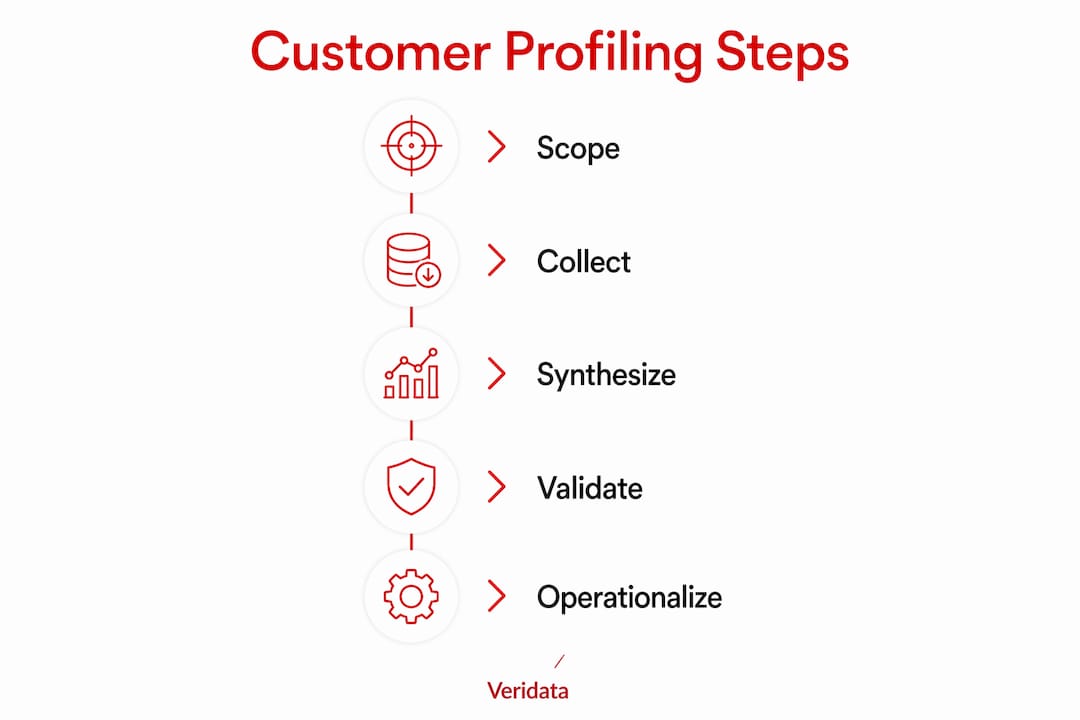
1. Scope the project
Define the business question the profile must answer (e.g., “Who are our highest-LTV customers and what do they have in common?”). Set a timeline, assign an owner, and agree on the KPI that will tell you the profile is working.
2. Audit existing data
Review your CRM, analytics platform, and transaction records for completeness. Flag gaps — missing firmographic fields, incomplete behavioral histories, or survey data older than 18 months.
3. Choose your signals
Select 4–6 data signals that map to your profiling type. For a B2B behavioral profile: pricing page visits, demo requests, email open sequences, and CRM stage velocity. For a B2C psychographic profile: survey responses, social engagement topics, and purchase category patterns.
4. Design your data collection
Combine quantitative and qualitative inputs. Collecting both quantitative signals and qualitative inputs such as surveys and interviews, then combining them, reduces misinterpretation of intent and motivations. Run a survey (10–15 questions), pull 6 months of transaction data, and schedule 5–8 customer interviews.
5. Sample strategically
Avoid sampling only your most vocal customers. Include recent churned customers, high-LTV retained customers, and mid-funnel prospects who never converted. Each group reveals a different dimension of the profile.
6. Synthesize into a profile
Cluster your findings by shared attributes and motivations. Write a one-page profile document per segment using the template fields below.
7. Validate before distributing
Run a small A/B test or holdout experiment to confirm the profile predicts behavior better than your baseline. If it does not, refine.
8. Operationalize and hand off
Distribute profiles to marketing, sales, and product with activation notes. Embed profile attributes as CRM fields or audience segments in your martech stack.
Compact profile template (copy into your internal docs):
- Profile name: [Segment label, e.g., “Growth-Stage SaaS Buyer”]
- Demographics/Firmographics: [Age range / Company size / Industry / Location]
- Role and seniority: [Job title / Decision-making authority]
- Primary goal: [What they are trying to achieve]
- Key pain points: [Top 2–3 friction points]
- Behavioral signals: [How they engage before buying]
- Preferred channels: [Email / LinkedIn / Search / Events]
- Objections: [Top 2 reasons they hesitate]
- Message hook: [One-sentence value proposition tailored to this profile]
Handoff tips: Tag profile attributes as custom fields in your CRM so sales reps can filter by profile type. In your email platform, build audience segments that map to each profile. In your product analytics tool, create cohorts that match profile behavioral criteria so you can track feature adoption by profile.
Which data sources power strong customer profiles?
The top sources are CRM records, web analytics, transaction data, surveys and interviews, social listening, and third-party enrichment. The single most important integration principle is identity resolution: every source must tie back to a unified customer record, or you end up with fragments that contradict each other.
A unified customer profile enables personalization at scale and is commonly built using a Customer Data Platform (CDP) to centralize identity, behavior, and preference signals. Without that unified view, siloed data becomes one of the top operational causes of profiling projects failing to move metrics.
What each source contributes:
- CRM: firmographic attributes, deal history, sales stage velocity, account health scores
- Web analytics (Google Analytics 4, Adobe Analytics): intent signals, content consumption patterns, funnel drop-off points
- Transaction data: purchase frequency, average order value, product category affinity, recency
- Surveys and interviews: psychographic depth, motivations, objections, satisfaction drivers
- Social listening (Brandwatch, Sprout Social): community signals, cultural narratives, sentiment
- Third-party enrichment (ZoomInfo, Bombora, Clearbit): firmographic and technographic data at scale
Integration checklist:
- Assign a unique customer ID that persists across all platforms
- Deduplicate records before merging (match on email, phone, and company domain)
- Validate data freshness: flag records not updated in 12+ months
- Document data lineage so downstream teams know which source each field came from
- Run a data processing and visualization audit before the first synthesis pass
Privacy callout: Under the California Consumer Privacy Act (CCPA), California residents have the right to know what personal data you collect, request deletion, and opt out of data sales. For any profiling project touching U.S. consumer data, document your data sources, obtain consent where required, honor opt-out requests promptly, and apply data minimization — collect only what the profile genuinely needs. This is not legal advice; confirm your specific obligations with qualified counsel.
How do you validate and test customer profiles?
Treat every profile as a hypothesis. A profile is not validated until an experiment confirms it predicts behavior better than your population baseline. A segment is only meaningful if it delivers materially different response rates; if groups perform like the population baseline, refine or discard them.
Practical validation experiments:
- A/B campaign lift test: run the same campaign to a profile-matched audience and a random sample. Measure conversion rate delta. If the profile-matched group does not outperform, the profile needs refinement.
- Holdout test: exclude a random 10–20% of your profile-matched audience from a campaign. Compare their conversion rate to the treated group after 4 weeks. The gap is your profiling lift.
- Conversion funnel analysis: map drop-off rates by profile segment across your funnel. A profile that shows a distinct drop-off pattern at a specific stage reveals a friction point worth addressing.
- Qualitative validation interviews: after a campaign, interview 5–8 customers from the target profile. Ask whether the message resonated and why. Qualitative feedback often surfaces the reason a quantitative test succeeded or failed.
Metrics to track:
- Conversion rate delta (profile-matched vs. baseline)
- Customer acquisition cost by profile segment
- Retention rate at 30, 60, and 90 days post-acquisition
- Activation rate (first meaningful product action within 7 days)
- Revenue per profile segment over a rolling 90-day window
For reliable A/B results, aim for a minimum of 200 conversions per variant before drawing conclusions. Smaller samples produce directional signals, not statistically reliable findings.
Refresh cadence: Review profiles quarterly for most businesses. Trigger an immediate refresh when you launch a new product, enter a new market, see a 15%+ shift in acquisition channel mix, or notice that campaign performance against a profile segment has declined for two consecutive months. Understanding shifting consumer preferences is an ongoing discipline, not a one-time project.
What are the most common profiling pitfalls, and how do you avoid them?
The three biggest risks are biased sampling, siloed data, and overfitting to historical behavior. Each one can produce a profile that looks credible internally but fails in market.
Biased sampling happens when you build profiles only from your most engaged or most vocal customers. Your newsletter subscribers and your power users are not representative of the full customer base, and they are definitely not representative of the prospects you have not yet won. Mitigation: deliberately include churned customers, non-converters, and recent acquisitions in your sample.
Siloed data produces contradictory signals. Your CRM says a customer is high-value; your support system shows they have filed six complaints in 90 days. Without a unified view, you cannot reconcile those signals. Mitigation: resolve identity across systems before synthesis, not after.
Overfitting to historical behavior is the subtlest trap. Profiles built entirely on past purchase data describe who bought from you, not who could buy from you. They can encode historical biases and miss emerging segments. Mitigation: supplement behavioral data with forward-looking signals like intent data and qualitative interviews about unmet needs.
Additional pitfalls and fixes:
- Using too few profile types (demographic only) → layer in behavioral and psychographic data
- Building profiles in marketing and never sharing them with sales or product → assign a profile owner and a distribution protocol
- Treating profiles as permanent → set a quarterly review cadence and a trigger-based refresh protocol
- Ignoring sample size → run power calculations before fieldwork to confirm your sample will produce reliable segments
Compliance checklist (U.S.-focused): Disclose data collection practices in your privacy policy. Honor CCPA opt-out requests within 45 days. Apply data minimization — do not collect fields you cannot justify using. Retain personal data only as long as your stated purpose requires. If you use third-party enrichment data, verify the provider’s compliance posture. For profiling projects involving sensitive categories (health, financial behavior), consult qualified legal counsel before proceeding. This article is general information, not legal advice.
How long does a profiling project take, and what does it cost?
A focused pilot runs 4–8 weeks. A full enterprise profiling program typically takes 3–6 months from scoping to activation. The difference is scope: a pilot targets one segment and one business question; an enterprise program covers multiple segments, integrates several data sources, and includes validation experiments across channels.
| Scope | Timeline | Core team roles | Primary budget drivers |
|---|---|---|---|
| Pilot (1–2 segments) | 4–8 weeks | Research lead, data analyst, marketing manager | Survey recruitment, analytics tooling, synthesis time |
| Mid-market program (3–5 segments) | 2–4 months | Research lead, data engineer, marketing strategist, sales enablement | CRM integration, qualitative fieldwork, CDP licensing |
| Enterprise program (6+ segments, multi-channel) | 3–6 months | Research director, data engineering team, cross-functional stakeholders | Data engineering, third-party enrichment licenses, vendor fees, validation experiments |
Primary cost drivers:
- Data engineering: building identity resolution and unified-view infrastructure is often the largest cost for organizations without a CDP
- Tooling and licenses: CDP platforms, survey tools (Qualtrics, SurveyMonkey), and intent data subscriptions vary widely in price
- Sample recruitment: recruiting hard-to-reach B2B or niche B2C audiences adds cost but dramatically improves profile accuracy
- Vendor and agency fees: full-service research firms handle design, fieldwork, synthesis, and reporting, which trades time for budget
Where to economize: start with your existing CRM and analytics data before purchasing enrichment. Run a small qualitative study (8–10 interviews) before commissioning a large quantitative survey. Pilot one segment before scaling to six.
What do real B2C and B2B customer profiles look like?
These two compact examples show how profile fields map directly to activation — ads, email sequences, and sales outreach. Think of them as copy-ready starting points, not finished documents.
B2C example: fitness apparel brand
- Profile name: Active Millennial Optimizer
- Demographics: Women, 28–40, household income $75K–$120K, urban/suburban U.S.
- Psychographics: Values efficiency and self-improvement; motivated by measurable progress; skeptical of trend-driven marketing
- Behavioral signals: Purchases 3–4x per year; browses new arrivals weekly; engages with performance-focused content; abandons cart when shipping cost appears
- Preferred channels: Instagram, email, Google Shopping
- Key objection: “I need to know it will actually perform before I pay premium pricing.”
- Sample message: “Built for the workout you actually do — not the one you planned. Free returns, always.”
B2B example: SaaS operations platform
- Profile name: Scaling Ops Director
- Firmographics: B2B SaaS company, 50–250 employees, Series B or C, U.S.-based
- Decision-maker: VP or Director of Operations, reports to COO
- Primary goal: Reduce manual reporting time and consolidate tool sprawl
- Behavioral signals: Multiple visits to pricing and integration pages; downloaded a ROI calculator; attended a product webinar
- Preferred channels: LinkedIn, direct email, peer review sites (G2, Capterra)
- Key objection: “We already have five tools. Why add another?”
- Sample outreach: “Hi [Name], I noticed you’ve been exploring [Platform] — specifically the integrations page. Most ops leaders we talk to at your stage are dealing with the same thing: too many dashboards, not enough answers. Worth a 20-minute call to see if we can actually consolidate two or three of those tools?”
What a one-page downloadable template should contain: profile name, segment size estimate, demographic/firmographic snapshot, top 3 behavioral signals, primary goal, top 2 objections, preferred channels, message hook, and a “do not say” field listing phrases that alienate this profile. That last field is underused and consistently valuable for creative briefs. For B2B profiling in consulting contexts, adding a “buying committee” field that maps all stakeholders in the decision is equally worth including.
Which KPIs tell you whether profiling is actually working?
The four to six KPIs that matter most are conversion rate lift, customer acquisition cost, customer lifetime value, retention rate, activation rate, and profile match rate in your CRM. Track them in pairs: short-term KPIs (conversion lift, activation rate) tell you whether the profile is accurate now; long-term KPIs (CLTV, retention) tell you whether it is attracting the right customers.
Short-term KPIs (30–90 days):
- Conversion rate lift: profile-matched audience vs. population baseline in the same campaign
- Activation rate: percentage of new customers completing a first meaningful action within 7 days
- Lead-to-opportunity rate: for B2B, the share of profile-matched leads that advance to a qualified opportunity
Long-term KPIs (90 days and beyond):
- Customer lifetime value by profile segment: confirms you are acquiring high-value customers, not just more customers
- Net revenue retention: measures whether profile-matched customers expand, contract, or churn
- CAC by profile segment: declining CAC over time signals that profiling is improving targeting efficiency
Attribution guidance: use holdout groups to isolate profiling’s contribution. Run a campaign to your full addressable audience, hold out 15%, and compare conversion rates. The delta is attributable to profiling-driven targeting. Sequential testing (running profile-targeted campaigns in alternating periods) works well when holdouts are operationally difficult.
Reporting cadence: review short-term KPIs monthly and long-term KPIs quarterly. Dashboard essentials: a segment performance table showing conversion rate, CAC, and CLTV by profile; a trend line for each KPI over rolling 90-day windows; and a flagging column that highlights any segment whose performance has declined two periods in a row.
How do you activate profiles across marketing, sales, and product?
The governing principle is simple: one source of truth, one owner. Profiles that live in a shared drive and get emailed around as PDFs do not get used. Profiles embedded in your CRM, your email platform, and your product analytics tool do.
Marketing activation checklist:
- Build audience segments in your ad platforms that map to each profile’s demographic and behavioral attributes
- Create email sequences with messaging tailored to each profile’s primary goal and top objection
- Map creative briefs to profile message hooks so every asset has a clear audience
- Tag campaign results by profile segment so performance data feeds back into profile refinement
Sales playbook integration:
- Add profile type as a CRM field and train reps to qualify against it
- Build a one-page “profile card” for each segment that reps can reference before calls
- Map objection-handling scripts to the objections listed in each profile
- Use profile match rate as a leading indicator in pipeline reviews
Product feature prioritization:
- Segment your product analytics by profile to see which features high-LTV profiles actually use
- Weight roadmap decisions toward features that serve your top two or three profiles
- Use profile-based cohorts to run feature experiments with statistically meaningful groups
Governance template:
| Role | Responsibility | Cadence |
|---|---|---|
| Profile owner (Research/Insights lead) | Maintains master profile documents and triggers refreshes | Quarterly review |
| CRM admin | Updates profile fields and segment definitions | As profiles change |
| Marketing lead | Maps campaigns to profiles and reports performance by segment | Monthly |
| Sales enablement | Distributes profile cards and trains reps | At onboarding and quarterly |
| Product manager | Uses profile cohorts for feature experiments | Per sprint cycle |
Flag profile drift when two consecutive reporting periods show declining performance for a segment, or when a major market event (new competitor, macro shift, product change) makes existing profiles suspect. AI-driven personalization workflows increasingly depend on well-maintained profile data as their primary input, which makes governance a prerequisite for any AI-assisted marketing program.
How Veridata Insights runs customer profiling projects
Veridata Insights approaches every profiling engagement with integrated qualitative and quantitative research, validated through experiments before any profile is handed to an activation team. That combination is what separates a profile that gets used from one that gets filed.
Project phases:
- Design and scoping: define the business question, agree on profile types, select data sources, and set validation KPIs
- Data collection: deploy surveys, conduct depth interviews, pull CRM and analytics data, and recruit any hard-to-reach audience segments
- Synthesis and profiling: cluster findings, build profile documents, and map attributes to activation fields
- Validation: run a small experiment or holdout test to confirm profiles predict behavior before full distribution
- Operationalization: deliver profiles with activation notes, embed attributes in client martech stacks, and brief marketing, sales, and product teams
Deliverables in a standard engagement:
- Project plan with timeline, roles, and KPIs
- Profile documents (B2C and/or B2B) with activation fields completed
- Experiment plan for validation testing
- Activation segment definitions for CRM and ad platforms
- Reporting dashboard template with KPI tracking structure
Veridata Insights recruits for B2B, B2C, healthcare, and hard-to-reach audiences, which matters when your best customers are not easy to find in a standard panel. In a qualitative research project for a sports equipment retailer, the firm designed and executed profiling research for a niche audience that standard panels could not reliably reach. That kind of recruitment precision is what keeps profiles grounded in real customers rather than convenient respondents.
Quality controls include questionnaire review before fieldwork, data cleaning and deduplication before synthesis, and a validation experiment before final delivery. The firm operates seven days a week, 365 days a year, which means time-sensitive profiling engagements do not wait for Monday morning.
[Author bio and case study placeholders preserved for E-E-A-T assets — insert author credentials and additional case examples here before publication.]
Key Takeaways
Strong customer profiling requires layering multiple data types, validating profiles with experiments, and embedding them as live assets in your CRM and martech stack — not storing them as static documents.
| Point | Details |
|---|---|
| Start with a scoped hypothesis | Define one business question and one KPI before collecting any data. |
| Layer at least two profile types | Behavioral plus psychographic data consistently outperforms demographic-only profiles for personalization. |
| Validate before you activate | Run an A/B or holdout test to confirm your profile predicts behavior better than the population baseline. |
| Assign a profile owner | Profiles without a named owner and a quarterly review cadence go stale within six months. |
| Veridata Insights delivers end-to-end profiling | From scoping and recruitment to synthesis, validation, and activation support, with no project minimums. |
Veridata Insights can run your next profiling project
Most profiling projects stall at the data collection or synthesis stage because teams do not have the bandwidth or the recruitment reach to do them properly. Veridata Insights handles the full engagement: scoping, survey design, qualitative fieldwork, data synthesis, profile creation, validation experiment design, and activation handoff. No project minimums, no waiting until next quarter.
Whether you need a focused four-week pilot to profile one high-value segment or a full program covering six segments across B2B and B2C audiences, the firm scales to fit. Typical deliverables include a project plan, completed profile documents with activation fields, an experiment plan, CRM segment definitions, and a reporting dashboard template. Veridata Insights also recruits for hard-to-reach B2B and niche audiences that standard panels miss, which is often the difference between a profile that reflects your real customers and one that reflects whoever was easiest to survey.
Contact Veridata Insights to scope your profiling project and get a proposal.
Useful sources and further reading
1. TechTarget: What Is Customer Profiling?
https://www.techtarget.com/searchcustomerexperience/definition/customer-profiling
A clear, practitioner-oriented definition covering profiling methods, use cases, and the distinction between profiling and segmentation. Good starting reference for teams new to the discipline.
2. Salesforce: Customer Profile and Unified View
https://www.salesforce.com/marketing/data/customer-profile/
Explains how CDPs build unified customer profiles and why identity resolution is the foundation of personalization at scale. Useful for teams evaluating martech infrastructure.
3. IBM: Customer Profile Examples and Methods
https://www.ibm.com/think/topics/customer-profile
Covers mixed-methods data collection, the role of qualitative inputs in reducing misinterpretation, and practical examples of profile construction. Strong on the synthesis step.
4. Shopify: How Customer Profiling Works
https://www.shopify.com/blog/customer-profiling
Practical overview of psychographic, typology, and characteristics-based profiling methods with e-commerce examples. Accessible for marketing generalists.
5. HubSpot: Customer Profiling in 10 Steps
https://blog.hubspot.com/service/customer-profiling
A step-by-step template-based approach that helps teams move from raw data to activation. The template structure is directly adaptable for internal documentation.
6. Pulsar Platform: What Is Audience Analysis?
https://www.pulsarplatform.com/guides/what-is-audience-analysis
Makes the case for community-based and cultural-signal analysis as a complement to demographic profiling. Particularly relevant for brands targeting identity-driven communities.
7. Snowflake: Customer Segmentation Fundamentals
https://www.snowflake.com/en/fundamentals/customer-segmentation/
Explains how to evaluate whether a segment is statistically meaningful and when to retire underperforming segments. Essential reading for teams running validation experiments.
8. Coursera: Customer Segmentation — Definition, Examples, and How to Do It
https://www.coursera.org/articles/customer-segmentation
A thorough overview of segmentation models (demographic, geographic, psychographic, behavioral, needs-based) with B2C and B2B examples. Good reference for teams building their first segmentation framework.
9. Veridata Insights: Why You Should Run Consumer Profiling Research
https://veridatainsights.com/why-you-should-run-consumer-profiling-research
Frameworks and methods tailored to professional services companies, with practical guidance on when and how to commission profiling research.
10. Veridata Insights: Overcoming Common Pitfalls in Market Research
https://veridatainsights.com/overcoming-common-pitfalls-in-market-research-for-consulting-firms
Practical mitigation tactics for the most common research failures, including sampling bias, siloed data, and overfitting. Directly relevant to the pitfalls section of this guide.