

Field and tab is a limited-service research model: the vendor collects respondent data (field) and produces tabulated outputs (tab), while the client owns questionnaire design, sampling strategy, and interpretation. It suits clients with in-house analytics or a budget-conscious approach who just need clean data returned efficiently. If you need help with design, weighting, or turning numbers into a story, you want full-service instead.
TL;DR:
- Field-and-tab vendors provide cleaned raw data, cross-tabulations, a codebook, and disposition codes, but do not handle questionnaire design or data interpretation.
- Online panels are quick and inexpensive but may skew toward survey enthusiasts, while face-to-face methods reach harder populations at higher costs.
- Accurate analysis files require labeled formats like CSV, SPSS, or Stata, with clear documentation of variable labels, recoding logic, and weighting variables.
- Transparency standards demand vendors disclose study sponsorship, sampling methods, fieldwork dates, sample sizes, and quality-control measures such as paradata and reinterview checks.
- Full-service research suits complex weighting or interpretation needs, whereas field-and-tab is ideal for clients with in-house analytics and simpler data requirements.
Table of Contents
- What “field” and “tab” actually mean
- What a field-and-tab vendor provides, and what they don’t
- Choosing how to collect the data: field methods and modes
- Getting analysis-ready files: tabulation, coding, and formats
- What quality and disclosure standards to insist on
- Deciding between field-and-tab and full-service
- How Veridata Insights supports field-and-tab projects
- Sources
- FAQ
What “field” and “tab” actually mean
“Field” covers everything involved in collecting responses: recruiting participants, running interviews or surveys, and managing whichever mode you have chosen, whether that is a panel, a phone bank, or an interviewer standing outside a store. It is the operational half of the project, and it ends once responses are captured and cleaned.
“Tab” is short for tabulation. This is where raw answers become cross-tabulations, meaning organized tables that break results down by subgroup. A tab deliverable typically shows one question’s responses as rows and a second variable, like age group or region, as columns, with cells filled in as counts or percentages, according to Quirk’s glossary. Researchers use these tables to spot patterns fast without touching raw data.
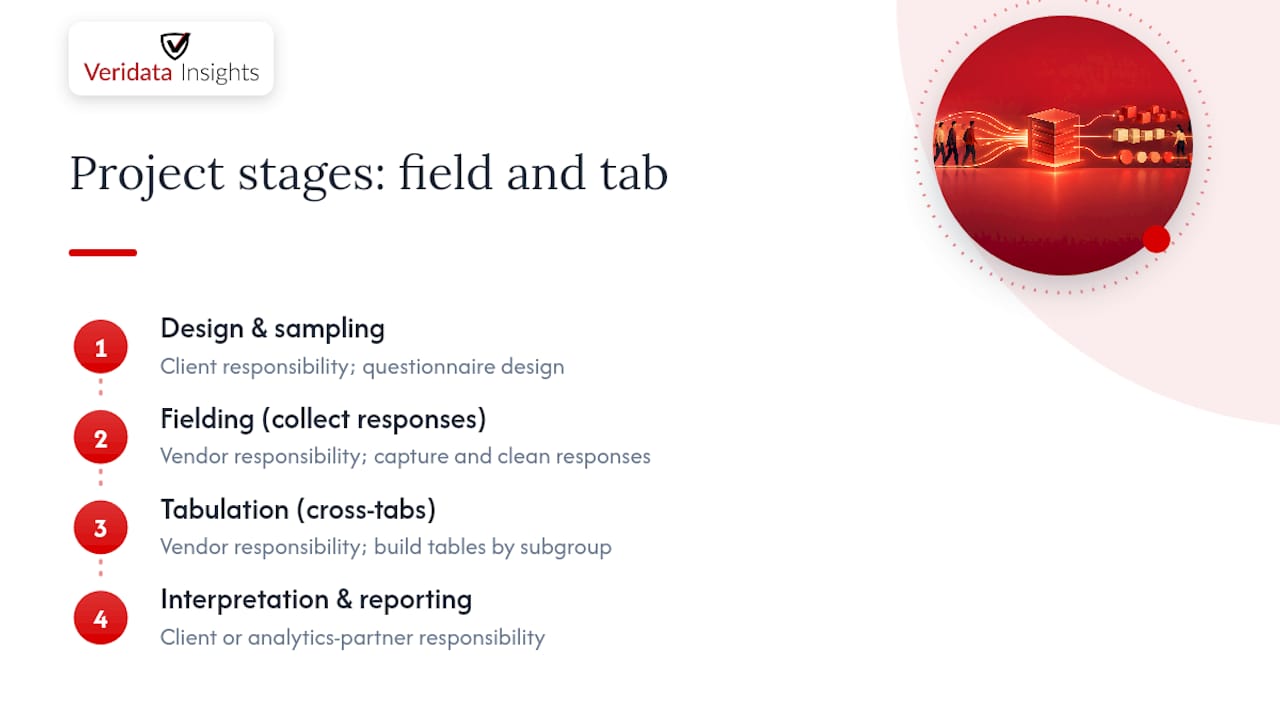
In a typical project timeline, design and sampling strategy come first, fielding happens in the middle, and tabulation follows once data collection closes. Field-and-tab vendors step in for the middle two stages and hand back structured output. Everything before and after, questionnaire construction and the interpretation of what the numbers mean, stays with the client or a separate analytics partner.
What a field-and-tab vendor provides, and what they don’t
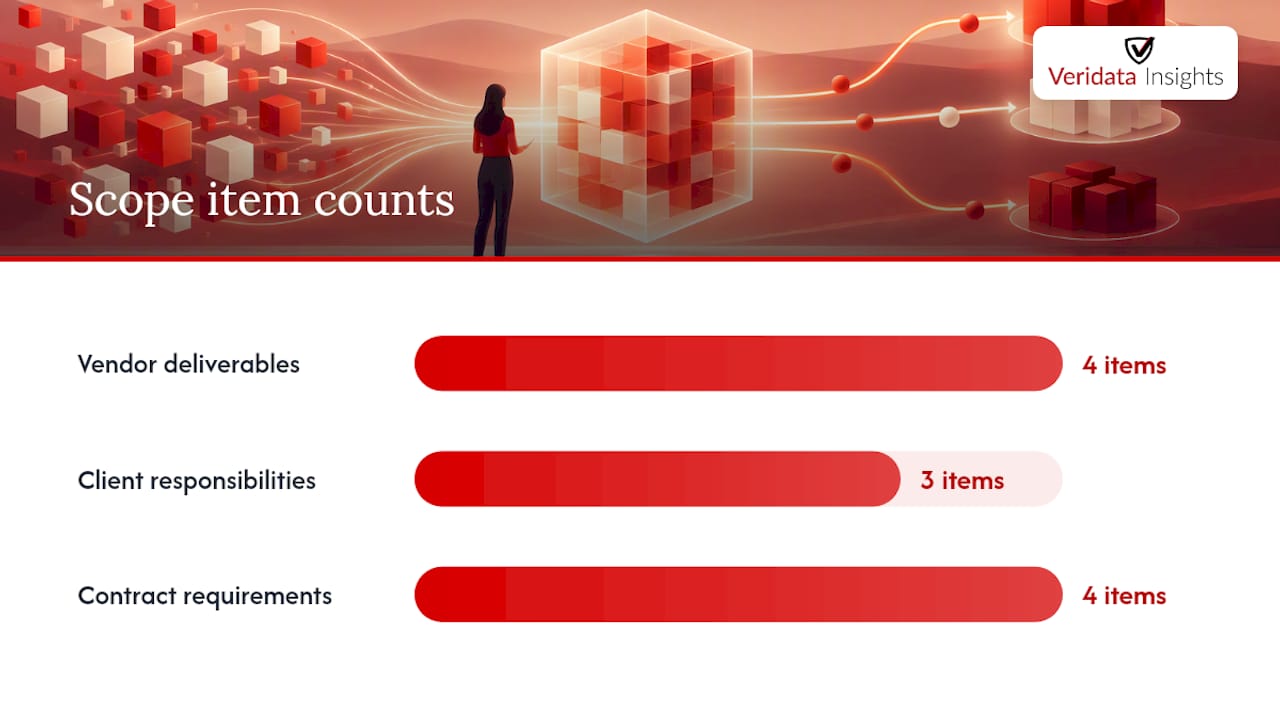
A field-and-tab engagement is a modular slice of a larger process, described by AAPOR as a limited-service model that typically excludes questionnaire design, high-level sampling strategy, interpretation, and slide-deck creation. Knowing exactly where the line sits keeps a project from stalling halfway through.
Expect these deliverables from a competent vendor:
- Raw data files, cleaned and ready for analysis.
- Cross-tabulated output covering the variables you specified.
- A codebook mapping variable names to question text and value labels.
- Disposition codes documenting how each contact resolved (complete, refusal, ineligible, and so on).
Expect these to remain your responsibility:
- Questionnaire design and question wording.
- Sampling strategy and weighting decisions.
- Interpretation, findings, and any client-ready slide deck.
Before signing anything, put these items in the contract: exact file format, rules for coding open-end responses, turnaround time, and the quality-control steps the vendor will run before delivery. Our Market Research Q&A page covers client responsibilities for design and methodology in more depth, which is worth a look before you scope a field-and-tab project.
Choosing how to collect the data: field methods and modes
The fielding method you pick shapes everything downstream, from cost to how representative your sample turns out to be. Online panels are fast and cheap but can skew toward people who take a lot of surveys. Telephone still works well for certain demographics but costs more per completed interview. Face-to-face approaches, including door-to-door, mall intercepts, and exit interviews, capture harder-to-reach populations but take longer and depend heavily on interviewer skill. Central location tests (CLT) and home use tests (HUT) suit product evaluation where people need to physically try something. Qualitative recruitment for focus groups or in-depth interviews follows its own screening logic entirely.
Every mode trades something for something else:
- Online panels: fast and inexpensive, but can skew toward frequent survey-takers.
- Phone and face-to-face: better reach into specific populations, at higher cost and slower timelines.
- CLT and HUT: necessary for hands-on product feedback, but logistically heavier to run.
On the ground, quality control matters as much as mode selection. Ask about interviewer training, live monitoring, verification callbacks or reinterviews, and whether the vendor captures paradata or GPS logs to confirm interviews happened where and when claimed.
Pro Tip: Put your quality-control requirements in the statement of work before fielding starts, not after you see the data.
Getting analysis-ready files: tabulation, coding, and formats
Crosstabs typically place one question’s responses in rows and a second variable in columns, with counts or percentages filling the cells for subgroup comparison, per Quirk’s glossary. That basic layout supports most reporting needs, from simple frequency breaks to more detailed segment analysis.
File formats matter more than buyers expect. Ask for a CSV alongside a labeled SPSS, Stata, or SAS file, with variable names and value labels intact so you are not guessing what “Q7_3” means six months later.
Request these items specifically:
- Both raw, unlabeled data and finished crosstabs, so you can audit independently.
- A codebook documenting every variable, its labels, and any recoding logic.
- Disposition codes and outcome-rate details tied to the AAPOR Standard Definitions framework.
- Weighting variables, if any were applied, clearly flagged in the file.
Open-end coding deserves its own conversation. Agree on coding categories before fielding begins, and ask for verbatim responses delivered alongside coded categories. AAPOR’s best-practice guidance recommends providing a template with variable names and missing-value conventions up front, which saves everyone a painful cleanup cycle later.
What quality and disclosure standards to insist on
Defensible research depends on transparency you can check, not just trust you extend. Before a project starts, ask the vendor to disclose who sponsored the study, who conducted it, the sampling method used, fieldwork dates, sample sizes, and how any weighting was applied. These disclosure items sit at the center of how AAPOR frames trustworthy survey research.
AAPOR’s Standard Definitions provide the accepted framework for calculating disposition codes and outcome rates, according to AAPOR, which means a vendor who cannot produce these numbers is skipping a step the rest of the industry treats as standard.
Watch for common quality risks:
- Falsification: interviewers fabricating responses to hit quotas.
- Nonresponse bias: certain groups systematically opting out.
- Mode effects: answers shifting depending on how the question was delivered.
Paradata, reinterviews, and basic statistical checks catch most of these before they contaminate your findings. Margin of error and outcome-rate reporting are not paperwork for its own sake. They tell you how much confidence your downstream analysis can actually carry.
Deciding between field-and-tab and full-service
The right choice usually comes down to five factors: your in-house analytic skill, budget, timeline, how complex your sampling or weighting needs are, and whether you need someone else to interpret the results.
- A brand team with a data analyst on staff and a straightforward tracking survey: field-and-tab fits well.
- A pharmaceutical company running a global study with complex weighting across markets: full-service makes more sense.
- A startup with no research background needing help translating findings for the board: full-service is worth the extra cost.
When you talk to a vendor, ask how they handle open-end coding, what disposition codes they report, and how quickly they turn around raw files. A proposal that is vague on file formats or dodges questions about quality control is a red flag worth taking seriously. Our page on what to look for when choosing a full-service market research agency walks through more of these vendor-evaluation questions.
Pro Tip: If you cannot answer what your weighting variable should be, you probably need full-service, not field-and-tab.
How Veridata Insights supports field-and-tab projects
Veridata Insights handles the pieces field-and-tab clients need most: clean data collection, coding, tabulation, and raw file delivery in the formats your team already works with. If your needs grow mid-project, you can step up to a fuller scope without switching vendors or re-explaining your study from scratch.
- Respondent recruitment across B2B, B2C, healthcare, and hard-to-reach audiences.
- Survey programming, translations, and localizations for multi-market studies.
- Data processing and visualization delivered in analysis-ready formats.
Our approach emphasizes flexible service with attention to projects of all sizes, offered year-round. Size isn’t everything. Quality matters, as Scrappy-Doo proved to us. Whether you need quantitative market research for a tracking study or qualitative market research to complement it, our team can scope a field-and-tab engagement or a full-service market research project depending on what your study actually needs. Reach out and tell us what you are working on.
Sources
FAQ
What are the three types of field research?
Field research generally breaks into observational research, interviews or surveys, and experiments conducted in real-world settings rather than a lab. In a field-and-tab context, this usually means online, telephone, or face-to-face modes such as intercepts, door-to-door, or central location testing.
Is MarketsandMarkets an MNC?
That question falls outside what field-and-tab covers and is not addressed by the standards or sources this article draws on. For accurate company classification, check the company’s own public filings or a business directory.
What does field research do?
Field research collects primary data directly from respondents in their natural environment, whether that is a phone call, an online survey, or an in-person interview. In field-and-tab work, this is the “field” half of the engagement, distinct from the tabulation that follows.
What is the major weakness of field research?
Field research can suffer from nonresponse bias, mode effects, and less control over conditions compared to a lab setting, all of which can skew results if not monitored. Vendors reduce these risks through interviewer training, paradata tracking, and reinterview checks, as outlined in AAPOR’s standards.