

A diary study is the right call when you need to understand how something changes for people over days or weeks, not how they behave in a single sitting. It captures decisions, emotions, and workarounds in the moments they actually happen, then lets you read each person’s story as a thread rather than a data point. Researchers reach for this method when the question is “how does this evolve,” not “can they complete this task.”
TL;DR:
- Diary studies are most valuable for tracking behavioral and emotional change over time, especially during onboarding, habit formation, or health treatment cycles.
- They require participants with high stamina, typically eight to fifteen finishers, recruited at 1.5 to 2 times the desired sample to accommodate attrition.
- The common protocol involves two to four weeks of daily prompts, mostly voice or text entries, with a pilot test to confirm usability and timing.
- Study design should match the behavior’s natural timeline, using interval, event, or signal-based cadences tailored to research needs.
- Veridata Insights offers full-service diary study support, from recruitment and design to analysis and reporting, with no minimum project size.
Table of Contents
- What Diary Studies Research Captures That Interviews and Usability Tests Miss
- When Diary Studies Fit Your Research Question and Product Timeline
- Choosing Cadence and Media: Interval, Event, and Signal Designs
- Designing the Study: Duration, Frequency, and Prompt Templates
- Recruiting the Right Participants and Keeping Them Through the Finish
- Consent, Safety, and Data Handling Throughout the Field Period
- Setting Up Tools, IDs, and File Handling Before You Launch
- Reading Threads First, Then Coding Across Cases
- Turning Diary Findings Into Recommendations Teams Will Actually Use
- How Veridata Insights Supports Diary Study Research in Practice
- Ready to Run a Diary Study Without Building the Operation Yourself?
- Sources
- FAQ
What Diary Studies Research Captures That Interviews and Usability Tests Miss
The core unit of analysis in diary studies research is not the individual entry. It’s the participant thread: the full arc of one person’s experience, read start to finish. A single diary entry tells you almost nothing on its own. Twelve entries from the same person, read in sequence, tell you when frustration set in, what triggered it, and whether it resolved or festered.
That distinction changes what kind of evidence you get compared to other methods. An interview asks someone to reconstruct a month in twenty minutes, and memory reliably smooths over the messy middle. Bolger, Davis, and Rafaeli’s foundational review on this made the case plainly: diary methods reduce retrospective bias because they capture experience close to when it happened, rather than relying on someone’s compressed, filtered memory of it. A usability test, meanwhile, tells you whether someone can complete a task in a lab, under observation, on day one. It says nothing about whether they’ll bother to do it again on day fourteen without a facilitator watching.
Experience sampling (ESM) sits closer to diary studies but serves a narrower goal. ESM interrupts people at random or scheduled moments to capture a snapshot state, often for a fixed short window, and works best for measuring mood or context variables with statistical regularity. Diary studies research trades some of that sampling rigor for narrative depth. Participants choose (within structure) what to report and how, which yields richer context but less uniform data.
Diary data answers questions like these particularly well:
- How does trust in a new financial app change between signup and the third month?
- What causes people to abandon a habit-tracking routine after the first two weeks?
- Where in a multi-day medical treatment does anxiety spike, and what triggers it?
- How do employees actually use a collaboration tool across a normal work week, not a demo?
If your question has a timeline built into it, diary studies capture in-context experiences across time in a way lab-based snapshots structurally cannot.
When Diary Studies Fit Your Research Question and Product Timeline
Not every longitudinal question needs a full diary protocol, and not every product moment justifies the operational lift diary studies research demands. The decision comes down to whether your research question has a “trajectory” in it.
Diary studies earn their cost on three kinds of research aims. Habit formation and behavior change questions (does a new routine stick, and when does it break) are close to the textbook use case. Onboarding research that spans the first two to four weeks of product use catches drop-off moments that a single onboarding usability test will never see, because those moments happen quietly, three days after the person closes the app. Episodic or infrequent journeys, like a healthcare treatment cycle or a major purchase decision that unfolds over weeks, also fit well, since the events you care about don’t happen on a schedule you can recreate in a lab.
Diary studies research is the wrong tool in a few common situations:
- The task takes under twenty minutes and happens once, like completing a checkout flow.
- You already know the answer is about a single interface decision, not a behavior over time.
- Your team needs an answer in under a week and can’t support a multi-week field period.
- The behavior in question happens so rarely that even a month of diary entries would produce almost no usable data.
Before committing budget and participant goodwill to a diary study, run this three-question check:
- Does the research question involve change, sequence, or context that a single session can’t capture?
- Can participants realistically self-report the behavior without heavy technical instrumentation?
- Does the team have the operational bandwidth (or a partner) to manage several weeks of check-ins, reminders, and data cleanup?
If the answer to all three is yes, a diary study is very likely worth running. If any answer is no, an interview series, a field study, or a simple usability test will usually get you a faster answer for less.
Choosing Cadence and Media: Interval, Event, and Signal Designs
Three cadence models drive the design of nearly every diary protocol, and each demands a different level of participant discipline.
Interval-based (time-triggered) designs ask participants to log an entry on a fixed schedule, once a day or once every evening, regardless of what happened. This is the workhorse default for product and UX research because it produces predictable, comparable data across participants and doesn’t require the participant to correctly judge what “counts” as reportable.
Event-based designs ask participants to log only when a specific thing happens, like every time they open a competing app or every time a symptom flares. This produces sparser but more targeted data, and it works well when the behavior of interest is infrequent but important.
Signal-based designs, the ESM approach, push a prompt to participants at random or scheduled intervals and ask for an in-the-moment response. It’s the most rigorous for measuring state (mood, stress, context) but the heaviest burden per prompt, and it tends to work better for shorter fielding windows.
Media choice matters just as much as cadence:
- Voice notes produce the highest completion rates for most product and UX studies, because talking for sixty seconds is dramatically less friction than typing a paragraph. Practitioner guidance consistently points to voice-first entries improving completion compared with text-only forms.
- Text entries work well when participants need to reference exact numbers, error messages, or specific language, and when transcription resources are limited.
- Photos are underused and often the richest signal in a study, especially for anything involving physical environments, workspace setup, or product placement.
- Video captures the most context but has the steepest completion cost. Reserve it for short, targeted moments rather than daily logging.
- Hybrid designs (a required voice note plus an optional photo) tend to outperform any single-media approach, because they let participants choose the lowest-friction option for that specific entry.
For most UX and product research questions, the default that works across the widest range of studies is interval-based cadence with voice as the primary medium and photo as optional backup.
Pro Tip: Never mandate photo or video for every entry unless the research question is explicitly visual. Making it optional almost always increases both completion rate and the odds that participants send you something genuinely useful.
Designing the Study: Duration, Frequency, and Prompt Templates
Duration and entry frequency decisions should follow the behavior you’re studying, not a default you picked because it sounded reasonable. That said, defaults exist for good reason, and deviating from them without a strong justification usually adds cost without adding insight.
Two to four weeks is the practical range for most product and UX diary studies, with fourteen days serving as the most common default in field practice. Shorter windows risk missing the behaviors that only emerge once novelty wears off. Longer windows increase attrition risk faster than they increase insight, unless you’re specifically studying a slow-moving process like chronic illness management or long-cycle purchase decisions.
Daily prompts are the standard frequency for interval designs. Aim for entries participants can complete in about a minute of voice or under 150 words of text. Longer entry requirements are the single most common reason participants quietly stop responding around day four.
A workable core prompt set for most product and UX diary studies looks like this:
- What did you do related to [topic] today, and what triggered it?
- How did that make you feel, in a word or two, and why?
- What almost stopped you, or what would have made it easier?
- Is there anything about this you want to show us? (optional photo prompt)
- Anything else on your mind about [topic] today?
Rotate in a targeted question every three or four days rather than repeating the exact same five questions daily. Repetition fatigue is real, and participants notice when they’re being asked the identical thing for the eleventh straight day. A rotating sixth question, tied to a specific sub-topic the study cares about, keeps entries feeling less mechanical without adding burden.
Piloting is not optional, and skipping it is the single most common reason field periods fail. Run the entire flow, from consent through the last entry, with two or three people who are not on your team before you launch. Confirm the following during the pilot:
- The form or app actually works on the device types your real participants will use, not just your team’s test devices.
- Voice notes upload and remain playable after the platform processes them.
- Entry length settings actually cap where you think they cap.
- A participant with no context beyond the initial instructions can complete an entry without contacting you for help.
- Timestamps record correctly, including time zone handling if participants span more than one.
Pro Tip: Time your own pilot entries with a stopwatch. If a voice-first entry takes you longer than ninety seconds to complete as the person who designed the study, it will take your participants considerably longer, and dropout follows quickly.
The practical guide to diary methods in qualitative research lays out design steps and timeline guidance in more depth, and it’s worth a full read before finalizing a protocol on anything higher stakes than a quick internal study.
Recruiting the Right Participants and Keeping Them Through the Finish
Diary studies live or die on retention, which means recruitment has to screen for stamina, not just eligibility.
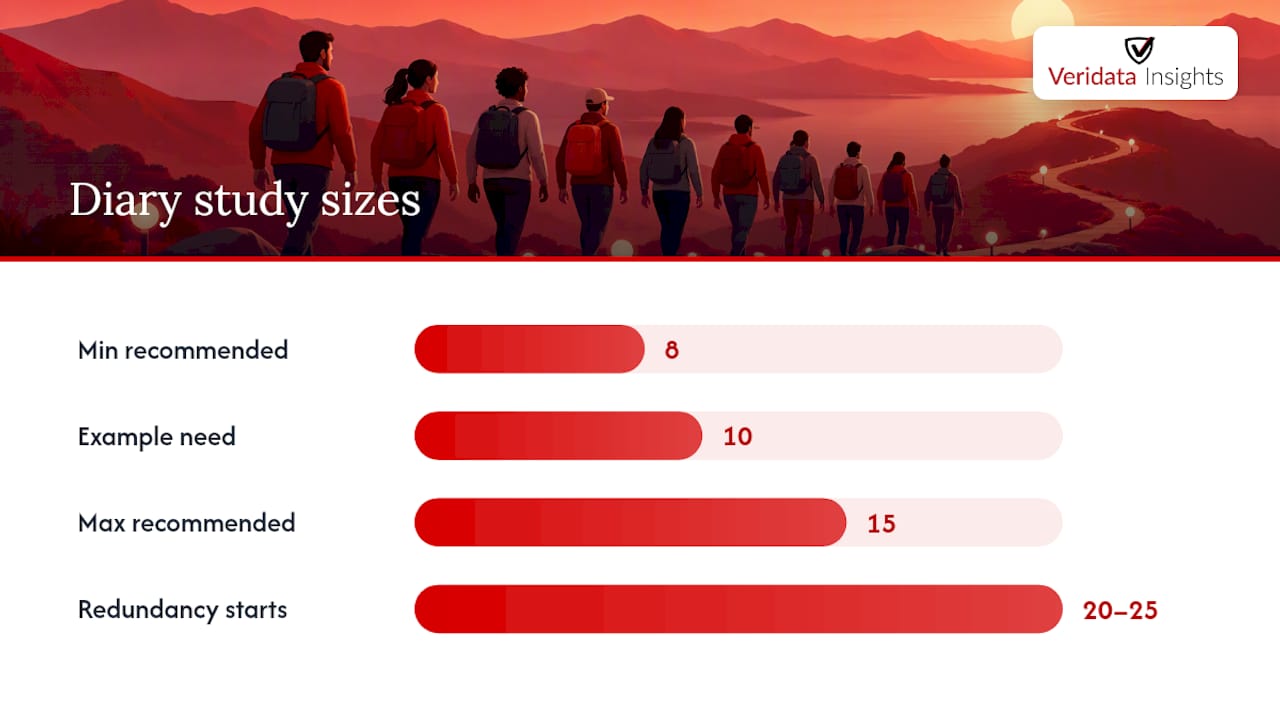
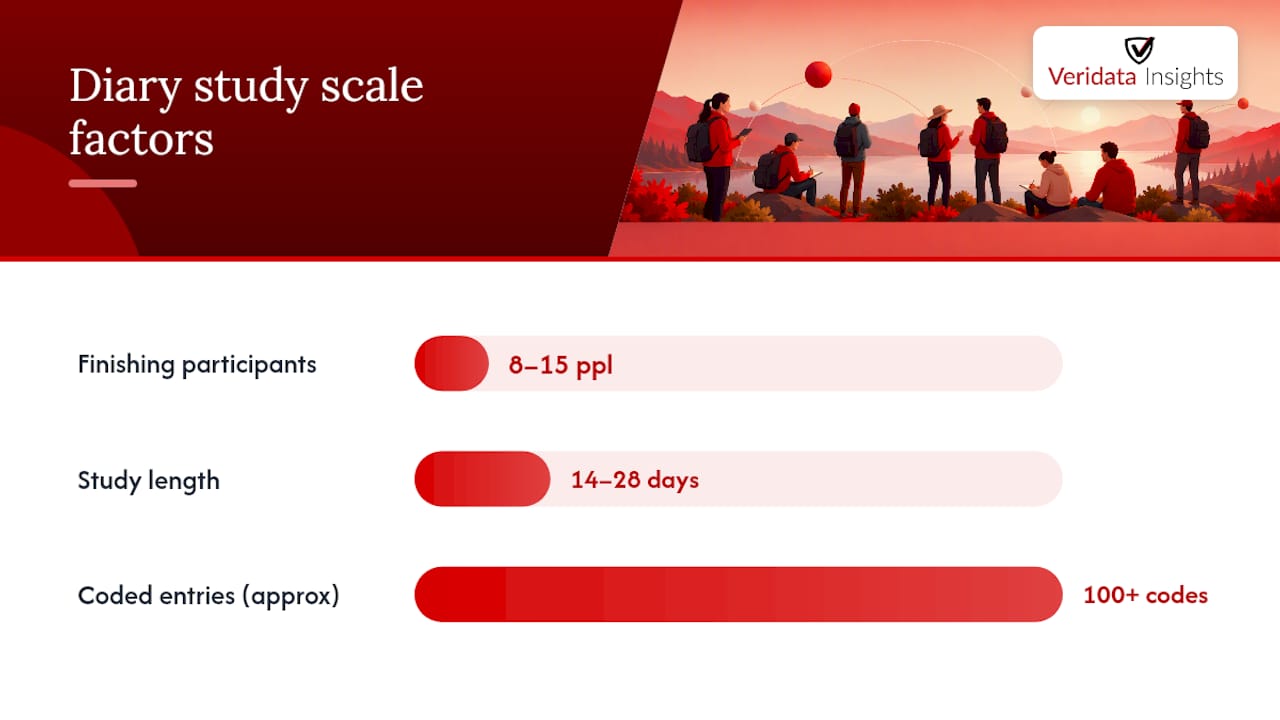
For a focused qualitative diary study, plan for eight to fifteen finishing participants. That’s a workable range for spotting patterns and divergence without drowning your analysis team in threads. Larger, more heterogeneous studies, especially ones spanning multiple markets or segments, should scale up from there, but going much past twenty or twenty-five finishing participants for a single segment usually adds redundancy rather than new insight.
Recruit at 1.5 to 2 times your finishing target. If you need ten finishers, start with fifteen to twenty screened participants. Attrition in diary studies is not a sign you did something wrong; it’s a structural feature of the method, and building in that buffer up front saves you from an awkward mid-study scramble.
Screener language should test for realistic availability, not just demographic fit. Ask directly about time commitment (“this involves about five minutes a day for two weeks, does that fit your schedule?”) and probe for past experience with any kind of ongoing commitment, whether that’s a fitness log or a previous research study. People who’ve never sustained a daily habit of any kind are a higher dropout risk, regardless of how enthusiastic they sound in the screener call.
A few retention tactics consistently outperform others in the field:
- Front-load engagement in the first three days. Participants who make it past day three at full engagement are dramatically more likely to finish than those who start weak.
- Set a reminder cadence that’s frequent but not naggy, typically once daily around the same time the participant said they’d be free.
- Use micro-incentives tied to milestones (day three, day seven, completion) rather than one lump sum at the end, since interim payouts sustain motivation better than a single distant reward.
- Reach out personally, not just via automated reminder, to anyone who misses two consecutive entries. A short, low-pressure human check-in recovers a meaningful share of at-risk participants.
- Keep total incentive value proportional to burden, and never so high that it starts to look like the actual motivation for participating rather than a token of appreciation.
A well-designed recruitment approach for hard-to-reach or specific audiences matters more here than in almost any other qualitative method, because the study depends on people showing up daily for weeks, not just once.
Consent, Safety, and Data Handling Throughout the Field Period
Diary studies raise ethical questions that a single-session interview simply doesn’t, because you’re asking someone to integrate research into their actual life for an extended stretch.
Consent in a diary study needs to be treated as ongoing, not a signature collected once at the start and forgotten. Participants should understand, from day one, that they can pause or stop at any point without losing incentive payments already earned, and they should be reminded of that option partway through longer studies, not just in the fine print of a form they signed weeks earlier.
Safety instructions deserve explicit, repeated attention. If your prompt design invites participants to respond in the moment (a signal-based or event-based design especially), state clearly that they should never log an entry while driving, operating machinery, or in any context where responding could put them at risk. This sounds obvious until you consider that many diary study platforms send push notifications at unpredictable times, and a participant who feels obligated to respond immediately is a participant you’ve put in a bad position.
A working ethical checklist for diary studies research includes:
- Ongoing, revisitable consent rather than a single upfront signature.
- Explicit guidance against responding in unsafe contexts, stated more than once.
- Data minimization: collect only what the research question requires, and avoid defaulting to video or photo capture “just in case.”
- Secure storage and anonymization for audio and media files, particularly for health, financial, or otherwise sensitive topics.
- Incentive structures that compensate fairly for burden without becoming coercive, especially for lower-income or economically vulnerable participants.
Academic work on the topic backs a related point that’s easy to overlook: diary studies can function as a beneficial experience for participants themselves, not just a data-collection burden, when prompts are designed to encourage genuine reflection rather than pure extraction. Treating participant well-being as a design input, not an afterthought, tends to produce both better data and a cleaner ethical footing.
Setting Up Tools, IDs, and File Handling Before You Launch
The technology layer is where diary studies quietly fail, and it usually happens for boring, preventable reasons rather than dramatic ones.
Tool selection should prioritize a short list of concrete features over anything flashy. Confirm the platform date-and-time-stamps every entry automatically, exports audio files in a standard, playable format rather than a proprietary container, and supports forced-ID fields so every entry ties unambiguously to one participant. Recording friction is the biggest single lever you control: operational friction from multi-step uploads or poor audio export is the largest driver of attrition in large-scale diary fieldwork, more so than incentive size or prompt design.
Before launch, run through this operational checklist:
- Confirm every entry can be downloaded in bulk, not one file at a time, because manual single-file exports do not scale past a handful of participants.
- Verify timestamps record correctly across time zones if your sample spans more than one, and check that the timestamp survives file conversion or transcription.
- Time the full participant flow, from opening the app or form to submitting a completed entry, and confirm it stays under ninety seconds for a standard entry.
- Test what happens when a participant’s device loses connection mid-upload. A platform that silently drops the entry instead of queuing it for retry will cost you real data.
- Set up a forced-ID or login scheme from day one rather than relying on participants to type their name or code consistently. Manual identifier entry is one of the most common sources of unusable, unmatched data in diary datasets.
Pro Tip: Build your file-naming and folder structure before a single real entry comes in, not after. A scheme like ParticipantID_Day_MediaType, applied automatically at export, saves hours of manual sorting once fifteen participants have each sent you fourteen files.
Transcription deserves its own line of planning. Decide upfront whether you’ll transcribe every entry or only a representative subset, since full transcription of a large audio diary study is a real time and cost line item. Keep every transcript tagged with participant ID and day number embedded in the filename itself, not just in a separate spreadsheet, so a misplaced file doesn’t sever the link to its place in that participant’s thread. This single habit is what preserves your ability to read within-person arcs later, which is the entire point of running a diary study in the first place.
Reading Threads First, Then Coding Across Cases
Analysis in diary studies research has to happen in a specific order, and skipping the first step is the most common analytical mistake teams make.
Read every participant’s full thread end-to-end before you start applying any coding scheme across the dataset. This sounds slow, and it is, but it’s what lets you see a participant’s arc as a story rather than as a scattered pile of tagged fragments. Analysts who jump straight to cross-case coding tend to over-index on whichever participants were most vocal or wrote the longest entries, while quieter participants with equally important (but sparser) threads get flattened into a single code and lost. Reading threads end-to-end before cross-case coding preserves the temporal arc that gets lost otherwise.
Once every thread has been read individually, build a coding schema that captures at least four dimensions: theme (what topic the entry addresses), emotion (the participant’s stated or implied affective state), trigger (what prompted the entry or the event described), and day or time-in-study (where this sits in the overall arc). Coding along these four axes at once, rather than theme alone, is what lets you later produce a trajectory map, a visual or tabular representation of how a given theme or emotion shifts across the study window for each participant or segment.
| Coding dimension | What it captures | Typical output |
|---|---|---|
| Theme | Subject of the entry | Frequency tables, thematic clusters |
| Emotion | Stated or implied affect | Sentiment arcs per participant |
| Trigger | Event or condition prompting the entry | Causal pattern maps |
| Day/time-in-study | Position in the field period | Trajectory and drop-off curves |
A study built around eight to fifteen finishing participants over fourteen to twenty-eight days will typically generate well over a hundred coded entries once you multiply participants by days. Reading each thread individually first, before that volume of entries gets flattened into a cross-case codebook, is what keeps the eventual findings honest.
Triangulation belongs at the end of analysis, not the start. Once thematic and trajectory patterns emerge from the diary data, check them against product analytics or a smaller round of debrief interviews before recommending any product or policy change. A pattern that shows up in diary entries and also shows up in behavioral event data is a far more defensible basis for a recommendation than diary data alone. Teams weighing which analytics platform to use for that cross-check often compare options like Mixpanel against Amplitude for exactly this kind of validation step, matching qualitative trajectory findings against quantitative event counts.
Turning Diary Findings Into Recommendations Teams Will Actually Use
A diary study that produces a beautifully coded dataset and no clear next step for a product or policy team has failed at the last, most important mile of the work.
The strongest reporting artifacts tie every recommendation to a specific piece of evidence, not a general impression. A participant journey map that shows exactly where trust dropped, an entry-frequency heatmap that shows which days generate the most friction complaints, and a prioritized opportunity list that cites the participant IDs and day numbers behind each item all do more work than a narrative summary alone.
Effective diary study reports typically include:
- Individual or composite participant journey maps that show the arc, not just an endpoint.
- A heatmap or frequency table linking specific days or triggers to specific emotional or behavioral patterns.
- A prioritized list of opportunities, each backed by a named number of participants and specific entry examples, not a vague “several participants mentioned.”
- A short methods appendix describing sample size, duration, and completion rate, so stakeholders can judge how much weight the findings deserve.
Connect each recommendation to a measurable product outcome wherever possible. If diary data shows onboarding anxiety spikes on day three, the recommendation should name a specific intervention (a check-in email, a simplified step) and a metric that would confirm improvement (day-three retention, a support-ticket rate) rather than stopping at “improve onboarding.”
Diary studies rarely stand alone well. Plan a follow-up sequence before you’ve even finished fielding: a short round of debrief interviews with a handful of finishing participants to add color to the strongest patterns, followed by a targeted usability test if the diary data points to a specific interface moment worth validating in a controlled setting. This sequencing turns one diary study into a full evidence chain rather than an isolated data point, and it’s the pattern that examples of qualitative research studies consistently show working best for teams that need findings to survive a stakeholder review.
How Veridata Insights Supports Diary Study Research in Practice
Running a rigorous diary study end to end (recruitment, technology setup, fielding, transcription, and analysis) takes real operational muscle, and that’s exactly where Veridata Insights spends most of its time. Our qualitative team handles the full chain: screening and recruiting participants who can realistically sustain a multi-week commitment, programming the intake and consent flow, managing fielding and reminder cadences, and building the coding and trajectory outputs stakeholders actually use.
Veridata Insights has fielded qualitative work across a range of demanding contexts, including multi-market qualitative studies that required coordinating recruitment and fielding across different countries and languages simultaneously, and workplace-focused research exploring how women navigate career decisions across time, a topic that all but requires a longitudinal, thread-based method rather than a single interview.
What that experience looks like in practice for a team weighing diary studies research:
- Recruitment reach into hard-to-reach and specialized populations (B2B decision-makers, healthcare patients, niche consumer segments) that a general panel struggles to fill reliably.
- Full-service capability spanning study design, questionnaire and prompt review, fielding, transcription coordination, and final reporting, so a team doesn’t have to stitch together five different vendors.
- A flexible-scope model with no project minimums, so a focused eight-participant pilot and a fifty-participant multi-market study both get the same methodological attention.
Most engagements start the same way, with a scoping call to define research aims, followed by a proposal outlining sample, timeline, and cost, then fieldwork and delivery on the agreed schedule.
Ready to Run a Diary Study Without Building the Operation Yourself?
Designing a diary study protocol is one challenge. Recruiting fifteen participants who will actually finish, keeping them engaged through week three, and turning a pile of voice notes into a report your stakeholders trust is a different one entirely, and it’s the part that trips up even experienced research teams.
A full diary study operation can be run as a flexible, project-based service, with no project minimums and year-round availability, so a tightly scoped pilot diary study can receive rigorous support similar to a large multi-market field program. Our qualitative research services cover study design, prompt development, and analysis, while our respondent recruitment team specializes in exactly the hard-to-reach and stamina-tested participants a diary study depends on, from B2B decision-makers to healthcare patients to narrow consumer segments.
If you’re weighing whether to build this capability in-house or bring in a partner for a specific field period, our full-service market research offering covers everything from consultation and design through data processing and final reporting. Reach out through our contact page to set up a scoping call and get a proposal built around your specific research question and timeline.
Sources
The methodological backbone of this guide draws on a handful of sources worth reading in full if you’re building out a formal protocol. The practical guide to diary methods covers design and ethics in depth. The Nielsen Norman Group overview remains the clearest comparison of diary studies against interviews and usability testing. For large-scale audio fieldwork specifically, the ten-step process for balancing rigor and practicality addresses the operational failure points most guides skip. Teams working in mental health or other sensitive domains should also review the scoping review of qualitative diary methods and its call for clearer reporting checklists.
- A practical guide to using diary methods in qualitative research
- Diary Studies: Understanding Long-Term User Behavior and Experiences
- Balancing rigour and practicality when conducting large-scale, longitudinal audio diary studies
- Diary studies in research: More than a research method
FAQ
What are diary studies in user research?
A diary study is a longitudinal qualitative method where participants log their own experiences, thoughts, or behaviors related to a topic over an extended period, typically two to four weeks. Researchers then read each participant’s entries as a connected thread to spot patterns, triggers, and changes over time that a single interview or usability test would miss, as detailed in the Nielsen Norman Group’s overview.
What are the four main types of research studies?
Qualitative research broadly includes methods like interviews, focus groups, ethnographic or field studies, and diary studies, each suited to different questions. Diary studies stand apart because they capture experience across time and in context, rather than in a single session, which is the core advantage covered throughout this guide.
What are 5 diary entries?
A typical diary study prompt set asks about five things per entry: what happened related to the research topic, what triggered it, how it felt, what almost stopped the behavior or made it harder, and an open-ended catch-all question. Rotating in a targeted sixth question every few days keeps the protocol from feeling repetitive without adding much burden.
What are famous examples of diaries?
Historical and literary diaries, like wartime journals or personal memoirs, share the same core structure researchers use today: entries written close to the moment they describe, which reduces the memory distortion that shows up in retrospective accounts. Research diary studies borrow that same principle deliberately, using structured prompts instead of free-form reflection to make the entries comparable across participants.
How many participants do I actually need for a diary study?
Most focused qualitative diary studies aim for eight to fifteen finishing participants, and recruiting at 1.5 to 2 times that number accounts for expected dropout. Larger or multi-segment studies scale up from there, but going well past twenty to twenty-five finishers per segment usually adds redundancy rather than new insight.
Can Veridata Insights run a diary study for my team?
Yes. Veridata Insights offers qualitative research services covering diary study design, prompt development, and analysis, along with specialized respondent recruitment for hard-to-reach populations. Pricing depends on scope and sample size, so current rates are available directly through the site rather than a fixed published figure.