

Survey piping dynamically inserts a respondent’s prior answer into a later question, making the experience feel personal and improving data quality. Use it to confirm key facts back to a respondent or to shape a contextual follow-up. Skip it for sensitive fields, optional source questions, or anywhere the piped text could make a question longer or harder to read.
TL;DR:
- Piping should be limited to short, non-sensitive answers, as longer or verbatim text can break the question’s readability or logic.
- Using stable field IDs and detailed routing maps is essential to prevent broken tokens and incorrect data analysis caused by skipped or optional source questions.
- Testing must include edge cases and pathway tests for all branches, especially when piping is combined with skip logic, to avoid orphaned questions or faulty denominators.
- Avoid stacking too many pipes in a single question and treat sensitive fields carefully, only piping them if there is a justified, clear reason.
- Complex piping setups with nested branches and multiple dependent questions typically require expert survey programming and thorough post-field QA to ensure data accuracy.
Table of Contents
- What Is Survey Piping and How Does It Work?
- What Types of Survey Piping Should You Know?
- How Does Piping Interact With Skip Logic and Routing?
- What Mistakes Should You Avoid, and How Do You QA a Piped Survey?
- Veridata Insights: How We Handle Piping on Real Projects
- What Do Safe Piping Patterns Actually Look Like?
- When Should You Bring In a Programming Specialist?
- Sources
- FAQ
What Is Survey Piping and How Does It Work?
Every piping setup has two parts: a sender question, which captures the original answer, and a receiver question, which displays that answer back to the respondent inside new text. When the respondent submits the sender, the survey engine stores the value and substitutes it into the receiver at runtime, before that screen ever renders. The MIT survey piping guide describes this as embedding a respondent’s own words to create a more conversational, personalized flow.
Platforms handle the underlying syntax differently. Some use bracketed tokens like {Q1}, others use dollar-sign notation like ${Q1}, and enterprise tools like REDCap have their own piping conventions worth checking against platform-specific documentation before you build anything complex. The concept stays constant across all of them: a token acts as a placeholder that gets swapped for real data.
Piping is not the same thing as pre-population, and it is not skip logic:
- Pre-population fills a field before the respondent ever sees the survey, often from a panel record or a CRM.
- Piping happens live, mid-survey, using an answer the respondent just gave.
- Skip logic decides whether a question appears at all; piping only changes the wording of a question that is already showing.
What Types of Survey Piping Should You Know?
Different research goals call for different piping mechanics. Here are the five types that cover most fielded studies:
- Answer or choice piping. Pipes a selected response option (say, a named brand from a prior list) into later question text. This is the workhorse type for personalization and brand-specific follow-ups.
- Text-entry piping. Pulls a respondent’s typed input, such as a job title or company name, into a later sentence. It reads naturally only when the source answer is short.
- Hidden-field prepopulation. Technically adjacent to piping, this passes sample data (a panel ID, a client name) silently through the survey without displaying it, often for routing or downstream matching.
- Multi-select piping. Loops through every option a respondent checked and repeats a question or matrix row for each one, common in usage-and-attitude studies.
- Expression or calculated piping. Runs a small calculation, like multiplying a monthly figure by 12, and displays the result. It is less universally supported across platforms than the other four types, so confirm your tool handles it before designing around it.
The common thread across all five: piping works best on short, unambiguous, non-sensitive answers, and it should always trace back to a source question the respondent was actually required to answer. Piping from an optional question is one of the fastest ways to break a receiver question when the source gets skipped.
How Does Piping Interact With Skip Logic and Routing?
Piping and skip logic solve different problems, and conflating them is where a lot of instruments quietly break. Piping changes what a visible question says. Skip logic decides whether that question appears at all. They interact constantly, and when the interaction is not planned deliberately, the result is orphaned items and incorrect denominators in your final data set.
The failure patterns tend to repeat across studies:
- A receiver question displays with an empty token because its sender was skipped, not just left blank.
- A branch routes a respondent past the sender entirely, leaving the piped phrase grammatically broken (“You told us you work at ___”).
- Analysts calculate a percentage against the wrong base because a piped, looped question fired for fewer respondents than the denominator assumes.
Three habits prevent most of this. First, use stable field IDs that never change once programming begins, since renaming a variable mid-build is how tokens silently stop resolving. Second, build a written routing map listing each field ID, its skip condition, and its destination, so a second person can audit the logic without opening the platform. Third, define an explicit fallback for every receiver in case its sender comes back blank, ambiguous, or “prefer not to answer.”
What Mistakes Should You Avoid, and How Do You QA a Piped Survey?
Most piping disasters trace back to a handful of preventable habits. Avoid piping long free-text verbatim into a question stem. A paragraph-length answer dropped into new sentence rarely reads as intended and can look strange to the respondent reading it back. Limit how many pipes stack into a single question. Two or three is manageable; five is a maintenance problem waiting to happen. And treat sensitive fields (health status, income, immigration status) as off-limits for piping unless there is a clear, defensible reason to repeat them back.
Testing catches what design rules alone cannot. Run through this checklist before any survey fields:
- Path-test every branch, not just the default path. Piping bugs hide in the routes testers skip because they seem unlikely.
- Force edge-case values through sender questions: empty responses, maximum-length text, special characters, and “none of the above” selections.
- Check AND/OR logic manually. A misplaced operator in a skip condition is one of the most common reasons a receiver question fires for the wrong group.
- Verify every fallback value by deliberately skipping or blanking each sender and confirming the receiver still reads sensibly.
Pro Tip: Build a simple spreadsheet with one row per sender/receiver pair, then manually walk each row during pilot testing. It takes twenty minutes and catches more bugs than clicking through the survey top to bottom.
Once fielding starts, the checklist continues. Run an orphan check to confirm no receiver question is displaying with a blank or malformed token. Verify denominators against your routing map, since a piped loop that fired inconsistently will quietly distort your base counts. And gate any variable in your codebook that depends on conditional logic, so anyone coding the data later knows exactly which respondents should have answered it. Some teams are now experimenting with LLM-assisted pretesting to simulate respondent paths before fielding, though this remains an emerging, experimental supplement to manual piloting rather than a replacement for it.
Veridata Insights: How We Handle Piping on Real Projects
Piping looks simple on a whiteboard and gets complicated fast once real respondents start clicking through real branches. That is the gap where projects go sideways, and it is exactly where we spend most of our time.
On client projects, that means:
- Questionnaire review before programming starts, flagging any pipe that relies on an optional or sensitive source question
- Full survey programming with documented routing maps for every skip and piped branch
- Path-based piloting of every branch, including edge cases like blank and maximum-length answers
- Post-fielding QA covering orphan checks and denominator verification before data goes to reporting
What Do Safe Piping Patterns Actually Look Like?
Seeing the pattern helps more than describing it. Here are conceptual examples you can adapt to whatever platform you are building in, since exact syntax varies by tool.
Basic answer piping: if Q1 asks for a company name, a later question might read, “You told us you work at {Q1}. How long have you worked there?”
Fallback syntax: a well-built receiver should have a default string for a blank sender, something like “You told us you work at [your company]. How long have you worked there?” so the question still reads cleanly if the token resolves empty.
Simple expression piping: if a sender asks for a monthly figure, a receiver can display the calculated annual value, such as “Based on $500 per month, that comes to roughly $6,000 per year. Does that sound right?”
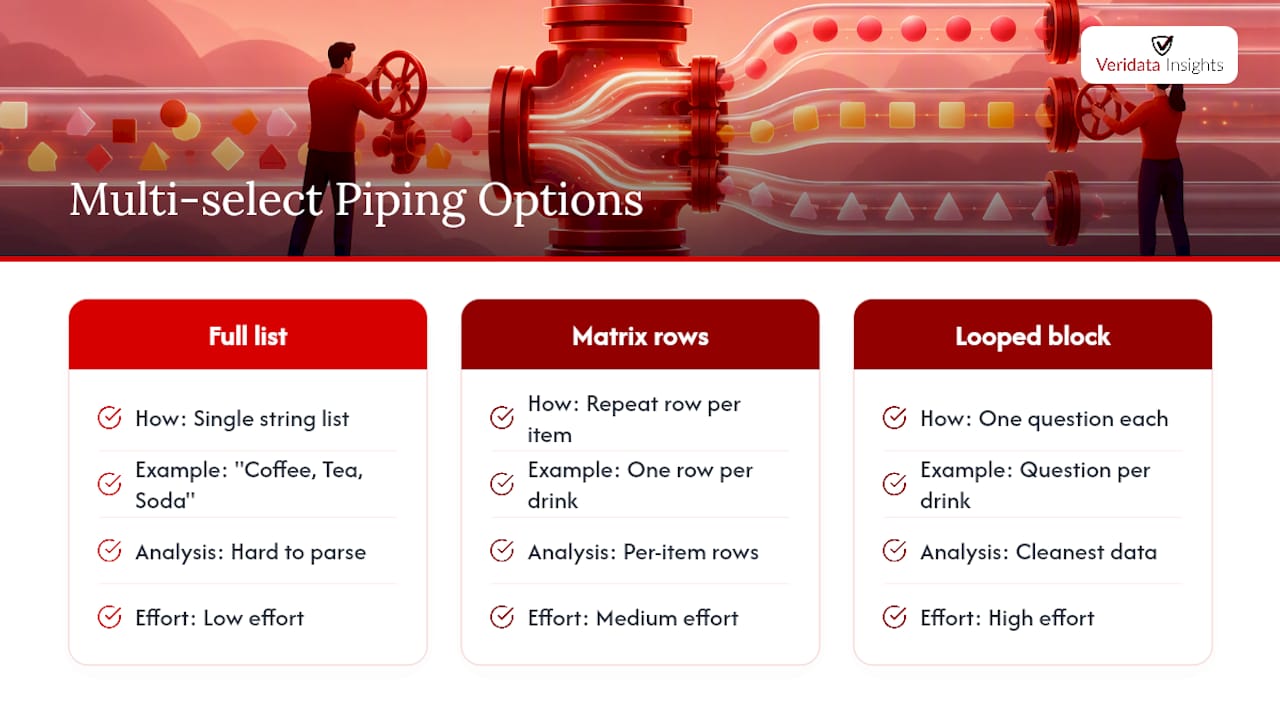
For multi-select senders, you have three real options: pipe the full list as a single string (“You selected: Coffee, Tea, Soda”), repeat a matrix row for each selected item, or build a looped block that shows one question per selection. Looping produces cleaner data for analysis but takes more programming time to set up and test correctly.
Grammar fixes matter more than they get credit for. Conditional phrasing (“your company” versus “your companies”) needs a rule for singular versus plural selections, and every receiver needs a fallback that reads naturally rather than displaying a broken token or a blank space. Reviewing sample question phrasing before you finalize receiver wording catches most of these issues early. Solid survey design fundamentals also help you decide up front which questions are even worth piping into.
When Should You Bring In a Programming Specialist?
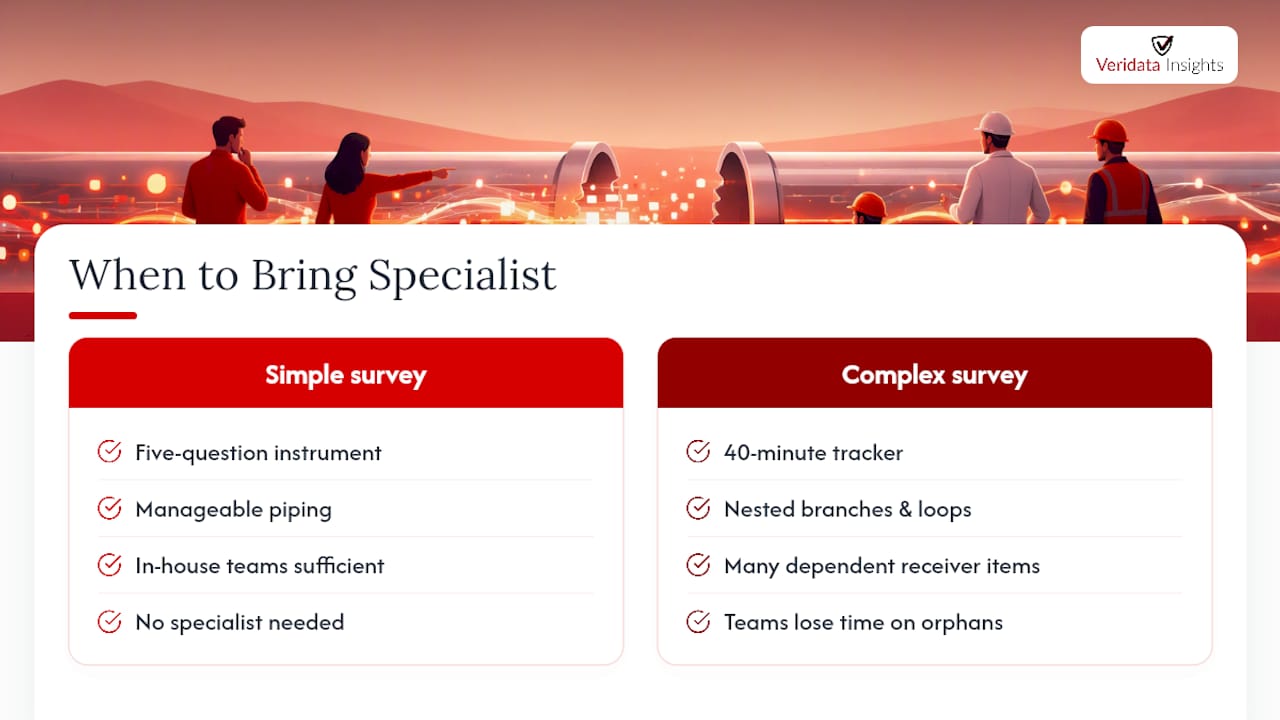
Piping is manageable on a five-question survey. It gets genuinely hard on a 40-minute tracker with nested branches, looped multi-selects, and a dozen receiver questions depending on senders that themselves depend on earlier skip logic. That is where in-house teams start losing time chasing orphaned items instead of analyzing data.
Veridata Insights runs full-service market research engagements with no project minimums, seven days a week, built around exactly this kind of complexity. Our survey programming and consultation work includes documented routing maps, path-based piloting of every branch, and post-fielding checks for orphaned items and denominator accuracy, the same discipline covered in the checklist above but executed by a team that does it on every project. We also handle respondent recruitment for hard-to-reach and specialized audiences, so your piloting sample actually reflects who will take the live survey.
If your next instrument has more branching than your last one, get in touch through our contact page and tell us what you are building. We will tell you honestly whether it needs a specialist or whether your team has it covered.
Sources
FAQ
What Does “Piping” Mean in a Survey?
Piping means inserting a respondent’s earlier answer into the text of a later question, so the survey feels responsive rather than generic. The MIT survey piping guide describes it as embedding prior answers to personalize the experience and improve data quality.
What Are the Four Types of Surveys?
Surveys are commonly grouped by delivery method: online/web surveys, phone surveys, in-person or face-to-face surveys, and mail surveys. Piping is most relevant to online surveys, since the logic requires a platform that can substitute text dynamically at runtime.
What Is a Pipeline Survey?
In market research contexts, “pipeline survey” usually gets confused with survey piping, but they are unrelated concepts. Piping is a text-personalization technique inside a questionnaire; a pipeline survey more often refers to physical or engineering assessments of buried infrastructure, a different field entirely from questionnaire design.
What Are the Five Basic Questions for Surveys?
There is no single fixed list, but most well-built questionnaires answer who, what, when, where, and why for the behavior or attitude being studied. How you sequence those questions determines which ones make good piping sources and which ones should stay untouched.
Should I Always Pilot Every Branch Before Fielding?
Yes. Path-based piloting of every branch is the single most effective way to catch logic and piping errors before they reach live respondents. Skipping this step is the most common reason orphaned items and denominator errors show up after fielding instead of before it.