

The healthcare recruitment strategies that work right now share one trait: they treat hiring as a pipeline you build, not a vacancy you fill. Start with candidates’ real career goals, put clinicians in the conversation, grow talent you already have, measure what happens after the offer, and test any automated tool before it screens a single applicant. Below is how to do each one, with the numbers behind why it matters.
We are a market research firm, not a staffing agency. That gives us a particular view: the organizations that recruit well are the ones that ask candidates what they want, then listen. We will show where research fits in, and where it does not.
TL;DR
- Demand is outrunning supply. Federal projections show healthcare adding about 2.3 million jobs from 2023 to 2033, and HRSA projects shortages in nursing, physicians and behavioral health.
- Personalize outreach. Explain how a specific role fits a candidate’s trajectory instead of blasting generic postings.
- Build as well as buy: apprenticeships and grow-your-own programs keep institutional knowledge in house.
- Track source quality, time-to-hire and attrition together, and tie them to staffing goals.
- Validate any AI screening tool against essential job functions. Under the ADA and Title VII, a biased algorithm is your legal problem.
Table of Contents
- Why healthcare hiring keeps getting harder
- Seven healthcare recruitment strategies worth your budget
- The AI screening trap
- Where research makes recruiting smarter
- How Veridata Insights can help
- A 90-day plan you can start now
- FAQ
- Sources
Why healthcare hiring keeps getting harder
The Bureau of Labor Statistics projects that healthcare and social assistance will be the largest source of job gains from 2023 to 2033, adding roughly 2.3 million jobs. Healthcare support occupations are projected to grow 15.2%, the fastest of any occupational group. An aging population and more chronic conditions drive that demand.
Supply is the other half. HRSA’s State of the US Health Care Workforce report projects a shortage of about 187,130 full-time-equivalent physicians by 2037 and a 6% nationwide shortage of registered nurses. Rural areas fare worse: the RN shortfall in nonmetro areas reaches 13%. Behavioral health looks bleaker still, with projected deficits of up to 203,690 FTE mental health counselors and over 152,500 FTE psychologists by 2038.
Then there is the cost of getting it wrong. iCIMS puts the cost of replacing one bedside nurse at about $61,110. Multiply that by a unit that turns over a few nurses a year and the case for retention-minded recruiting makes itself.
The takeaway: you cannot out-post this market. You have to out-listen it.
Seven healthcare recruitment strategies worth your budget
1. Make outreach candidate-centric
The American Organization for Nursing Leadership (AONL) says strong recruiting is candidate-centric: it speaks to an individual’s career goals instead of broadcasting the same post to everyone. In practice:
- Segment candidates by what they said they want: a clinical ladder, a new specialty, predictable schedules, tuition help.
- Write the first message about their trajectory, not your vacancy list.
- Name the person they will actually work with, not a generic HR inbox.
A new-grad nurse and a 15-year ICU veteran are not reading the same job ad for the same reasons. Treat them differently from the first touch.
2. Put clinicians inside the recruiting process
In high-performing systems, recruiting is not a silo. AONL describes embedding unit liaisons or “buddy nurses” in the process so candidates can ask real questions about unit culture and daily realities. The same guide says talent acquisition teams and nurse leaders get better results when they work closely together and keep their messaging consistent.
A simple version you can start this month:
- Pick one or two clinicians per unit who are willing and good at it.
- Give them a short script of what they can and cannot promise.
- Offer every finalist a 20-minute informal call with one of them before the offer.
Candidates trust a peer more than a polished careers page. If the peer’s answer is honest, you will lose a few mismatched candidates early and keep more of the right ones.
3. Build, not just buy
The American Hospital Association’s workforce guide points to a shift from external hiring toward internal development: apprenticeships and grow-your-own programs for existing staff. Training a current employee to fill a specialized clinical vacancy has an upside external hires lack: they already know your culture and have shown commitment.
Where to look first:
- Aides and techs who want to move into nursing or imaging.
- Experienced nurses interested in a specialty with chronic vacancies.
- Local community college and school partnerships that feed a steady stream of students.
HRSA’s own materials on graduate medical education show how much faculty recruitment and hospital partnerships matter to building training pipelines, so a program is only as strong as the partners behind it.
4. Compete on pay and benefits you can actually flex
Pay is not the only lever, but it is the one candidates compare first. Even federal employers use targeted tactics. The Indian Health Service’s recruitment and retention guide lists options such as setting starting pay at a higher General Schedule step for superior qualifications. Private systems have their own versions: sign-on bonuses, loan repayment, shift differentials, flexible scheduling.
Make the offer easy to understand. A clear range and a plain benefits summary beat a clever package that takes a spreadsheet to decode.
5. Lead with workload and work-life balance
The top-ranking guides for nurse recruiting all say some version of this: burnout and long hours are why people leave, so show how your unit handles them. But do not just claim balance. Show it. Share real scheduling rules, float policies, and staffing ratios. If you cannot show them, fix them before you advertise.
6. Make your visibility work as hard as your offer
Candidates search before they apply. Your careers pages, unit pages and role descriptions need to show up when someone searches for a specific job in your city. A content-driven approach can move the needle: one published case study describes a site growing from 435 to 13,118 organic clicks a month. Your results will differ, but the lesson holds. Pages written around what candidates really search for outperform a generic job board listing.
7. Measure the whole funnel, not only time-to-fill
APQC advises monitoring a balanced set of metrics, such as time-to-hire, source quality and attrition patterns. It also says to connect them to strategic goals so that decisions between building, buying or redesigning roles are deliberate, not reactive.
A starter dashboard:
| Metric | What it tells you | Watch for |
|---|---|---|
| Time-to-hire by role | Where your process stalls | Offers that sit while competitors move |
| Source quality | Which channels produce people who stay | Cheap sources with high 90-day attrition |
| Offer acceptance rate | Whether the pitch matches the job | Drops after the final interview |
| 90-day and 12-month retention | Whether recruiting promised what the unit delivers | Clusters on one unit or manager |
| Internal fill rate | How well build programs work | Stalled grow-your-own pipelines |
The last column matters more than the numbers. A single figure rarely explains a problem. A pattern across two or three usually does.
The AI screening trap
Automated tools are tempting when a posting draws hundreds of applicants. iCIMS notes that AI-powered applicant tracking systems can filter on required certifications such as Advanced Cardiovascular Life Support. That is a legitimate, job-related use.
The risk comes when a tool learns from your past hires. Nancy Tippins, an industrial-organizational psychologist, told the EEOC that organizations must validate selection tools so they measure essential job functions and nothing more. An algorithm trained on historical patterns can screen out qualified people, for example by penalizing an employment gap that was really time spent on caregiving. That can create exposure under the ADA and Title VII. Buying an off-the-shelf system does not remove the obligation to check that its criteria are job-related.
The EEOC and the Department of Justice have also warned employers about disability discrimination when software tools score or screen applicants.
Before you switch a tool on:
- Write down the essential functions of the role.
- Ask the vendor what the tool measures and how it was validated for that role.
- Test results by group and review rejected candidates by hand on a sample.
- Keep a human decision at the end, and give applicants a way to request an accommodation.
For legal questions about your specific tools, talk to your employment counsel. This is the one place where a shortcut can cost more than the time it saves.
Where research makes recruiting smarter
Most recruiting plans rest on assumptions. “Nurses want higher pay.” “Physicians hate our application.” Sometimes true, often only partly. Research replaces guesses with answers you can act on. Here is where it earns its keep:
- Exit and stay interviews. Qualitative conversations show why people leave and what keeps people on a unit.
- Candidate experience surveys. A short quantitative survey of recent applicants, including those who declined offers, reveals where the process loses people.
- Employer brand tests. Ask target clinicians how they see your organization compared with others in your market, before you rewrite a careers page.
- Market sizing by specialty and region. Know how many people you are really competing for, and what they care about, before you commit budget.
The hard part is reaching the right people. Clinicians are busy, screened out of many panels, and wary of long forms. Our deeper guides cover how to recruit healthcare participants, why recruitment gets blocked by design, and how to cut burden before raising pay when you need physicians for a study.
If your goal is to recruit B2B decision-makers such as hospital administrators or purchasing leaders, these five questions save project time.
How Veridata Insights can help
Size Isn’t Everything. Quality Matters! That applies to samples as much as to hiring. At Veridata Insights we recruit for B2B, B2C, healthcare and hard-to-reach audiences, and we can do as much or as little of the project as you need. There are no project minimums, and we are available seven days a week, 365 days a year.
If you want to learn what nurses, physicians or allied health staff think about working in your region, our healthcare market research team handles design, programming, fieldwork, coding and reporting. If you only need the right respondents, start with respondent recruitment. Or see how a full-service engagement works from consultation to data visualization.
A 90-day plan you can start now
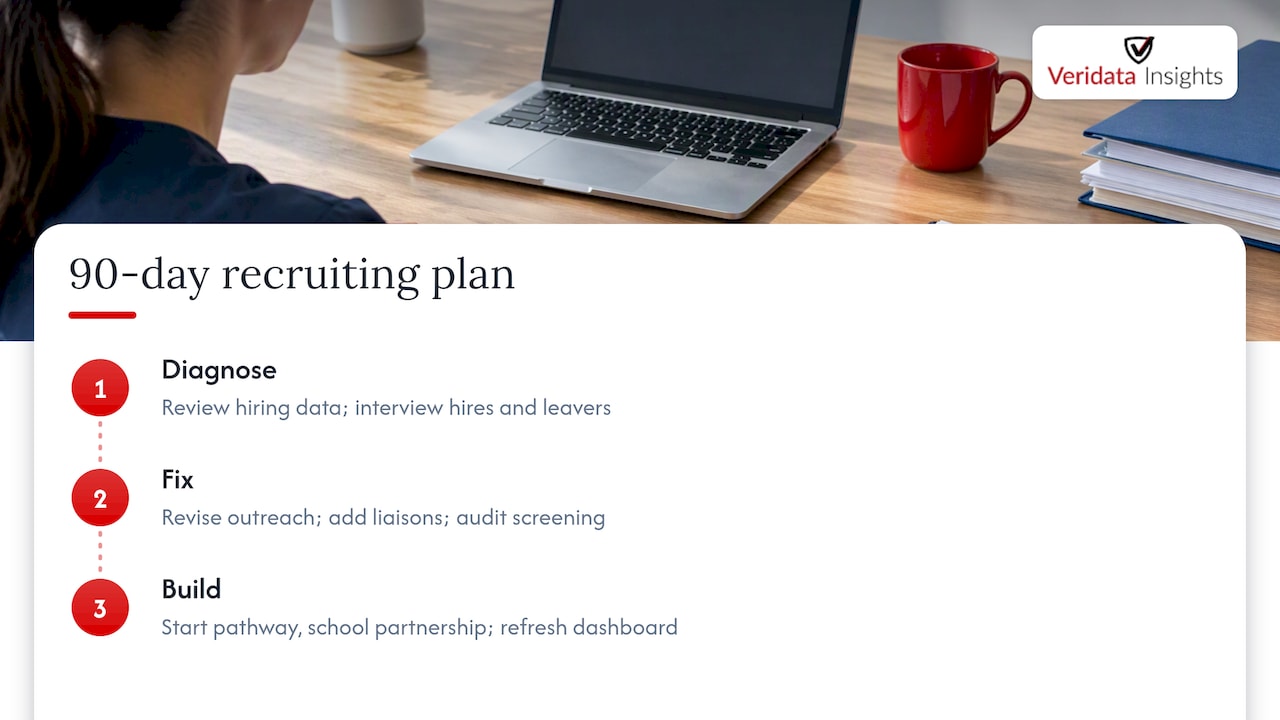
Days 1 to 30: diagnose. Pull time-to-hire, source quality and 12-month retention for your five hardest roles. Interview ten recent leavers and ten recent hires. Look for patterns, not anecdotes.
Days 31 to 60: fix the obvious. Rewrite outreach for each candidate segment. Add clinician liaisons to the interview loop. Audit any automated screening against essential job functions.
Days 61 to 90: build the pipeline. Pick one grow-your-own pathway and one school partnership. Set the dashboard above to refresh monthly, and review it with unit leaders as well as HR.
The goal is not a perfect plan. It is a recruiting operation that learns every month from its own data and from the people it wants to hire.
FAQ
What are the most effective healthcare recruitment strategies?
The ones with the best evidence behind them are candidate-centric outreach, clinician involvement in hiring, internal development programs and metric-driven management. Each addresses why people accept a job and why they stay. Pay and scheduling flexibility matter too, but they work best alongside these.
How do you recruit healthcare professionals when there is a shortage?
Widen the pipeline and shorten the path. Partner with schools, build apprenticeships for current staff, and respond quickly to qualified candidates. In rural areas, where HRSA projects the steepest nursing shortfall, flexibility and community ties often matter as much as pay.
Is AI safe to use for screening healthcare candidates?
It can help with job-related tasks such as checking required certifications, but it carries legal risk if it learns from biased history. Validate any tool against essential job functions and review outcomes by group. Ask employment counsel about your specific setup.
Is recruitment part of HR?
Usually, yes, but in healthcare the strongest results come when HR works with clinical leaders. Nurse managers and unit staff can answer questions HR cannot, and that honesty reduces drop-off after hire.
Can market research help with healthcare recruitment?
Yes. Surveys and interviews with candidates and current staff show what drives acceptance and retention, so you spend budget on what matters. The challenge is reaching busy clinicians, which is where a specialist recruitment partner helps.
Sources
- BLS: Industry and occupational employment projections, 2023 to 2033
- HRSA: State of the US Health Care Workforce 2025
- iCIMS: 10 healthcare recruiting strategies
- AONL: Attracting and recruiting nursing talent
- AHA: Strengthening the health care workforce
- HRSA: Teaching Health Center GME program overview
- Indian Health Service: Strategies to recruit and retain health care staff
- APQC: Improving healthcare talent acquisition
- EEOC: Testimony of Nancy T. Tippins
- EEOC and DOJ warn against disability discrimination