

Asynchronous qualitative research is a method where participants complete tasks (writing, photos, video, voice notes, or app logs) on their own time, over days or weeks, instead of all sitting together in a live session. Choose it when your topic unfolds over time, when your participants are scattered across time zones or shift schedules, or when the behavior you care about happens somewhere a moderator can’t be. It’s a fit for tracking a new parent’s first month with a product, mapping a patient’s medication routine, or capturing B2B buyers who can’t all clear an hour on a Tuesday call.
The three signals that async is right for your study:
- The behavior is episodic or routine based (meal prep, commuting, medication adherence).
- Your sample is geographically dispersed or time-poor (physicians, night-shift workers, rural households).
- Recall bias would corrupt a synchronous interview (asking someone to describe “what you felt three days ago” is a poor substitute for capturing it in the moment).
Mobile-based asynchronous capture reduces recall bias because participants document experiences at the point of service delivery rather than reconstructing them from memory later. If you’re weighing whether this fits your next project, run a small pilot first. Two weeks, 10 to 15 participants, daily micro-tasks. You’ll know within days whether the format earns its keep.
Key Takeaways
Asynchronous qualitative research works because it captures behavior and reflection close to the moment it happens, which reduces recall bias and extends reach to participants a synchronous study would miss.
| Point | Details |
|---|---|
| Match format to question | Use mobile ethnography for behavior, diaries for attitude shifts over time, AOFGs for discussion-dependent topics. |
| Pilot before scaling | Run 10 to 15 participants for 7 to 14 days with daily micro-tasks before committing to full fieldwork. |
| Protect against drop-off | Assign a dedicated participant contact and keep tasks under ten minutes to sustain engagement. |
| Plan for consent complexity | Get explicit consent for bystanders in photos and strip location metadata before analysis. |
| Outsource complex fielding | Veridata Insights handles recruitment, programming, coding, and reporting for teams that need full-service execution. |
Table of Contents
- What Asynchronous Qualitative Research Looks Like in Practice
- How Does Asynchronous Research Differ From Synchronous Methods?
- Core Asynchronous Formats Every Researcher Should Know
- How Do You Design and Run an Asynchronous Study?
- Turning Async Data Into Usable Findings
- Ethics, Consent, and Quality Control in Async Studies
- When Asynchronous Methods Fall Short
- How Veridata Insights Runs Asynchronous Projects
- Get Async Research Support Without the Overhead
- Sources
What Asynchronous Qualitative Research Looks Like in Practice
Once you commit to an asynchronous design, the mechanics come down to how you deliver prompts and how participants respond. Most platforms push a task (a question, a photo request, a short video prompt) to a phone or web portal, and participants respond whenever the moment fits, whether that’s a text reflection, an uploaded image, a thirty-second voice memo, or an automatically logged action.
That structure changes the relationship between researcher and participant. In mobile ethnography, participants function as active co-researchers: they decide what to photograph, when to narrate, and how much context to add, and that autonomy shapes both instruction design and the richness of what comes back.
A few operational realities follow from this:
- Prompt delivery by various channels can work, but consistency matters more than which channel you choose.
- Response formats such as text diaries, photo journals, screen recordings, and short videos each offer different views.
- Device and access vary; some participants might not have smartphones or strong data plans, so consider possible sampling bias carefully.
Get the instructions right and you get texture you’d never capture in a lab. Get them wrong and you get abandoned tasks.
How Does Asynchronous Research Differ From Synchronous Methods?
The trade-offs come down to three dimensions: memory, interaction, and time.
- Recall and ecological validity. Synchronous interviews rely on participants remembering and narrating past events, often days or weeks removed from the actual experience. Asynchronous capture happens closer to the moment, which is why it’s frequently used for point-of-purchase or point-of-care research.
- Probing and nonverbal cues. A live moderator can follow an unexpected answer down a new path and read body language in real time. Asynchronous formats lose that immediacy. You compensate with structured follow-up prompts, a second wave of questions once you’ve reviewed initial submissions, or brief synchronous check-ins layered on top.
- Temporal design. Synchronous research is a snapshot. Asynchronous studies can span days or weeks, which makes them the natural choice for longitudinal questions, but it also means your analysis plan has to account for change over time, not just aggregate themes.
Neither approach is universally better. The right one depends on whether your research question needs a moment or a timeline.
Core Asynchronous Formats Every Researcher Should Know
Four method families cover most asynchronous qualitative work, and each earns its place for a different kind of question.
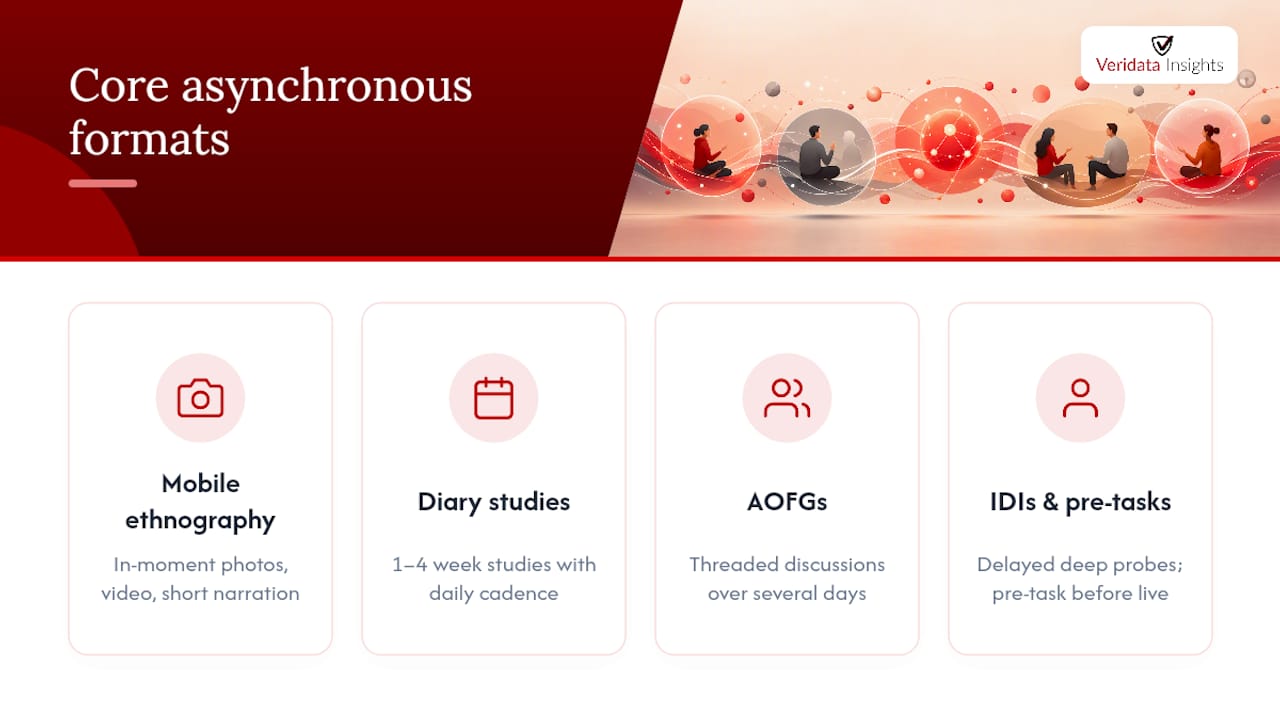
Mobile ethnography captures in-the-moment behavior through participant-generated photos, video, and short narration, submitted via a dedicated app as the behavior happens. It’s the format of choice when you need to see a kitchen counter mid-recipe or a store shelf at the point of decision, and it’s the format most closely tied to the recall-bias advantage documented in the mobile ethnography literature.

Diary studies track attitudes or usage patterns over a longer stretch, usually one to four weeks, with a consistent daily or every-other-day cadence. They’re the workhorse for tracking evolving relationships with a product or habit.
Asynchronous online focus groups (AOFGs), sometimes called bulletin-board research, run threaded discussions over several days, letting participants respond to the moderator and to each other on their own schedule. A study of young women discussing mental health found 59.6% reported being “extremely satisfied” with the AOFG format and another 34.6% “somewhat satisfied,” a strong signal that the format holds up even for sensitive topics.
Asynchronous in-depth interviews (IDIs) and pre-tasking trade real-time back-and-forth for delayed, deeper probing, often paired with a synchronous session later. Pre-tasking (sending a reflection exercise before a live interview) is a hybrid worth using almost by default; it primes richer answers once you do get participants live.
Most of these formats run through purpose-built apps, WhatsApp threads, web portals, or plain email, and the asynchronous email interview has decades of methodological precedent behind it. Accessibility matters here: screen readers, low-bandwidth options, and non-native-language support should factor into your channel choice from the start.
Pro Tip: If your sample includes older adults or lower-income households, test your platform on a mid-range Android phone with a throttled connection before fielding. What looks smooth on your work laptop can be unusable on theirs.
How Do You Design and Run an Asynchronous Study?
Running an asynchronous study well comes down to five sequential decisions.
- Match the format to the research question. A behavior-tracking question calls for mobile ethnography. An attitude-shift question over time calls for a diary study. A discussion-dependent, socially textured topic calls for an AOFG.
- Recruit and screen deliberately. Beyond standard demographic and behavioral criteria, screen for digital access, comfort with the task type, and realistic time availability. A participant who can’t commit fifteen minutes a day for two weeks will drop out, and that attrition skews your findings toward the most compliant (not necessarily the most representative) voices.
- Write prompts that balance guidance and freedom. Give participants a clear invitation (“Show us your morning routine”) rather than a rigid checklist, but pair it with a sample response from your pilot so they know what “good” looks like. Cap task length. Five to ten minutes per task keeps completion rates healthy across a multi-week field period.
- Onboard with a real pilot. Run a technical check before fielding, and assign a dedicated contact participants can reach with questions. Practitioner guidance consistently points to dedicated participant support as one of the most reliable ways to cut drop-off and keep data quality high.
- Vet the platform before you commit. Confirm it handles clean data export, accurate timestamping, secure storage, and a participant experience that doesn’t feel like a chore. A platform that fails on any of these four will cost you time later that you can’t get back during fielding.
Pro Tip: Build your first three days of prompts before recruitment closes, not after. Seeing real submissions early lets you tweak wording before it’s too late to fix a confusing task across your whole sample.
Turning Async Data Into Usable Findings
Raw async submissions (photos, voice notes, threaded replies, timestamped logs) don’t become insight on their own. The workflow that gets you there starts with discipline around metadata: timestamps, consent flags for each media type, and version control so you know which submission is the final one when participants revise an answer.
From there, three analytic approaches cover most projects:
- Timeline synthesis lays out each participant’s submissions chronologically to reveal shifts, triggers, and turning points a single snapshot would miss.
- Iterative coding applies a codebook that evolves as new themes emerge across the field period, rather than locking categories before you’ve seen the data.
- Narrative and thematic synthesis blends individual stories with cross-participant patterns, useful when stakeholders want both a compelling case and a defensible trend.
AI-assisted transcription tools speed up the grind of converting voice and video into searchable text, but tone, sarcasm, and visual context still need a human eye. Treat automated transcripts as a first draft, not a final read.
Package outputs to match how stakeholders actually consume them: a highlight reel for a leadership audience, a journey timeline for a product team mapping a rollout, and a themed thematic deck for anyone who needs the full analytic trail. Asynchronous formats can also surface richer peer-supported storytelling than solo diary prompts, though that same threaded structure can produce disjointed replies if a moderator doesn’t actively steer the conversation.

Ethics, Consent, and Quality Control in Async Studies
Multimedia submissions raise consent questions text-based research rarely faces. A photo of a kitchen table might capture a roommate, a child, or a license plate in the background, and location metadata embedded in an image file can reveal more than a participant intends.
Protect participants and your data quality with a short list of standing practices:
- Get explicit consent for third-party appearances in photos and video, not just the primary participant.
- Strip or flag location metadata before it reaches your analysis team.
- Keep task cadence light. Daily micro-tasks under ten minutes sustain engagement better than sprawling weekly assignments.
- Scale incentives to task burden, and pay participants promptly once submissions are verified.
- Build in submission checks and a follow-up probe for anything incomplete or ambiguous before you code it.
- Document your consent flow and data handling clearly for your institutional review board, especially when third-party images are involved.
When Asynchronous Methods Fall Short
Async isn’t the right call for every question. Topics that need real-time probing (crisis response, complex decision trees, anything where a moderator must read a hesitation and follow it) lose too much without a live moderator.
Watch for these common pitfalls:
- Digital access and literacy gaps can quietly skew your sample toward the most tech-comfortable participants.
- A single photo or clip, stripped of context, invites over-interpretation if you don’t ask participants to annotate it.
- Simply moving a task online doesn’t make it ethnographic. True digital ethnography requires sustained researcher engagement and reflexive self-awareness about your own presence in the data, not just remote collection.
- When in doubt, hybridize: pair asynchronous capture with a short synchronous debrief call to fill probing gaps.
How Veridata Insights Runs Asynchronous Projects
We’ve fielded enough async studies at Veridata Insights to know the difference between a pilot that works and one that quietly wastes two weeks. Our starting point mirrors what the research backs: a 10 to 15 participant, 7 to 14 day pilot with daily micro-tasks, two structured follow-up probes, and incentives scaled to task burden before anyone commits to a full field launch.
Here’s what we bring to that process:
- Methodology consultation and questionnaire review before a single prompt goes live.
- Recruitment across B2B, B2C, healthcare, and hard-to-reach audiences, including participants who need translated or localized materials.
- Data processing, coding, and reporting once submissions start coming in, so raw media doesn’t sit unanalyzed.
- Full-service execution when a team needs more hands than an in-house researcher can spare.
Running a study in-house makes sense when your team already has coding capacity and a manageable sample. Once you’re juggling multiple languages, hard-to-reach recruitment, or a dataset too large to code manually, that’s the point to bring in a full-service partner.
Get Async Research Support Without the Overhead
If you’ve read this far, you already know the mechanics. The part that eats time isn’t the method, it’s the operational load: screening for digital access, building a platform that exports clean timestamped data, keeping a dedicated contact staffed for two straight weeks, and coding hours of voice and video once submissions land.
Veridatainsights runs that entire load as a project, not a subscription. There’s no minimum project size and no long-term commitment. You get recruitment for B2B, B2C, healthcare, or hard-to-reach audiences, methodology consultation, questionnaire review, programming, data processing, and reporting under one engagement, seven days a week, all year. If you’re weighing whether to run your next diary study or AOFG in-house versus outsourcing it, our full-service qualitative and quantitative research page walks through how we structure custom and global studies. For teams that want a dedicated qualitative team handling design straight through fieldwork, reach out to Veridata Insights to scope your pilot.
Sources
- Online, Asynchronous Data Collection in Qualitative Research — Oxford Handbook chapter
- Asynchronous Online Focus Groups: An Effective Approach to Engage Young Adult Women in Discussions on Mental Health Problems — International Journal of Qualitative Methods
- What is ethnographic about digital ethnography? — Frontiers in Sociology
- Mobile ethnography — Wikipedia