

A complete market research RFP must cover ten core elements: research purpose and objectives, scope of work with methodology expectations, target audience and quota specifications, deliverables and reporting requirements, project timeline and milestones, evaluation criteria and scoring, pricing and cost-breakdown instructions, minimum vendor qualifications, submission rules, and confidentiality plus data-security requirements. Real public examples like the District of Columbia Health Benefit Exchange RFP and the Lee County Visitor & Convention Bureau RFP show exactly how public-sector buyers phrase each of those elements. Veridata Insights works with buyers at every stage, from RFP design through final reporting, and the structure below gives you a ready skeleton to populate and publish.
Key Takeaways
A strong market research RFP combines precise quota language, a line-item budget requirement, a published scoring matrix, and clear submission rules so every proposal you receive is comparable and auditable.
| Point | Details |
|---|---|
| Write quotas as hard minimums | “A minimum of 150 completes” beats “approximately 150” and eliminates the most common bidder shortfall. |
| Require a line-item cost breakdown | Lump-sum bids hide assumptions; line-item pricing makes proposals directly comparable and change orders defensible. |
| Publish your scoring matrix | Sharing weighted evaluation categories before proposals are due attracts better-fit vendors and protects your selection decision. |
| Set a written-questions-only deadline | A firm Q&A cutoff with written answers posted as addenda keeps all bidders on equal footing and creates an audit trail. |
| Use Veridata Insights for design through delivery | Veridata Insights covers the full scope from RFP review and study design to recruitment, fieldwork, analytics, and final reporting. |
Table of Contents
- What does a market research RFP need to include?
- Copy-ready sample language for purpose, SOW, and quotas
- How should you score and evaluate research proposals?
- What pricing formats should your RFP require?
- What does a realistic procurement and project timeline look like?
- What minimum qualifications and documents should vendors submit?
- What contract and data-security language belongs in your RFP?
- How should you specify submission instructions and handle bidder questions?
- Pre-release checklist: what to confirm before you publish the RFP
- What can you learn from real public RFP examples?
- Veridata Insights best practices for vendor-proof RFP language
- Veridata Insights is ready to respond to your RFP
- Sources
What does a market research RFP need to include?
A well-built RFP for market research is a procurement document and a research brief rolled into one. It tells vendors what you need, how to respond, and how you will choose a winner. Use this ordered structure as your template skeleton.
- Purpose and objectives. State the research question, the decision it will inform, and the intended audience for findings. One clear paragraph here prevents scope creep later.
- Background and organizational context. Briefly describe your organization, the program or product under study, and any prior research vendors should know about.
- Scope of work and methodology expectations. Specify the methods you require or are open to (online survey, telephone, focus groups, intercepts, secondary analysis). Name deliverable phases. As pre-award market research guidance notes, clear methodology requirements at this stage directly improve proposal quality.
- Target audience and quotas. Define who must be surveyed, the minimum completes per cell, and any oversample requirements. Hard numbers here reduce bidder questions by half.
- Deliverables. List every output: raw data files, cross-tabulation shells, topline reports, full analytical decks, and executive summaries, each with format and due date.
- Project timeline. Provide a procurement calendar and a fieldwork-to-final-report schedule with named milestones.
- Pricing instructions. Require a line-item cost breakdown. Specify whether you want a not-to-exceed total, per-complete pricing, or both.
- Evaluation criteria and scoring. Publish the weighted categories and point scale so bidders can self-assess fit before investing time in a proposal.
- Minimum qualifications. State the floor: years of experience, relevant project types, required certifications, and reference contacts.
- Submission instructions. Name the submission portal or email, the deadline with time zone, file format, and naming convention.
- Contract terms, confidentiality, and data security. Include IP ownership, data retention, encryption requirements, and NDA expectations.
- Appendices. Attach sample questionnaire shells, weighting plan assumptions, sampling frame notes, and any prior research summaries that orient bidders.
For multi-award or recurring engagements, a lot-based structure like the one UNICEF uses in its Global Audience and Market Insights Services LTA lets you split service categories across separate bidding lots, which keeps each proposal focused and comparable.
Copy-ready sample language for purpose, SOW, and quotas
Purpose and objectives: three variants
Public-sector buyer:
“The [Agency Name] seeks a qualified research firm to design and conduct a mixed-method study assessing [program/policy area] awareness and satisfaction among [target population] in [geography]. Findings will inform [specific decision or report] expected in [quarter/year].”
Nonprofit buyer:
“[Organization Name] invites proposals to conduct a quantitative survey and up to four focus groups exploring [topic] among [audience]. Results will guide [strategic plan/campaign/program design] for the [fiscal year] cycle.”
Private-sector buyer:
“[Company Name] requests proposals for a custom market study measuring [brand metric/category behavior] among [consumer segment]. The selected vendor will deliver a final report and presentation-ready deck by [date].”
Statement of work: core scope bullets
The contractor must:
- Design or co-design the survey instrument and discussion guide in collaboration with the client team
- Program the survey in a CAPI, CATI, or online panel environment as specified
- Recruit and screen respondents to meet all quota cells defined in Section 4
- Conduct quality-control checks including response-time flagging, straight-lining detection, and open-end review
- Clean, weight, and process data to the agreed weighting plan
- Produce cross-tabulation tables in Excel or SPSS format with banner specifications provided by the client
- Deliver a topline report within five business days of fieldwork close, and a full analytical deck within the timeline in Section 6
For recruitment best practices on hard-to-reach or B2B audiences, build those requirements directly into the SOW so vendors price them accurately.
Deliverables list
- Raw data file (SPSS .sav or CSV) with data dictionary, due within three business days of fieldwork close
- Cross-tabulation tables (Excel, client-supplied banner), due within five business days of fieldwork close
- Topline report (PowerPoint or PDF, 10–15 slides), due within five business days of fieldwork close
- Full analytical deck with charts and narrative (PowerPoint), due per timeline in Section 6
- Executive summary (two-page Word or PDF), due with final deck
- Appendix files: screener, questionnaire, weighting documentation, and disposition codes
Quota and sample table example
| Audience segment | Target completes | Oversample | Notes |
|---|---|---|---|
| Adults 18–34 | 150 | 25 | Weight back to census proportions |
| Adults 18–34 | 150 | 25 | Primary analysis cell |
| Adults 65+ | 150 | 25 | Weight back to census proportions |
| Hispanic/Latino adults | 100 | 50 | Conduct in English and Spanish |
| Total | 450 | 150 | Final n = 450 after weighting |
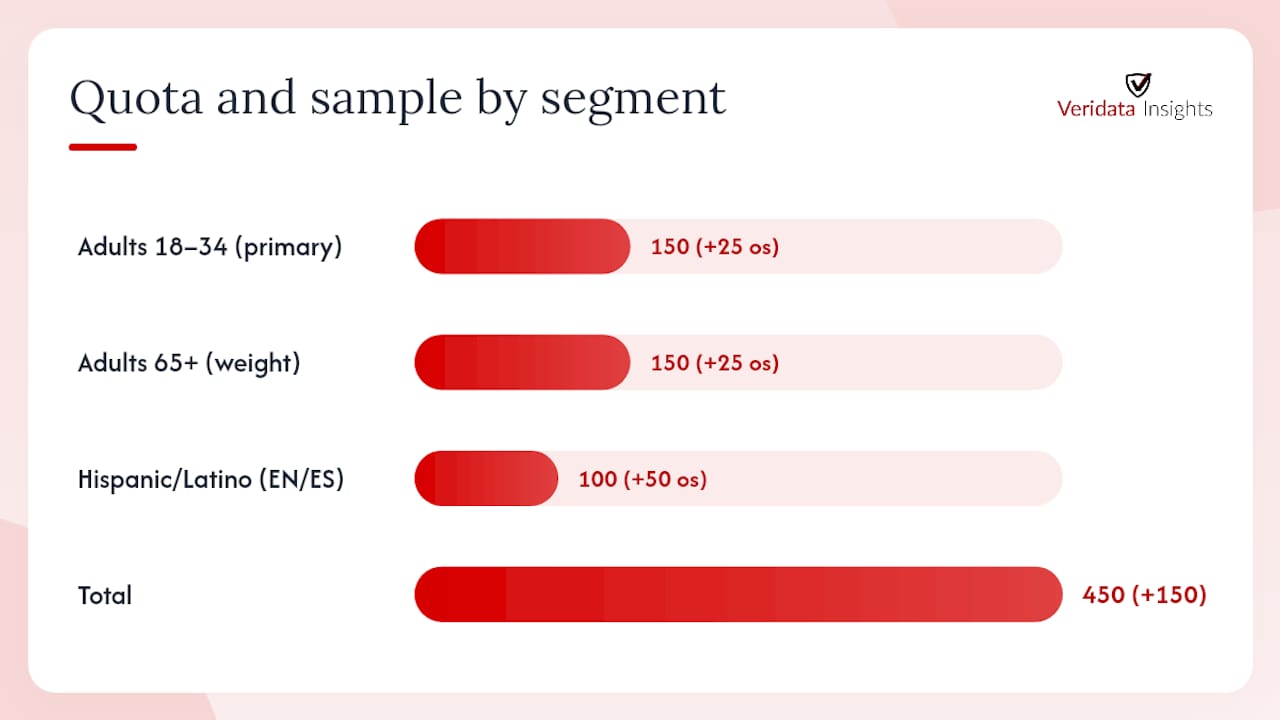
Weighting note: the vendor must provide a weighting plan for client approval before fieldwork launch. Post-stratification weights should align to current U.S. Census Bureau ACS estimates for the target geography.
Pro Tip: Write quota cells as hard minimums, not targets. “A minimum of 150 completes among adults 18–34” is unambiguous. “Approximately 150” invites vendors to deliver 120 and call it close enough. Avoid “or similar” wording in any quota cell.
How should you score and evaluate research proposals?
Clear evaluation criteria protect you legally and help vendors self-select. Publish the weighted categories before proposals are due. The University of Virginia Market Research RFP is a practical model for how a public institution structures this section.
- Technical approach and methodology (30 points). Does the proposed design answer the research question? Is the sampling plan credible? Are quality-control procedures described?
- Relevant experience and references (25 points). Has the vendor conducted comparable studies with the same audience type? Are three references provided with contact information?
- Recruitment and fieldwork plan (20 points). Is the panel or recruitment source appropriate? Are incidence estimates realistic? Is the timeline achievable?
- Project management and staffing (15 points). Is a named project lead identified? Is a staffing plan included? Is the timeline detailed and milestone-specific?
- Cost and price (10 points). Is the cost breakdown complete and line-itemized? Is the total within the stated budget range?
Scoring rubric for reviewers:
- 90–100% of available points: Exceeds requirements; proposal is thorough and demonstrates clear expertise
- 70–89%: Meets requirements; minor gaps that can be addressed in clarification
- 50–69%: Partially meets requirements; significant gaps in methodology or experience
- Below 50%: Does not meet minimum requirements; nonresponsive
Assign at least two independent reviewers per proposal. Where scores differ by more than 15 points on any single category, reviewers must document their rationale before a consensus score is recorded. Ties go to the higher technical score, not the lower price.
For qualitative projects, the criteria for assessing qualitative experience should include moderator credentials, discussion guide samples, and prior focus group transcripts or summaries.
What pricing formats should your RFP require?
Require a line-item cost breakdown. A single lump-sum bid makes proposals impossible to compare and hides assumptions that will surface as change orders later.
Acceptable pricing formats:
- Line-item cost breakdown by role, task, and phase (preferred)
- Not-to-exceed (NTE) total with the line-item breakdown attached
- Per-complete pricing with explicit assumptions about incidence rate, survey length, and incentive amount
Required cost elements
- Labor by named role (project manager, analyst, programmer, moderator) with hours and hourly rate
- Incentives per respondent, with total incentive budget
- Survey programming and hosting fees
- Data processing, coding, and weighting
- Travel and facility costs (if qualitative)
- Reporting and deliverable production
- Project management and client communication
- Optional value-adds (additional cross-tabs, data visualization, executive presentation)
Cost breakdown template
Ask vendors to list optional value-adds separately so you can compare base bids on equal footing before deciding on extras.
What does a realistic procurement and project timeline look like?
Rushed timelines produce thin proposals and missed quotas. Build in at least five business days for the question-and-answer period and at least two weeks for proposal evaluation. The market research process from design to final report typically spans eight to fourteen weeks depending on methodology and audience difficulty.
Sample procurement and project schedule
| Milestone | Estimated date/duration |
|---|---|
| RFP posted | Day 0 |
| Bidder questions deadline | Day 7 |
| Addendum/answers issued | Day 10 |
| Proposals due | Day 14 |
| Evaluation period | Days 15–28 |
| Award notification | Day 29 |
| Contract execution | Days 30–35 |
| Project kickoff | Day 36 |
| Instrument design and approval | Weeks 1–2 post-kickoff |
| Programming and soft launch | Week 3 |
| Fieldwork window | Weeks 3–6 |
| Data processing and QC | Week 7 |
| Topline report | Week 7, day 5 |
| Full analytical deck (draft) | Week 9 |
| Client review and revisions | Week 10 |
| Final report delivered | Week 11 |
For hard-to-reach audiences, B2B panels, or healthcare respondents, add two to three weeks to the fieldwork window.
What minimum qualifications and documents should vendors submit?
Minimum qualifications filter nonresponsive bids before evaluation begins. State them as pass/fail requirements, not scored criteria.
Minimum qualifications checklist:
- Minimum three years of experience conducting market research studies of comparable scope and methodology
- At least two completed projects with the same target audience type (e.g., healthcare consumers, B2B decision-makers, general population)
- Three professional references with name, title, organization, phone, and email
- Named project lead with relevant credentials and a staffing plan
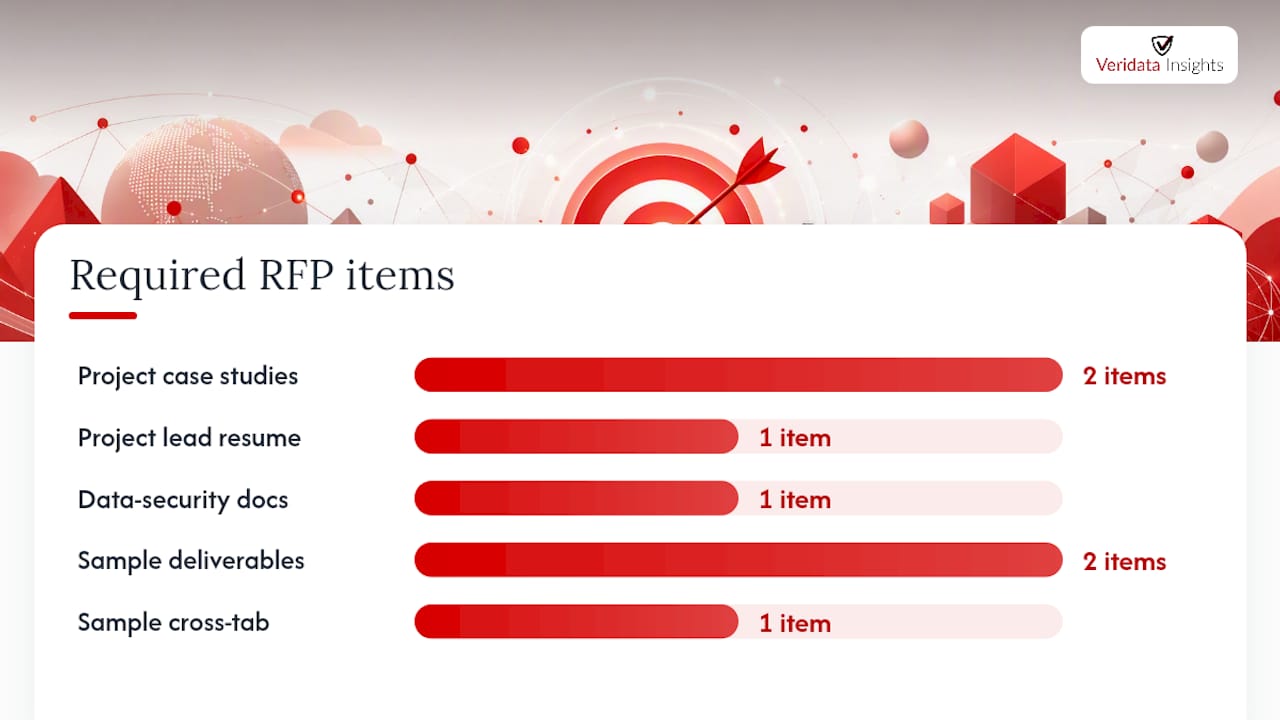
- Proof of data-security practices (SOC 2 Type II, ISO 27001, or equivalent documentation)
Required attachments:
- Completed proposal document following the format in Section 10
- Resumes or CVs for all named project staff
- Two to three sample deliverables from comparable projects (redacted as needed)
- Reference contact list (three contacts minimum)
- Signed confidentiality agreement or NDA (if required pre-award)
- Cost breakdown in the format specified in Section 5
Proposal formatting rules:
- Maximum 20 pages, excluding appendices and cost breakdown
- PDF format, named: [VendorName]_[RFPNumber]_Proposal.pdf
- Font no smaller than 11pt, margins no smaller than 0.75 inches
- Appendices labeled A, B, C in the order referenced in the proposal body
The University of Virginia RFP is a clean public model for how to phrase attachment requirements and minimum-qualification language so nonresponsive bids are easy to identify and set aside.
What contract and data-security language belongs in your RFP?
Include sample contract clauses in the RFP so vendors know the legal framework before they bid. Surprises at contract execution slow awards and sometimes lose your preferred vendor.
Sample contract clauses:
- IP and data ownership: “All data, reports, instruments, and deliverables produced under this contract are the sole property of [Client Name]. The vendor retains no rights to use, publish, or share any project data without prior written consent.”
- Deliverable licensing: “Client is granted a perpetual, royalty-free license to use, reproduce, and distribute all deliverables for internal and external purposes.”
- Confidentiality: “The vendor agrees to hold all project information, data, and findings in strict confidence and to execute a mutual NDA prior to project kickoff.”
Data-security checklist:
- Encryption in transit (TLS 1.2 or higher) and at rest (AES-256 or equivalent)
- Data stored only in U.S.-based servers unless client approves otherwise in writing
- Access controls: role-based access, two-factor authentication for project systems
- Data retention policy: raw data destroyed or returned within 90 days of project close unless otherwise agreed
- Subcontractor obligations: all subcontractors must meet the same security standards and sign a data-processing agreement
- Breach notification: vendor must notify client within 48 hours of any confirmed or suspected data breach
For federal or state-funded projects, consult your legal team on whether federal procurement policy requirements under the Federal Acquisition Regulation (FAR) apply to your solicitation. FAR compliance adds specific clauses around data rights, small-business subcontracting, and audit access that go beyond a standard commercial RFP.
How should you specify submission instructions and handle bidder questions?
Clear submission language prevents late bids, wrong file formats, and procurement disputes. Copy the block below and fill in your specifics.
- Electronic submission. Proposals must be submitted via [portal URL or email address] no later than [date] at [time] [time zone]. Submissions received after the deadline will not be evaluated.
- File requirements. Submit one PDF proposal file named [VendorName]_[RFPNumber]Proposal.pdf and one Excel cost breakdown named [VendorName][RFPNumber]_Cost.xlsx.
- Acknowledgment. Vendors will receive an automated acknowledgment within one business day of submission. If no acknowledgment is received, contact [procurement contact name] at [email].
- Questions and clarifications. All questions must be submitted in writing to [procurement contact email] by [question deadline date] at [time]. Questions submitted by phone or in person will not be answered. Written answers will be posted as an addendum to [portal or website URL] by [addendum date].
- Addenda. Any changes to this RFP will be issued as numbered addenda. Vendors are responsible for checking [portal/website] for addenda before submitting. Proposals submitted without acknowledging all issued addenda may be deemed nonresponsive.
- Late submissions. Proposals received after the deadline will be returned unopened or deleted without review.
Contact block template:
Procurement Contact: [Full Name], [Title]
Organization: [Organization Name]
Email: [procurement email]
Phone: [phone number, optional]
Questions deadline: [date and time, with time zone]
Pre-release checklist: what to confirm before you publish the RFP
Run through every item below before posting. One missing element can trigger a protest or require a costly addendum.
Content completeness:
- Research purpose and objectives are stated clearly in one paragraph
- Scope of work specifies methods, phases, and QC requirements
- Quota table lists hard minimums for every audience cell
- Deliverables list includes format, file type, and due date for each output
- Project timeline includes procurement calendar and fieldwork-to-report milestones
- Evaluation criteria are published with weights and point scale
- Pricing instructions require a line-item cost breakdown
- Submission instructions include portal/email, deadline with time zone, and file naming rules
- Minimum qualifications are stated as pass/fail requirements
- Data-security requirements and contract clause language are included
- Confidentiality and IP ownership language is present
Attachments:
- Sample questionnaire shell or topic guide (if applicable)
- Weighting plan assumptions or sampling frame notes
- Cost breakdown template
- Reference request form (optional but helpful)
Sign-off:
- Procurement lead review: ________________ Date: ________
- Legal review: ________________ Date: ________
- Budget approval: ________________ Date: ________
What can you learn from real public RFP examples?
Two public RFPs stand out as models worth reading before you draft your own.
District of Columbia Health Benefit Exchange (HBX) RFP
The DC HBX research RFP specifies a mixed-method design combining focus groups and a telephone survey. It names explicit target-group quotas including oversamples for specific demographic segments, sets minimum cultural-competency requirements for the vendor, and publishes fixed procurement deadlines. What to copy: the quota table structure, the cultural-competency minimum requirement, and the way the SOW separates qualitative and quantitative phases into distinct deliverable blocks. What to adapt: the telephone methodology may not fit your project; replace it with online or CAPI if appropriate, and adjust the cultural-competency language to match your target audience.
Lee County Visitor & Convention Bureau (VCB) RFP
The Lee County VCB solicitation covers destination-specific deliverables including occupancy surveys, intercept methodology, and economic impact modeling. It requires backup documentation for all reported figures and publishes a procurement schedule with hard deadlines and named contact details. What to copy: the backup-documentation requirement (it reduces disputes over reported numbers), the hard-deadline procurement calendar, and the contact block format. What to adapt: the occupancy survey and intercept methodology are destination-tourism specific; replace them with your own methodology requirements, but keep the documentation standard.
Both examples show that the most effective public RFPs are specific enough that a vendor can price accurately on the first read, without a single clarifying call.
Veridata Insights best practices for vendor-proof RFP language
Strong RFP language does two things at once: it attracts qualified vendors and filters out the ones who cannot deliver. Here is what we see separate winning RFPs from the ones that generate a flood of clarification questions.
Vendor-vetting questions to require in proposals:
- Describe two projects where you recruited [specific audience type, e.g., oncology nurses, small-business owners with fewer than 10 employees]. Include sample sizes achieved, incidence rates encountered, and how you handled shortfalls.
- Who will be the named project lead? Provide their resume and describe their role in day-to-day project management.
- What quality-control steps do you apply during fieldwork? Describe your process for flagging and removing low-quality responses.
- What is your data-security certification status? Attach documentation.
- Provide two sample deliverables (redacted) from comparable projects.
Quota-wording that prevents scope creep:
Write: “A minimum of [n] completed interviews among [audience], defined as [screening criteria].”
Avoid: “Approximately [n] interviews” or “a representative sample of [audience].”
Deliverable specification that prevents format disputes:
Write: “Raw data delivered as an SPSS .sav file with a full variable and value label dictionary, plus a CSV export, within three business days of fieldwork close.”
Avoid: “Data file in a standard format.”
Including sample table shells and a reporting template in the RFP appendix reduces bidder variance on deliverable format. Vendors who see exactly what the final deck should look like price more accurately and deliver closer to expectations.
Pro Tip: Ask every bidder to submit one sample cross-tabulation table from a prior project. It tells you more about their analytical capability than any paragraph in their proposal narrative.
For guidance on choosing a full-service research partner and what capabilities to require in your minimum qualifications, the checklist there maps directly to the vendor-vetting questions above.
Learn more about BizKnowledge – Veridata Insights’ validated panel – here.
Veridata Insights is ready to respond to your RFP
When you are ready to issue your solicitation or need a partner who can respond to it, Veridata Insights delivers the full scope: study design, questionnaire review, survey programming, recruitment for B2B, B2C, healthcare, and hard-to-reach audiences, data collection, processing, analytics, and reporting. No project minimums. No waiting until Monday. We work seven days a week, 365 days a year, and we scale to exactly what your project needs, nothing more, nothing less.
If you want a second set of eyes on your RFP draft before you publish, we can review it and flag gaps in the SOW, quota language, or deliverable specs that typically generate bidder questions. Contact Veridata Insights to request a quote or send your draft for a complimentary review.
Sources
- Request for Proposals – Research (DC HBX)
- Market Research: the Key to Your Next RFP’s Success
- Market Research RFP# MW061517
Use each example as a language model, not a template to copy wholesale. Swap in your organization’s name, program context, and methodology requirements, and keep the structural elements (quota tables, procurement calendar, submission block) that make these documents so easy to respond to.
Recommended
- Best Ways to Engage Market Research Respondents – Veridata Insights
- How to Maximize Your ROI in Market Research – Veridata Insights
- Market Research Buyers: What Agencies and Panels Should Deliver – Veridata Insights
- What To Look For When Choosing a Full-Service Market Research Agency – Veridata Insights