


The most reliable way to verify respondents is a multi-layer, composite approach that flags participants only after multiple independent checks agree. The core layers are pre-field gating, metadata review, content and attention checks, identity verification, and manual audit. Each layer costs something in time, privacy exposure, or false positives, so calibration against your own fielding conditions matters more than any single tool.
TL;DR:
- Combining multiple independent fraud detection checks increases sensitivity from about 50% to over 75%, reducing noise in survey data.
- Layered verification techniques include pre-field gating, metadata analysis, identity matching, and manual review, each with specific strengths and limitations.
- Opt-in and crowdsourced samples generally require more intensive layering and closer monitoring due to higher fraud risks compared to panel or list-based samples.
- Using at least two independent flags as exclusion criteria balances fraud detection with avoiding false positives, with manual review reserved for borderline cases.
- Full technical stacks cannot eliminate all fraud types, making ongoing monitoring, protocol adjustments, and transparent respondent communication essential.
Table of Contents
- Why multi-layer verification beats single checks
- Primary verification techniques: gating, metadata, and identity checks
- Behavioral and content checks that catch inattentive or fraudulent respondents
- Composite scoring and flagging: how to combine indicators without overcorrecting
- Human review, auditing, and documenting every decision
- Implementation checklist and protocol for pre-field, field, and post-field stages
- What verification cannot solve
- How Veridata Insights can help with respondent verification
- FAQ
- Sources
- Key research and guidance to read next
Why multi-layer verification beats single checks
Researchers who rely on one fraud signal are, statistically, going to miss a lot of bad data. A 2026 analysis published in the Journal of Medical Internet Research found that individual indicators such as reCAPTCHA v3 scores alone can miss between 33% and 48% of fraudulent records, while combining several independent checks raises detection sensitivity from roughly 50% to 60% up to more than 75%. That is not a small improvement. It is the difference between a dataset that quietly contains a meaningful chunk of noise and one that a client can actually act on.
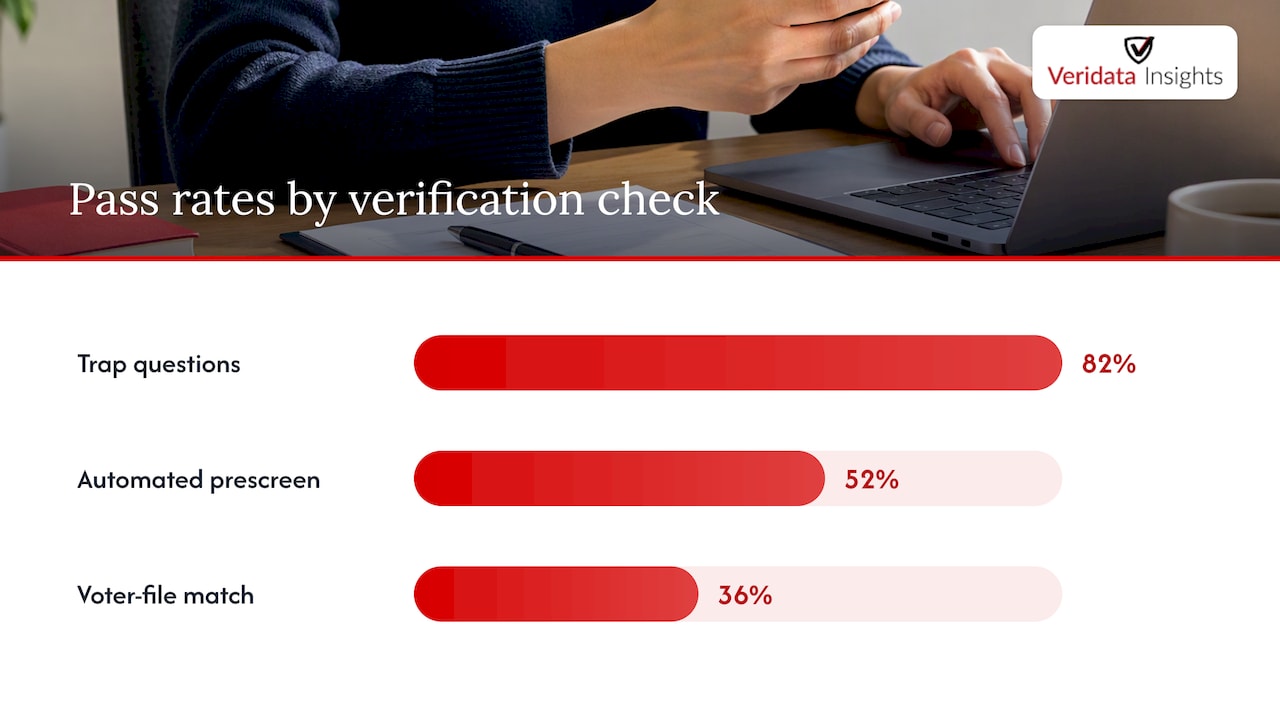
The scale of the problem becomes clearer when you look at how different screening methods perform against the same pool of respondents. A 2026 study of 11,114 U.S. adults, summarized in detail by researchers tracking opt-in poll quality, found that 82% of respondents passed basic trap questions, but only 52% passed automated prescreening, and just 36% matched against a commercial voter file. Three checks, three very different pass rates, on the exact same sample. That gap is the entire argument for layering: a respondent who clears a trap question tells you almost nothing about whether they would clear an identity match.
Composite fraud detection can lift sensitivity from roughly 50 to 60% up to over 75%, according to JMIR’s 2026 analysis of fraud detection performance, a gain that matters most in opt-in and crowdsourced panels where fraud risk is already elevated. The downstream effect on findings is not cosmetic. Academic and industry reviews of the Triple C Project’s experience with online survey fraud document cases where bogus respondents shifted key political estimates by up to 4 percentage points before removal. Pew’s own appendix on this topic adds an uncomfortable wrinkle: bogus respondents do not fail randomly. They disproportionately claim membership in sought-after subgroups, like younger age brackets or Hispanic identity, because those are the quotas that get them paid. That turns fraud into systematic bias rather than harmless noise, which is a much harder problem to average away.
Recruitment channel changes the baseline risk substantially. Probability-based panels show far lower bogus-respondent rates than open, opt-in, or crowdsourced samples, according to Pew’s own comparison across sampling modes. A screener tuned for a tightly managed B2B panel will be miscalibrated for an open social-media recruit, and vice versa. There is no universal threshold that works everywhere.
What this means in practice:
- Treat any single-check pass rate as a floor, not a verdict, since no indicator alone separates real respondents from fraudulent ones reliably.
- Expect opt-in and crowdsourced samples to need heavier layering than panel or list-based recruitment.
- Watch for clustering in high-value subgroups, since that pattern often signals quota-chasing fraud rather than genuine diversity.
- Always pilot your detection rules on a small batch first and report exactly how many cases were flagged and excluded, so clients and reviewers can judge the sensitivity analysis themselves.
Primary verification techniques: gating, metadata, and identity checks
Verification starts before a single response is collected. The earlier you filter, the less cleanup you need later, and the cheaper the whole exercise becomes.
Pre-field gating is the first line of defense. A two-stage recruitment process, where a short screener qualifies respondents before they ever see the main survey, lets you apply trap questions and quota logic without burning your full questionnaire length on people who will not qualify. Unique, single-use links tied to an individual invitation prevent the same person from completing a survey multiple times under different identities, and they make link-sharing on forums or group chats far easier to detect because duplicate submissions trace back to one token. When timing allows, invite by SMS or verified email rather than open social links, since a known contact channel gives you a second identity signal for free.
CAPTCHA and bot detection catch the crudest automated submissions but stop well short of solving the problem. reCAPTCHA v2 interrupts the respondent with a visible challenge, which filters simple bots but also adds friction that legitimate respondents resent. reCAPTCHA v3 runs invisibly and scores risk in the background, which is smoother for the respondent but, as the JMIR sensitivity figures above show, still misses a large share of fraud on its own. Neither version was built to catch a human being paid to click through a survey carelessly, or a respondent using a device farm. Treat CAPTCHA as a cheap first filter, never as a verification strategy in itself.
Metadata checks are where technical fraud starts to surface. Worth building into your pipeline:
- IP address review for duplicate submissions, data center ranges, or known proxy and VPN exit nodes, since legitimate consumer respondents rarely connect from hosting infrastructure.
- Timezone and geolocation consistency checks that compare the respondent’s reported location against their device timezone and IP-derived location, flagging mismatches for review rather than automatic exclusion.
- Device fingerprinting that captures browser, screen resolution, and hardware signals to catch the same device completing a survey under multiple respondent identities.
- Timestamp clustering analysis, looking for bursts of completions seconds apart, which often indicate a shared link being passed through a fraud ring rather than organic recruitment.
- Completion speed outliers, flagging submissions far faster than a careful read of the questionnaire would allow.
Practitioners documenting fraud mitigation in the Triple C Project’s methodological review describe exactly this kind of layered metadata stack combined with manual, case-by-case review, and they are candid that even a full technical stack can be evaded by a sufficiently motivated actor. That caveat matters: metadata checks narrow the pool, they do not close it.
Identity verification is the heaviest layer and should be used selectively. Matching respondents against a voter file or commercial personal-record database, as tested in the Pew study referenced above, is one of the stronger discriminators available, but it also means collecting personally identifiable information you may not otherwise need, which raises IRB and privacy questions immediately. SMS verification of a phone number is a lighter-touch alternative that confirms a respondent controls a real, working number without pulling a full identity record. If your study design involves SMS outreach for invitations or verification, compliance rules around consent and messaging frequency apply in the United States, and TCPA compliance guidance for marketers is worth reviewing before you build that step into a protocol.
Pro Tip: Reserve voter-file or personal-record matching for studies where the cost and privacy trade-off is justified by the stakes, such as high-visibility political or health research, rather than applying it as a default on every project.
Our internal reference on forensic markers and verification methods walks through how these technical signals get weighted in practice.
Behavioral and content checks that catch inattentive or fraudulent respondents
Technical checks catch bots and obvious duplicates. Behavioral and content checks catch something harder: a human who is present but not paying attention, or a sophisticated fraud actor working around the metadata layer entirely.
Attention checks and speed bumps work best when they are varied and modest in number rather than a single obvious trap repeated throughout. A well-designed item asks the respondent to follow a specific, slightly unusual instruction embedded in a normal-looking question, placed once in the first third of the survey and once more past the midpoint, never back to back. Overusing them creates fatigue and can itself distort responses on tasks that require sustained concentration, which is the exact caveat raised in JMIR’s review of fraud reduction in online health surveys: attention checks detect inattention reliably, but they can also alter performance on cognitive tasks, so pilot their placement and report their effect rather than assuming they are free of consequence.
Open-ended questions turn out to be one of the strongest detection tools available, not just a qualitative nice-to-have. A 2025 validation study published in JMIR on fraud detection algorithms found free-text checks reached 92.7% sensitivity and 100% specificity, outperforming most other individual indicators tested. Practical rules worth setting: require a minimum response length for any open-ended item meant to carry verification weight, flag exact or near-exact duplicate text across respondents, and route anything suspicious to manual linguistic review rather than automatic exclusion, since AI-generated text increasingly slips past simple pattern matching.
Consistency tests catch a different failure mode: a respondent who is not fraudulent in the fabrication sense but is answering carelessly or inconsistently. Useful patterns include:
- Repeating a key screener item inside the main survey and flagging any respondent whose answer changes.
- Cross-checking derived variables, such as comparing a stated birth year against a separately reported age, and flagging mismatches.
- Scanning grid questions for straight-lining, where a respondent selects the same column for every row regardless of content.
- Comparing response patterns on reverse-worded items to catch respondents who are clicking without reading.
Pro Tip: Run your attention checks and consistency tests on pilot data first and report the flag rate before fielding at scale, since a check that flags 2% of a pilot sample behaves very differently from one that flags 20%.
Composite scoring and flagging: how to combine indicators without overcorrecting
A scoring schema turns a pile of individual checks into one defensible decision rule, and it is the piece most protocols skip.
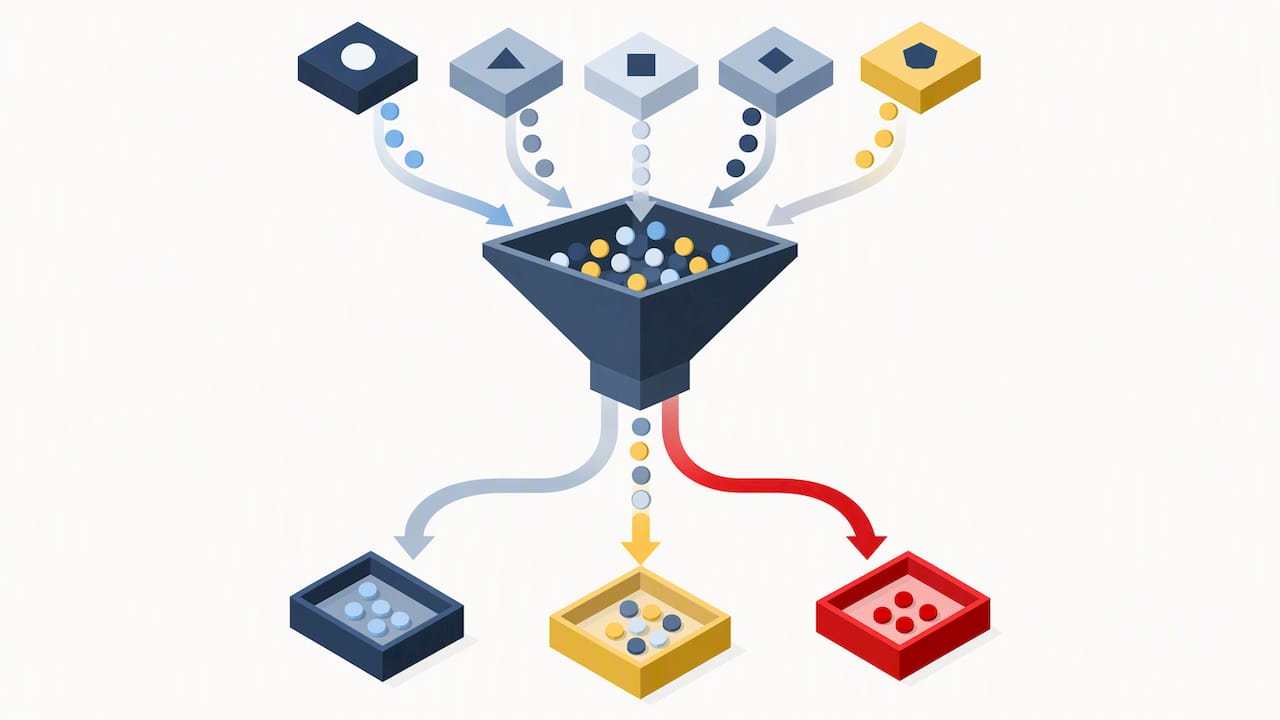
Group your indicators into four categories: technical (IP, device fingerprint, timestamp clustering, CAPTCHA score), behavioral (attention checks, straight-lining, speed outliers), identity (voter-file or record match, SMS verification), and content (open-text quality, duplicate text, consistency checks). Assign each flag within a group a point value, sum within groups, and treat each group as a binary flag once its internal sum passes a threshold you set during piloting.
A workable exclusion rule looks like this:
- Score each response across the four indicator groups independently, so a weak signal in one group cannot sink a respondent on its own.
- Exclude automatically only when two or more independent groups are flagged, since this is the structure the JMIR fraud detection research points to when it recommends requiring at least two independent flags before exclusion, a rule that balances catching coordinated fraud against penalizing a legitimate respondent who happened to trip one indicator.
- Route single-group flags to manual review rather than automatic exclusion, since a single flag is exactly the ambiguous case human judgment is suited for.
- Log the reason code for every exclusion, naming which groups triggered and why, so the decision can be audited or revisited later.
- Re-run the threshold on a pilot batch before full fielding, checking how many cases each candidate threshold would exclude, and adjust up or down based on whether the flag rate looks plausible for your recruitment channel.
At least two independent flags before exclusion is the practitioner benchmark recommended in JMIR’s 2026 fraud detection analysis, a threshold meant to preserve sensitivity without excluding legitimate respondents who trip a single, isolated indicator.
Calibration is not a one-time task. Pilot runs let you see roughly how your rule performs against a known or estimated fraud rate, similar in spirit to a sensitivity and specificity check, even without a true gold-standard label for every case. Borderline cases, meaning anything that trips exactly one group, deserve manual review rather than a blanket rule either way. Automated triage can handle the clear-cut cases on both ends: zero flags passes automatically, four flags excludes automatically. Everything in between goes to a human, and every decision, automated or manual, needs a logged reason code so the whole process is reproducible if a client or reviewer asks how a given exclusion was made.
Human review, auditing, and documenting every decision
Software narrows the pool. People make the final call on anything ambiguous, and that review needs structure or it becomes inconsistent fast.
A daily audit workflow keeps the backlog from piling up and catches contamination while a link is still live. Practically, that means:
- Pulling a representative sample of the day’s completions, not just the flagged ones, since reviewing only flagged cases misses whatever your rules did not catch.
- Setting red-flag triggers that force same-day review, such as a cluster of completions within minutes of each other from the same geographic area.
- Assigning a named reviewer role for open-text adjudication, since linguistic judgment calls should not rotate unpredictably across staff.
- Escalating any respondent dispute or appeal to a second reviewer before a final exclusion is confirmed.
Open-text authentication is the part of manual review that resists full automation. A trained reviewer reading flagged free-text responses can usually tell the difference between a rushed but genuine answer and a generic, templated one, a distinction that matters more as AI-generated text becomes harder to catch with pattern matching alone. Practitioners writing about fraud detection in web-based surveys note that sophisticated fraud can evade automated checks entirely, which is exactly why manual adjudication stays part of the stack even on projects with a strong technical layer, and why no single commercial fraud-scoring tool should be treated as the final word.
Recordkeeping protects the study later. Every exclusion should carry a reason code tied to the specific indicator groups that triggered it, a timestamp, and the reviewer’s initials, stored in a format that can be handed to a client or an IRB reviewer without reconstruction. Participant-facing communication about exclusion, when a respondent asks why they were not paid or not included, works best as a short, consistent template that explains the general quality-control process without revealing the specific detection logic that a bad actor could use to game it next time.
Pro Tip: Keep your fraud-scoring logic undocumented in any respondent-facing communication. Explaining the general quality-control process is fine. Explaining the thresholds is an invitation to be gamed.
We built our approach to respondent recruitment around exactly this kind of layered judgment, treating composite scoring and manual review as inseparable parts of the same workflow rather than a technical layer bolted onto a human afterthought.
Implementation checklist and protocol for pre-field, field, and post-field stages
A protocol only works if it is written down before the first invitation goes out. Here is a structure you can adapt directly into a project plan.
Pre-field:
- Draft IRB or ethics language that discloses the general nature of quality checks without exposing exact thresholds.
- Build and pilot the screener, including at least one trap question and one consistency item.
- Generate unique, single-use invitation links tied to individual respondent records.
- Run a small pilot batch through your full detection stack and record the flag rate before scaling up.
- Configure platform-level settings: CAPTCHA, geolocation capture, and device fingerprinting turned on from the first live response.
In-field:
- Monitor completion timestamps daily for unnatural clustering.
- Review open-text responses from the previous day’s batch before the next day’s quota opens further.
- Pause or regenerate any link showing signs of being shared outside the intended recruitment channel.
- Track pass and fail rates by indicator group to catch a sudden shift mid-field.
Post-field:
- Run the full composite scoring pass across the entire completed dataset.
- Pull a manual audit sample of borderline, single-flag cases for human adjudication.
- Decide incentive payment on excluded respondents according to a rule set before fielding, not case by case.
- Report topline results both with and without flagged cases included, so clients can see the sensitivity of their findings to the exclusion rule.
Staffing and cost scale predictably with volume. A small survey, under a few hundred completes, usually needs a single reviewer checking flagged cases a few times during fielding. A medium study benefits from daily monitoring and a dedicated reviewer for open-text adjudication. A large, multi-market study typically needs a small team split between technical monitoring and manual review, plus budget for identity-verification services or SMS outreach if those layers are part of the design. The main cost drivers beyond staff time are identity-verification or voter-file matching fees, SMS delivery costs where used, and the reviewer hours that manual audit requires, which scales with how aggressively your automated layer flags cases for human eyes.
What verification cannot solve
No protocol catches everything, and claiming otherwise sets up a client for disappointment. Rented survey-taking accounts, VPNs that mimic residential IP ranges, and increasingly fluent AI-generated open-text responses all represent failure modes that a well-built stack reduces but does not eliminate. The practitioner literature on survey fraud is consistent on this point: even full technical stacks combining CAPTCHA, honeypots, and timestamp or IP review can be evaded by sophisticated actors, which is why ongoing monitoring and rule updates matter more than any one-time setup.
Privacy and IRB trade-offs deserve equal weight. Identity verification methods that work best, like voter-file matching, also require collecting the most personally identifiable information, so the right approach is minimizing what you collect to only what the verification step genuinely requires rather than gathering identity data by default.
A few practices keep this honest:
- Offer a clear, simple appeals process for respondents excluded by composite scoring, since false positives happen and a respondent deserves a way to contest one.
- Check whether exclusions skew toward particular demographic groups, since quota-chasing fraud concentrates in specific subgroups and an overly aggressive rule can compound that bias rather than fix it.
- Disclose the general existence of quality checks to respondents upfront, without revealing the specific thresholds that would let bad actors route around them.
How Veridata Insights can help with respondent verification
Running a layered verification protocol well takes staff time, the right platform settings, and judgment calls that are hard to make alone on top of everything else a study requires. We offer respondent recruitment built around exactly this kind of layered screening, drawing on our experience recruiting B2B, B2C, healthcare, and hard-to-reach audiences where fraud risk and recruitment difficulty both run high.
Our services cover the full stack a verification protocol needs:
- Survey programming and consultation to build single-use links, screener logic, and platform-level fraud settings into the fielding tool from day one, detailed on our capabilities page.
- Manual audit support as part of full-service engagements, reviewing flagged and borderline cases rather than leaving composite scores to stand alone.
- Data processing and visualization that reports results with and without flagged cases, so clients see exactly how sensitive their findings are to the exclusion rule applied.
- Quantitative and qualitative research services for studies that need these protocols built around a specific methodology rather than bolted onto a generic template.
We work with no project minimums, seven days a week, year round, so a verification plan can scale from a small pilot to a full field study without switching vendors partway through. If you want help designing or auditing a verification protocol for an upcoming study, get in touch about your project.
FAQ
Is Respondent legit or fake?
“Respondent” typically refers to Respondent.io, a research recruitment platform, and separately to any individual who completes a survey or study. Whether a specific platform is legitimate and whether an individual respondent is genuine are different questions: verifying the latter is what the multi-layer methods in this article address, through metadata checks, content review, and identity matching rather than a single yes-or-no judgment.
How do I get my money from Respondent?
Payment processes for research participation vary by the platform or study you participated in, and each platform publishes its own payout terms and timelines. Check the specific platform or research firm’s payment policy directly, since methods, minimum thresholds, and processing times differ across providers.
Can you really make money with Respondent?
Paid research participation is a real and common practice across market and academic research, with compensation varying by study length, topic, and respondent qualifications. Specific earnings depend entirely on the platform, study volume, and incentive structure set by each individual research provider.
Can you give me some examples of respondents in research?
A respondent is anyone who provides answers in a research study, spanning consumers completing a product survey, physicians answering a healthcare questionnaire, B2B decision-makers responding to a market study, or patients participating in a clinical research panel. The term applies across quantitative surveys, qualitative interviews, and panel-based research regardless of industry or audience type.
Sources
- Statistical Modeling, Causal Inference, and Social Science — Pew Research findings summary (2026)
- Journal of Medical Internet Research — 2026 analysis on fraud detection performance
- Managing and Minimizing Online Survey Questionnaire Fraud: Lessons from the Triple C Project (PMC)
Key research and guidance to read next
The sources behind this article’s figures and protocols are worth reading directly if you are building or auditing your own verification workflow.
- A 2026 breakdown of how trap questions, automated prescreening, and voter-file matching perform against the same sample, useful for setting realistic pass-rate expectations.
- Methodological lessons from a large-scale project on managing survey fraud through combined detection methods and manual review.
- Practitioner guidance on building layered protocols with CAPTCHA, honeypots, and metadata checks, including honest limitations.
- Quantified sensitivity gains from combining fraud indicators versus relying on any single tool.
- Validation data on free-text response checks as a high-sensitivity, high-specificity fraud detection method.