

Most healthcare studies land between $75 and $250 per completed patient interview, and clinician recruitment often runs $150 to $400 or more per complete, once you account for screening. Three things move a project between those bands: how rare your target respondent is (incidence), how much you pay in incentives, and how many hours a recruiter has to work to find and qualify each person. Get those three right and the budgeting template below will do the rest.
TL;DR:
- Recruitment costs depend heavily on respondent rarity, incentive amounts, and recruiter hours, with hard-to-reach populations increasing per-complete expenses.
- Itemized vendor quotes help identify negotiable costs, especially in screening and sample qualification, which often cause budget overruns for low-incidence groups.
- Larger incentives do not always reduce total costs, as their impact on recruiter workload varies with recruitment channel and population, making pilot testing essential.
- Registry recruitment offers the lowest cost per enrolled person but is limited, whereas clinic-based recruitment is costly but necessary for certain clinical samples.
- Proper budgeting involves estimating incidence, defining quotas, and accounting for contingencies, with pilot tests guiding incentive levels and optimizing expenses.
Table of Contents
- Break Down the Cost Drivers: What Vendors Charge For and Why
- Incentives: Evidence on Sizing, Delivery Method, and Cost-Efficiency
- Channels and Their Cost and Yield Patterns
- Budgeting Template and Checklist for Cost Per Complete
- How Veridata Insights Can Execute and Reduce Recruitment Risk
- Sources
- FAQ
Break Down the Cost Drivers: What Vendors Charge For and Why
A recruitment quote is rarely one number. It is a stack of line items, and knowing what each one covers helps you spot what is negotiable and what is not.
- Incentives: the cash, check, or gift card paid to each qualified respondent.
- Screening and sample costs: the cost of finding and qualifying enough candidates to hit your quota.
- Recruiter hours and project management: staff time spent calling, emailing, scheduling, and following up.
- Panel or list fees: what you pay a panel provider or list broker for access to potential candidates.
- Travel and stipends: costs tied to in-person sessions, including mileage or parking reimbursement.
- Admin and accounting: invoicing, incentive fulfillment, and compliance paperwork.
Screening is where budgets quietly balloon. If only one in ten people who take your screener actually qualifies, you need ten screens for every complete, and every screen costs recruiter time even when it ends in a screen-fail. Low-incidence clinician targets are the classic example: a narrow specialty or a rare condition can mean dozens of contacts per qualified respondent, which is why per-complete prices for hard-to-reach populations climb fast.
Intermediaries add another layer of cost. Every extra party between you and the respondent, a panel broker working through a sub-panel, or a recruiter routing through a third-party list, adds time, margin, and a chance for miscommunication about your screening criteria. A qualitative study of primary care recruitment found that projects run more smoothly and cheaply when sponsors minimize intermediary layers, keep the process simple, and pay both participants and staff fairly for their time.

Pro Tip: Ask any vendor to itemize their quote by line rather than quoting a flat per-complete rate. It is the fastest way to see where your money is actually going.
Incentives: Evidence on Sizing, Delivery Method, and Cost-Efficiency
Bigger incentives do not automatically mean a bigger bill, but they do not automatically mean a smaller one either. It depends on how the incentive changes recruiter workload.
A physician survey experiment found that raising incentives from $25 to $50 pushed per-complete cost from $154.22 to $208.01 while modestly increasing completions and cutting the average number of reminders needed, according to research on physician survey incentives. In that case, the incentive increase raised total spend faster than it raised responses. A separate 2024 study in Trials found the opposite pattern is possible: in some phone-based recruitment designs, a larger incentive reduced the recruiter hours needed per participant enough to lower the total cost per complete, not raise it.
The lesson is not “pay more” or “pay less.” It is that the relationship between incentive size and total cost depends on your channel and population, which is exactly why pilot testing matters before you lock a budget.
A few other findings worth knowing before you set incentive policy:
- Comparing checks and cash cards for clinicians found up-front checks produced higher response in some regions, 54.1% versus 41.9% for cash cards among primary care physicians, though results varied by region.
- Pre-paid incentive research shows some non-responders never cash their checks, which can offset part of the incentive budget, but building your budget around uncashed checks is a risky assumption, not a plan.
Channels and Their Cost and Yield Patterns
Where you recruit from matters as much as how much you pay. Different channels carry very different cost-per-enrolled profiles, and the cheapest option is not always the right one for your target population.
- Registries tend to be the most cost-efficient starting point but are a finite resource that dries up as a study progresses.
- Digital channels (social ads, email panels) generate volume quickly but response quality and qualification rates vary widely.
- Clinic-based recruitment is typically the most expensive per person but is often necessary for hard-to-reach clinical populations or implementation research that needs a clinical setting.
- Recruitment firms add reach and screening capacity, which matters most when incidence is low and you cannot find enough qualified people through registries or ads alone.
A comparison of recruitment strategies across five eHealth trials found registry-based recruitment produced the lowest cost per enrolled person at $8.99, while clinic-based recruitment climbed as high as $1,295.23 per enrolled person in the same comparison. That gap is not a reason to avoid clinic-based recruitment when your study needs it, but it is a reason to layer channels: use registries and digital sourcing to capture the easy completes cheaply, then bring in clinic-based or firm-led recruitment for the harder quota cells.
Staffing time follows the same pattern and can be effectively managed using modern HR time management tools for small clinics. Provider samples generally cost more in recruiter hours than patient samples because clinicians are harder to reach, screen more heavily for specialty and role, and require more follow-up before they commit. One electronic recruitment study reported recruiter-staff costs of $89 to $202 per recruited primary care provider depending on whether preparation hours were counted. For a deeper look at operational tactics across channels, our practical guide to recruiting healthcare participants walks through the tactics behind these numbers.
Budgeting Template and Checklist for Cost Per Complete
Building a defensible budget takes five steps, and none of them require special software.
- Define your target completes and quotas. Break the total down by respondent type (patient, caregiver, clinician) since each carries a different cost profile.
- Estimate incidence and screen-fail ratio. If roughly one in eight people who start your screener qualifies, you need eight contacts per complete, not one.
- Set your incentive per complete. Base this on comparable studies, not guesswork, and treat it as the number most likely to move your total.
- Estimate recruiter hours and hourly rate. Multiply expected hours per complete by your team’s or vendor’s rate to get labor cost.
- Add sample fees, overhead, and a contingency line. A 10 to 15% contingency covers the inevitable quota cell that recruits slower than planned.
Add the incentive, labor, sample fees, and overhead per complete to get your cost-per-complete figure, then multiply by your total target completes for the project total.
The Trials 2024 study frames this as insurance: a short pilot tells you whether a higher incentive actually lowers recruiter time enough to save money, rather than just raising cost.
Pro Tip: When comparing vendor quotes, ask for their assumed screen-fail rate, their replacement policy for dropped quota cells, expected timeline, how incentive payments are handled, and how often they report progress. Our step-by-step recruitment guide covers the monitoring cadence worth requesting from any vendor.
How Veridata Insights Can Execute and Reduce Recruitment Risk
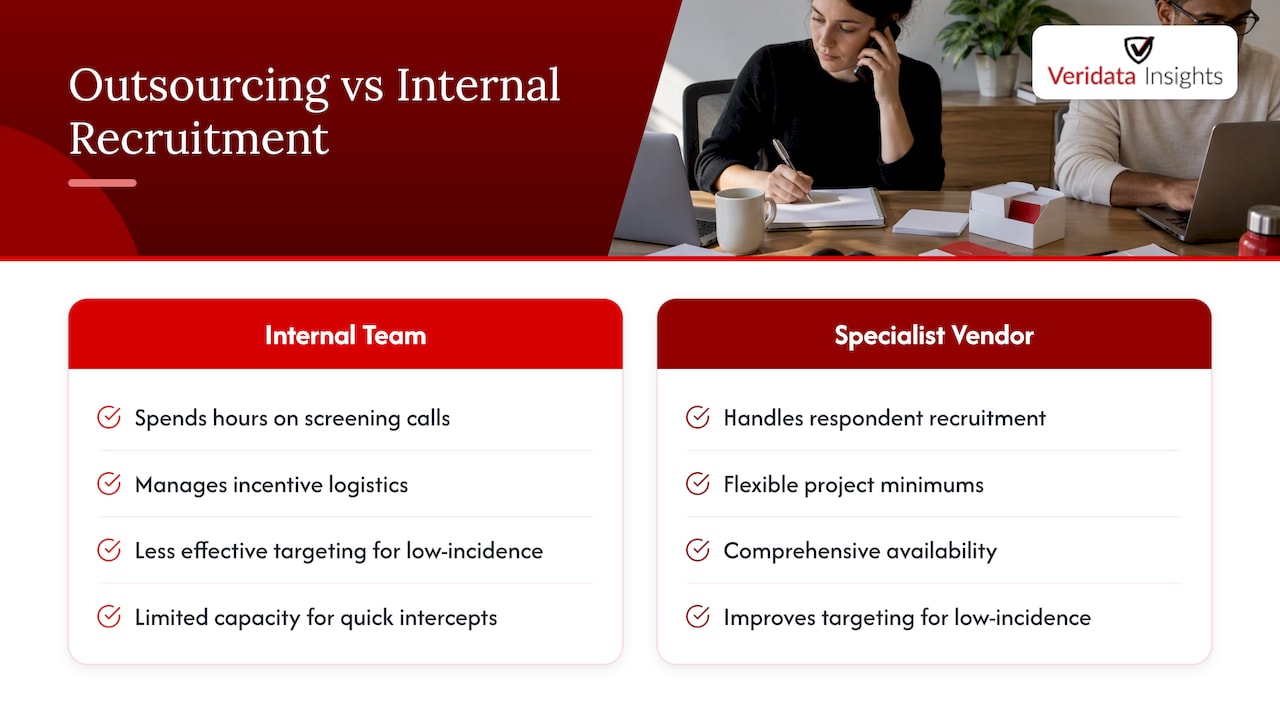
Running the math above is one thing. Finding forty qualified oncology caregivers or two hundred primary care physicians on deadline is another. A specialist vendor handles respondent recruitment as part of a full-service model with flexible project minimums and comprehensive availability, so a low-incidence clinician study and a quick patient intercept receive appropriate attention.
Handing recruitment to a specialist shifts the assumptions in your favor. Your internal team stops spending hours on screening calls and incentive logistics, and targeting improves for the low-incidence samples that eat budgets fastest. Because we work healthcare studies alongside B2B and consumer projects, the same team can support your recruitment, survey programming, and reporting from consultation through final delivery.
If you are budgeting a study now, request a quote through our healthcare market research page or start with the respondent recruitment service to get line-item pricing against your own quotas.
Sources
- Comparison of up-front cash cards and checks as incentives for participation in a clinician survey: a study within a trial
- The Costs of Using Pre-Paid Incentives in a Physician Survey
- Increasing financial incentives can lower the cost of trial recruitment | Trials
FAQ
What is a reasonable cost per complete for healthcare recruitment?
Costs vary by respondent type and incidence, but patient completes commonly fall in the $75 to $250 range while clinician completes often run $150 to $400 or higher once screening effort is factored in. The exact figure depends on incentive level, incidence, and how many recruiter hours each complete requires.
Do higher incentives always increase recruitment costs?
Not necessarily. A physician survey experiment found raising incentives from $25 to $50 raised cost per complete from $154.22 to $208.01, but a separate 2024 Trials study found larger incentives can lower total cost when they cut recruiter hours enough. Pilot-testing your specific population and channel is the only reliable way to know which direction it will move.
Which recruitment channel is cheapest for healthcare studies?
Registry-based recruitment showed the lowest cost per enrolled person at US $8.99 in a five-trial eHealth comparison, but registries are a finite pool. Clinic-based recruitment is typically the most expensive per person but often necessary for hard-to-reach clinical populations.
How much should I budget for a recruitment pilot test?
The Trials 2024 study recommends this approach to find a cost-efficient incentive level.
What does the vendor charge for respondent recruitment?
Flat recruitment rates are not published because pricing depends on incidence, quotas, and study design. You can request a project-specific quote through the respondent recruitment page.