

A screening question is a short eligibility check that keeps the right respondents in a study and filters everyone else out before they touch your real questionnaire. The single rule that matters most: screen for behavior, not identity, and ask one condition per question. Get that right and the rest of your screener, funnel order, quotas, incidence rate math, and pilot checks, falls into place.
TL;DR:
- Narrow behavioral questions are more effective than identity-based ones in preventing respondents from guessing the qualifying answers.
- Overly tight screener filters reduce false positives but may exclude genuine participants, increasing study costs and delays.
- Pilot testing with 30 to 100 completes helps identify issues like high false qualifying or drop-off rates before full deployment.
- Incidence rate calculations should be adjusted for low-incidence quota cells and over-recruitment by 10 to 15%.
- Structuring questions from broad to sensitive topics and using sequential logic enhances screening accuracy and respondent experience.
Table of Contents
- What Is Screening Question Design and When Do You Need It?
- Why Screener Quality Determines Your Data Quality
- What Are the Main Types of Screening Questions?
- What Are the Core Rules for Designing Screening Questions?
- How Do You Structure a Screener for Best Results?
- What Is the Incidence Rate Formula for Screener Planning?
- How Do You Pilot Test a Screener Before Full Fielding?
- Screening Question Templates You Can Copy
- Why Veridata Insights Gets Screener Design Right
- Get Screener Support From Veridata Insights
- Sources
What Is Screening Question Design and When Do You Need It?
Screening question design is the practice of writing questions that qualify or disqualify respondents before they enter a study. It’s the gatekeeper between your sample and your data, and it shows up everywhere: online surveys, usability tests, in-depth interviews, and panel recruitment for B2B or hard-to-reach populations.
Every screener has to balance two goals that pull in opposite directions. You need enough detail to verify someone genuinely fits your target profile, but you can’t reveal so much that respondents figure out the “right” answer and lie their way in. The GitLab experience research handbook puts this tension at the center of screener writing, and it’s the tension every researcher wrestles with on every project.
Screeners also do double duty as your quota engine. They’re what feeds your sample plan:
- Confirming demographic or firmographic fit before a respondent sees a single substantive question
- Enforcing quota cells (age bands, regions, job titles) so your final sample matches your target composition
- Catching disqualifiers early, competitors, conflicts of interest, prior participation, so you don’t waste field time
- Feeding incidence-rate estimates that determine how many contacts you’ll need
Why Screener Quality Determines Your Data Quality
A loose screener doesn’t just let in a few off-target respondents. It contaminates your entire dataset, because everything downstream, cross-tabs, segment comparisons, statistical tests, inherits whoever slipped through the gate.
Screening tightness is a trade-off, not a default setting. Tighter gates reduce false qualifies but increase false disqualifies, turning away people who actually fit but answered awkwardly. Loosen gates and you speed up fielding but risk data you can’t trust.
The cost math is straightforward once you’ve fielded a study with a bad screener: you pay for interviews or completes that get thrown out in cleaning, then pay again to re-field the cells that came up short. A reliable screener design process that catches problems in a pilot phase, before hundreds of contacts, is far cheaper than catching them after full launch. For studies touching regulated populations, patient panels or clinical audiences, the stakes are higher still, and screener wording should align with the consent and eligibility expectations laid out in FDA institutional review board guidance.
What Are the Main Types of Screening Questions?
Most screeners draw from four buckets, and a well-built questionnaire usually mixes at least three of them.
- Demographic and firmographic filters: age, income, region, or for B2B, company size, industry, and revenue band.
- Behavioral and usage questions: purchase frequency, product usage in the last 30 or 90 days, specific actions taken with defined recall windows.
- Attitudinal filters: agreement or interest thresholds, used sparingly since attitudes are easy to fake toward a perceived “correct” answer.
- Disqualification and conflict checks: employment at a competitor, prior participation in a similar study within the last six or twelve months, or professional respondent flags.
Behavioral questions deserve the most attention because they’re the hardest to fake convincingly. Asking “how many times in the past 30 days” instead of “do you use this product” forces a more specific, harder-to-fabricate answer, a technique NN/g’s research on participant screening backs consistently across studies.
What Are the Core Rules for Designing Screening Questions?
Good screeners aren’t clever. They’re disciplined. Here’s the operational checklist we’d hand any researcher on day one:
- One condition per question. Don’t ask “Do you own a car and have you bought insurance in the last year?” in a single item. Split it. Combined conditions make it impossible to know which part disqualified someone, and they confuse respondents into guessing.
- Anchor behavior, not identity. “How many times have you purchased X in the last 90 days?” beats “Are you a frequent buyer of X?” every time. Identity claims invite respondents to self-select toward whatever sounds right.
- Use plausible distractors. In multiple-choice screeners, include answer options that are common and believable, not absurd ones that telegraph the correct choice. NN/g’s guidance on selecting the right research participants notes that well-built distractors cut down on guessing and exaggeration.
- Set explicit, mutually exclusive timeframes. “In the past 30 days” and “in the past 12 months” should never overlap in your answer bins. Overlapping windows create double-counting and inconsistent quota math.
- Always include “none” or “other.” Forcing a choice among options that don’t fit pushes respondents into false positives. Give them an honest way out.
- Push sensitive items to the back. Income, health status, and other invasive questions belong after you’ve built some rapport with lower-stakes items, and after the harmless disqualifiers have already thinned the pool.
Pro Tip: Write your screener’s “correct” answer path last, then reread every question pretending you’re a respondent trying to guess what qualifies. If you can guess it in under ten seconds, so can they.
How Do You Structure a Screener for Best Results?
Order matters as much as wording. The standard heuristic is funnel logic: broad questions first, narrow ones later; harmless topics early, sensitive ones last. This isn’t arbitrary. Early broad questions filter out obvious non-fits cheaply, before you’ve invested any goodwill or time asking about income or health.
Practical sequencing looks like this:
- Early gates: location, basic eligibility, hard disqualifiers (employment at a competitor, prior study participation) — cheap to ask, high disqualification value.
- Middle gates: behavioral and usage questions that need more thought, product frequency, role responsibilities, purchase history.
- Late gates: income, health conditions, attitudinal items, anything that could feel invasive if asked first.
Skip logic should express combined conditions as sequential display rules rather than compound questions, “show Q7 only if Q3=Yes AND Q5=18 to 34,” never as one tangled item. For quota cells with a low expected incidence rate, the Kicue screener design guide recommends splitting the screener into a fast single-question gate that filters obvious non-qualifiers, followed by a secondary qualification step for the smaller pool that remains. It preserves throughput without burning contacts on people who never had a shot.
What Is the Incidence Rate Formula for Screener Planning?
Every recruitment plan comes down to one formula:
Required contacts = Target completes ÷ (Incidence rate × Completion rate)
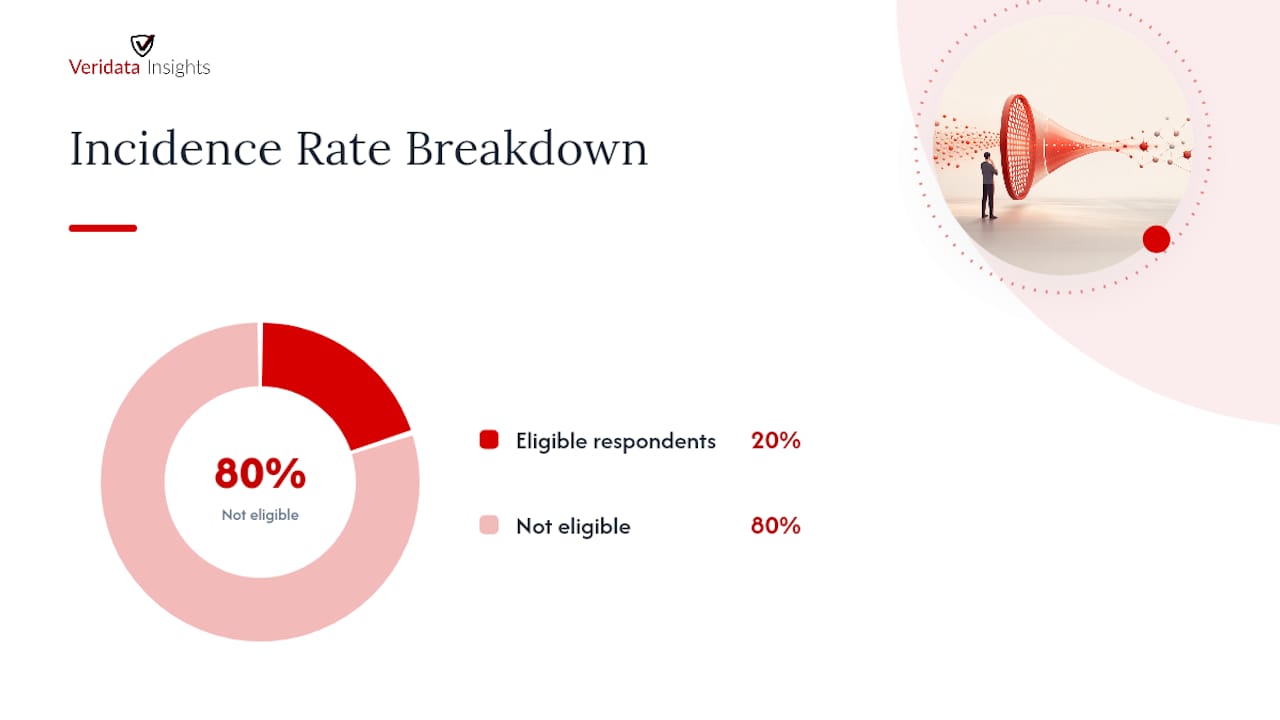
Incidence rate (IR) is the percentage of the general population that qualifies for your study. Completion rate accounts for people who qualify but drop out before finishing. Both numbers should come from prior fielding data or panel benchmarks whenever you have them, and you should adjust conservatively since self-reported recall tends to overstate recency and frequency.
| Variable | Example value |
|---|---|
| Target completes | 100 |
| Estimated incidence rate | 0.20 |
| Estimated completion rate | 0.80 |
| Required contacts | 625 |
That 625 comes from 100 ÷ (0.20 × 0.80). Run this per quota cell, not just once for the total sample, because a niche cell (say, B2B buyers at companies over 500 employees) often has a far lower IR than your general population estimate. Over-recruit each cell by 10 to 15% to cover late drop-off, then convert the contact total into a fielding timeline using your panel’s average daily response rate.
How Do You Pilot Test a Screener Before Full Fielding?
Pilot with 30 to 100 completes before launching at scale, and watch three numbers closely: incidence rate, screener drop-off, and false-qualify rate.
- Leaking the study purpose shows up when respondents suddenly cluster on one “obviously correct” answer.
- Satisficing looks like speeders clicking through without reading options.
- Professional participants give suspiciously polished, fast answers across every qualifying item.
If false qualifies run high, tighten wording, add distractors, or move the flagged question later in the funnel. If drop-off spikes, your screener is too long or too invasive too early, shorten it or reposition sensitive items. The Mass is a useful sanity check for researchers building their first screener from scratch.
Screening Question Templates You Can Copy
Three quick templates worth keeping on hand:
- Consumer purchase-frequency screener: “In the past 30 days, how many times have you purchased [category]?” with answer bins (0, 1 to 2, 3 to 5, 6+) plus a distractor category adjacent to your real target.
- B2B role and firmographic screener: “What is your primary role at your organization?” followed by company size bins and tenure (“How long have you held this role?”), always asked as separate items.
- Open-ended articulation check: “Briefly describe the last time you [relevant behavior].” Reject answers that are templated, too short, or generic, a technique the User Interviews UX Research Field Guide recommends for catching professional participants in qualitative recruitment.
For more copy-ready examples across study types, our survey question examples guide has additional templates you can adapt directly.
Why Veridata Insights Gets Screener Design Right
Screener design is where a lot of studies quietly go wrong, and it’s exactly where Veridata Insights spends the most upfront attention. A skilled team with experience in building screeners across B2B, healthcare, and hard-to-reach consumer audiences treats the screener as a design problem worth solving before a single contact goes out.
What that looks like in practice:
- Questionnaire review focused specifically on funnel order, distractors, and timeframe wording
- Recruitment expertise for populations that are naturally low-incidence or historically hard to reach
- Programming and quota logic built to match the incidence-rate math before fielding starts
- A pilot-first approach that catches false qualifies and drop-off before they become full-sample problems
Our research on recruitment and data quality covers more of how this plays out across project types.
Get Screener Support From Veridata Insights
If you’re staring at a screener draft wondering whether question four is going to leak your study purpose, that’s exactly the kind of thing a second set of professional eyes catches fast. Full-service market research is offered, including questionnaire review, methodology consultation, recruitment, programming, and reporting, with flexible project scopes from single screener reviews to entire studies.
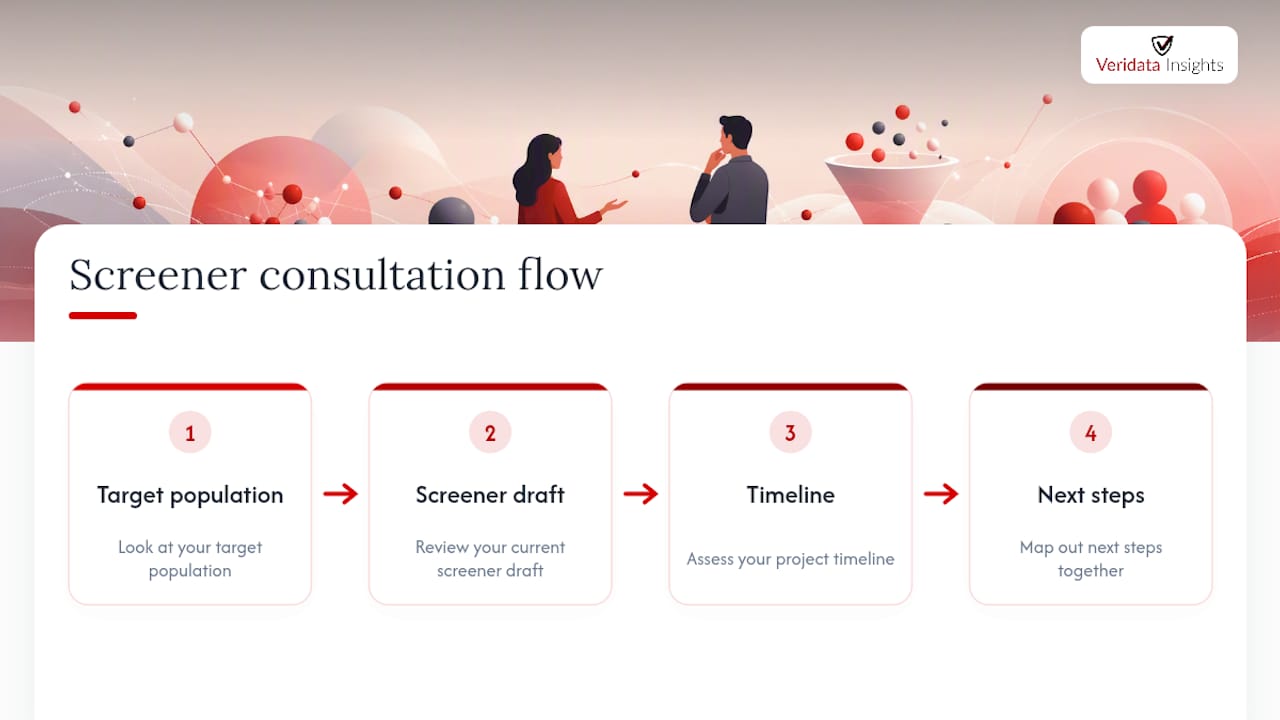
Specialization in recruitment for B2B, B2C, healthcare, and other hard-to-reach audiences helps address many low-incidence-rate challenges. When you reach out, expect a straightforward consultation: we’ll look at your target population, your current screener draft if you have one, and your timeline, then map out next steps together.
Ready to get a screener reviewed or a study scoped? Contact our team and let’s talk through what your project needs.
Sources
For deeper reference, the GitLab experience research handbook and NN/g’s screening participant guidance remain two of the most practical, field-tested resources available. Our own market research standards guide rounds out the professional context.
- How to write an effective screener | The GitLab Handbook
- Screening Question Design — How to Let Only the Right Respondents Through | Kicue
- Screener Surveys for UX Research | UX Research Field Guide
- Institutional review boards (IRBs) and protection of human subjects – FDA